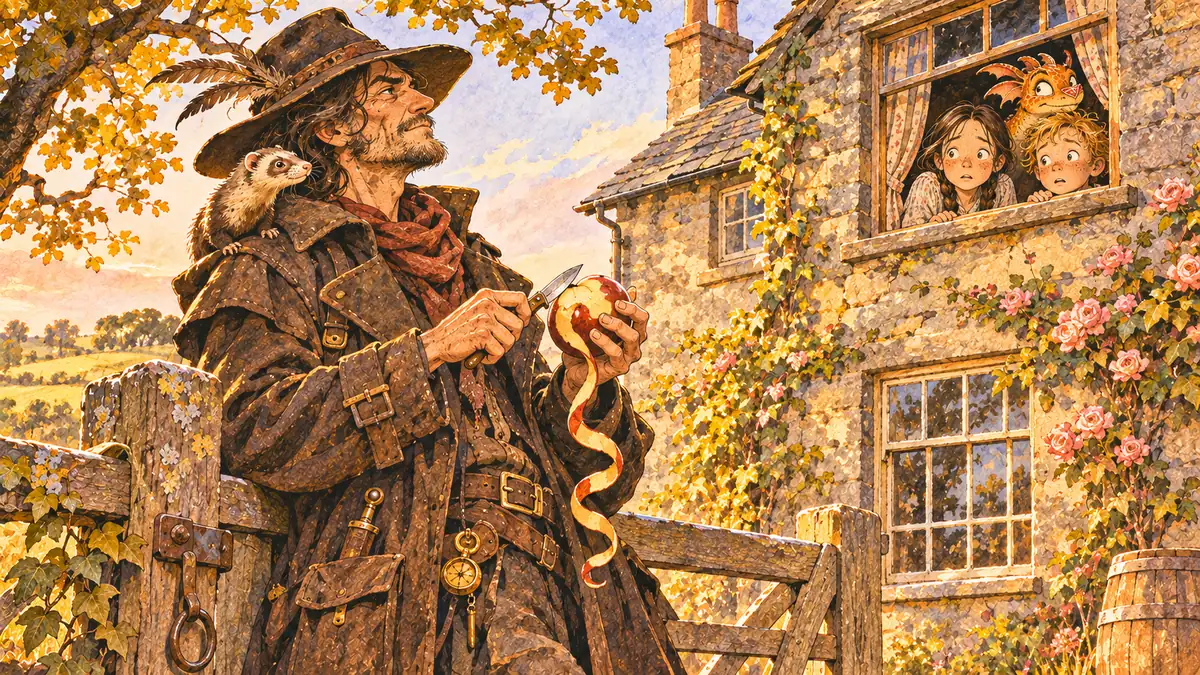
The Man Who Peeled Apples
He came up the lane on Monday afternoon, at a walk.
Josie saw him from the yard, where she was hanging out sheets. First she saw a long brown coat between the hedges, a long way down. Then a hat. Then, as he came closer, she saw that he was peeling an apple as he walked, with a small knife, and that the peel was hanging down from his hand in one long unbroken curl, turning slowly as he moved.
Nobody walked up the lane on a Monday. The lane went to Top Farm and nowhere else.
Josie put down the peg basket. "Toby," she said, not loudly. "Barn."
Toby was sitting on the mounting block with the blue book on his knees. He looked up, and looked down the lane, and went.
Grandpa was not there. He had taken the cart to Greyford market at six that morning, with two calves and a list, and he would not be back until dark. Before he went, he had moved Biscuit out of the kitchen and into the old tack room at the back of the barn, which had stone walls a foot thick and one small window and only one door.
"She'll eat the latch," Josie had said.
"Then she'll eat the latch," Grandpa had said. "At least she'll be out of sight of the lane."
The man reached the top of the lane. He stopped at the front garden wall, at the place where the gate used to be, and looked at the two empty gateposts with interest. Then he sat down on the wall, with his back to the nearer post, and finished peeling the apple. The peel dropped onto the grass in a single spiral. He cut a slice off the apple and ate it from the knife.
"Now then," he said.
He was thin and brown, with a face like a walnut and pale grey eyes that looked as if they were always slightly amused about something. His coat had more pockets than any coat Josie had ever seen. Some were big and some were small, and one of them, low down on the left side, was moving.
"Good afternoon," said Josie.
"Good afternoon," said the man. "Is your grandfather about?"
"He's at market."
"Ah." He ate another slice of apple. "Nice farm. Shame about the barn."
"It was the storm," said Josie.
"So I heard." He looked past her, across the yard, at the barn, with its roof still lying in a heap on one side and a tarpaulin stretched over the hole. "Big storm, that. They say it took the blacksmith's horseshoes, too. Every one. Took his back-door latch. Took the boot-scraper off the church." He cut another slice. "Strange sort of storm."
"Mrs. Figg says it was a gang from Greyford," said Josie. "She wrote to the newspaper."
"So she did. I read it." The man smiled at her. "That's why I'm here."
Toby came out of the barn. He walked across the yard with his hands in his pockets, looking at the sky, and stood next to Josie.
"Hello," said the man.
"We haven't got a dragon," said Toby.
There was a pause.
Josie put her foot on top of Toby's foot and pressed down. Toby's face went pink.
"Nobody said anything about a dragon," said the man.
"No," said Josie. "He's been reading the newspaper too. The bit about the reward. He thinks it's funny."
"It is funny," said the man. "Very funny. Everybody in the post office laughed." He finished the apple, core and all, and wiped the knife on his sleeve. "Name's Moss."
He did not say anything more for a moment. He folded the knife and put it away in one of the pockets. Then he put his hand on the pocket that was moving, low down on the left side, and opened the flap.
A ferret poured out.
It was long and pale and quick, cream-coloured with a dark mask, and it came out of the pocket the way milk comes out of a jug. It ran up Moss's arm and sat on his shoulder and looked at the children with small black bright eyes. It made a soft sound, a sort of chuckle: dook-dook-dook.
"This is Zip," said Moss. "He finds things."
"What sort of things?" said Toby.
"Things people have lost," said Moss. "Things people have hidden. Rabbits, mostly. Sometimes other things." He scratched the ferret under the chin. "Go on, then."
Zip poured down off his shoulder onto the wall, and off the wall onto the grass, and set off across the yard.
"Wait," said Josie.
The ferret did not wait. It went past the water trough, where Gertrude raised her head and honked at it. It went past the mounting block and the woodpile. It did not go into the house or the cowshed or the hen house. It went in a straight line, low to the ground, nose down, straight into the barn.
Josie took a step after it. Moss did not move. He sat on the wall with his hands on his knees and watched the barn door. Toby made a small noise in his throat.
For a few seconds nothing happened.
Then, from deep inside the barn, came a growl.
It was low and long. Josie had heard it before, under a cardigan on the bench by the range. It was louder now. It went on and on, a growl from something much bigger than a spaniel. Gertrude stopped honking. A hen ran out of the hen house.
Then there was a sharp crack and a flash of orange light from the back of the barn, as bright as a match struck in a dark room.
Zip came out of the barn door at a gallop.
He came back across the yard much faster than he had gone, flat to the ground, and went straight up the wall and up Moss's coat and into the pocket head first. For a moment his tail stuck out of the top. Then that went in too. The pocket shook.
Moss reached into the pocket and lifted the ferret out by the scruff, gently, and held him up to look at him.
Zip's face was black with soot. On one side of his nose, his whiskers had been singed short, and they were curled at the ends like burnt string. He smelled of smoke.
Moss looked at the ferret's whiskers. Then he looked at the barn. Then he looked at Josie and Toby.
He let out a long, slow breath.
In the dark doorway of the barn, something moved. Josie did not turn round to look. She knew what it was. She had heard the tack-room latch go, a few seconds after the growl. She could feel it standing just inside the door, in the shadow, and she could hear it breathing.
Moss could see it. She could tell from his face. He was looking past her shoulder into the barn, and his eyebrows had gone up, and stayed up.
"Biscuit," said Toby, without turning round. "Go back in."
From the shadows came one small, guilty puff of smoke.
Moss put the ferret back in his pocket and buttoned the flap.
"I'll tell you how it is," he said. He said it in the same easy voice he had used about the storm. "I work for His Lordship. Up at the Hall. I find things for him, the way Zip finds things for me. He's in the capital at the moment, seeing to his collection. He comes home on Thursday."
"Thursday," said Josie.
"Thursday. Three days." Moss stood up off the wall and brushed down his coat. "When he comes home, he'll ask me what I found. And I'll have to tell him something. That's my job."
"There's nothing to find," said Josie.
"No," said Moss. "I don't suppose there is."
He put his hand in another pocket, one of the small ones, and took out something round that caught the sun. He laid it on top of the gatepost.
It was a gold coin.
"For the blacksmith," said Moss. "For his horseshoes. Tell him a gang from Greyford sent it back."
"We didn't take his horseshoes," said Josie.
"No," said Moss. "I don't suppose you did."
He nodded to them both, and touched his hat, and turned round, and went back down the lane the way he had come, at a walk.
Josie and Toby stood in the yard and watched until the brown coat had gone round the bend.
Then Toby turned round and ran into the barn, and Josie ran after him.
Biscuit was lying flat just inside the barn door, behind the tarpaulin, with the tack-room latch inside her. Its outline showed through the scales of her chest. She was the size of a spaniel and she was trying to look small.
When Toby knelt down beside her, she put her head under his arm.
"That flash," said Josie. "That was the horseshoes. The new iron. Like the tablecloth."
"She was protecting us," said Toby.
"She was protecting herself," said Josie. "From a ferret." She sat down on an upturned bucket. "He saw her, Toby."
"I know."
"He works for the man with the glass cases. The man who wants a living dragon."
"I know." Toby put his face down against Biscuit's neck. "Three days," he said, muffled.
Grandpa came home at dusk.
They heard the cart in the lane and ran out to meet him, and they told him everything in the yard, both talking at once, while the horse stood in the shafts and steamed. Grandpa did not interrupt. When they had finished, he got down from the cart, slowly, and looked at the gold coin on the gatepost. He picked it up and turned it over in his fingers.
"Moss," he said. "Long coat. Apples." He put the coin in his waistcoat pocket. "Go in and get your supper."
They went in and ate their supper. Grandpa sat at the kitchen table and looked at the fire. Biscuit had come in from the barn and lay on the rag rug at his feet with the grey army blanket pulled over her, and every now and then he reached down without looking and put his hand on her head.
Josie went up to bed. She took out the notebook and ticked the list. Mum. Dad. Baby. Grandpa. Toby. Biscuit. She lay down. She did not sleep.
At about eleven she heard Grandpa get up.
She heard him go into the back kitchen. She heard the long wooden chest with the brass corners creak open. She heard him come out again, and go up the stairs, past their door, to the landing cupboard where the big things were kept. Something heavy was dragged out of the cupboard and bumped down the stairs.
Josie got out of bed and went to the top of the stairs. Toby came out behind her and stood on the step above.
Grandpa was in the kitchen. On the table was the biggest laundry basket in the house, the one with two handles that Grandma had used for the sheets. Over the back of his chair was a red coat with brass buttons, the red coat from the chest, still creased from being folded for so long. Grandpa was standing with his hand on it.
He looked up and saw them on the stairs.
"Pack warm," said Grandpa. "We're going north."
Josie held on to the banister.
"How far north?" she said.
Grandpa looked down at the dragon on the rug, asleep under the army blanket with the red number showing at one corner.
"All the way," said Grandpa.