Midsummer
On Midsummer morning, because there was no longer a ladder, Josie and Toby came down out of the hayloft on a rope.
They tied it to a beam and let it down through the hatch and climbed down it hand over hand, Josie first, then Toby, and dropped the last few feet into the straw on the barn floor. Then they went to the barn doors and looked out through the crack.
The yard was full of green.
There were keepers everywhere. Keepers by the water trough. Keepers by the hen house. Keepers leaning on the gate, with their long poles and their nets, yawning. They had been there all night. Gertrude was walking up and down in front of them, hissing at each one in turn.
In the middle of the yard, beside a green carriage, stood Dr. Pye with her notebook.
Josie pushed the barn door open and went out. Toby went with her.
"Good morning," said Dr. Pye. She looked at Josie over the top of her spectacles. "I don't believe your uncle the Duke is with you this morning?"
"No," said Josie.
"No. I thought not." Dr. Pye wrote something down. "Lord Harrowgate's butler let him out of that glass box at breakfast. He hasn't stopped sneezing since." She looked up. "Where is she?"
Josie had the answer ready. She flew away in the night. North. You'll never find her now. Up in the hayloft behind her, Biscuit was buried so deep in the hay that not even the tip of her tail showed, and the ladder was down, and no keeper could climb up to look.
Josie looked at Dr. Pye.
"She's up there," she said. "In the hayloft. Asleep."
Toby looked at her as if she had grown another head.
Dr. Pye lowered her notebook.
"You told me a lie at the junction," she said. "A very good one. I went along with it, because I could not prove otherwise." She looked at Josie over her spectacles. "This morning you could have told me another, and I could not have proved that either. You didn't." She closed the notebook on her finger. "So I'm listening."
"Then look at this," said Toby.
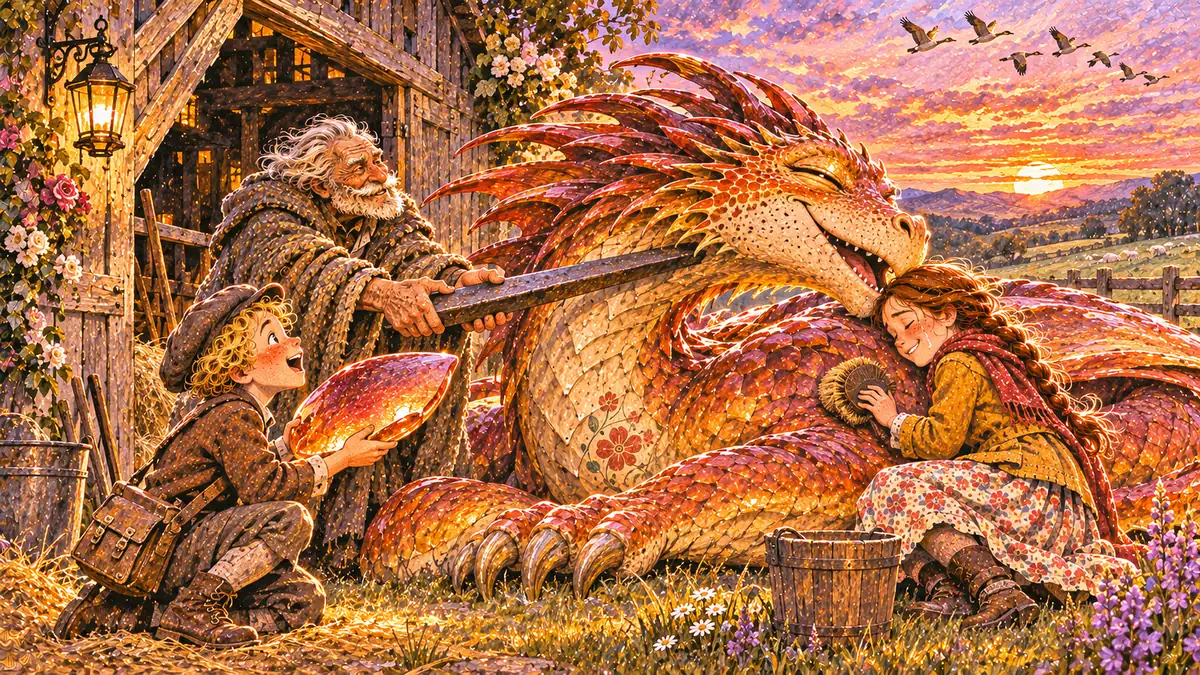
He had his bag over his shoulder. He took out a bundle wrapped in a scarf, and unwrapped it, and held it out in both hands so that the morning sun caught it.
It was the scale. Red-gold, and as big as a tea tray.
"That's not hers," said Toby. "It's bigger than her whole head. I found it on the mountain, in the Kilns. It was still warm." He swallowed. "It's from this year."
Dr. Pye took it. She turned it over. She bent it, very gently, and it bent. She held it up to her nose, and her eyebrows went up.
"Smoke," said Dr. Pye.
Up in the hayloft, the hay rustled.
A copper head came out of the loft door, high up in the end of the barn, and looked down at the yard full of keepers. The keepers took a step back, all together. Then the rest of Biscuit came out, and spread her wings, and dropped down into the yard, and landed in front of Dr. Pye.
Nobody reached for a net.
Biscuit did not look at the keepers. She was looking at the scale. She sniffed it, very carefully, all over, the way she had sniffed it in the cave. Then she took it out of Dr. Pye's hands, gently, in her teeth, and lay down in the dust with it, and drew it in against her chest with both front legs.
And she hummed. Low and deep and long, with her eyes half closed, as if the scale were someone she had been waiting for.
Then she got up and carried it across the yard and set it down at Toby's feet.
Dr. Pye watched all of it without writing anything down.
"This scale is new," she said at last, slowly, so that everybody in the yard could hear. "That means grown dragons are alive somewhere. North, over the sea, I expect." She looked at Biscuit. "The Act is for creatures that are gone. These aren't gone. They've moved."
One of the older keepers cleared his throat. "Begging your pardon, Doctor. The Commissioner in the capital won't like it. He's promised the King."
"Then if I'm wrong," said Dr. Pye, "they can have my job." She tucked her notebook away. "And while we're on the subject. My keepers went through every room in Harrowgate Hall last night. His Lordship's whole collection is coming to the Menagerie, every case of it. Anything in it that's still alive goes to proper keepers who'll let it be what it is. And His Lordship will be explaining to a magistrate why he had a soldier's blanket in a glass case with a label on it that said Original Wrapping." She looked across the yard at Grandpa, who had come out to the kitchen door on his sticks. "I'm told it was never his."
"It was not," said Grandpa.
Dr. Pye turned to the keepers.
"Pack up the nets," she said. "We're going home."
When the last green carriage had gone down the lane, and the yard was empty except for Gertrude, nobody said anything for a while.
At noon Moss came up the lane in his shirtsleeves, with Zip riding on his shoulder.
He stopped at the gateposts where the garden gate used to be. He did not come any further. Biscuit lifted her head from the dust where she was lying, and looked at him. Then she got up and went into the barn, and came out again with a long brown coat in her teeth, the one Josie had worn home over the park wall, and carried it across the yard, and dropped it at his feet.
Moss picked it up. He shook the hay out of it and put it on. Zip ran down his arm and into the bottom left-hand pocket, and turned round, and put his head out.
"Now then," said Moss quietly, to the dragon.
Biscuit breathed on him, warm.
"Where will you go?" said Toby.
Moss looked north, past the barn, past the hayfield, at the line of the hills.
"Up the coast," he said. "There's fishing boats go out from the north ports, a long way out, further than anyone needs to go for fish. I thought I might go with one." He pulled his coat straight. "Have a look."
"Will you write?" said Toby.
"I'm no hand at writing."
"Send us something anyway."
Moss looked at him for a moment. Then he nodded once, and touched his hat to Grandpa in the kitchen doorway, and went off down the lane with his hands in his pockets.
"She could stay," said Toby at last. "Couldn't she? Now. Nobody's going to take her. She could stay here."
"Yes," said Josie, before he had quite finished.
She went and got the brush from the stable, the big stiff one for the horses, and began to brush Biscuit all over in the sun. Biscuit lay down to be brushed. Her scales went from copper to a deeper, darker red as the dust came off them.
Josie talked while she brushed.
"We'll have to clear the barn properly," she said. "And mend the roof. All the way. And she'll need a lot of iron. We can ask the blacksmith for the old horseshoes. And when Mum and Dad come home in August, and the baby, she can meet the baby. And then in the autumn," said Josie, brushing faster, "we can go down to the river and she can fish, if dragons fish, and then in the winter she can sleep by the range, she'll fit if we move the table..."
She polished Biscuit's claws with her sleeve, one by one, while she talked. She did not look up.
Toby did not say anything.
After a while he went into the barn and climbed the rope back up into the hayloft, with the scale under his arm. He was gone a long time. When Josie went in to look for him, Biscuit went with her, and climbed the rope after him with her claws, and Josie climbed after them both.
Toby was sitting in the hay by the hole in the end wall, where they had found the egg. He had the scale on his knees.
When Biscuit came and lay down next to him, he took the scale and put it down on the hay between her two front feet.
"That's yours," said Toby.
Biscuit looked at it.
"I wanted to find them," said Toby. "Me. Whoever dropped it. I wanted it to be me that found them." He pushed it a little closer to her with his hand. "But I can't fly." He took his hand away. "You find them, then."
Biscuit put her nose down to the scale, and then up against Toby's cheek.
Toby knocked on the top of her head with one knuckle. Once. Twice. Three times.
Biscuit's tail thumped the floor of the loft. Once. Twice. Three times.
Josie sat down in the hay on the other side of her brother.
She had meant to say something. She did not know what. And instead Josie Tuttle began to cry.
She cried properly, with her face in her knees.
Toby said nothing. He just reached over, and found her hand in the hay, and held on to it.
When she had stopped, she sat up and wiped her face on her sleeve and looked at Biscuit. Biscuit was lying with her head up and her nose pointing at the little window high in the end wall, the one that faced north. She had been lying like that, Josie realised, all afternoon.
Josie took a breath.
"Right," she said. Her voice was very small. "Here's the plan." She did not hold up any fingers. "At dusk, we open the doors."
At dusk the hayfield went gold.
They came down out of the loft on the rope, all three of them, and stood in the barn. The big double doors at the end were shut. Across them, on its iron brackets, lay the great iron bar that Grandpa dropped into place every night, and lifted out every morning, and had done for fifty years.
Grandpa was there. He had come across the yard on his two sticks without a word, and stood by the doors.
He leaned one stick against the wall. He put his hand on the iron bar, and lifted it out of its brackets, slowly, with a grunt. It was heavy. He held it for a moment in both hands, looking down at it.
Then he turned round and held it out to Biscuit.
Biscuit looked at him. She looked at the bar. Then she took the end of it in her teeth, and ate it, from one end to the other, while Grandpa held it, until his hands were holding nothing.
Grandpa put his hands in his pockets.
The doors swung open on their own, a little, with nothing to hold them.
Josie pushed them the rest of the way.
Outside, the long hayfield went down the hill in the evening light, all gold, with the shadows of the hedges stretched across it, and the sky above it going from yellow to pale green to blue. It was very quiet. And then, far off, from somewhere beyond the hill, there was a sound.
Honking.
Over the top of the hill came the geese.
They came in a long pointed line, like the head of an arrow, dozens of them, high up and flying north, with the low sun on their wings, honking to each other as they came. They came straight over the hayfield.
Biscuit walked to the doorway.
She did not flatten her ears. She did not hiccup. She did not hide. She stood in the open doorway of the barn with her head up, and watched the geese go over, all the way, the whole long line of them, with her copper scales glowing in the last of the sun.
Then she turned her head, and looked back at Josie and Toby.