We Can Still Do It
They followed the cart as far as the shoulder of the mountain. From there they could see all the way down.
The old mine track wound down the black slope to the moor, and at the bottom it met a road. The cart had stopped there. The driver was looking at the horses' feet. The men in tweed were standing about, and the man with the brass horn had taken a leather purse out of his coat.
Moss was standing in front of him.
The man with the horn counted gold coins out of the purse into Moss's open hand. One. Two. Five. Ten. The children could see them flash in the sun, even from so far away. Moss closed his hand round them and put them in one of his pockets.
Then he did something else. He took off his long brown coat, the one with all the pockets, and went round to the back of the cart, and threw it over the brass cage. He tucked it in at the corners, carefully, all the way round, so that the bars were covered and only the straw showed underneath. Then he climbed up beside the driver in his shirtsleeves, and the cart moved off along the road to the south.
He did not look back up the mountain.
"He put his coat over her," said Toby slowly. "Like on the moor. In the sleet."
"So she keeps nice for His Lordship," said Josie.
On the seat beside the driver, Moss took an apple out of his shirt pocket and began to peel it. The children watched the long curl of peel come down from his knife. It got longer, and longer. Then it broke, and the end of it fell off into the road.
Toby took the blue book out of his wet coat. He found the place, a long way back, where it said Moss is a baddie, with a line through it. He looked at it for a while, with his pencil ready. Then he closed the book without writing anything.
They told Grandpa in the first cave. Toby told it, mostly, standing in front of him with his wet trousers steaming in the warm air. Grandpa listened with his bad leg up on the blanket. When Toby got to the part about the brass net, Grandpa shut his eyes. When he got to the part about Moss and the gold, Grandpa did not open them.
Then Toby turned round and looked at Josie.
"She had the red stones," he said. "All the time. She took them out of my coat in the night. She had them in her pocket. She was standing right there, right in front of Biscuit, and Biscuit was trying to burn the net and couldn't, and Josie had the stones the whole time, and she didn't throw them."
"You took her to the tarn," said Josie.
"I was looking for tracks!"
"You took her out of the cave without telling anyone. To look for a dragon that isn't there. You always go off. You always just go off, and then something happens, and it's the window, and it's the forge, and now it's this."
"You let them take her!"
"You took her to them!"
They were both shouting. The round black walls threw it back at them, flat and hard.
"Why?" said Toby. His voice cracked in the middle. "Why didn't you throw them?"
Josie had her hands in fists. She opened her mouth to shout something else. Then she shut it, and opened it again.
"Because of what Grandpa said by the fire," said Josie. "About the red stone. I heard him. I saw the lamp melt, and I knew what the stones would do, and I knew what that meant." Her face crumpled. "I didn't want her ready. I didn't want her to go anywhere. I wanted her to stay."
"But she wouldn't have gone!" said Toby. "Not then! Not that minute! She'd have melted the net and come straight back to us!"
"I know."
"And now she's going in a glass case! That's worse than going anywhere!"
"I know," said Josie. "I knew it standing there. I knew all of it." She wiped her face with her sleeve. "And I still couldn't."
Grandpa had opened his eyes. He looked at Josie for a long moment, and his face was very sad.
Toby looked at the floor.
"I wanted to find the other dragon," he said, in a much smaller voice. "Me. I wanted it to be me that found it. So I went without telling." He scuffed his foot. "And I sat on her back to see over the ridge, and that's why she couldn't fly properly on the ice. Because I was too heavy."
They stood on opposite sides of the cave, a long way apart.
"Both of you," said Grandpa quietly. "And me. I'm the one who said it by the fire. And I'm the one who walled her up for sixty years." He leaned his head back against the rock and shut his eyes again.
Josie picked up her own blanket from the floor and dropped it round Toby's wet shoulders on her way past. He did not look up, but he did not shake it off, either. He pulled it tighter.
Then Josie went down the passage on her own.
She took the lantern. She went left, always left, as Grandpa had said, down and down through the round rooms full of carvings, past the great wall of rising dragons and the geese, past the hollow where the brass lamp had melted, past the side-hollow where the scale had been. She did not hum. Nothing hummed at her.
At the bottom of the passage was the last room. It was the smallest, hardly bigger than the kitchen at home, and as cold as the rooms above it, except in one place. At the back, low down, the rock was warm to the touch, as if the heart of the mountain were just on the other side of the wall. There was a hollow in it, about the size of a pumpkin. It was empty.
Beside the hollow, cut into the black stone, was a carving.
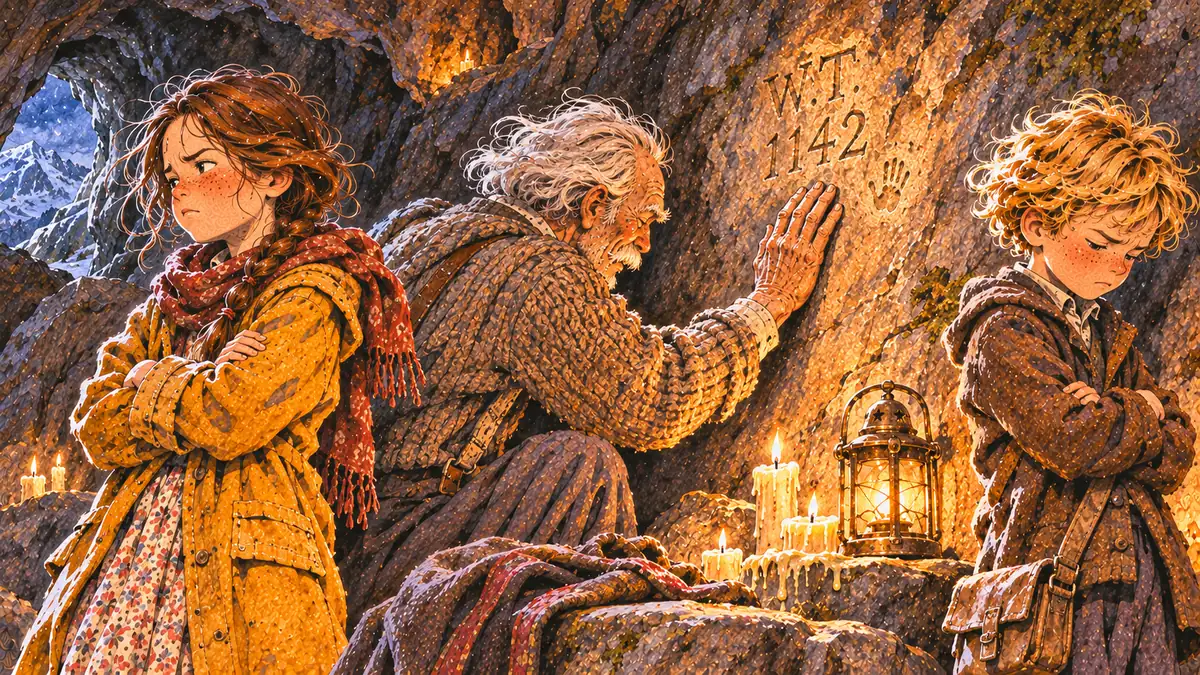
It was very simple. There was an egg, round and plain. And next to the egg, a hand. A small hand, with its fingers spread, about the size of Josie's own.
She held the lantern closer.
Underneath the carving, scratched into the rock with something sharp, a knife or a nail, in letters that were not carved by any dragon, were two letters and a number.
W. T. 1142.
"W. T.," said Josie, very quietly. "Walter Tuttle. Eleven forty-two."
She put the lantern down on the floor. She took off her mitten. And she put her hand flat on the rock beside the carved hand, so that the two hands were side by side, hers and the carved one. Hers was a little bigger.
She stayed like that until the rock under her palm was warm.
Then she put her face close to one of the little round holes in the wall and hummed Grandpa's tune into it, not well, the way Biscuit hummed it.
For a moment there was nothing. Then, from deep inside the rock, from all the little holes at once, soft as breathing, the mountain hummed it back to her.
Josie sat back on her heels and wiped her face with the back of her hand. Then she picked up the lantern and went back up the passage, a good deal faster than she had come down.
When she came back up to the first cave, Toby was sitting by the fire with the blue book on his knees, not writing in it.
Josie took her coat off the rock. She put her hand in the pocket and took out the red stones, all of them, and knelt down in front of her brother and put them in a heap on the open pages of the book.
"Go on," said Josie.
Toby looked at the stones. Then at her.
"You were going to make a plan," said Josie. "I can see you were. You've had your plan face on since we came in. Go on."
Toby looked down at the book. He turned the pages back, slowly, to the beginning. He put his finger on the first line.
"Cold makes her grey and sleepy," he said. "On the moor. And Grandpa said the egg slept in the wall because it was cold." He turned a page. "Harrowgate's going to keep her somewhere. He'll want her small, so she fits in his glass case. So he'll keep her cold. I bet he will." Another page. "Red stone makes her hot. Hot enough to melt brass. We saw it." He looked up. "So if we can get to her, wherever she is, and give her the stones, she can melt the net. Or the cage. Or anything. That's the plan. Get to her. Give her the stones."
"That's not a plan," said Josie. "That's a wish."
"It's a plan," said Toby. "It just hasn't got any steps in it yet." He looked at the red stones. "We can still do it."
Josie looked at him. Then, slowly, she held up one finger.
"Right," she said. "Steps." She held up a second finger. "Your plan. With steps in it. Step one, we find out where he's taking her. Step two, we get there before he puts her in the case. Step three, somebody gets close enough to give her the stones." She looked at Toby. "That's you. You're the one she does things for. That's the most important job, and it's yours."
Toby picked up one of the red stones and held it in his hand. It glowed faintly between his fingers.
"Will they hurt her?" he said. "The men. In the cart."
"No," said Grandpa. "You heard him. His Lordship wants her perfect. Nobody's going to hurt her." He was quiet a moment. "They'll keep her, that's all."
"Then where's he taking her?" said Toby.
"Home," said Grandpa, from the wall. "To the Hall. Where else would he put her? It's where he keeps everything." He shifted his bad leg and winced. "Above Thistlecombe. A hundred and twenty miles from here. And they've got a cart and two horses and a day's start, and I can't walk."
Before the light went, Josie took her notebook out of her pocket and opened it to the back page. EVERYONE. Mum. Dad. Baby. Grandpa. Toby. Every name had its tick. At the bottom, in capitals, BISCUIT, with an empty space beside it where the tick should be.
She held the pencil over the space. Then she put the notebook away without ticking it, and went to the mouth of the cave and looked out.
The moor was going purple in the last of the light. Far below, a thin bright line in the last of the sun, the old mine rails ran down from the foot of the mountain, all the way across the moor, all the way back to the wharf where Captain Lumb was waiting.
At the very top of them, beside the heap of rusty iron, sat an old ore-cart. Toby had played in it the day they arrived. It had four iron wheels, and a brake lever, and room in it for an old man with a bad knee.
Toby came and stood beside her and looked where she was looking.
"Fact," said Toby. "That's downhill."