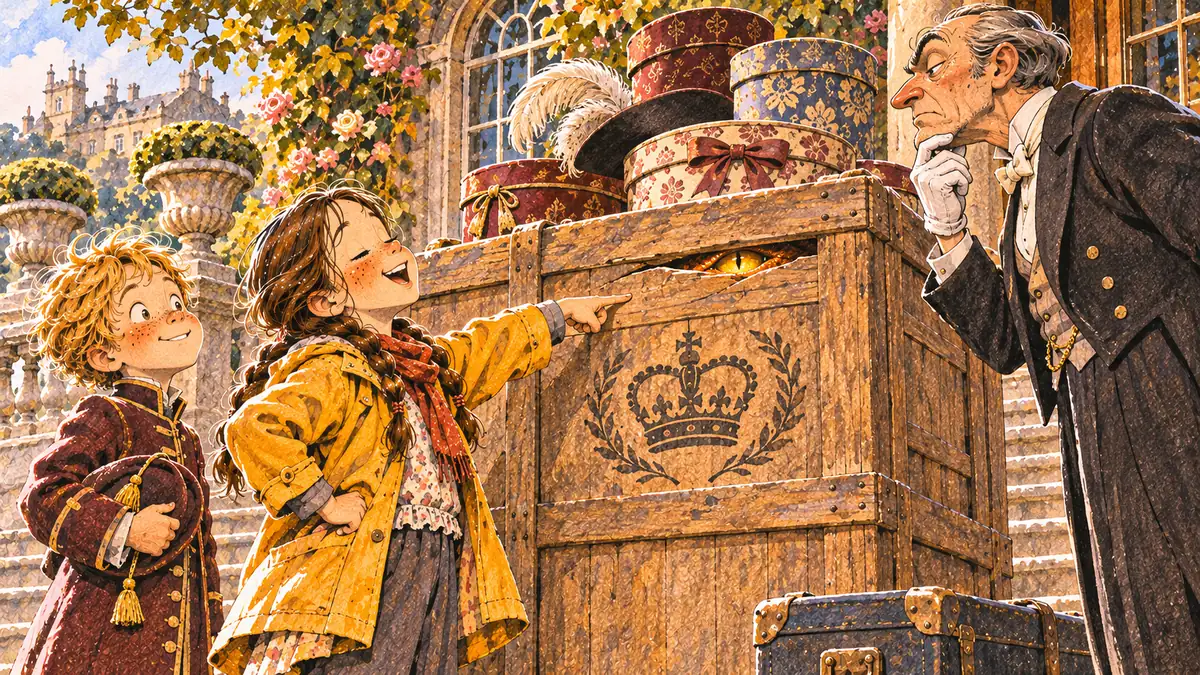
His Grace's Hats
Nettlebury Junction was where two canals met, and on the morning the Plum Duff came round the bend towards it, it was full.
There were boats tied up three deep along both banks, all waiting. There was a wharf with a crane on it, and a long low warehouse, and a crowd of boat people standing about with their arms folded. And there was a woman in green.
She was walking slowly along the line of boats with a green notebook open in her hand. Beside her walked a keeper in a green coat, carrying a net on a long pole, like a fishing net for a very large fish. At every boat the woman stopped. The keeper with the net climbed aboard and looked in the hold. The woman wrote something in her notebook, and said what she was writing aloud as she wrote it, and moved on.
"That's her," said Toby. "The Keeper."
"Every hold," said Captain Lumb, at the tiller. She steered the Plum Duff in against the bank at the back of the queue and tied her up. "There's no getting round her. There's only the one way north, and it goes through there."
Josie looked at the hold. Down in the dark between the cheeses, Biscuit was the size of a large dog now, with wings. There was nowhere left to hide her that a man with a net would not look.
Then Josie looked at the wharf.
At the near end of it, beside the crane, there was a mountain of luggage. Leather trunks, hat boxes, crates with rope handles, a rocking horse, a harp in a case. Every single piece had a label tied to it, and every label had the same crest printed on it in gold: a crown with a stag's head underneath. Men were carrying the luggage, one piece at a time, onto a big shiny barge with brass rails.
The woman in green walked past the barge. She did not stop. She did not look in it. The keeper touched his hat to it as he passed.
"Whose is all that?" said Josie.
A boatwoman leaning on the next rail took her pipe out of her mouth. "The Duke's," she said. "Moving house. Been loading since six. Nobody looks in a Duke's luggage. Wouldn't dare."
Josie did not move for a moment. Then she turned round.
"I've got an idea," she said.
It was Toby who got the label.
He walked along the wharf with his hands in his pockets, looking at the crane, and the harp, and the rocking horse, and nobody looked at him at all. When he came back he had his hands in his pockets still, and in one of them was a big brown luggage label with a gold crown and a stag's head on it, and in neat black ink the words HIS GRACE'S HATS. KEEP DRY. DO NOT OPEN.
"It was on a hatbox," said Toby. "A little one. I don't think they'll miss it till they get there."
Captain Lumb's biggest crate was the one she kept her spare rope in. It was as long as a bed and as deep as a bath, with a heavy lid and an iron clasp on the front. They tipped the rope out of it onto the deck. Josie tied the label to the handle. Then they opened the hatch of the hold.
"In you get," said Josie.
Biscuit looked at the crate. She looked at Josie. She sat down.
"In," said Josie.
Biscuit lay down flat on the floor of the hold, with all four legs tucked under her, and became exactly as heavy as a sack of wet sand.
"Toby," said Josie. "You do it."
Toby climbed into the crate himself. He sat down in it, and lay down, and folded his arms behind his head, and said, "Look. It's nice. It's like a bed."
Biscuit got up. She walked across the hold, put her front feet over the side of the crate, looked in at Toby, and climbed in on top of him, and lay down on his chest.
"Ow," said Toby. "Get off."
She did not get off.
"Get out from under her, then," said Josie.
It took a minute and a lot of wriggling. When Toby finally climbed out, red in the face, Biscuit was curled up in the bottom of the crate on her grey blanket, looking satisfied. They put the lid down. Josie fastened the iron clasp.
The keeper with the net was two boats away.
The woman in green was younger than Josie had expected, with a long thin face and very clean boots and spectacles on a chain. When she reached the Plum Duff she stopped and wrote in her notebook.
"Narrowboat," she said, writing. "Plum Duff. Cheese." She looked up. "Good morning. Dr. Ottoline Pye, Keeper of the Royal Menagerie. You've seen the notices, I expect."
"Yes," said Captain Lumb.
"Then you'll know why we're looking. Section Four, Paragraph Two. Any animal that has died out everywhere else. We've had reports from a village to the south. Horseshoes. Gates. All eaten." She smiled. "I don't expect to find anything. But if there is anything, it ought to be somewhere safe. The Menagerie gives every rare creature the finest cage in Elland. The hold, please."
The keeper climbed aboard with his net. He went down into the hold, and walked up and down between the cheeses, and poked one or two of them, and came back up again.
"Cheese," he said.
Then he saw the crate on the deck, and leaned his net-pole against it, and bent to look at the label.
Josie stepped forward.
She had put on her good coat, the blue one with the velvet collar, and she had brushed her hair until it shone. She stood beside the crate with her hands folded in front of her and her chin a little bit up, and she looked at the keeper the way a cat looks at a dog that has come into the wrong garden.
"I wouldn't touch that," she said. "That's my uncle's."
The keeper straightened up. "Your uncle's, miss?"
"His Grace," said Josie. She said it in a bored voice, as if she said it fifty times a day. "Those are his hats. He sent us on ahead with the overflow, because the barge is full. He's terribly particular about his hats. If they get damp he simply goes purple."
Dr. Pye's eyes went from the gold crest on the label to Josie's good blue coat.
"The Duke's niece," she said, writing it down. "On a cheese boat."
"The barge was full," said Josie again, and sighed.
From inside the crate came a growl.
It started very low, lower than anything Josie had heard Biscuit do, so low that at first it seemed to come out of the deck itself. Then it grew. It went on and on, and as it went on, the long wooden net-pole leaning against the crate began to tremble, and then to rattle, tapping against the lid in a quick shaking rhythm, as if something under the boards were trying to shake it off.
The keeper took a step back.
Dr. Pye stopped writing.
"His Grace's spaniel," said Josie, without moving. "He travels with the hats. He bites."
The growl stopped.
There was a moment of perfect quiet. Then, from inside the crate, very clearly, came a crunch.
Josie looked down. The iron clasp on the front of the crate was gone. Where it had been, there were two neat holes in the wood. The clasp had been stamped all over with the Duke's crest, a crown and a stag's head, and now there was nothing holding the lid down at all.
The lid lifted. One inch. Two.
A biscuit-coloured nose came out into the daylight. It sniffed. And on the very end of it, faint and clear on the soft scales, was a small gold crown with a stag's head underneath. She had eaten the clasp, and its stamp had come up on her nose like a seal pressed in wax.
The keeper saw it. His mouth opened.
Josie put her hand flat on the lid and pushed it shut again, gently, as if she were closing a piano.
"You see," she said, and sighed again, a long-suffering sigh. "He even has the crest on his nose. My uncle has it put on everything. Spoons. Saddles. Spaniels. You can imagine his temper."
The keeper closed his mouth. Dr. Pye looked at Josie for a long moment over the top of her spectacles.
Then somebody on the wharf shouted.
"Oi! That's ours!"
A very tall, very thin man in a black coat and a high white collar was coming along the bank towards them, fast. He had a list in one hand and a pencil in the other, and he was pointing the pencil at the crate.
"That's His Grace's label," said the man in the black coat. "That label came off the hatbox. I've been looking for it this half hour. What's it doing on a cheese crate?"
Toby, standing beside Josie, made a very small noise.
Josie turned round. She looked at the tall man with polite surprise.
"Are you His Grace's butler?" she said.
"I am," said the butler.
"Then you'll know," said Josie, "that His Grace sent this crate on ahead with us, by the cheese boat, because the barge was full. He told me so himself at breakfast. I expect he forgot to tell you." She paused. "He does forget things. He forgot my birthday."
The butler opened his mouth and closed it.
"He never said anything to me about a cheese boat," he said.
"Well, he wouldn't," said Josie. "Would he? He's a Duke."
The butler frowned at his list. Beside Josie, Toby had gone a curious colour and was staring hard at the water.
"A goat," whispered Toby, out of the side of his mouth, "would have been easier."
The butler put his pencil behind his ear.
"I'll speak to His Grace," he said stiffly, and walked away along the bank.
Dr. Pye watched him go. Then she wrote something in her notebook, but this time she did not say it aloud. She closed the notebook.
"Go on through," she said. "Mind his hats."
They did not speak until the junction was behind them and the Plum Duff was out on the open canal again, with the horse plodding along the towpath and the woman in green a small dot on the wharf.
Then Toby lay down flat on the cabin roof and said, "I thought I was going to be sick."
"You weren't," said Josie. Her hands had started to shake, now that it was over. She put them in her pockets.
In one of the pockets was a letter.
Captain Lumb had collected it from the wharf office while the butler was still walking away. It had been waiting there with the other post. It was addressed in Mum's handwriting, slanting and quick: Miss Josie Tuttle, care of the narrowboat Plum Duff, to be called for at Nettlebury Junction. Every boat going north stopped for its post at the junction, and Grandpa had written to the hospital from the first bridge to tell Mum so.
Josie took it out and looked at it. The envelope was thick. There were at least two pages inside.
She put it back in her pocket without opening it.
Toby saw. He opened his mouth, and then he shut it again, and looked away down the canal.
The canal went on north through a long flat valley full of sheep. In the middle of the afternoon the wind changed. It had been blowing from the west all day, smelling of grass and water. Now it came round from the north, from somewhere ahead of them, and it smelled of something else.
It smelled of frying. And burnt sugar. And smoke from a great many chimneys. And under all of it, faint and sharp, a smell that made the hair stand up on Josie's arms. It was the smell of the forge in Thistlecombe. Hot iron.
From the crate on the deck came a click. Then another. Then a fast, eager clatter of teeth.
"Nettlebury," said Captain Lumb, sniffing. "Another few miles. It's fair week."
Far away, over the sheep and the hedges, came the thin wheezing music of a steam organ.
The crate lid flew open. The Duke's label went one way and the grey blanket went the other, caught round Biscuit's back leg. She came out of the crate in one long leap, landed on the towpath, skidded, and was away up the path towards the music before anybody could catch hold of her, with the blanket flapping behind her like a flag.