Falling Off Things
At the foot of Old Smoke, where the rails ended, there were the ruins of a village. Nobody had lived in it for a very long time. There were a dozen stone huts with their roofs fallen in, a rusty winding wheel lying on its side in the heather, and heaps of black slag where the miners had tipped what they did not want. In the shadow of the biggest hut, where the sun never reached, there was a long drift of old grey snow.
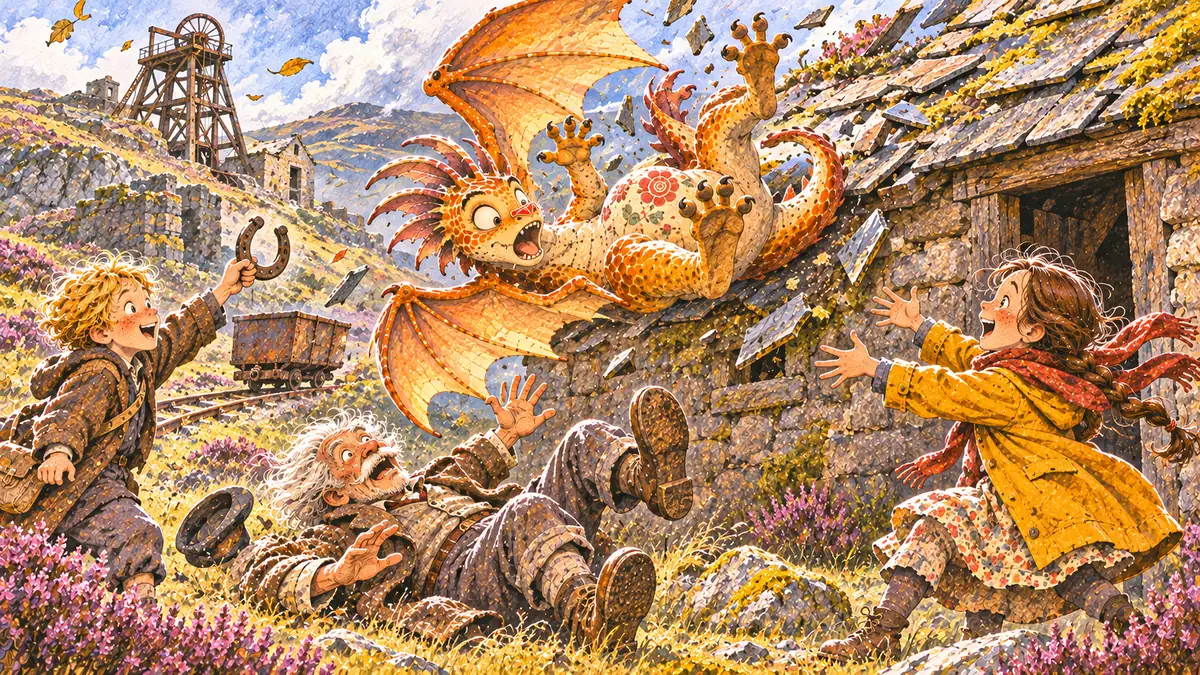
Biscuit was standing on the roof of that hut. There was not much left of it: three beams and a ridge.
She had climbed up there on her own. She stood on the ridge with her legs braced and her wings spread wide, looking out over the moor, with the breeze lifting the edges of them, and her chin up.
Then she jumped, flapped twice, and dropped straight down into the snowdrift.
"That's the fourth time," said Toby.
Biscuit's head came up out of the snow. She sneezed, and shook herself, and looked offended.
"She's doing it wrong," said Josie. "She's not doing it all together. She needs to be told." She marched over to the drift. "Right. Listen to me. One, you open your wings. Two, you flap. Three, you jump. All right? One. Two. Three."
On three, Biscuit sat down in the snow.
"She doesn't like being counted at," said Grandpa from the doorway of a hut, where he was sitting on a stone with his sticks across his knees. "She never has."
"Then how is she supposed to learn?"
Nobody had an answer to that. Biscuit got out of the snow, climbed back onto the roof, and fell off again, and then off a wall, and then off a big boulder by the winding wheel, and then off Grandpa, who had made the mistake of standing up.
Toby sat down on the slag heap with the blue book.
He turned back through the pages, slowly. Past the roses and the gate and the horseshoes. Past Copper. No. Brass. Pah. Past the window, which he had written down as well, small, at the bottom of a page. He was looking for something, and he did not know what it was until he found it.
At the locks, she had flown. Not flown. Glided. Down the hill, after Zip.
At the fair, she had flown. Badly, but she had. Away from the geese.
Both times, she had been going after something, or away from something. Neither time had anyone counted.
"Josie," said Toby. "She doesn't fly when she's told. She flies after things."
He got up and went to the end of the rails, past the old ore-cart where he had spent the first half hour of the morning sitting and pulling its brake lever, which went clunk, to the heap of rusty iron where the miners had thrown away their broken tools. He dug in it. At the bottom he found an old horseshoe, small and thin, from a pit pony. He held it up so Biscuit could see. Her eyes followed it.
Toby walked to the edge of the slope, where the ground fell away steeply into a gully full of heather and boulders, a long way down.
"Toby," said Josie. "Not near the edge."
Toby threw the horseshoe out over the gully as hard as he could.
Biscuit went after it.
She went past Toby at a run, and off the edge, and for a horrible moment she dropped straight down, with her wings still folded and her eyes on the turning horseshoe. Josie screamed. Then the wings came open. They came open all at once with a crack like a sheet on a washing line in a high wind, and they caught the air, and Biscuit stopped falling.
She swooped. She went down the length of the gully in a long, low, beautiful curve, faster than the horseshoe, and at the bottom of the curve she snapped it out of the air with her teeth. Then she seemed to remember that she did not know how to stop. She hit the heather on the far side, rolled over three times with her wings tangled and her legs in the air, and lay there on her back.
She was holding the horseshoe. She looked delighted.
Toby was jumping up and down on the edge of the gully, shouting. Josie found she had both hands over her mouth.
"Well," said Grandpa, on his stone. "That's how."
The Kilns were halfway up the mountain.
Grandpa led the way, very slowly, with a stick in each hand. He did not need Moss to show him. He went up the black slope as if he had walked it yesterday, picking his way between the steaming cracks, stopping every few yards to get his breath. Biscuit went beside him. She had stopped falling off things. She had flown four more times after the horseshoe, and now she kept opening her wings for no reason at all, just to feel them fill.
On the last slope, a long run of loose black scree, Grandpa's left knee gave.
He did not fall far. His knee went, and he sat down hard on the stones, and his sticks went clattering away down the slope. He sat there for a moment with his face screwed up.
"I'm all right," said Grandpa. "I'm all right. Give me a minute."
He did not get up after a minute. He tried, and his knee would not take him, and he sat down again.
"I'll carry him," said Moss.
"You will not," said Grandpa.
But in the end Moss did, with Grandpa's arm round his shoulders and Toby carrying both sticks, and Josie and Biscuit on the other side. They went up the last of the scree that way, slowly, and came over a lip of rock onto a flat ledge.
In the face of the mountain above the ledge was a doorway.
It was round, and much bigger than a door, and its edges had been worn by something to a glassy shine, the way stones go shiny in the bed of a river. Warm air breathed out of it. Inside it was a round room, a cave, with smooth black walls and a smooth black floor, and the air in it was warm all through.
They put Grandpa down against the wall just inside, out of the wind. He let out a long breath and shut his eyes.
"This is the first one," he said. "There's more, further in. I'll not get to them now." He opened his eyes and looked round. "Sixty years," he said. "It hasn't changed."
All round the inside of the doorway, carved into the black rock, there were pictures.
Toby saw them first. He went along them with his finger, not quite touching. Little people, carrying baskets on their backs. Lumps of something in the baskets. The people coming out of the mountain, one after another, in a long line, carrying the lumps away. And dragons, sitting on the rocks above, watching them go. The dragons in the first pictures were round and big. The dragons in the later pictures were thin. Their ribs showed.
"What are they carrying?" said Toby.
"Red stone," said Grandpa. "Ore. Iron ore, out of the heart of the mountain. Look there."
He pointed with his stick at a picture low down beside him. It showed a big dragon bending its head over a small one, and dropping something into the small one's open mouth.
"That's what the mothers fed the little ones," said Grandpa. "Red stone. Their own mountain's iron. Not nails. Not scrap. That."
Toby wrote it in the blue book. Red stone. Mothers. Little ones.
Biscuit had gone further in, to the middle of the round room. She stood there with her head up, sniffing. Then, very softly, she hummed.
The walls hummed back.
It came out of the rock all round them, from small round holes in the walls that Josie had not noticed: dozens of them, high and low, each about the size of a fist. The same note, low and long, as if the mountain were answering her.
Biscuit hummed again. The mountain hummed again.
"They made those," said Grandpa. "The holes. They go right down inside. Like flutes. If a little one ever got lost on the mountain, it only had to hum, and the mountain would hum back, and it could follow the sound home."
Biscuit curled up in the middle of the floor, with the mountain still humming round her, and went to sleep.
That night they made a fire of heather at the mouth of the cave, though they did not need it for warmth. Moss boiled the kettle. They ate the last of the bread. Toby fell asleep against Biscuit's side, and Josie lay down next to him, and pulled her coat over her head, and listened to the mountain breathing.
She did not go to sleep. After a while she heard Grandpa talking to Moss by the fire, low.
"She's not ready yet," said Grandpa. "She's never had proper food. Only scrap. You've seen her colour."
"And if she had it?" said Moss. "The red stone?"
"Then she'd be what she is," said Grandpa. "She'd be her own colour, and her own fire, and she'd be grown. Once she's had her own mountain's food, she'll be ready to go."
Josie lay under her coat and did not move.
"Go where?" said Moss.
Grandpa did not answer.
Toby woke up in the dark. He did not know why. The fire was down to embers. Biscuit was not beside him any more.
She was standing at the mouth of the cave.
He got up and went to stand next to her. The night outside was enormous and clear. The sleet had gone, and the moon was up, round and full and white, over the edge of the moor and the long dark line of the sea beyond it, far away to the north.
Biscuit was staring at it.
"What is it?" whispered Toby.
Something crossed the moon.
It was a long way off, out over the sea. It was a shape. It was dark against the white of the moon, and it moved slowly from one side of it to the other, and it was too big to be a bird, and too slow, and it had wings. It took a long time to cross. Then it was gone into the dark on the far side.
Toby forgot to breathe.
Far out over the sea, a light flared in the clouds. A small orange flare, like a lamp lit and put out again in a far window. It went out. A moment later it came again, a little further off. Then nothing.
Biscuit did not move. She did not hum. Every scale on her back stood very slightly up, and her wings lifted an inch from her sides and stayed there.
Toby put his hand on her neck. She did not seem to feel it.
He stood with her until his legs ached, and then he sat down against her side. Some time before morning he fell asleep there, sitting up. When he woke again the moon had gone and the sky over the sea was turning grey, and Biscuit was standing exactly where she had been, with her face to the north.