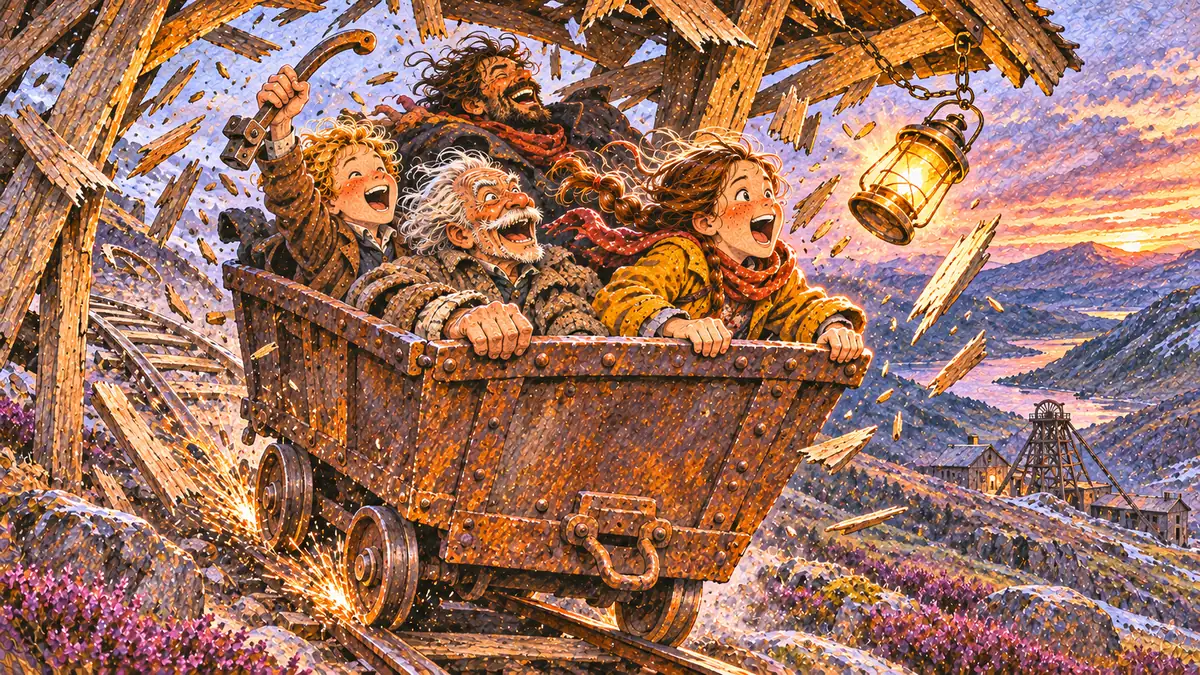
Downhill All the Way
At dawn Grandpa sat in the ore-cart, wrapped in his red army coat, with his bad leg stretched out in front of him and his two sticks across his lap.
The cart was an iron box on four iron wheels, rusty, with a wooden seat at the back and a long iron lever sticking up beside it for the brake. It sat at the very top of the rails, at the foot of the mountain, pointing down. In front of it the rails ran away across the black ground and over the edge of the first slope and out of sight.
Josie climbed in behind Grandpa. Toby climbed in behind Josie and took hold of the brake lever with both hands.
"You've tried the brake," said Grandpa.
"I've tried it," said Toby.
"Properly?"
"I pulled it and it went clunk."
Grandpa looked at the rails going over the edge of the slope.
"Well," he said. "Let her go."
Josie leaned over the side and pulled out the block of wood they had wedged under the front wheel. For a moment the cart did not move. Then, very slowly, with a long rusty groan, it began to roll.
It rolled to the edge of the first slope. It tipped. And it went.
The cart ran down the slope with a rumble like thunder, and the wind came into their faces, and the black ground went by on both sides faster and faster. Toby shouted. Josie held on to the sides and found she was laughing. Even Grandpa had his chin up.
Then the cart came to the first bend, and did not slow down.
"Brake!" shouted Josie.
Toby pulled the lever.
It went clunk. And then it came off in his hand.
He sat there holding it. It was a long iron bar, quite heavy, with a rusty bolt hanging off the bottom end. It was not attached to anything.
"Toby," said Josie.
"It came off," said Toby.
The cart went round the bend on two wheels, screaming. Sparks came off the rails in a long fan. Grandpa was thrown against the side, and Josie grabbed his coat, and Toby, still holding the brake lever, fell into the bottom of the cart and sat there.
Ahead of them the rails ran straight through the middle of an old wooden shed with its roof half fallen in.
They went through it. They went in at one end and out of the other, and on the way through they took a curtain of old boards with them, and a cloud of dust, and a startled family of sparrows, and a hanging lantern that Toby caught without meaning to and then did not know what to do with. Then they were out in the light again, and going faster.
The ground fell away on both sides.
They were on a bridge. It was made of wood, a long trestle on tall wooden legs, across a deep gully, and half its planks were gone. The rails went straight across, with nothing under them in places but air, and the cart went straight across on the rails, rattling, rocking, with the bottom of the gully a long way down underneath. Josie did not look. She looked at the back of Grandpa's red coat and held on.
Then they were across, and the rails ran out level onto the moor, and the cart did not slow down at all.
"How far's the wharf?" shouted Josie.
"Two days' walk!" shouted Grandpa.
"How far is that in a cart?"
Nobody knew. The moor went by. Sheep ran away from them in every direction. The cart sang along the rails with its wheels screaming, mile after mile, down and down, and slowly, very slowly, the hills got lower and the grass got greener, and Josie began to be able to see, far ahead, a thin bright line of water.
The canal.
And on it, small and red and green, a boat.
"It's her," said Toby. "It's the Plum Duff. She waited."
"She'll be waiting a long time," said Josie, "if we hit her."
The rails ran down the last slope towards the wharf, and the wharf was a stone edge, and after the stone edge was the canal.
Josie looked at the iron brake lever in Toby's hands.
She took it from him. She leaned out over the side of the cart, as far as she dared, with Toby holding on to the back of her coat. And she jammed the end of the lever down hard into the gap in front of the wheel, between the iron wheel and the iron rail.
There was a shriek of metal on metal. The lever bent, and held. The wheel locked. The cart slewed round sideways in a great shower of sparks and gravel and grass, and went skidding down the rails, slower, and slower, and stopped.
It stopped twenty yards from the wharf, beside the Plum Duff.
For a moment nobody moved. Grandpa was still holding both his sticks. Josie looked at the bent lever, wedged under the wheel, and then at her own hands, which were black with rust.
On the roof of the Plum Duff, Captain Lumb put down her tin mug.
"Well," she said. "That's all right, then."
There was someone else on the roof.
He was sitting at the far end of it, with his back to the chimney and his knees drawn up.
Toby got out of the cart. He walked up to the edge of the wharf, with the brake lever still in his hand, and stood there looking up.
"You took the gold," he said. "We saw you."
"I did," said Moss.
He was in his shirtsleeves, and his arms were goose-pimpled with cold. His long brown coat was nowhere.
Then he took the purse of gold out of his shirt and tossed it down to Captain Lumb, who caught it with one hand.
"For horses," said Moss. "I took his gold so he'd let me near her. The road south runs right past this wharf. I rode with her this far." He looked at Josie. "She's alive. She's got my coat."
Josie stood on the wharf with her rusty hands in fists.
"Why should we believe you?" she said.
Moss looked at her for a moment, and said nothing more.
Captain Lumb weighed the purse in her hand.
"How far to this Hall?" she said.
"Two hundred miles by water," said Grandpa from the cart. "The canal goes the long way round."
"Then that," said Captain Lumb, taking the purse, "buys a lot of horses."
Josie took her notebook out of her pocket and turned to the back page. She did not look at Moss while she did it. At the bottom of the list, beside BISCUIT, she made a small, careful tick.
A fly-boat, Captain Lumb said, was a boat that did not stop.
Ordinary boats tied up at night. A fly-boat went on. It changed horses at every stage, every ten or fifteen miles, where there was an inn by the canal with a stable, and it went on through the dark with a lantern on the front and someone always at the tiller. The canal ran downhill most of the way home.
So that was what the Plum Duff became. Dumpling was left at the first inn with a bag of oats and a promise. After that there was a different horse every few hours, big ones and small ones, a grey and a bay and a black one with a white face that bit Moss. Captain Lumb steered by day. Moss steered by night. Grandpa sat in the cabin with his leg up. Josie and Toby slept in turns, on the cheese.
Toby had put the red stones in one of his long woollen socks, and tied a knot in the top. He kept it in his coat. At night, in the dark of the hold, it glowed very faintly through the wool, a dull warm red, like the last ember in a stove. Sometimes he took it out and held it, and it was warm all over, and he put it back.
Nobody slept in the laundry basket. It sat at the end of the hold between the cheeses, empty, with the lid off.
On the fourth day they came to the Seven Steps.
Going south, the locks went downhill: the boat went into each one at the top, and the water went out of it, and the boat went down with the water like a bucket into a well. Toby worked every paddle. He did not need the lock-keeper now. He did it faster than the lock-keeper had ever done it, and the lock-keeper stood in his doorway in his slippers and watched him, and did not say anything until the boat was in the last lock.
Then he came down to the edge with a letter in his hand.
"Came by the mail coach," he said. "Yesterday. For you."
It was a square envelope, thick and creamy, and it was addressed in violet ink, in large curly writing: The Children. Care of the narrowboat Plum Duff. To be called for at the Seven Steps.
It smelled of lavender.
Toby took it, and the smell came up off it, and he sneezed. He sneezed again. Toby sneezed three times, and then held the letter out at arm's length and gave it to his sister.
Josie opened the letter. There was one sheet inside, with a crest at the top. She read it aloud.
"I write from an inn on the road south. She travels in a cart packed round with ice, which she does not care for. She lies very still. She has stopped humming, and her colour is going; she is nearly grey. By the time you read this she will be at the Hall, quite safe and quite cold, and she will not grow any more. You may see her on Midsummer Eve, through the glass, like everyone else. Children, I regret, are not admitted." She turned the sheet over. On the back was a single letter. "H."
Toby had put his hand into his coat, round the sock of stones, and was holding on to it.
"How long till Midsummer Eve?" he said.
"The day after tomorrow," said Grandpa.
Josie folded the letter and put it in her coat pocket. Mum's letter was already in there, still sealed, still thick. She did not take it out. She put her hand flat over both of them, the old one and the new one, and kept it there.
Toby untied the knot at the top of his sock and looked in at the red stones. They glowed up at him.
"Two days," he said.
"Two days," said Josie.
The bottom gates of the last lock swung open. Ahead of them, the canal ran away south through the fields in the evening light, towards Thistlecombe and home. A new horse was waiting on the towpath, a big brown one with feathered feet, and Captain Lumb clicked her tongue at it.
The rope went tight. The Plum Duff slid out of the Seven Steps and on into the dusk, without stopping, with a lantern on her bow and a dull red glow in a sock in a small boy's pocket, going home.