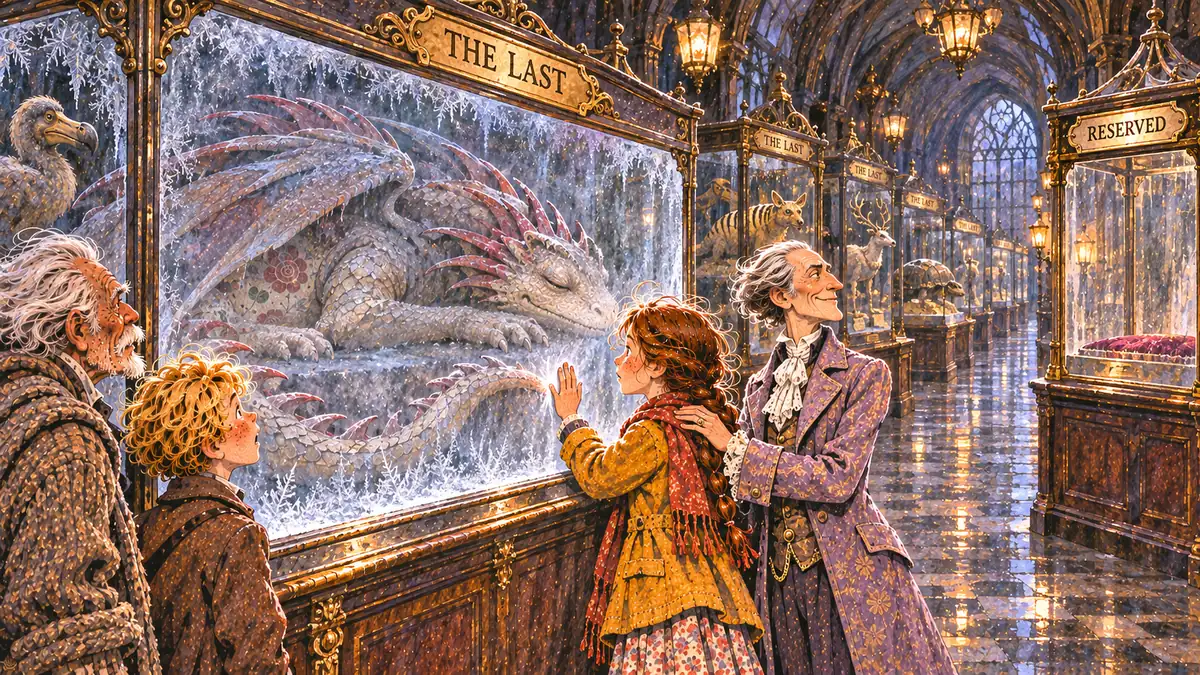
Forever
The door opened, and a gentleman stood there with a lamp.
He was wearing a lavender dressing gown with a silk cord, and soft lavender slippers, and very white gloves. In one gloved hand he held the lamp. In the other he had a slim black cane with a silver top. His face was long and pale and smooth, and his eyes, in the lamplight, were the same pale, friendly, unblinking eyes that Toby had seen across the fairground at Nettlebury.
Toby, lying flat in the dark under the case among the ice trays, held his breath.
"And who," said Lord Harrowgate, "might you be?"
Josie's breath hung in the cold air between them.
"The ice, sir," she said. "I'm helping Bert. His boy's away at sea."
Lord Harrowgate looked at her for a moment. He looked at the tongs in her hand, and her old raincoat, and her red cold fingers.
"Ah," he said. "The ice." He turned away from her at once.
He came in and shut the door behind him. He set the lamp on top of one of the tall glass cases by the wall, and its light spread out across the room, so that Josie could see the cases properly for the first time.
Each one had a little brass plate on the front. Each brass plate began with the same two words.
THE LAST.
"You may as well see what your ice is for," said Lord Harrowgate. "Nobody else has. Not yet." He walked slowly along the wall, touching nothing. "The last bottle of Dandelion Fizz. A lemonade. They stopped making it forty years ago." In the case sat a green glass bottle with a cork in it, full of something pale. "I shall never open it. If I opened it, there would be none."
He moved on.
"The last ticket for the Royal Theatre, in the capital. It burned down during the interval." A small yellow card, propped up on velvet. "Nobody went back in for the second half."
He moved on.
The next case held a bird. It was a stuffed bird, about the size of a hen, with a long sad beak and an enormous crest of feathers on its head like an untidy feather duster.
"The last Crested Wobble," said Lord Harrowgate fondly. "It fell over a great deal. That was its difficulty."
He stopped in front of the case in the middle of the room.
He did not touch it. He stood with his gloved hands folded on top of his cane and looked through the glass at the grey dragon curled on the velvet, for a while, with his head a little on one side.
"And this," he said softly, "is the last of all."
Josie said nothing. She had come to stand on the other side of the case, so that she could see Biscuit's face. Biscuit's eyes were shut. Her breathing was very slow.
"She was quite a different colour when she came," said Lord Harrowgate. "Brown. Patterned, rather vulgarly, with stripes. And noisy. She hummed." He gave a little shiver of distaste. "The cold has seen to all that. That is what the ice is for, you see. In the cold she does not grow. She does not change at all. She simply stays as she is." He smiled at the glass. "A specimen must not change. She will be exactly this, forever."
The lamp hissed on top of the cabinet.
Lord Harrowgate turned his head. Beside the dragon's case, against the far wall, there was another glass case. It was the same size. It was polished like a mirror. It was empty. The brass plate on the front of it said one word.
RESERVED.
He looked at it for a moment. Then he turned to Josie.
"Children change," said Lord Harrowgate. "It is the great flaw in them."
Josie did not move. Her palm was flat on the glass of Biscuit's case, where she had put it without thinking. The glass was so cold it hurt.
Inside the case, Biscuit's tail moved.
It moved slowly, as if it were very heavy. It lifted off the velvet, and came down. Thump. It lifted again, and came down, a little nearer the glass. Thump. And a third time, right against the glass, against the place where Josie's hand was on the other side. Thump.
That one.
Josie kept her face perfectly still. Her eyes stung, and she did not let them.
Lord Harrowgate had not noticed. He was frowning at the floor under the case.
"The ice," he said. "Tonight. During the unveiling, the ice must be changed from beneath, through a trapdoor in the stage, so that she does not warm up in front of all those people. I had meant my footmen to do it." He looked annoyed. "My footmen are all far too large."
"My brother would do it," said Josie.
Her voice came out calm and polite and a little bored, as if she said this sort of thing every day.
"He's small," said Josie. "He's eight. He fits anywhere. He'd do it for a shilling."
Lord Harrowgate looked at her properly for the first time.
"A shilling," he said.
"And his supper," said Josie.
Lord Harrowgate laughed, a short dry laugh like a cough. "Very well," he said. "Half past nine. Under the stage. My footman will show him." He picked up his lamp. "Come. I don't care to leave the door open."
He held it for her. Josie picked up an empty ice tray and followed him out, without looking back at the dark gap under the case.
Behind them, the door swung slowly shut. Before it did, a small figure slid out from under the case on its back, and wriggled across the floor, and got up with an empty ice tray in its arms, and slipped through the gap after them and away down the passage the other way.
Toby spent the day in the icehouse.
It was the safest place he could think of, and the coldest. He had the iceman's spare pick, borrowed off the cart, and a flat stone from the riverbank for an anvil. He sat in the straw at the back, among the great sacking-wrapped blocks, and tipped the red stones out of the sock one at a time, and broke them.
It took all morning. Each stone had to be cracked, and then the pieces cracked again, and then again, until they were chips no bigger than peas, and grit. Every chip glowed. When he had finished, the sock was half full of red crumbs, small enough to go through a hole the size of a pencil end, and warm all through. He tied the knot, and held it against his chest, and watched the line of daylight under the door move slowly across the floor.
Josie spent the day in the Hall kitchen chipping ice for the punch.
Nobody asked who she was. The cook gave her a hammer and a bowl and a corner of the table, and she chipped. All day the Hall got busier and louder. Carriages began to arrive in the afternoon. Footmen ran up and down the stairs with candles. Somewhere a band was practising, and stopping, and starting again.
Two maids came in with trays and stood by the range to warm their hands, talking.
"The Menagerie lady's taking it away," said one. "Whatever it is. Tonight. After the party."
"His Lordship won't let her."
"She says he's got to. Something about the King's law. She's had a carriage got ready with a cage in it, I've seen it. Velvet inside. Finest cage in Elland, the coachman says."
"Poor thing," said the other maid, and they went out again with their trays.
Josie went on chipping. She chipped the same lump of ice until there was nothing left of it but water.
At nine o'clock, as the light began to go, Josie went out to the kitchen yard with a bucket and found Toby waiting by the wall, exactly where they had said, white with cold and with straw in his hair.
At a quarter past nine a tall footman came out and said, "The ice boy?"
"Here," said Toby.
The footman took him away into the Hall. Josie watched him go. He looked very small beside the footman's legs. He did not look back, and she did not want him to.
She went in after them as far as the passage to the cold room, with her bucket, and stood against the wall.
Four footmen came down the passage. They went into the cold room. When they came out again, they were wheeling the great case between them on its little brass wheels, slowly, carefully, with Biscuit grey and still inside it on the velvet. The wheels squeaked. They wheeled it past Josie, so close that she could have touched the glass. Biscuit did not open her eyes. They wheeled it on, down the passage and through a pair of curtains at the end, and Josie heard them lift it up some steps, and set it down with a bump, and a voice say, "There. Over the trap."
Then they came back for the other one. The empty case, with RESERVED on its brass plate. They wheeled that past Josie too.
"His Lordship wants it on the stage beside her," one footman said to another. "So people can see what's coming next."
The tenants were gathering in the long gallery.
Josie slipped in at the back, with her bucket, and stood by the wall where the maids stood. There were waiters everywhere, hired for the night from all over the county, carrying trays of punch. One of them, a thin brown man in a borrowed black coat that was too short at the wrists, went past her with a tray of glasses. His eyes met hers for half a second. Something pale and small looked out at her from his top pocket, and ducked back in. Then he was gone into the crowd. The gallery was full of farmers in their best suits and farmers' wives in their best hats, all talking in low voices, all looking at the glass cases along the walls. The footmen had carried the Dandelion Fizz and the theatre ticket and the Crested Wobble up from the cold room that afternoon, so the tenants could admire them, and someone had already knocked the Wobble over.
Grandpa was there, in his red army coat with the brass buttons done up to the neck. He was leaning on both sticks. He was standing quite still in front of a small glass case in the middle of the room. In it, folded neatly on velvet, was a grey army blanket with a red stripe.
Lord Harrowgate was beside it, in a lavender evening coat now, with his white gloves.
"Original wrapping," he was saying to the farmers round him. "Found with the specimen. An army blanket, if you please. One of my late father's soldiers, I believe, made off with it."
Grandpa did not raise his voice.
"Private eleven forty-two," he said. "That is my blanket, sir."
The farmers round him stopped talking.
Lord Harrowgate turned his head very slowly, and looked at the old man in the red coat. Then his eyes went past Grandpa, across the gallery, to the maids standing by the wall, and stopped on a girl with a bucket of ice and straw on her raincoat.
He smiled.
"Carry that onto the stage," he said to a footman, nodding at the blanket. "Beside the other. So the soldier may watch."
Then he came across the gallery towards Josie, not hurrying. The farmers moved out of his way. He stopped in front of Josie, and his gloved hand came down, gently, on her shoulder.
"Then you will be the granddaughter," said Lord Harrowgate pleasantly. "Stay by me, my dear. I met your brother at Nettlebury."
His hand stayed on her shoulder. It was quite light. Josie could not have moved out from under it if she had tried.
Lord Harrowgate turned to the nearest footman.
"There is a small boy under my stage," he said. "Fetch him out."
The footman went. Josie watched his back go down the gallery, through the far door, towards the curtains and the steps and the dark under the stage. A moment later a thin waiter with a tray, in a black coat too short at the wrists, put his tray down on a windowsill and went out through the same door.
Somewhere in the house, a gong began to sound.