The Ice Cart
The Plum Duff came to the little stone bridge in the middle of the afternoon on the day before Midsummer Eve.
It was the same bridge, and the same grassy bank where the cart had broken down on the first morning, in May. In the field beside it the farmer from the bridge farm was turning hay.
Captain Lumb steered the boat in against the bank and tied her up.
"This is as near as the water comes," she said. "The rest is up to you."
The rest was eleven miles of road. The farmer from the bridge farm lent them his pony and trap, and did not ask any questions. Grandpa sat up in front with the reins and his bad leg stretched out. Josie and Toby sat in the back. Moss sat on the tailboard with his legs hanging over and Zip in his collar, and said he would come as far as the village.
Captain Lumb stayed with her boat.
"I'll be here," she said. "Cheese doesn't deliver itself." She looked at Josie and Toby for a moment, from the roof of the Plum Duff, with her tin mug in her hand. "Bring her back," she said. "If you can."
They came up the last hill into Thistlecombe as the sun was going down.
From the top of the hill they could see the Hall on the far side of the valley, standing on its own hill above the village. Every window in it was lit, and in the middle of its roof a great glass dome glowed like a lantern. And in its courtyard, in the last of the light, stood three carriages painted green, with a royal crest on every door.
"The Menagerie," said Toby. "She's here. The Keeper."
Halfway down the village street Grandpa stopped the trap outside the forge, where the blacksmith was shutting up for the night. Grandpa took a gold coin out of his waistcoat pocket and held it out.
"For your horseshoes," he said. "Back in April. From a gang in Greyford."
The blacksmith looked at the coin, and at Grandpa, and took it, and did not ask.
At the bottom of the street Moss got down off the tailboard.
"I'll be about," he said, and walked off down the street with his hands in his pockets, in his shirtsleeves, with Zip looking back at them over his shoulder.
"Where's he going?" said Toby.
"I don't know," said Josie.
Grandpa turned the pony up the lane. Josie jumped down outside the post office.
"I'll walk up," she said. "I want to ask Mrs. Figg something."
Mrs. Figg was locking up. She stopped when she saw who it was, and stared, and then came out from behind the counter.
"Well," said Mrs. Figg. "Look what the cat dragged in. Seven weeks without a word." She went to the shelf behind the counter and took down an envelope. "There's this for him. It came two days ago. From the Hall."
Josie took it. It was a card, stiff and white, with a gold crest at the top.
"Midsummer Eve," read Mrs. Figg over her shoulder, without being asked. "Seven o'clock for supper, and the unveiling at half past nine, when it's dark enough for the candles. Every tenant on the estate invited, to see His Lordship's new treasure. No children. It says so at the bottom, see." She folded her arms. "Came home two days ago, His Lordship did, with a cart all covered over and packed with ice, and nobody's allowed to see what's in it. And there's a lady from the Royal Menagerie staying up there, in green, with a notebook. I'm only saying."
"Does Bert the iceman still go up to the Hall at five?" said Josie.
"Every morning," said Mrs. Figg. "On his own, poor man. Double this week." She looked at Josie sharply. "Why?"
Josie was not thinking about the card. She was thinking about something Mrs. Figg had said in this very shop, weeks ago, on the day of the reward. Glass cases, half of them kept cold. And Bert the iceman, going up to the Hall every morning at five, on his own since his boy went to sea.
"Thank you, Mrs. Figg," said Josie, and went home up the lane in the dark, walking faster and faster, until she was running.
The farm was exactly as they had left it. The cowman had kept the cows milked and the hens fed. The kitchen smelled of cold ashes, and the rag rug lay in front of the range with nothing on it.
Gertrude met them in the yard. She looked at them, one after another, and then at the space beside them where something else ought to have been walking. She did not honk. She went back to the trough.
Josie put the invitation on the table.
"Five o'clock," she said. "The iceman. Bert. He takes ice up to the Hall every morning at five, for the cold cases. Mrs. Figg told me in May. He's on his own." She looked at Toby. "He goes in at the kitchen yard and down to the cold room. That's where she'll be. Where it's cold."
Toby looked at her. Then he looked down at the sock of red stones in his hands.
"So Bert needs help," said Toby slowly.
"So Bert needs help," said Josie.
Grandpa picked up the invitation. "And I'll be there at seven," he said, "with the tenants. In my red coat." He put it down. "I can't do much. But I can be in the room."
Josie went up to bed and did not sleep.
She lay in her own bed, in her own room at Grandpa's, with the moon coming in round the curtains. Toby was asleep in the other bed with the sock of stones under his pillow. She could see the faint red of it through the pillowcase.
After a while she got up, and found her coat, and took out the two letters.
One was creamy and square and smelled of lavender. She put that one back.
The other was in Mum's handwriting. It was thick, and soft at the corners from being carried so long, and a little torn at the flap where she had gripped it under the willow.
Josie sat on the end of her bed in the moonlight and opened it.
There were three pages. She read them all, slowly. Then she went back to the top and read them again. Then she went across and shook Toby by the shoulder.
"Wha'?" said Toby.
"It's from Mum," said Josie. "Listen."
She sat on the edge of his bed and read it to him, in a whisper.
"My darling Josie and Toby. I hope this finds you somewhere along the canal, and I hope Grandpa is making you wash. The baby is doing so well. She's feeding properly now, and she's put on a whole pound since you went to Grandpa's, and this morning she held on to my finger so tight I couldn't get it back. The doctor says she's strong. He says we can bring her home in August. Dad's ship comes in the same week. We'll all be home together."
Toby sat up.
"In August," he said.
"There's more." Josie turned the page. "And Josie. We still haven't given her a name. Dad and I keep trying names on her and none of them fits. So we've decided to wait until you can see her. You're her big sister. We'd like you to help us choose. Have a think. Love you both more than all the cows in Elland. Mum."
Josie stopped reading.
"She wants you to choose," said Toby.
"Help choose."
"That's nearly the same."
Josie took her notebook out of her coat pocket and turned to the back page. EVERYONE. Mum. Dad. Baby. Grandpa. Toby. Biscuit. She looked at the word Baby, with the pencil over it, as if a name might come. None came.
She ticked Mum. And Dad. And Baby. Then she went over the tick beside Biscuit's name, the one she had made at the wharf, and pressed it a little darker.
"Go to sleep," she said to Toby. "Five o'clock."
At five o'clock it was grey and cold and the river was smoking with mist.
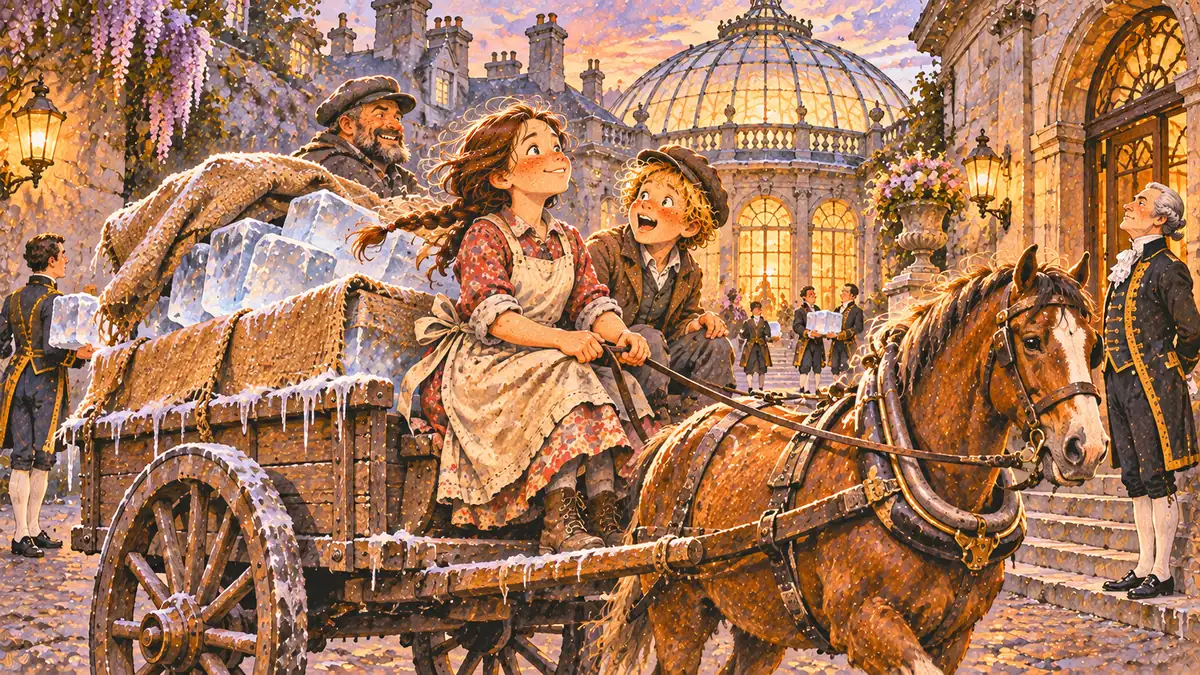
The icehouse was a round brick hut half buried in the riverbank, like a giant's beehive, with a heavy wooden door. The ice cart stood outside it with an old horse in the shafts, and an old man in a leather apron was loading great dripping blocks of ice into the back of it, wrapped in sacking and straw, one at a time, and puffing.
Josie walked straight up to him.
"Good morning, Mr. Bert," she said. "Our grandfather says you've been on your own since your boy went to sea, and you're to have us for the morning, for a shilling. He says you're not to argue."
Grandpa had said nothing of the kind.
The iceman straightened up and looked at them.
"Walter Tuttle's lot," he said. "From the top farm." He looked at his cart, and at the ice still waiting inside the icehouse, and at his own red hands.
"Well," he said. "There's tongs in the box. Mind your fingers."
They rode up to the Hall on the back of the cart, sitting on sacks on top of the ice, and the iceman talked the whole way.
"Double ice," he said. "Every morning this week. All of it down to the cold room behind the ballroom, and nobody allowed in but me and His Lordship. And tonight they're going to wheel the whole thing out onto the stage in the ballroom, case and all, for the guests to look at. There's a trapdoor in the stage, so the ice can be changed from underneath while he makes his speech." He spat over the side. "Ice for a party. I ask you."
Josie looked at Toby. Toby had his hand in his coat pocket, round the sock.
The cart turned in at the back gate of the Hall and rattled across a cobbled yard to the kitchen door. They each took one end of a block of ice and carried it in. The kitchen was enormous and hot and full of people running, cooks and maids and boys with trays. Nobody looked twice at two children carrying ice.
They went down a passage. At the end of it, coming the other way, was a woman in green with spectacles on a chain and a green notebook open in her hand.
Josie put her head down.
The last time Dr. Pye had seen her, Josie had been the Duke's niece, in her good blue coat, with her chin up. The Duke's niece did not carry ice. Josie bent over the block in her arms and let her hair fall across her face, and walked past without breathing. Dr. Pye was writing something, and saying it aloud as she wrote, and did not look up.
"Cold room. Temperature satisfactory," said Dr. Pye, and went on round the corner.
The cold room was at the end of the passage. Its door was thick and heavy, and the handle had frost on it.
Inside, it was so cold that Josie's breath hung in front of her face. All round the walls there were glass cases, tall and short, each with a little brass plate on the front. And in the middle of the room, by itself, on a low brass stand with four small wheels, stood the biggest case of all, carried down from the long room upstairs for the cold. Its brass plate said LIVING SPECIMEN.
Its sides and top were glass. Its base was brass. And inside it, lying on a bed of velvet, was Biscuit.
She was grey. Not the tired grey of the moor. This was flatter. Every pattern was gone from her scales. She lay curled up with her eyes shut and her wings folded tight, and she did not move, and she did not hum.
Under her chin, pulled half out from under her and bunched up the way she bunched up her blanket at home, was a corner of something brown. A long brown coat, with a great many pockets.
"She kept it," whispered Toby. "His coat. They took her out of the cage and put her in here, and she wouldn't let go of it."
Josie put the ice down very carefully on the floor.
The iceman pointed under the case. Below the brass base there was a gap, a hollow as long as the case and as deep as a drawer, and in it lay metal trays of melting ice. "Old ones out, new ones in," he said. "You're small. You do it. I'll fetch the rest." He went back down the passage, puffing.
Toby lay down on his back on the freezing floor. He pulled out the first tray, and slid in a new one. He pulled out the second.
Then he stopped.
He was lying with his face right under the brass base of the case. And the base was full of holes. Little round holes, dozens of them, in rows, each about as big as the end of a pencil. Through them he could see the grey of Biscuit's belly on the velvet. And the cold from the ice was rising up through them, in thin white threads, into the case.
"Josie," whispered Toby. "There's holes. In the bottom. For the cold to go in."
Josie knelt down beside him and looked.
Toby took the sock out of his pocket and tipped one red stone into his palm. It was as big as a hen's egg. He held it up next to one of the little holes. The hole was smaller than his fingernail.
"They won't go through," said Josie.
Toby looked at the stone, and at the hole, and at the iceman's tools lying on top of the sacking by the door: tongs, and a saw, and a short pick with an iron point, for breaking ice.
"Then I'll make them small," he whispered.
Footsteps sounded in the passage outside. Not the iceman's. They were lighter and slower, with a small dry tapping, like a cane. A thread of lamplight showed under the door.
Josie put her hand flat on Toby's chest and pushed. He slid backwards along the floor into the dark of the ice hollow, under the case, and lay still among the trays. Josie stood up with the tongs in her hand, between the case and the door.
The light under the door grew brighter. The frost on the handle cracked as it began to turn.