Biscuit Decides
Biscuit stood in the doorway of the barn, against the yellow sky, and did not move.
The last of the geese went over the far hedge. Their honking got smaller. The hayfield was gold, and then it began to be less gold, as the sun went down behind the hill.
Then Biscuit turned round and came back into the barn.
She came past Grandpa. She came past the empty iron brackets on the doors. She went to the corner where the grey army blanket lay on the straw, where Toby had dropped it when they came down the rope, and she picked it up in one claw. It hung from her claw, grey, with its red stripe and its red number, and trailed on the floor. Then she went to the bottom of the rope, where Toby had left the red-gold scale leaning against the wall, and she picked that up in the other.
She walked across the barn on her back legs, holding them, a little unsteadily, like someone carrying too much shopping.
She stopped in front of Josie.
Josie did not move. She could not. She stood with her hands at her sides and looked at the dragon, and the dragon looked at her, with her eyes the colour of honey held up to a lamp.
Biscuit put the blanket and the scale down on the straw. Then she lowered her long copper neck, all the way down, and laid her chin on the toe of Josie's boot.
She stayed there. Looking up.
Josie knelt down. She put her arms round Biscuit's neck. They did not go very far round it any more. The copper scales were warm, the way they had been warm in the hatbox on the dresser, the way they had been warm under her arm in the forge, the way they had been warm again at the foot of the mountain, after the long cold night on the moor. Josie put her face against them and held on.
Then she let go.
She did it all at once, and stood up, and stepped back.
Biscuit lifted her head. She turned to Toby.
Toby was standing with his hands in his pockets and his chin wobbling. He did not cry.
Biscuit bent her head and pressed her warm forehead against his chest, and held it there.
"I know," said Toby. "I know. Go on."
She lifted her head. She picked up the blanket in one claw and the scale in the other, the way she had before. She looked at Grandpa, by the doors. Grandpa took his hands out of his pockets, and did not say anything, and put one hand flat on the top of her head for a moment, the way he used to when she lay at his feet in front of the range.
Then Biscuit walked to the open doors.
She took three running steps out into the hayfield. On the third step her wings came open, wide, wider than the barn, red-gold in the last of the sun, and she beat them once, and the grass flattened round her in a great ring, and she was off the ground.
She went up.
Not falling. Not skimming. Not sinking under the weight of two children. Up, in long slow beats, easily, as if she had always known how, with the blanket and the scale held close against her chest, higher and higher over the hayfield, until she was above the barn roof, above the elm trees, above the hill.
At the top of the climb she turned. She came round in one long wide circle over the farm. Over the yard, and the house, and the barn with its patched roof, and the three of them standing in its doorway with their faces turned up.
Grandpa put two fingers to his lips and whistled. Loud, this time. Not softly at all. The whole of his old marching tune, from beginning to end, up into the evening sky.
High above them, Biscuit dipped one wing.
Then she straightened out, and turned her nose to the north, the way the geese had gone, and flew.
They watched her go. She got smaller. She was a dragon, and then she was a bird, and then she was a dark speck against the green of the evening sky, over the far hills. Josie kept her eyes on the speck and did not blink, so as not to lose it.
She lost it anyway.
There was only the sky.
They stood in the barn doorway until it was dark.
Nobody said anything. After a while Gertrude came round the corner of the barn, and stood beside them, and looked at the sky too, where they were looking. Then she put her head under her wing.
Toby took the blue book out of his pocket. He opened it to the last page that had writing on it, and licked his pencil, and wrote, saying it under his breath.
"Fact. She's not scared of geese."
He looked at it. Then he held the book out to his sister.
Josie looked at the book, and at the pencil.
She had never written in the Book of Biscuit. Not once. It was Toby's. She took it, and turned it to the light from the kitchen window across the yard, and under Toby's last fact, in small careful capitals, she wrote one line.
She gave the book back to Toby. Toby held it up to the light and read it out, very quietly.
"The doors are open," said Toby.
He closed the book and put it in his pocket, and did not ask her anything.
Grandpa put one hand on each of their shoulders.
"Supper," he said.
The next spring there was a thunderstorm on the first warm night of April.
The farmhouse was full. Mum and Dad had come home in August, the same week, Dad off his ship, brown as a nut and smelling of tar, and the baby with them, in a basket, wrapped in a shawl. They had all stayed. Dad was mending the barn roof properly, slate by slate. Mum had taken over the kitchen from Grandpa, who sat by the range in the evenings now with his leg up and told everybody how to do everything. And tonight Captain Lumb was there too, up from the canal with a cheese the size of a cartwheel. It was the last of the Nettlebury cheeses, nearly a year late. The Plum Duff was tied up at the bridge for the night, and Dumpling, fetched back from the inn long ago, was cropping the verge in the lane. Captain Lumb sat at the end of the table with her tin mug.
The baby was in Josie's lap.
She was not very small any more. She was round and heavy and warm and smelled of milk, and she had a fist of Josie's hair and would not let go of it. Her name was Daisy. Josie had chosen it, in the end, sitting on the end of the bed in August with Mum, after trying fifty names out loud. Daisy had been the fifty-first. When Josie said it, the baby had opened her eyes and looked straight at her.
There was a knock at the kitchen door, and Mrs. Figg came in without waiting, shaking the rain off her hat.
"Evening post," said Mrs. Figg. "And it's coming on to thunder, so I'll not stop." She held up an envelope. "For the children. From up north somewhere. Off a fishing boat, by the stamp." She had already opened it. She took out a postcard and read it aloud before anyone could take it from her. "There's nothing on it," said Mrs. Figg. "No writing. Not a word. Just a drawing of a beach, and an M at the bottom." She squinted at it. "And the beach is red." She shook the envelope, and something long and brown and curly fell out onto the table. "And this. Whatever it is."
It was a curl of dried apple peel. It was as long as Toby's arm, and it had not broken once.
Toby picked it up very carefully. Josie took the postcard and propped it up on the mantelpiece beside the clock, next to an old silver thimble with forget-me-nots on the rim, and Toby laid the curl of peel along the mantelpiece beside them.
Mrs. Figg went.
The thunder came a little nearer. The window rattled.
Josie looked down at Daisy, asleep now in her lap, with her mouth open. Then she reached into her pocket and took out a notebook. It was a new one, with a green cover. She had bought it at the post office in the autumn, when the old one was full.
She opened it to the back page. At the top, in capitals, she had written EVERYONE. Underneath were the names.
Mum. Dad. Daisy. Grandpa. Toby.
She ticked them, one at a time, with the short pencil. Mum, by the sink. Dad, by the window. Daisy, in her lap. Grandpa, by the range. Toby, on the floor with the blue book.
Then she held the pencil over the empty line at the bottom.
She wrote BISCUIT, in capitals.
She did not tick it.
Grandpa put down his newspaper.
He put his hand on his left knee, and rubbed it.
"Thunder tonight," said Grandpa. He looked at the window. "Big one."
The thunder came. Lightning lit up the yard white, and the rain came down on it, and the old farmhouse shook. Daisy woke up and looked surprised, and then went back to sleep.
And through the noise of the rain, from very high up, somewhere above the clouds, there came a whistle.
Four quick notes going up. One long note coming down.
Grandpa sat up in his chair.
Toby was already at the door. Josie gave Daisy to Mum, all in one movement, and was after him, out into the yard, into the rain, in her socks.
The whistle came again, nearer. Lower. Something very big was coming down through the clouds over the farm. They heard the wings before they saw anything: great slow beats that they felt in their chests, like the whole sky breathing in and out.
Then it came down out of the dark into the light from the kitchen window, and landed in the middle of the yard.
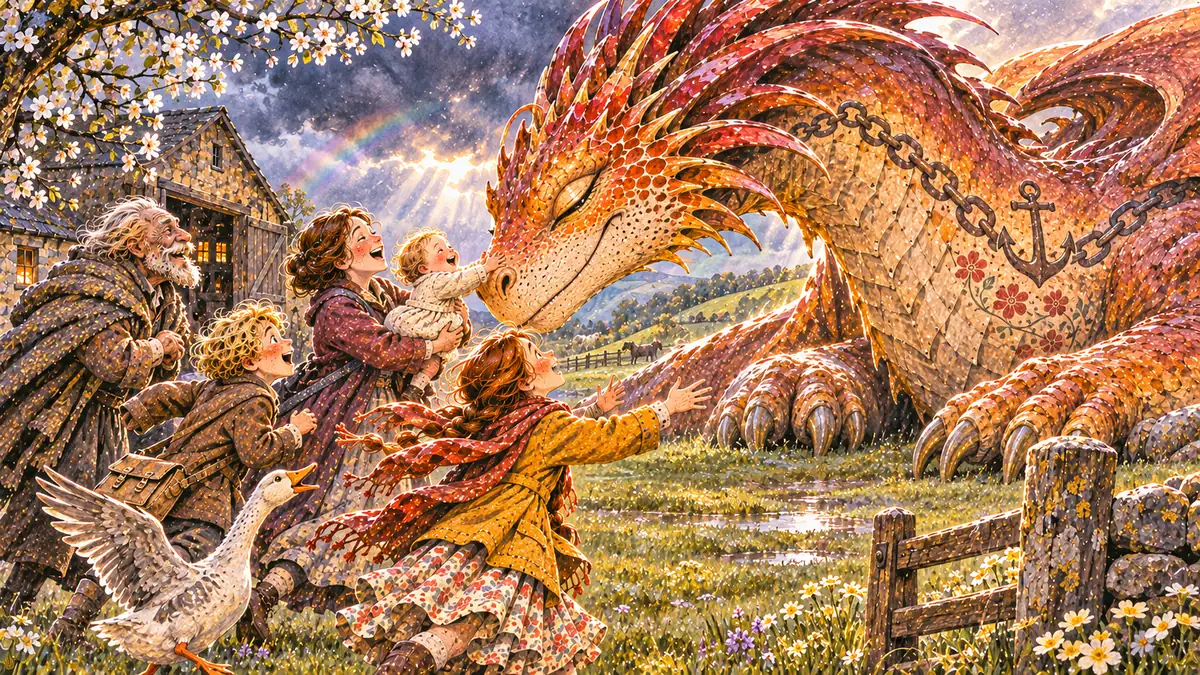
It was bigger than a carthorse. It was red-gold all over, glowing faintly in the rain, and steam came off its back where the drops hit it. Down one side, along its great flank, faint and grey, ran a pattern Josie had never seen before. It looked like links of heavy chain.
Toby stared at it.
"She's been eating anchors," he said.
It folded its wings.
It lowered its long neck, and opened its claws, and dropped something at Grandpa's feet, where he stood in the kitchen doorway on his two sticks.
It was a grey army blanket with a red stripe. It was scorched along one edge, and wet, and it smelled of salt and the sea. When Grandpa bent down slowly and picked it up, red sand ran out of the folds of it onto the step.
Gertrude, in the doorway of the hen house, opened her beak to honk.
She shut it again.
Behind Grandpa, in the lit doorway, Captain Lumb looked out at the dragon in the yard, and put down her tin mug.
"Well," said Captain Lumb, "that's all right, then."
The dragon put its head down to Josie, and to Toby, standing in the rain in front of it. And it hummed: the same low steady hum they had first heard through the lid of a hatbox on a dresser, a year ago, in this kitchen.
Mum had come out into the doorway behind Grandpa with Daisy in her arms, wrapped in a shawl against the rain. Daisy looked at the dragon. Then she leaned out of Mum's arms, as far as she could, and put out one small hand, with its fingers spread, and laid it flat on the end of the dragon's warm nose.
Josie looked at the small hand on the dragon's nose.
Then she took the pencil out of her pocket. She opened the green notebook, there in the rain, and found the empty space at the bottom of the list, and made a tick beside BISCUIT. The rain ran down the page and blurred it. She did not mind.
Biscuit lifted her head and looked up, into the dark, into the rain, the way she had looked at the mountain once.
And from somewhere far above the clouds, very faint, a second whistle answered. Not quite the same tune.
The end