Eleven Forty-Two
Captain Lumb did not take the Plum Duff back through Nettlebury. She turned Dumpling off the main canal at the first bridge, down a narrow green side-water that nobody used any more, and she did not stop until they were a mile from the town, under a willow so big and so old that its branches came right down to the water on every side like a curtain.
Then she tied the boat up in the middle of the curtain and said, "No lamps."
So they sat in the dark. It had begun to rain. It pattered on the willow leaves and on the cabin roof, and dripped through the open hatch onto the top step.
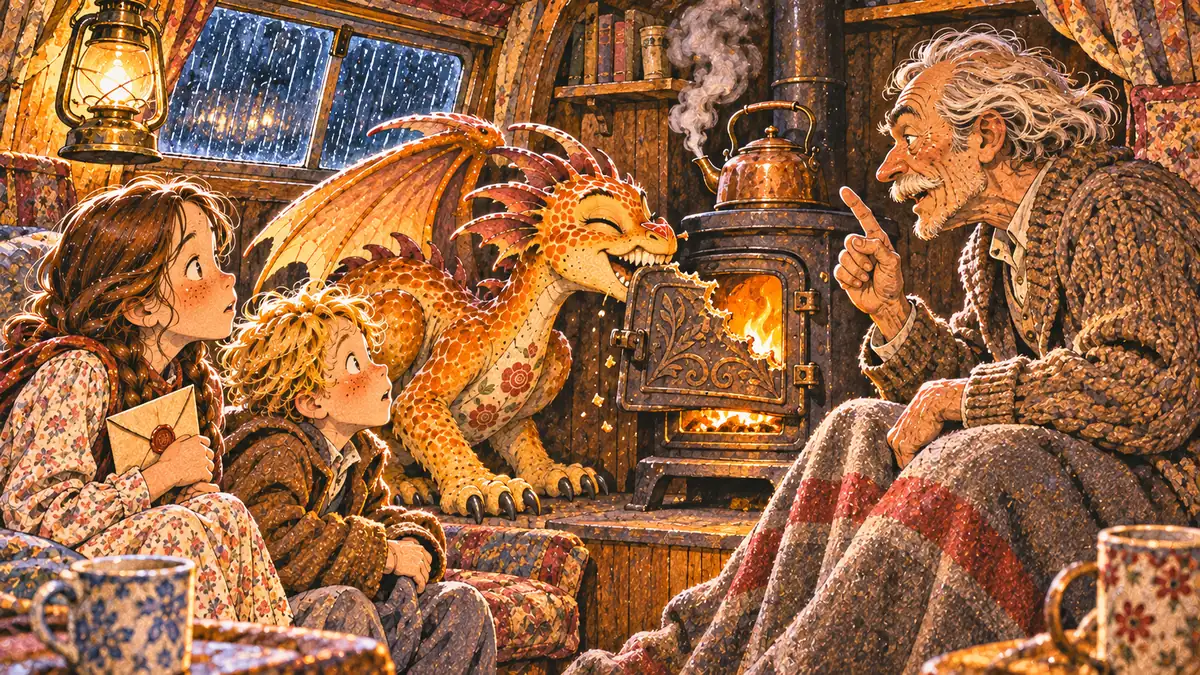
The tiny cabin at the back of the boat had never been meant for four people and a dragon. Grandpa sat on the end of the bottom bunk with his bad leg out straight. Captain Lumb sat on the step. Josie and Toby sat on the floor. And Biscuit, who was too big now for any of the spaces that were left, had wedged herself in between the table and the stove with Grandpa's red army coat over her back.
She was shivering.
She had been shivering since the fair. It came in long shudders that started at her nose and went all the way to the end of her tail. She did not have her blanket. She kept turning her head and sniffing at the corners of the cabin, as if it might be there.
Toby had not said anything since he came back down the towpath at a run, without the blanket. Now, in the dark, he said one thing.
"He said hello to me."
Nobody asked who.
Josie got up on her knees.
"Grandpa," she said. "Who is eleven forty-two?"
Grandpa did not answer.
"It's on the blanket," said Josie. "It's on your medal. I found it, in the chest, under the red coat. You know what she is. You knew before she hatched. You whistled to her in the hatbox." Her voice was going up, and she let it. "Who is eleven forty-two?"
Grandpa was quiet for so long that Josie thought he would not answer.
"I was," he said. "When I was nineteen. There was a lord who wanted bones."
He stopped.
Biscuit had put her head down to the stove. It was a little round iron stove, the only warm thing in the cabin, with a door on the front. She sniffed at the door. She licked it. Then, with a crunch that made everyone jump, she bit it clean off its hinges and began to eat it.
"Not the stove," said Captain Lumb.
Biscuit swallowed the last of the door. The fire inside, which had been banked down low, gave a puff of ash and went out. The cabin was colder at once.
"Well," said Captain Lumb at last. "You've had the door. You might as well light it."
She pointed at the dead stove with her thumb.
Biscuit put her nose to the open front of the stove and breathed out. It was not a sneeze, and it was not sparks. It was a short, hard puff of bright orange flame, as long as a hand, and it went into the stove with a whump. The coals caught. Light came out of the open front and lit up all their faces.
"New iron," said Toby, under his breath. "The weights. The carousel."
Biscuit lay down with her chest against the warm side of the stove, and stopped shivering.
"Old Lord Harrowgate," said Grandpa. "The father of the one you saw today. He had a long room full of glass cases, and he wanted dragon bones to go in them. So he went north to look, to the mountain where the dragons used to live. Old Smoke, it's called. And because it was wild country, he took twenty soldiers to guard him."
"And you were one," said Toby.
"Private Walter Tuttle," said Grandpa. "Number eleven forty-two."
On the floor by the stove, Biscuit's eyes opened. She lifted her head. And very softly, in the firelight, she began to hum.
Toby grabbed Josie's arm. "She knows it. She knows the number."
"She knows the voice," said Grandpa. But he looked at the dragon a long moment before he went on.
"Black rock," he said. "All of it. And it steams. There are caves in the side, round ones, warm as a kitchen. That's where they laid their eggs, a long time ago. We went through every cave for three weeks and found nothing. Then on the last day I went into the deepest one on my own, with a candle."
"And she was there," said Toby.
"Toby," said Josie. "Let him."
"She was there," said Grandpa. "In a hollow in the wall at the very back. An egg, faintly warm. And beside it, carved in the rock, a picture. An egg, and next to it a hand. A small hand. Like a child's."
Toby held up his own hand in the firelight and looked at it.
"His Lordship wanted it the minute he saw it," said Grandpa. "For a glass case. The last dragon's egg in the world. He had me carry it down the mountain, wrapped in my own blanket. And on the way down, on the bad part, by the ice, I told him I'd slipped. I told him it had rolled out of my arms and gone down a crevasse."
"You lied," said Toby. "To a lord."
"I did."
Toby looked at his grandfather as if he had never properly seen him before.
"You told me never to fib," said Toby. "Every day."
"I did," said Grandpa. "He docked me a month's pay. And I carried it home in my kitbag, a hundred and twenty miles, by the road."
Josie had gone very still. She was thinking about the barn. About the stones round the hole, which were not like the other stones, and the mortar that somebody had smoothed flat with their hand. About a little silver thimble with forget-me-nots on it.
"It didn't hatch," she said slowly. "So you put it in the wall. You and Grandma. And Grandma pushed her thimble into the mortar when you'd finished."
Grandpa looked at her.
"For luck," he said. "She wanted it by the old chimney, at the warm end. I said the cool end. Let it sleep, I said, till somebody's ready." He rubbed his face with his hand. "Sixty years. I never once looked."
"Why not?" said Toby.
Grandpa did not answer that for a while. The stove ticked. The rain went on overhead.
"As long as I didn't look," said Grandpa, "she might still be alive."
Biscuit had stopped humming. She had crept close to Grandpa's boot, and lay there watching him.
Josie sat back on her heels. In her coat pocket her hand had found the letter from Mum, the thick one, still sealed. She held on to it.
"Grandpa," she said. "Why are we going north?"
"To get away from His Lordship."
"No," said Josie. "If you just wanted to get away, you'd have gone anywhere. You'd have gone to the sea. You'd have gone to Mum. You didn't. You went north, straight north, all the way." She took a breath. "Why north?"
Grandpa's eyes went from the sleeping dragon to Josie. Then he told her.
"Because that's where she comes from," he said. "I'm taking her back. To the mountain. To the caves." He said it very gently. "And I'm going to leave her there. Where she belongs."
Josie's hand closed so hard on the letter in her pocket that the envelope crumpled.
For a moment she could not say anything at all.
"You were always going to leave her," she said. "The whole time. In the cart. On the boat. You let me put her on the list." Her voice had gone thin. "And all the time you were going to give her away."
"Josie."
She did not let go of the letter. She did not take it out, either.
Toby had taken the blue book out of his coat. He opened it on his knee in the light from the stove. His face was quite still.
"Fact," said Toby, writing it as he said it. "You didn't tell us."
He did not cross it out.
Somebody knocked on the cabin roof.
It was three slow knocks, polite ones, as if on a front door. Captain Lumb stood up and took the long wooden boathook down from behind the door and held it in both hands.
"Who's that?" she said.
"It's Moss," said a voice from the rain. "I'm on my own. I'd like to come down."
Nobody said yes. After a moment the hatch slid open anyway, and he came down the steps, dripping, with his hat in his hand and Zip in his collar. He did not have an apple. He stood on the bottom step with water running off his coat, and looked at Biscuit by the stove, and Biscuit lifted her head and looked back.
"You work for him," said Josie.
"I did," said Moss. "Twenty-five years. I've done all His Lordship's finding since I was hardly older than you. He pays better than anybody in Elland, and he's the only one who pays at all for what I do." He put his hand up to his collar, and Zip climbed onto it. "At the Seven Steps she went down a waterfall after this one. Nobody's ever gone after Zip but me." He was quiet for a moment. "I didn't throw the net at the fair. He'll know that by tonight. After that there's nobody in the whole kingdom who'll give me work."
"How do we know you're not lying now?" said Toby.
"You don't," said Moss.
Zip had climbed down off his collar. He went across the cabin floor, low and quick, past Josie's knees and under the table, and stopped beside the stove. Biscuit looked at him. Then she lifted one wing a little way off the floor, and the ferret went under it, and curled up against her warm side, and stayed there.
Moss watched him go. He did not call him back.
"Then why come?" said Grandpa.
"Because he's not waiting," said Moss. "He's sent men out. Six of them, with lanterns and dogs, one lot up each towpath, and he's told them to look under every bridge and every tree. They'll be here inside the hour." He looked at Grandpa. "And you'll be going to Old Smoke. I know the road. I've walked it."
Captain Lumb went up the steps without a word. Josie went after her and put her head out of the hatch into the rain.
Through the hanging branches of the willow, far off across the dark fields, there were lights. Small yellow lights, six of them, moving slowly along the line of the main canal, stopping and swinging and moving on. Somewhere behind them a dog barked, and another dog answered.
Captain Lumb was already untying the rope.