The Moor
The canal ended at a stone wharf in the middle of nowhere. It had taken them five weeks to get there from the willow tree, by side waters and back canals and long days tied up in the reeds, hiding from Harrowgate's men. Five weeks of Captain Lumb's bread and cheese and tea, and of Moss going ashore at every village with a forge and coming back with a sack of old nails and broken hinges for Biscuit, bought with his own money. Five weeks of Mum's letter in Josie's pocket, still sealed, going soft at the corners. On the morning they reached it, it was sleeting.
It was June. Josie had never seen sleet in June. It came sideways off the hills in grey handfuls, half snow and half rain, and stung her face, and melted down the back of her neck. Beyond the wharf there was a field of rough grass, and beyond the field there was nothing but moor: brown and grey and purple, rising and rising into the cloud.
Running up into it, from the end of the wharf, were two rusty iron rails.
"Mine rails," said Moss. "They used to bring the ore down from the mountain in carts. They go all the way to the foot of it. We follow them."
"How far?" said Toby.
"Two days," said Moss. "If the weather holds."
Josie looked at the sky. "It isn't holding."
"Two days anyway," said Moss.
Captain Lumb stood on the roof of the Plum Duff with her hat pulled down, and watched them unload.
"I'll wait," she said. "Ten days. Dumpling could do with the rest." She looked at Biscuit, who was standing on the wharf in the sleet with her wings folded tight and her head down, like a horse in a field. "Mind she keeps warm."
Biscuit carried the packs.
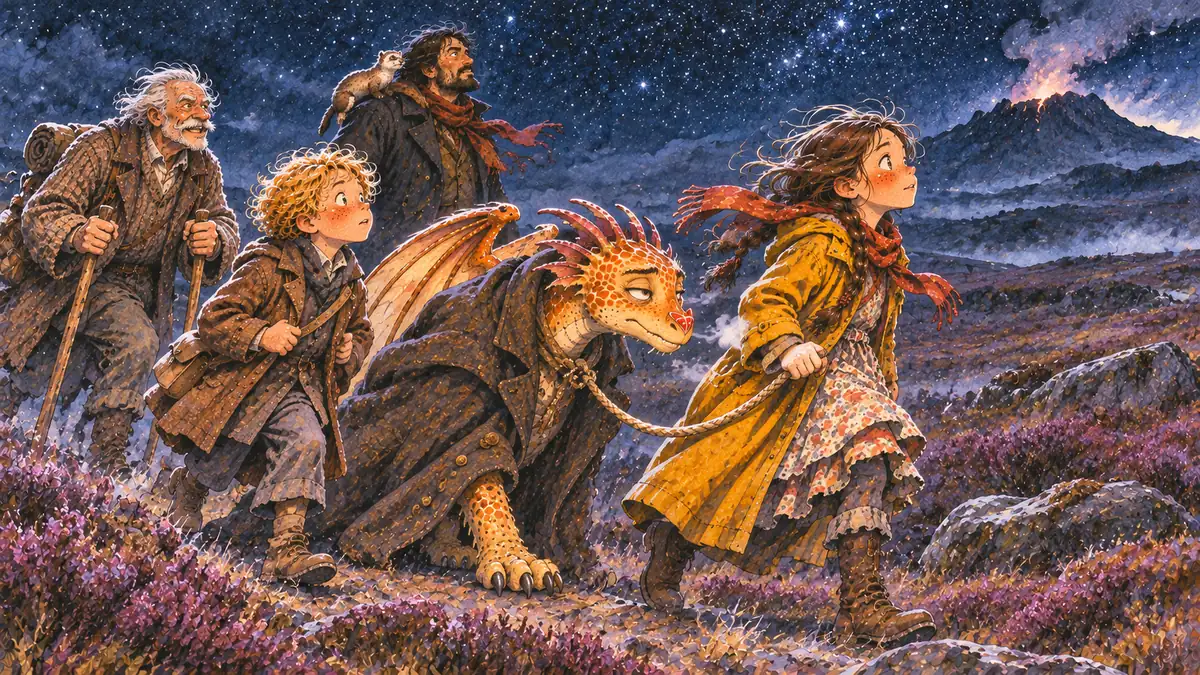
She was too big now for any basket. She stood as high as Josie's shoulder, as big as a pony's foal, all legs and wings, and her scales had darkened from biscuit to the colour of strong tea. Grandpa had made her a sort of harness out of rope and a folded sack, and on it they tied the bedrolls and the food and the kettle and the pot. She did not seem to mind. She walked along the rails with the packs bumping on her sides, and every so often she stopped and ate a bit of rail.
Moss walked in front, with Zip in his collar. Grandpa walked behind, with a stick in each hand. Josie walked next to Biscuit. Toby walked next to Moss, and asked him questions.
"How do you know the way?"
"I've walked it."
"When?"
"Years ago. For His Lordship. He sent me to see if there were any dragons left."
"Were there?"
"No," said Moss. "Only rocks."
"What did you tell him?"
"Rocks."
Josie did not ask Moss anything. In five weeks on one small boat she had hardly said ten words to him. When he dropped back to walk beside Biscuit, she walked faster and put herself between them.
At midday they stopped in the lee of a big stone and ate bread and cheese. Toby lay down on the wet heather with his coat over his face. Zip came out of Moss's collar, ran across the grass, climbed onto Toby's chest and curled up there in a warm pale knot.
Biscuit looked at the ferret on Toby's chest.
Then she walked over, turned round twice, and lay down on top of both of them.
"Get off," said Toby from somewhere underneath. "I can't breathe. Biscuit. Get off."
Biscuit closed her eyes and did not get off. Zip, squashed flat between the boy and the dragon, made a small offended noise.
"She's jealous," said Grandpa.
"Of a ferret?" said Toby.
"She was here first," said Grandpa.
In the afternoon the sleet got worse.
It came down so thick that they could only see a little way along the rails in front of them, and the hills disappeared, and the whole world was grey. The wind got under Josie's coat. Her hands went numb on the straps of her bag.
And Biscuit began to change colour.
Josie noticed it first. The faint stripes from the bits of rail she had been eating all morning, which had shown along her sides like the lines on a ledger, were gone. The rest of her was going too. The strong-tea colour of her scales was fading, as if someone were slowly washing it out, until she was a flat, dull grey all over, the colour of the sky.
She was walking slower, too. She did not stop to eat the rails any more.
"Grandpa," said Josie. "Look at her."
Grandpa looked. He stayed quiet, but he walked faster.
Then, out of the sleet ahead of them, came two dogs.
They were big black-and-white sheepdogs, wet through, and they came at a run, low to the ground, barking. They went past Moss and past Toby. They went straight for the grey thing walking along the rails with packs on its back.
Biscuit stopped.
She reared up.
She went up on her back legs, higher than Josie, higher than Moss, with her wings half open and the packs swinging and the kettle clanging against the pot. Her mouth opened. Her eyes, which had been dull with cold all afternoon, lit up in her grey face like two coals in a grate when the door is opened. She did not roar. She made a sound low down in her chest, deep and rough, like the sound a big stone makes when it begins to slide.
The dogs stopped as if they had run into a wall. They stood for one moment with their fur standing up. Then they turned round and ran, whining, back into the sleet, and did not come back.
Biscuit came down onto four feet again. The light went out of her eyes.
Toby had stepped back. He had not meant to. His feet had done it on their own, and now he was standing two steps further away from her than he had been, with his hands up in front of him. He put them down quickly. Biscuit looked round at him.
"It's all right," said Toby. His voice wobbled. "It's all right. It's me."
She came over and pushed her cold grey nose into his hand.
An hour later she lay down.
She was walking, and then she was not walking. She folded down onto the heather beside the rails, with the packs still on her back, and put her head on the ground, and shut her eyes.
Josie knelt beside her. Biscuit's scales, which were always warm, were cold. Not cool. Cold, like a stone that has been out all night.
"Get up," said Josie. "Biscuit. Come on. Get up."
Biscuit did not get up.
Moss crouched down on the other side of her. He put his hand on her neck and kept it there for a while.
"She's done," he said. "We'll have to stop. There's a shepherd's hut a mile back. We go back to it, get a fire going, and wait out the weather. Tomorrow, maybe the day after, it'll clear."
"He's right," said Grandpa. He leaned on his two sticks. His face was grey too. "We can't carry her, Josie. We'll wait."
Josie did not move.
She was looking at Biscuit's grey scales. She was thinking about an egg in a wall. An egg that had been put at the cool end on purpose, so that it would sleep. An egg that had stayed asleep for sixty years.
"No," said Josie.
They both looked at her.
"If we stop, she'll go to sleep," said Josie. "Properly. Like the egg in the wall. You said it yourself, Grandpa. You put it at the cool end so it would sleep. Cold makes her sleep. And if she goes to sleep out here in this, she might not wake up for sixty years." She stood up. "Where's the nearest warm place? Not a hut. Warm."
Moss looked at her for a long moment.
"The mountain," he said. "The lower slopes. The ground's warm there. There's steam comes out of the rock."
"How far?"
"All night. If we don't stop."
"Then we don't stop," said Josie.
Grandpa opened his mouth.
"I'll carry the lantern," said Josie. "Mr. Moss, you take Grandpa's bag. Toby, you take hers." She was already pulling the packs off Biscuit's back. "And she walks. She walks if I have to pull her."
Nobody argued.
They walked all night.
Josie walked in front with the lantern held up, along the rails, in the sleet and then in the dark and then in a fine cold rain. She had tied a rope round Biscuit's neck and the other end round her own wrist, and every time Biscuit slowed down Josie pulled, and talked, and whistled Grandpa's tune, and Biscuit took another step. Behind her she could hear Toby, panting under the extra pack, and Grandpa's two sticks going click, click on the sleepers, and Moss's steady boots.
Nobody talked much. Once, Moss came up alongside without a word, took off his long brown coat, and laid it over Biscuit's back, so that only her head and tail stuck out. Josie opened her mouth to tell him to take it back. Then she looked at the coat, and at the dragon walking a little easier under it, and closed her mouth again, and said nothing at all, and Moss walked on in his shirtsleeves in the rain.
Somewhere in the middle of the night Josie realised she was crying a little, from tiredness, and kept walking anyway.
Towards morning the rain stopped.
And the ground under her feet began to change. It was not soft and wet any more. It was gritty and black, like cinders, and it was warm. She could feel it through the soles of her boots. Here and there, in cracks in the rock beside the rails, little threads of steam were rising into the cold air.
Biscuit lifted her head.
She sniffed. She stopped dragging. She walked forward on her own, past Josie, to the nearest crack, and put her nose down into the steam, and stood there breathing it in. Slowly, as Josie watched, a faint brown colour began to creep back into the grey of her scales, like tea poured into milk.
Biscuit raised her head and looked back at them. Then she pursed her lips, the way she had seen Grandpa do a thousand times on the boat, and blew.
A thin, high squeak came out. One note.
Grandpa stopped where he was. He leaned on his sticks and looked at her, and did not say anything for a while.
"That was my tune," he said. "That was the first note of my tune."
The sun came up behind them. Ahead, the rails ran on across the black ground and stopped at the foot of a mountain.
It stood up out of the moor all on its own, black and steep, with a broken top like a tooth. All over its sides there were cracks, and out of every crack came steam, slow and white, rising and drifting in the morning light, so that the whole mountain seemed to be breathing.
"Old Smoke," said Moss.
Biscuit walked to the very end of the rails, where they stopped against a heap of rusted iron at the foot of the slope. She stood there for a while with her face turned up towards the mountain. Then she opened her mouth and hummed, the low steady hum she made in front of the range at home.
Nobody moved.
From somewhere deep inside the mountain, so low that Josie felt it in the ground before she heard it, something hummed back.