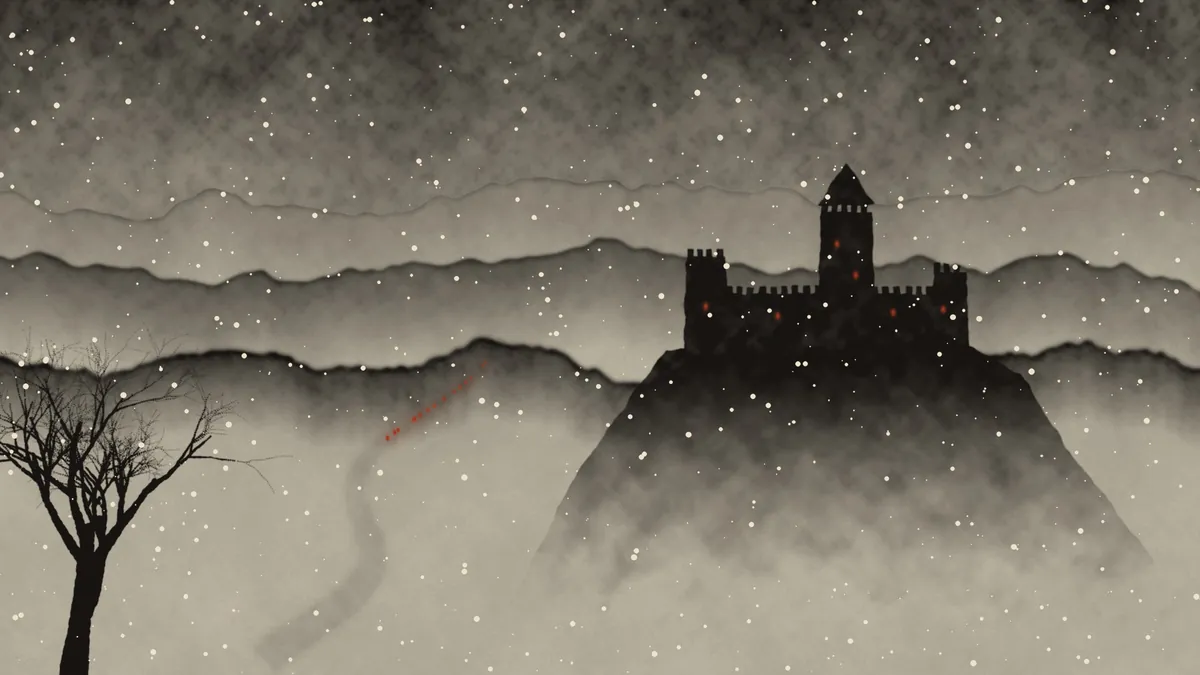
Winter at Karthen
The patrol was a day late, and the snow had not come.
Rovan Tal rode north out of Karthen with twenty horse behind him and the river Kell talking to itself on his right hand. In most years the upper pass would have been shut a fortnight already, white from wall to wall, and nothing would have moved on the road until April but wolves and the wind. This year the sky had stayed high and hard and blue into December. The snow lay thin on the slopes and thinner on the road. The pines stood black above it, and every rock showed its face.
He did not like it. Rovan had commanded Karthen for thirteen winters, and he had learned to trust the snow. The snow was the best soldier in the garrison. It shut the north like a door and kept it shut, and it asked no wages.
"You're frowning at the weather again," said Edran, riding at his knee.
"Someone has to."
"Gant will have stopped at Grimsel to drink their beer and court the miller's widow," Edran said. "You know he will. He's done it twice this autumn."
"Then he'll be on a charge," said Rovan, "and you'll write it."
His nephew grinned. Edran was twenty-six, long in the leg and quick in the hand, and he still rode as if the horse were a gift he'd been given that morning. He had his mother's dark eyes and none of her patience. Rovan had made him a captain the spring before, and had spent most of the summer wondering if he had done it too soon. Then in September Edran had brought a mule train through a rockfall in the dark with the loss of one mule, and Rovan had stopped wondering.
The road climbed. Three miles above the fortress, the pass widened and the Kell spread itself out over a shingle bed in a broad, shallow ford. The road crossed there, and in summer the drovers stopped to water their beasts. Rovan heard the ford before he saw it, over the shoulder of the hill. He heard water, and something under the water.
He held up his hand, and the riders stopped behind him.
Steel. A horse screaming. A man's voice, high and hoarse, shouting a name over and over.
"That's Gant," Edran said.
Rovan was already moving.
They came over the shoulder at a canter and the ford opened under them. Rovan took it in with one look. A sergeant had taught him that, thirty-odd years ago, and hit him whenever he took two.
A farm cart stood in the middle of the ford with one wheel sunk in the shingle and its mule down in the traces. Around it, in the water and on the near bank, Gant's patrol was fighting on foot, six men left, back to back around the cart. In the cart and crouched behind it were people: women, a few old men, children in blankets. On the far bank and in the shallows, fifteen or twenty riders in long gray cloaks were circling, closing, cutting in and wheeling away. They rode small shaggy northern horses, and they rode them well. As Rovan watched, one of them leaned from the saddle and opened a soldier's shoulder with a long curved blade, and was gone again before the man fell.
"Line," Rovan said. "On me. Walk, then trot. Edran, take five and get round their left in the trees. Don't charge till I do."
He drew his sword. It was an old pattern, heavy in the blade and plain in the hilt, and he had carried it since the Teshar border. It came out of the scabbard with a sound he felt in his teeth.
They went down the slope at a walk, then a trot, twenty riders knee to knee on loose shingle, and the gray riders heard them and turned. Rovan saw faces under the hoods. They were weathered, bearded faces, the faces of farmers and carters, and they watched the oncoming line with calm interest, as men watch a change in the weather.
One of them raised his arm and shouted a word in the northern tongue. Half the gray riders swung round to meet Rovan's line. The other half went for the cart.
Rovan put his heels in.
The water came up white around his horse's knees. A gray rider came at him from the left with the curved blade high. Rovan took the cut on his blade, close to the hilt, and felt the shock go up his arm into his shoulder. He let it turn him and cut back low, under the man's arm, where the cloak opened. The rider folded over his saddle-bow and went down into the river. The shaggy horse ran on without him, stirrups flying.
Another came, and Rovan met him horse to horse. The beasts shoved and screamed. He could smell the man, wet wool and woodsmoke and something sharp, like hot iron. The rider was strong. He hammered at Rovan's guard three times, four, and on the fifth Rovan let the blade slide off his and drove the pommel into the man's face. He felt teeth go. The rider reeled, and Rovan's trooper Ellery put a spear through him from the side.
Then Edran came out of the trees.
He had not waited. Rovan had known he would not. He came out of the pines on the left with his five men at the gallop, low on their horses' necks. He went straight through the gray riders around the cart with the weight of a falling wall. Rovan saw him cut one man from the saddle. He saw a second rider turn on him and Edran's horse go down in the shingle, hit in the chest. Edran rolled clear and came up on his feet in water to his thighs, with his sword still in his hand.
A gray rider was reaching down into the back of the cart. He had a child by the arm, a girl of seven or eight in a red hood, and he was lifting her. Rovan never knew why. Perhaps for a shield. Perhaps to carry her back north to wherever they had come from.
Edran reached him in three long, floundering strides through the water. He caught the rider's sword-arm, dragged him half out of the saddle, and struck him twice in the side. The man let go of the child. She fell back into the cart among the blankets. The rider fell the other way into the river, and Edran stood over him with the water pulling at his legs.
The gray riders broke. They did not scatter. Their leader shouted again, and they drew off together across the ford and up the far bank. They went at a canter, in good order, taking two of their wounded with them. At the top of the bank they stopped and looked back, the whole troop in a line against the pale sky. Then they turned and went north up the road at an easy trot, and were gone among the pines.
"Let them go," Rovan said, before anyone could ask. "They know this ground better than we do on that side, and I want everyone home by dark."
He looked at Edran, standing in the river with his dead horse beside him.
"I told you to wait for me."
"You'd have been late," Edran said. He was white around the mouth and grinning. "Sir."
Gant was sitting on the tail of the cart with his left arm bound up in a child's blanket and his face gray under the dirt. He was a small, square man with ginger whiskers and a broken front tooth, and he had the gift of making any trouble he was in sound worth the telling.
"We found them a mile above Grimsel, sir," he said. "Coming down the road. Thirty-one of them, all from the village, all on foot except the old ones on the cart. The riders were after them by noon yesterday. We've been fighting a running fight ever since. Lost Meller last night in the dark. Lost Nash and young Tenby this morning." He looked at the river. "We'd have lost the lot in another quarter-hour."
"You did well, Gant," Rovan said.
"I did. Write it down, sir. I'll want it read out at my funeral." He looked past Rovan at Edran, who was helping the girl in the red hood down out of the cart. "And the captain did well. Mad as a hatter, but well."
"What drove them out?" Rovan asked. "The villagers."
"I don't rightly know, sir. I don't have their speech, past please and thank you and how much. There's an old woman who has some southern. You'd best ask her."
The old woman sat in the bottom of the cart with a bundle on her knees. She was very small, and very old, wrapped in so many shawls that she seemed to have no shape at all. Her face was brown and creased as a walnut, and her eyes were black and clear. When Rovan came round to her she looked up at him without fear. She looked him over as if he were a horse she might or might not buy.
"You are the commander," she said. Her southern was slow and heavily accented, but good. "Of the fortress below."
"I am. Rovan Tal. What's your name, mother?"
"Hild." She put her hand out of the shawls and touched his sleeve, briefly, as though to make sure he was real. "We are from Grimsel. The mine village, on the north side of the pass."
"I know it," Rovan said. "I've bought your iron."
"There is no more iron. They took the men. All the men from the mine, and the boys over twelve. Riders came, and officers, with paper. They said the men were required in the valleys. Required." She said the word as if it tasted of something. "The women would not let them take the boys. So we ran. Some of us. South, to you."
"Who took them?" Rovan asked.
Old Hild looked at him for a moment, and then up the road, north, where the gray riders had gone.
"The Seat's people," she said. "Who else is there?"
Rovan did not know what she meant, and there was no time to ask. The light was already going amber on the high snow. He set two men to cut the mule out of the traces and two more to get the cart's wheel out of the shingle. He put the children up on the horses in front of his troopers. The girl in the red hood rode in front of Edran on a borrowed horse, wrapped in his cloak, and talked to him the whole way down. She spoke in the northern tongue, and he answered in his. Neither of them could understand a word, and neither seemed to mind.
Karthen came into sight around the last bend of the road at dusk, as it always did, and as always Rovan felt it settle into his chest.
The fortress stood on the shoulder of the mountain on the west side of the pass, two hundred feet above the river. Its oldest walls were massive and irregular, piled up by men four hundred years dead, and they seemed to grow out of the rock. Later walls had been added around them, crooked and thick, enclosing barracks and stables and storehouses, kitchen gardens on terraces, houses for the families, a forge and a chapel and a bakehouse. Below the walls, beside the river, lay the little town: two inns, a row of warehouses, livestock pens, a smithy, and the house of a merchant named Peck who was the bane of Rovan's life.
The road climbed from the town onto the shoulder and came to the outer gate, which faced north. Through that gate was the outer ward with the barracks and the stables. Beyond, through the inner gate, lay the inner ward, the old keep, and the families' quarters. At the back of the inner ward, a vaulted tunnel ran three hundred yards through the solid rock of the mountain to a small gate on the south face. The garrison called it the Long Passage. The mules used it to bring up supplies from the south road without climbing through the town. Children dared each other to run it in the dark.
Lights were coming on in the windows. Smoke from the kitchens lay along the walls, and Rovan could smell bread. He could hear someone shouting down in the town, and someone else shouting back, and he knew without needing to hear the words that it was Wenna Cole and Peck.
He was right. They were in the yard of Peck's warehouse when the column came through the town, standing toe to toe in the lantern-light. Wenna was a big woman with a blacksmith's forearms, who ran Karthen's kitchens as other people run armies. Peck was a thin man in a fur collar, holding his account book in front of him with both hands.
"Commander," Peck said, seeing Rovan, with enormous relief. "Commander, I appeal to you."
"He's sitting on his flour like a broody hen," Wenna said, "and asking double for it."
"The roads may close any day," Peck said. "My costs have risen."
"The roads have been open all winter, you thieving article," Wenna said, "and you've a warehouse full of flour you'll be eating yourself come spring."
Rovan looked at Peck, and Peck looked at the thirty-one refugees from Grimsel trailing in behind the horses, at the children asleep in the troopers' arms, at Gant with his arm in a blanket.
"October's price," Rovan said. "And you'll send ten sacks up tonight as a gift to these people, who have walked here from Grimsel with riders at their backs. I'll see your name is mentioned in my dispatches as a man of charity."
Peck opened his mouth, and shut it, and said, "October's price. And the ten. Very good, Commander."
"October's price is still robbery," said Wenna, as they climbed the road to the outer gate. "Begging your pardon."
"It is. But he'll go on selling to us. You'll need him in March."
"I'll need him in a pie in March," said Wenna, and went off to see about beds for the women from Grimsel.
The winter supper was held in the great hall of the old keep, on the first Sunday of December, every year since before anyone could remember. It was supposed to celebrate the closing of the pass. This year it celebrated nothing in particular, except that they were all still there, and the bread was hot.
Rovan sat at the high table, which was not high at all, only the end of the long table nearest the fire. Brand sat on his right. Captain Ivo Brand was Rovan's second, a tall, slow-spoken man of thirty-eight with a farmer's face and a gift for remembering the names of every man's children. He had served under Rovan for eleven years. They had buried Rovan's wife together, eight winters ago, in the little cemetery on the terrace below the chapel. Brand had dug the grave himself, because the ground was frozen and he would not let anyone else do it.
On Rovan's left sat Edran, still damp at the knees and telling the story of the ford for the third time. In this version there were forty gray riders.
"Twenty," said Gant, from further down the table. His arm was in a proper sling now, and he had been given the place of honor by the fire and a jug to himself. "Twenty, Captain, and three of those were boys."
"They fought like forty," Edran said.
"They fought like twenty. I should know, I was there before you." Gant raised his cup to Edran. "But you did well. I said so to the commander. I said, he's mad, but he's our madman."
Laughter went down the table. Rovan let it run over him like warm water. Perhaps two hundred sat in the hall, soldiers and families and the refugees from Grimsel. The northerners had been fed and given dry clothes, and sat in a tight knot at the far end, watching everything with wide, wary eyes. Wenna's kitchen boys and girls went up and down the benches with jugs and platters. Kit, her grandson, was the smallest and the fastest. He was eleven and had red hands and an opinion on every horse in the stables.
Sergeant Harl Mabry was carving. He was a big man with a gray, cropped head and a face as craggy as the pass, and he carved meat with the same grave care he gave to everything. Five years ago he had been a common soldier with a reputation for fighting in taverns. Rovan had made him a corporal, then a sergeant, against Brand's advice. Mabry had not been in a tavern fight since. He had a wife in the town and three daughters, and his daughters fought Kit daily over which pony in the stables was the fastest.
"The commander's portion," said Mabry, setting a plate in front of Rovan. "Off the bone, sir, and none of the fat, because Mistress Cole says you're to watch yourself."
"Does she," said Rovan.
"She does, sir," Mabry said. "She says you're getting a belly."
"Tell Mistress Cole she may keep her opinions."
"No, sir," said Mabry, with great dignity. "I'll not."
At the far end of the high table sat the oldest man in the fortress, who was not a soldier at all. Dace Tolliver had been Karthen's armorer for twenty-two years. He was sixty-three, bald as an egg, with a white beard down to his belt. He had been born in Teshar, in the south, and still spoke with its soft, rolling vowels, though he had not seen it in forty years. He had come north as a young man to fight in the border wars and had never gone home. He said it was because the beer was better in Karthen. Everyone knew it was because a woman had once lived here whom he loved, and who had married someone else.
Dace was eating with one hand and drawing on the table with the other, a wet finger in spilled beer. He was explaining to Kit the proper angle for grinding an axe.
"That's not how Master Harrow does it," Kit said.
"Master Harrow," said Dace, "is a fine smith and an honest man, and if I let him grind an axe for me I'd use it to shave him." He looked up and caught Rovan's eye. "Commander. Is it true you've filled my armory with northern swords? Gant says you brought a whole cartload."
"Five."
"Five's a cartload, to Gant," Dace said. "Let me see them in the morning. I want to know what they're forging up there."
"I'll bring you one," said Rovan.
"Bring me all five. I'll put them on the wall and tell lies about how you won them." Dace looked down the hall at the refugees from Grimsel, and his face softened. "That old one with the shawls. She came into my forge this afternoon and stood looking at the fire for an hour. Didn't say a word. Then she picked up a horseshoe I'd just finished and turned it over in her hands. She said it was good iron, but not as good as theirs."
"She was right, probably."
"That's what I can't forgive," said Dace.
At the end of supper came the swearing.
It was an old custom of the fortress that recruits who had come in during the autumn were sworn at the winter supper, in the hall, before the whole garrison and their families. Rovan had never liked it much. An oath seemed to him a private thing. A boy of eighteen saying words in front of two hundred people was more likely to be thinking about his collar than his honor. But it was a custom, and Karthen was a fortress made of customs, and he would not be the commander who broke it.
Six had come in this year. They came up the hall in their new coats, red-faced, in a ragged line, and knelt on the flags in front of the fire. Brand stood behind them with the book. Rovan got to his feet.
He had sworn many men in thirteen years. He knew the words without the book.
"Say after me," he said. "I bind my service to the Undying Throne, and to the Crown that holds its charge."
"I bind my service," said the six recruits, raggedly, "to the Undying Throne, and to the Crown that holds its charge."
"To serve the King of Auren in arms, at his command and the command of his officers, in Karthen and wherever I am sent."
They said it. Their voices were stronger now. One of them, a big fair boy named Wylie, was shaking.
"Until I am dismissed, or until I die."
"Until I am dismissed," said the six, "or until I die."
At the far end of the hall, by the fire, something fell.
Rovan looked up. It was the old woman, Hild. She had been sitting on a stool by the fire among the women of Grimsel, and she had dropped her cup. It lay on the flags, and the beer ran out of it, steaming in the heat. She was staring at the six young men kneeling on the floor, and her black eyes were wide.
The women around her bent to pick up the cup and speak to her. She paid them no heed. She said something in the northern tongue, loudly, and then again in southern, quite clearly, so that half the hall heard it.
"The Seat is waking."
The hall went quiet. Rovan saw people turn their heads.
"The Undying One," said Old Hild. "He is waking under the mountain. And you have just given him six more."
Dace Tolliver broke the silence. He leaned back in his chair and said in his soft Teshar voice, "Well, if he wants them, Mother, he'll have to come down and feed them. These six eat like wolves." There was a gust of laughter, a little too loud, and the hall came back to itself. The recruits got up off their knees and went to be clapped on the back. Kit ran to fetch the old woman a fresh cup.
Rovan sat down again. Brand closed the book and sat down beside him.
"What was that about?" Brand said.
"Northern talk. They have a story about a buried king." Rovan reached for his cup and found it empty. "The ballads say Auren was founded when our forefathers beat him. The Undying Throne is his chair, and the Crown holds it in charge. It's an old form of words. Nobody's thought about it in a hundred years."
"Except her," Brand said.
Rovan only nodded.
Brand turned his cup in his long fingers. "You never swore those words yourself, did you? I remember you saying."
"I came in under the Dunmere articles, thirty-four years ago, before the reform. A shorter oath and a worse supper." Rovan looked down the hall. Old Hild sat with her hands folded in her shawls, gazing at the embers. The women of Grimsel were close around her, and none of them were talking. "Your words were the new ones."
"Everybody's are, now. Everybody under forty." Brand smiled. "I swore them in this hall. You weren't here; it was old Captain Varrin. I had a cold, and sneezed in the middle of the Crown. He made me start again."
Rovan laughed, and Brand laughed, and Edran came up with the girl from the ford asleep on his shoulder to ask where she should be put. The moment passed.
The sentry came for him an hour after midnight.
Rovan had not been asleep. He had been sitting in his room in the old keep with a candle and the winter returns, failing to make the forage figures come right. When the knock came he was on his feet before the boy had finished saying his name.
"Lieutenant Finn says you're to come to the north tower, sir. He says there's lights on the road."
The night was very cold and very clear, and the stars were as thick as frost on a window. Rovan climbed the north tower stair with his cloak around him and came out on the roof, and Finn pointed without a word.
Far up the pass, five or six miles off, where the road came down out of the high snow, there was a line of lights.
They were torches. Rovan could see them clearly in the black air: a long, slow chain of them, winding down the bends of the road, stopping and moving on. A great many of them. Between the torches, as his eyes grew used to the dark, he could make out bulk. Something large moved on the road. More than one thing. Great dark shapes, higher than a wagon, lurching from torch to torch.
"How long have you been watching?" he said.
"Half an hour, sir. They've come down a mile since then. Slow." Finn was young, and he kept his voice steady with an effort. "I make it a hundred torches, sir. More, maybe. And those things in the middle, I don't know what those are. They must have teams of twenty on them."
Rovan watched. A torch near the front of the line stopped, and swung, and others gathered around it. Over the miles of cold air, faint as a thought, came the sound of a whip, and the shouting of men at horses. Then the line moved on.
Footsteps on the stair behind him, and Brand came up onto the roof in his shirt and boots with a cloak thrown over, and Edran after him.
"The patrol's gray riders?" Brand said.
"Gray riders don't bring wagons." Rovan watched a moment longer. "Finn. Double the watch on every wall. Turn out the duty company and put them on the outer gate. Have the gate shut and barred, and the bar chained. No one goes in or out until I say."
"Sir."
"Brand, wake the clerks and write to Hallam," Rovan said. "Tell Governor Sayle we have a column of unknown strength coming down the pass with heavy wagons, at night, in December. Ask him for whatever he can spare. Send it with two riders, by the south road. Tell them to kill their horses if they have to."
"He'll think you've gone soft in the head," said Brand.
"Then let him think it at Hallam with his boots on."
Brand went. Edran stood at the parapet with his hands on the cold stone, staring north.
"Let me take a dozen men up the road," he said. "We could be there in an hour. I'd see what they were, and be back before dawn."
"No."
"Uncle, a dozen men," Edran said. "That's all I ask."
"No. You'd be riding up a road you can't see, in the dark, toward a hundred torches you can. If they're friends, they'll be here by morning and you'll have lost your sleep. If they're not, I'll have lost a dozen men and my sister's only son, and I'll have to ride to Dunmere and tell her." Rovan looked at him. "I'll want you on the inner gate at first light, with your company, rested. That's where you're useful to me. Go to bed."
Edran stood a moment longer. Then he said, "Yes, sir," and went down the stair.
Rovan stayed. He watched the torches until his feet were numb. They came on, slow and patient, down the switchbacks of the road, and stopped, and came on. At the head of them, lit by the torches around it, a great dark shape swayed on its wheels, riding the ruts. Once, when the wind turned, he thought he heard a sound from it. It was low and soft, a deep hum, the noise a great pot makes when someone brushes it with a sleeve. Then the wind turned back, and he heard nothing.
He went to bed at last, near four, because Brand came up and told him to.
He lay in the dark in his narrow bed in the old keep, with his sword on the chair beside him and his boots on the floor where he could put his feet straight into them. The fortress was quiet around him: the old, settled quiet of stone that had stood a long time and meant to stand longer. Somewhere a dog barked once in the town, and was hushed. Somewhere in the inner ward a child was crying, one of the Grimsel children, and a woman was singing to it in the northern tongue.
Sleep would not come. He lay and listened.
Under the singing, under the dog and the wind and the far, soft sound of the river, he began to hear something else. It came up through the rock, through the floor, through the frame of the bed. It was as faint as his pulse, but it kept no time with his heart.
It was the slow, grinding turn of iron wheels on a frozen road, coming down.