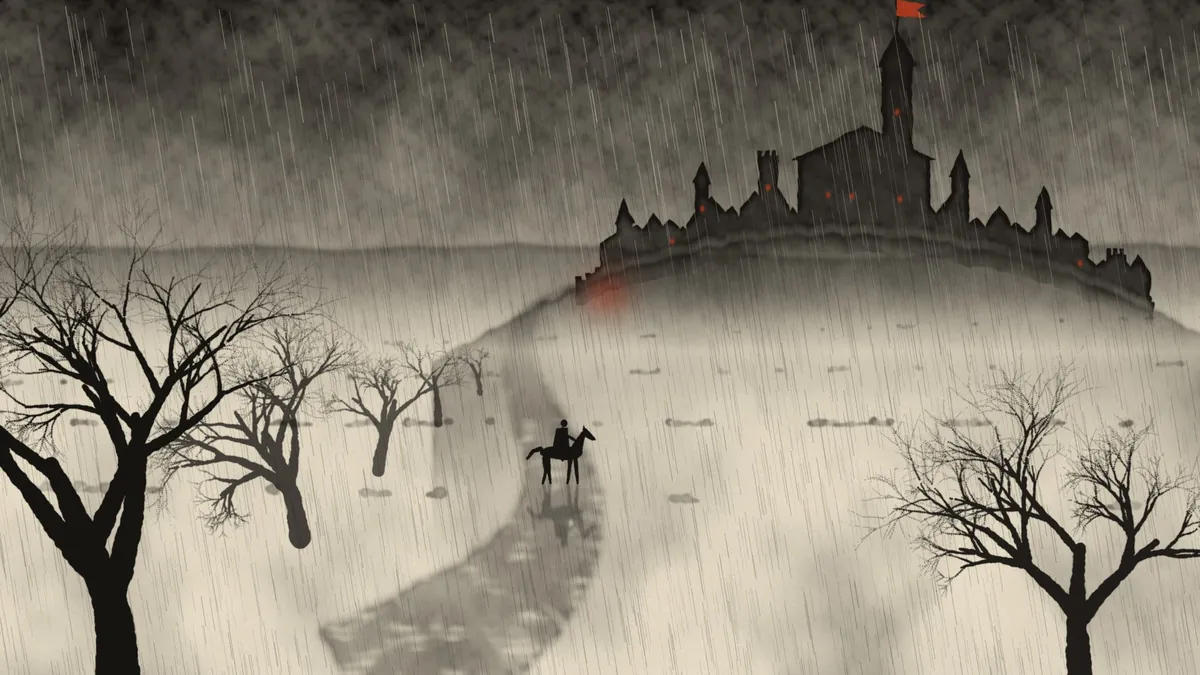
The Crown's Response
Kingsholm arrested Rovan at its Merrow Gate, at noon, in the rain, eleven days after the bell broke at Merrow Ford, with every soul in the gate-yard watching.
Maelin had expected something of the kind. She had not expected it to be done so badly.
The road from Merrow Ford came in from the north-east along the high ground above the Lune. The royal city sat at the end of it on its long hill, gray walls over gray water, with the palace roofs climbing to the crown of the hill behind. They had ridden fifty miles in three days to reach it. There were seven of them. Rovan and Maelin rode in front, with the Fenwick twins, Noll Trask with the brandy, and a Karthen trooper called Tey who held the horses. Tey was one of the bound, and had asked to come; he said a city with no bell in it was the one place he could still be useful. Behind them came Old Hild from Grimsel, wrapped in four shawls on a mule, who had not complained once and had not stopped praying either.
The captain of the gate was a young man with a fine mustache and a paper in his hand. He came out of the guardroom as they rode under the arch, and twenty men in royal blue came out behind him and spread across the yard.
"Rovan Tal, late Commander of Karthen?"
"Yes," said Rovan.
"I am Captain Sutton of the King's Foot. By order of the Lord Marshal, I arrest you for the desertion of your command and the abandonment of the king's fortress to his enemies. And for mutiny against the king's governor at Hallam." He read the last part off the paper, carefully, because it was new to him. "You'll give me your sword."
Rovan looked at him for a breath. Then he unbuckled the old heavy sword from his belt and held it out, hilt first.
Maelin swung down from her horse. "Captain. A word."
"Mistress Rennick." Sutton had the grace to look uncomfortable. "There's a paper for you too. From Dunmere. I'm to escort you to your lodging and keep you in it."
"How kind." She walked past him to the side of the gate-arch, pulling off her right glove as she went, then pulling it on again, slowly, so that every man in the yard could see the iron across its knuckles and palm. The portcullis hung above them in its groove, raised. Its chain came down the inside of the arch to a winch in the guardroom wall. It was a good thick chain, black with grease. She laid her hand on it.
She felt it at once. Forty links of wrought iron, the pulley at the top, the great grid of the portcullis hanging on its pins. The pins were sound. The pulley's axle was not. Somebody had let water into its housing for twenty years, and the rust had eaten a waist into it like a wasp's.
"Captain Sutton," she said pleasantly, "I teach the breaching of gates. I've taught it at this city's own school, in the yard behind the Lune barracks. I expect your instructors had their notes from me." She tapped the chain with one finger, and the iron hummed under it. "Your pulley axle is rotten. If I ask it to, it'll let go, and that grid will come down on the twenty men behind you, and on me, and on the Commander, and on you. I'd rather it didn't. I'm fond of the Commander."
The yard had gone quiet. Rain dripped off the arch.
"You're threatening the king's gate," Sutton said.
"I'm telling you about it. Somebody should." She did not take her hand away. "Here's what I'd like. You'll keep the Commander's sword, since you've been told to. You'll put him somewhere dry, with a fire. You'll put me across the passage from him. And you'll send a man up the hill to the king, the king himself, not the Lord Marshal, with three words from me. Tell him the oath is poisoned. Tell him Maelin Rennick asks to show him where. If he won't hear me, I'll mend your pulley for nothing and go home."
Sutton looked at her hand on the chain, and then at Rovan, who was sitting his horse in the rain with his empty scabbard and no expression at all. His eyes went back to his twenty men, who were edging out from under the portcullis one by one with great care.
"Yes, Mistress," he said. "Across the passage."
They were kept in the Lune Tower, at the river end of the palace, in two rooms off a stone corridor with a guard at each end. Maelin's room had a fire and a window over the water and a bed with curtains that smelled of mice. Rovan's had a fire and no window. She knew this because she inspected it, while the guard looked on in an agony of doubt, and she complained about it until he brought Rovan a second blanket.
The answer came down the hill at dusk. The king would hear them in the morning, in the hall of the Lune, with Lord Marshal Tierney present.
"He's curious," Maelin said. She sat on the end of Rovan's bed with her boots to his fire. "Curious is good. Curious kings listen."
"Tierney won't." Rovan had taken off his coat and was sewing a button back on its cuff, with a needle he had begged off the guard. He had always done his own mending, and he did it badly. "He's put his name to my arrest. If I'm right, he's sent his whole army to stand in front of bells for twenty years without knowing it. He'll want me wrong."
"Then we'll make him wrong in front of his king." She watched him bite the thread. "You could let me do that, you know."
"I've seen you do it," Rovan said. "Last time it cost us the Hallam causeway."
"The Hallam causeway had it coming." She took a long pull from Noll's flask and passed it to him. "Hild's ready. She's been praying in the northern tongue since Merrow. I asked her what she was praying for, and she said a short hearing."
Rovan smiled, which he had not done in three days. It took ten years off him. Then it went, and he looked at the fire.
"Edran swore the words when he was eighteen," he said. "In the great hall at Karthen. I stood by the table and heard him. He was so proud he stammered."
Maelin put the flask back in her coat. "Then we'll get him back," she said, "and he can stammer at you again."
The hall of the Lune was long and cold and very high, with tall windows down one side over the river and the king's banners hanging in the gloom of the roof. The king sat at the far end on a dais, in a high-backed chair with a fur over it. He was a big, handsome, gray-bearded man of nearly sixty, with a soldier's shoulders and the steady, attentive eyes of a man who has learned to listen to bad news without moving his face. Maelin had met him once, years ago, and had liked him.
At his right, standing, was Lord Marshal Tierney.
Tierney was big too, and older, with a gray beard cut square and a marshal's coat of royal blue with gold at the cuffs. He had commanded the army of Auren for eleven years and had never lost a battle he had chosen to fight. His eyes went to Rovan as Rovan was brought in between two guards, and then away, and stayed away.
Half the court was there, on benches down both sides: officers, councillors, clerks, a bishop, a scatter of lords in furs. Somebody had told them there would be a show.
"Commander Tal," said the king. "You lost my fortress."
"Yes, Majesty."
"Without a fight, I'm told," the king said.
"With a fight, Majesty. Against my own garrison." Rovan stood easily with his hands behind him. His voice was low, and it carried to the back of the hall. "Before dawn on the fourth of December, a bell rang on the road north of Karthen. When it rang, about two in every three of my soldiers turned on the rest of us. They knew what they were doing. They begged us to run while they did it. My second opened the outer gate to the enemy with tears on his face. My nephew held the Long Passage for me, and then the bell rang again, and he turned in his tracks and came at me with his sword." He paused. "I brought out four hundred soldiers and five hundred civilians. I lost the rest."
"And at Hallam?" the king asked.
"At Hallam, Majesty, it happened again. To Governor Sayle's garrison. Mistress Rennick saw it."
Tierney spoke up then. "Mistress Rennick saw a garrison turn on a mob of deserters, sire. So would I have."
"Mistress Rennick," said Maelin, "saw six hundred royal soldiers who'd been told to escort the families to safety turn round in the middle of the road and try to kill them. I took the heads off their spears. I'd do it again." She stepped forward before anyone could stop her. "Majesty, there's a roll in your archive. I asked for it last night. Your clerks were good enough to bring it up."
The king glanced at Tierney, and Tierney shrugged. The king nodded to the clerk at the side table, an old man in black who stood up with a long leather case in his arms.
"The roll of the reformed oath," said the clerk, "as enacted in the nineteenth year of the late king, after the Teshar war. The standard oath of the royal army, to be sworn by every soldier entering the king's service, or passing from one regiment into another."
"Read it," said Maelin. "No. Let me."
She took the roll from him and unrolled it on the side table, under the gray light from the windows. She had read it the night before by candlelight, sitting on the floor of her room with her back to the door. It was a fine clean hand on good vellum.
She read it aloud.
"I swear before the gods and this company to serve the king and his lawful officers in arms, to obey their orders, to defend the realm and its people, and to bear true faith. I bind my service to the Undying Throne and to the Crown that holds its charge. This I swear for my life and my death."
She let the roll curl up on the table.
"Every man who stood at Karthen swore something older than this, or nothing. The ninety-two bound men in Rovan's column swore what you have just heard. When the bell rang at Hallam, every one of them who was near it turned." She looked down the benches. "The Undying Throne. Who in this hall has ever heard of it?"
The hall was silent. A lord near the front laughed nervously and stopped.
"It's a form of words," Tierney said. "The throne of Auren. It's an old way of saying the Crown endures."
"Then why say the Crown twice?" Maelin turned to the king. "Majesty, I ask your leave to call a witness. She's old, and frightened, and she doesn't speak our tongue well when she's frightened. Your clerk reads northern. Let him put her words into ours."
Old Hild came up the hall on Tey's arm, in her four shawls, with her eyes on the floor. She was small and bent, all shawls and knuckles, and she smelled faintly of the mule. When she reached the foot of the dais she let go of Tey and stood by herself and looked up at the king.
The old clerk, whose name was Simeon Larkin and who kept the northern letters, came and stood beside her. He asked her something in the northern speech. It was a rough, rolling tongue, with the shape of their own words under it like stones under water.
Hild answered him. She spoke on in a low voice, and the hall leaned forward to hear her, though none of them could understand a word.
"She is Hild, widow of Arne, of the mining settlement of Grimsel in the iron valleys," Larkin said. "She is seventy-four years old. She says that in her grandmother's time, and in her grandmother's grandmother's, the Seat slept under the mountain at Dhor Kharad. The Seat is their word for a throne, Majesty. A chair of state. She says the old songs call it the Undying, because the one who sits on it does not die." He listened again. "She says that two winters ago the priests came down the valleys and said the Seat was waking. They gave every grown man and woman in Grimsel the words to swear. Those who swore came to belong to it. Those who would not swear were driven out. She would not, and her neighbors would not, and the riders burned their houses and chased them down the pass to Karthen."
Hild said something else, sharply, and pointed a crooked finger at the roll on the side table.
Larkin hesitated.
"Go on, Master Larkin," said the king.
"She asks what the lady was reading, Majesty. She heard the word for undying." Larkin cleared his throat. "I have told her. She says that in her tongue the words are the same words the priests gave at Grimsel. The Seat, the Undying Throne. She says, I'll give it as she says it, she says your soldiers have been swearing themselves to the old one under the mountain, and did nobody in this fine house ever think to ask him why he wanted them?"
The hall was utterly silent. Hild looked up at the king, and the king looked back at her. Then the old woman bobbed him a small country curtsy, as she might have to a reeve, and turned round, and walked back down the hall alone.
Tierney fought it all afternoon, and he fought it well.
He was too clever to call Hild a liar. He called her a frightened old woman who had seen a terrible thing and given it the names of her grandmother's songs. He granted that something had happened at Karthen. He granted that it had happened at Hallam, though he had only the word of two outlaws for it. He suggested that a bell might work on men's fear, as drums did, and that the men who broke were the young and the newly sworn because the young broke easiest.
"Every man in the royal army has sworn that oath, sire," he said at last. "Every man under forty. Twenty-two regiments. Suspend it, or call it poisoned, and you tell twenty thousand soldiers that their word to you means nothing. You tell them they may be enemies already, every one, and their officers can't trust them. I'll have no army by the spring. I'll have twenty thousand frightened men who've been told they belong to a corpse in the north. They'll go home, sire. And I wouldn't blame them."
"And if Mistress Rennick is right?" said the king.
"Then I'll find it out myself." Tierney turned to face Rovan. "Give me eight thousand men, sire. Give me the Queen's Foot and the Western Horse and the engines from Brackwater. I'll take back Dunmere and Hallam before the snow goes off the hills, and I'll bring these bells down the river on barges and hang them in your cathedral. Then we'll know what they are."
"You'll march eight thousand sworn men at a bell," Rovan said quietly. "My lord, that's what they want."
"I'll march them at the enemy, Commander. That's what soldiers are for." Tierney's voice stayed level. "I didn't run."
Maelin watched the king. He sat with his big hands on the arms of his chair and looked from one man to the other, and his face gave nothing. He was tired, she thought. She saw his eyes go to the roll on the side table and stay there.
She went back to it while they argued, and unrolled it again. She had read the oath. Now she read the preamble above it, the long lines of the long-winded law-clerks' Aurener that no soldier ever read. Halfway down, in the same clean hand, she found a sentence and read it again.
The clause following, it said, being taken word for word from the Order of the Coronation, that the soldier may bind himself to the Throne in the same form as his sovereign.
She looked up at the dais. The king was looking at Tierney. He missed it.
She rolled the vellum up again, slowly, and tied its ribbon, and kept her mouth shut.
Winter nights had never suited her, and that night in the Lune Tower she made no attempt. She sat at her window with a blanket round her and Noll's flask, and watched the lights of the river barges go down the Lune toward the Arle, and thought about the king's face.
Some time after the bells of the city struck two, the guard in the corridor stopped walking.
She had been hearing him all night without listening to him: twelve steps along the stone to the stair end, a pause, twelve steps back, the scrape of his boot as he turned. Now the steps came to the stair end and stayed there. She heard a voice, low, and the clink of something set down on stone. Then nothing.
Maelin put the flask down and stood up.
She went to her door in her stockings and opened it a crack. The corridor was lit by one lamp at the stair end, in an iron bracket on the wall. The guard was sitting under it with his back against the stone and his chin on his chest, as if he had fallen asleep at his post. Beside him on the floor stood a tray with a jug and a cup. Rovan's door, across the passage, stood open a hand's breadth. It had been locked at ten. She had heard the key.
She was across the corridor before she had decided to be.
The room was dark but for the red of the dying fire. A man was bending over the bed. He was a servant, in the palace gray with a white apron, and his arm was raised, and there was a knife in his hand.
The bed was empty.
Rovan came out of the dark beside the door. He had been sitting in the corner on the floor, with his blanket round him, as old soldiers sleep in strange places. He came up off the floor in one movement and threw the blanket over the man's head and arm together, and drove him into the wall.
They went down together in the hearth. Sparks went everywhere. The man was fast. He got the knife-hand free of the blanket and struck backward, and Rovan caught the wrist and twisted it, and the man drove his head back into Rovan's face. Maelin heard the crack of it. Rovan grunted and held on. The man got a foot to the wall and heaved, and they rolled out of the hearth and across the floor, and through the open door into the corridor.
In the lamplight Maelin saw him clearly at last. He was lean and fair, with a short beard and a narrow face, and he was not afraid at all. He came up on one knee with the knife and slashed at Rovan's belly. Rovan threw himself back. The blade opened his shirt and drew a thin red line across his ribs. The man came on, low, cutting, and Rovan gave ground down the corridor, bare-handed, in his stockings on the cold stone.
"Rovan!" Maelin snatched at the lamp-bracket on the wall. It was leaded into the stone, and she felt the iron, the soft gray metal round it, the old mortar. She asked it to let go, and it came out of the wall into her hand in a shower of grit, lamp and all, and the lamp went out.
In the dark she heard them come together. Something hit the wall. Somebody grunted. She swung the bracket at where she thought the fair man's head would be and hit stone.
A hand came out of the dark and seized her by the coat, and a second blade came up at her throat. She saw it as a gleam from the fire through Rovan's door. She caught it in her right hand.
The iron on her glove took the edge. She felt the steel of the knife, a good northern blade, thin and hard and cold, and she closed her fist on it and squeezed. The steel folded in her hand with a small sharp sound, a stick under a boot, and she twisted, and the man let go of the hilt with a curse.
The curse was not in Aurener.
Rovan came in behind him. He had found the first knife somewhere on the floor. He took the man round the neck from behind with his left arm and drove the blade in under the ribs with his right, once, hard and upward, and held him while his legs went. The man made no more sound. Rovan let him down onto the stone, and knelt over him, and stayed there with his hand on the hilt until there was no point in staying.
At last he sat back on his heels and touched his nose. His hand came away dark.
"Are you cut?" Maelin said.
"Across the ribs. Not deep." He was breathing hard. "You?"
She opened her hand. The folded knife fell out of it onto the stone. Her glove was scored across the palm, and through the score she could see the leather was wet. It began to sting. "A little. Mother of mountains. Who sends a servant with two knives?"
"A careful man." Rovan got up and went along the corridor to the guard under the bracket. He crouched beside him, and looked, and closed the guard's eyes. "Poppy in the wine," he said. "Then the knife. He's young. He came on at midnight."
Down the stair, at last, came the sound of running feet and shouting and the light of torches.
Maelin crouched by the dead man and opened his apron. Under it, against his shirt, he wore a flat leather purse on a thong. She cut the thong with the folded knife and weighed the purse in her hand. It was heavy. She tipped it out into her bloody palm.
Silver crowns, two dozen of them, new and bright. She turned one to the firelight from Rovan's door. On its face, under the king's head, was struck a small tower with a star over it.
Rovan took it out of her fingers and turned it in the light.
"The Hallam paymaster's mark," he said. "It goes on every crown that comes out of the March pay-chests. It's been on my pay since I was seventeen." He closed his hand on the coin. "This is Sayle's chest. The quarter's pay for the Hallam garrison was sitting in his strongroom when the gate opened."
They laid him on a trestle in the hall of the Lune at nine the next morning, under a sheet, and the king came down from his dais and lifted the sheet himself.
He stood over the narrow fair face until the hall began to shift on its benches. At last he let the sheet fall and held out his hand, and Maelin put the purse in it. The king tipped a coin into his palm and turned it to the window, and looked at the tower and the star. He passed it to Tierney without a word.
"He spoke as he died," Maelin said. "Not our tongue. Master Larkin, I'll try to give you the sound of it." She gave it as well as she could, three rolling words, while her cut palm throbbed inside its bandage.
The old clerk stared at her. "The Seat endures," he said. "It is what the Kharadi say, Majesty, in place of a blessing."
"He came in through the kitchens," said Captain Sutton, who stood at the end of the trestle looking sick. "Three days ago. He had a letter of character from a wine merchant in Merrow. The steward took him on to carry trays. He carried them well."
"Three days ago," said Rovan. "Before we came."
His nose was swollen across the bridge and a long thin bandage ran round his ribs under his shirt. He stood by the trestle with his hands behind him and spoke to the king and not to anyone else.
"Majesty, her rider named her under Hallam's wall, and the Hallam men we freed at Merrow name her again. The Marshal Serath. She knew I was coming here before I knew it. She knew where you'd put me. She paid a man to wait in your kitchens with the money she took out of your governor's pay-chest at Hallam. I don't know how much else she knows. But I know she thinks I'm worth killing, and I've done nothing yet to deserve it except tell you what I've seen."
Tierney put the coin down on the sheet. "It proves the Marshal has spies," he said. "Every enemy has spies. It proves nothing about the oath."
"No, my lord," said Rovan. "It proves she's afraid of what I'd say about it."
The king looked at the two of them, and then down at the dead man, for a long time. When he spoke at last it was to Tierney.
"Take your eight thousand," he said. "You'll have them. Take Dunmere back, and Hallam, and bring me these bells." He raised a hand before Tierney could thank him. "But you'll keep every man under forty out of the van. You'll put your old soldiers and your foreign companies in front, and your scouts far out, and if you hear a bell you'll fall back from it until you know what it is. That's an order, Tierney, and I'll have it written."
Tierney's face was stone. "Sire, you can't fight a war from the rear rank."
"Then fight it carefully." The king turned to Rovan. "Commander Tal. You're no longer under arrest. Your outlawry is lifted, and Mistress Rennick's with it. I'll have it cried in Dunmere, when Dunmere is mine again." He paused. "I'll not suspend the oath. Tierney is right that it would break the army, and I need the army. But you'll raise me another one."
Rovan waited.
"Free men," said the king. "Men who never swore the words. Your Dunmere veterans, the provincial companies, the foreign-born, the free cities if they'll come. Raise them under my warrant, and keep them apart from my regiments, and use them as you see fit against the Marshal. I can give you no royal troops. I can give you a little money, and my name." His eyes went to Maelin. "And I can give you Mistress Rennick, if she'll go."
"Try and stop me," said Maelin.
Tierney marched twelve days later, in a fine cold drizzle, with eight thousand men.
Maelin watched them go from the river gallery of the palace, a long stone walk with arched windows that looked north-east over the walls toward the Merrow road. The regiments came down out of the city in column, under their colors, with the drums going. The Queen's Foot came first, in blue with buff facings. Behind them came the Western Horse on their tall bays and a long train of wagons. Behind the wagons came the foot regiments of the line, one after another, all the way down the hill and out along the road into the rain.
Most of the faces under the helmets were young.
Rovan had gone down to the Lune quay at dawn to see to a boat. The king's warrant was in an oilcloth case in his coat, with a promise of three thousand crowns that might or might not be paid. With it went a letter of introduction to the council of Lissen that Maelin had read and thought would do more harm than good. They would go down the Lune by water to the Arle, and meet Hessa Dorn's barges coming down from Merrow, and go on with her to Lissen and the free cities. The king had given Rovan his hand on it in the hall that morning, before the court. Rovan had told her afterward that the hand was cold.
"Mistress Rennick."
She turned. The king had come along the gallery alone. He had sent his gentlemen back to the far end, and they stood there in a knot by the stair, watching and not hearing. He came and stood beside her at the window and watched his army go out along the road.
"They look well," he said.
"They do, Majesty."
"Tierney was against it, you know. Putting the old men in front. He says the young ones will think I don't trust them." He watched the lancers go out of the gate below. "Perhaps he's right. He usually is."
She held her tongue. Down on the road the drums went on, small with distance.
"You read the preamble," the king said. "Of the roll. I saw you, after you'd read the oath. You went back and read the top of it, where nobody reads, and you put it down as gently as a sleeping child, and you didn't look at me." He kept his eyes on the road. "I've been king for nineteen years, mistress. I know when a woman isn't looking at me."
"Majesty."
"I knelt in the cathedral of this city when I was thirty-nine," he said, "and the archbishop held the old book open in front of me, and I read out what was written in it. I remember my voice going up into the roof. I don't remember the words. Kings never do." He turned from the window at last and looked at her, and his face was gray and very steady. "Did I swear them? The same words?"
Maelin had stood in front of kings before. She had told them their walls would fall and their bridges would not bear the weight they wanted. She had never yet lied to one about stone.
"Yes, Majesty," she said.
The king held her eyes a moment longer. At last he turned back to the window, and watched the last of his regiments go out of the gate into the rain.
"Then never let me near one," he said.