The Broken Agreement
The king had a new oath, and he was very proud of it.
He had it read aloud to them in the hall of the Lune in the last week of June, by a herald with a voice that filled the rafters, from a scroll with the great seal hanging off it on a red cord. Maelin stood at the back of the hall between Rovan and Edran and listened. She had ridden a hundred and fifty miles in five days to listen to it, and her backside had opinions about that.
"I pledge my service to the living Crown of Auren," the herald gave out, "and to Osric, who wears it, and to his heirs, to serve in arms at their command and the command of their officers, until I am dismissed, or until I die."
He rolled the scroll up. The hall applauded. It was full of officers in new coats, two or three hundred of them, and they clapped long and loud.
"No throne," said the king from his chair on the dais. He was smiling. "No Undying anything. The words you found in the rolls, Mistress Rennick, are struck from them forever. Every soldier in my army has spoken this pledge in the last month, before his officers. Every one of them has had the old oath formally released, by my hand and seal. Twenty-two thousand men." He spread his hands. "You told me in January that the oath was the danger. I've taken the oath away."
Maelin looked up at him. Osric was fifty-eight, a big, handsome, gray-bearded man with the shoulders of a soldier and the eyes of a man who had not slept well since February. He had been kind to her in the winter, in his stiff way. He had believed her, when believing her cost him his marshal. She liked him. That made it worse.
"Majesty," she said, "may I ask something?"
"Ask," the king said.
"How many of the twenty-two thousand swore the old words first? Before the new ones?"
The king's smile stayed where it was. "Most of them, I suppose. The old soldiers. The recruits since February have only sworn the new."
"Then most of them are still bound," Maelin said.
The hall stirred. Somebody laughed, a short, uneasy bark.
"They have been released," the king said. "By the Crown that took the oath. Legally, fully, in writing."
"Legally, yes. Magically, Majesty, I'd not bet a copper on it." Maelin kept her voice level, which cost her. "The Crown didn't take that oath. The Seat under the mountain did. You can't release a man from a promise he made to somebody else."
"You have no proof of that," the king said.
"I have." It was Edran, beside her. He stepped forward into the aisle between the benches, and the officers turned on their benches to look at him. He had asked to come into the hall in irons, and Rovan had let him. The chain clinked between his wrists as he walked. "Majesty, I'm Edran Tal. Captain, Karthen garrison. I swore the old words at eighteen. I was taken by the bell at Karthen, and freed at Thornwick in March by my uncle, when he carried me beyond the field."
"I know who you are, Captain," the king said.
"Then you know what I am, Majesty." Edran lifted his wrists. "My commission was taken from me in March, by the Crown. I was dismissed from the royal army by your clerks for desertion. I've renounced the old oath in writing, three times, before witnesses. I've sworn your new pledge. And in April, at the Sorrel Bridge, Mistress Rennick struck a captured bell, and I walked toward it on a rope. A third of a mile, half a mile. And at half a mile, Majesty, it took me. As easily as it took me in December."
The hall had gone very quiet. Edran let his wrists fall.
"They had to haul me back by the rope," Edran said. "I tried to kill the men holding it."
The king heard them out. He was a fair man, and he heard them out to the end, and then he told them his plan.
He did not mean to stand on the defensive and wait for Serath to come to him with her bells. He meant to take her bell before she could ring it.
"She has one bell with her army," he said. "One. My scouts have seen it every day for two weeks, in the middle of her line, under guard. She needs it to turn my men, and she knows it, and she'll wait to strike it until we're close." He leaned forward in his chair. "So we'll take it first. I have four hundred horse under Sir Hugh Marrable, every man of them a recruit who has never sworn anything but the new pledge. No bell can touch them. They'll go in at dawn, before the armies meet, and kill her bell-crew where they stand. And when her bell is ours, I'll advance with my army, and it will be an army of free men against hers."
"And if she has two bells?" Rovan said.
"She has one," said the king.
"At Brackwater she had two. At Thornwick she had a depot of them."
"My scouts have been over every yard of that ground," the king said.
"Your scouts saw the one she wanted them to see, Majesty." Rovan's voice was quiet. "I would. In her place."
The king looked at him for some time. Maelin saw him weigh it, and saw him decide.
"I'll put my horse on her flanks," he said. "They'll watch for a second bell. But I'll not hide in Kingsholm, Commander, behind my walls, while my army fights in my name. A king who hides from his own army has no army. I'll ride at the center."
She caught him that night, alone, in the long gallery that ran above the river.
He was standing at a window with his hands behind his back, looking down at the Lune. He heard her come and did not turn round.
"I thought you might," he said.
"Majesty. In January you asked me whether you'd sworn the words. At your crowning."
"And you said yes," said the king.
"And you said, then never let me near one," said Maelin. She stopped beside him. "I'm asking you not to go. Let Sir Hugh take his bell. Let your marshals fight. Stay in Kingsholm, or go west, or go anywhere. But don't ride at the center of an army with a bell in front of it."
"I know." He turned his head and looked at her, and his eyes were tired. "I've thought of little else for a week, Mistress Rennick. And I've decided I must go. Half the men in that army have heard I'm bound. They've heard it from the same rumors that told them they were. If I stay behind, they'll know I believe it. And they'll believe it of themselves, and they'll break before the first stroke." He looked back at the river. "Sir Hugh will take the bell. Then it won't matter."
"And if he doesn't?" Maelin asked.
"Then you'll be there," said the king. "Won't you?"
Rovan found her in the stable yard an hour later, sitting on a mounting block in the dark with her gloves in her lap.
"He's going," she said.
"I know. I heard him at supper. He told the whole table." Rovan sat on the edge of the water trough. "He's not wrong about his men, Maelin. Half of them would break without him."
"And the other half will break with him, the moment that bronze speaks. I've read the musters. Two in three of them swore the old words." She turned the gloves over in her hands. Their iron plates were worn bright at the fingertips from twenty years of walls. "He looked at me in that gallery as if I were his mother come to tuck him in. He's a decent man, Rovan. He's a decent, stubborn, proud old fool, and I like him, and he's going to ride straight into it."
"Then we'll be on his left, and we'll watch the ground," Rovan said.
"That's what he said. Then you'll be there." She pulled the gloves on, finger by finger. "Plague take all kings. I should have stayed in Dunmere and taught the militia to knock down henhouses."
"You'd have died of boredom by the spring fairs."
"I'd have died warm," said Maelin, and stood up, and went to see to her horse.
Callan Downs lay nearly forty miles east of Kingsholm on the Lissen road. It was a long, open sweep of chalk hills, bare of trees, with short sheep-grass gone yellow in the summer sun.
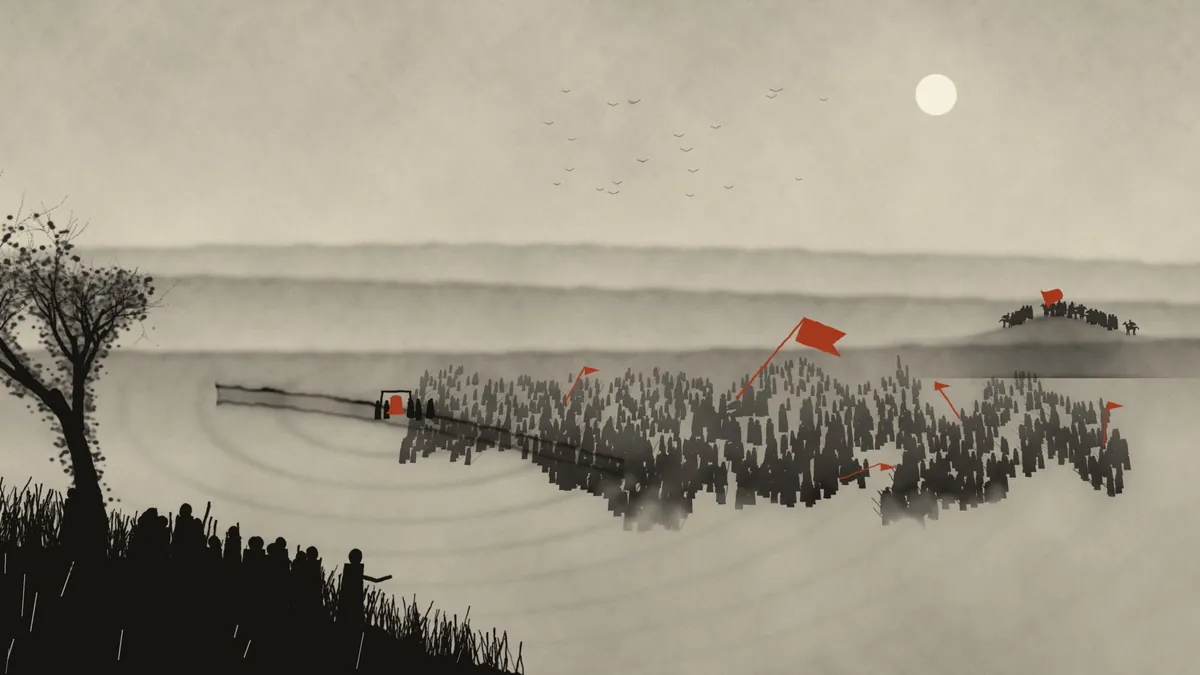
Maelin stood on the western ridge in the last of the light, the evening before the battle, and took it in. The king's army was spread along the ridge on either side of her, twenty thousand men in their camp lines, with their fires coming up in the dusk. Below, the ground fell away in a long slope to a shallow valley, dry and grassy, half a mile across. On the far side of the valley rose the eastern ridge, a mile from where she stood. Serath's fires were burning along its crest. In the middle of her line, under a ring of torches, Maelin could see the shape of the bell on its wagon.
A sunken lane ran down from the eastern ridge, a drovers' road, cut ten feet deep into the chalk by a thousand years of sheep. It crossed the valley floor and came up the western slope toward the king's center, and its banks were thick with hawthorn.
The coalition held the left of the king's line, the northern end. They were all that could be gathered in time: Hessa's company, four hundred and eighty strong now, three hundred of Rovan's veterans from Karthen, and six hundred of Garrick's horse. Rovan had sent Edran back north to Merrow Ford with the baggage the day before, with two guards and orders to keep moving if he heard a bell. Every man left on the coalition's lines had never sworn the old words. Maelin had seen to that herself, with Hessa's lists.
She knelt in the grass and pulled off her glove and laid her palm on the ground.
Chalk. She had known it would be chalk. It was soft and broken and full of water, and it carried the feel of things as a wet sponge carries a voice, with everything there and nothing clear. She could feel the weight of the armies on it, a great dull pressure everywhere. She could feel the iron in the soil. She could feel no bell, because no bell was ringing.
"Well?" said Hessa, beside her.
"It's mush." Maelin wiped her hand on her coat. "I can break it, if I've something solid to push against. I can drop a bank. I can't do anything fine with it. And I'll feel a field the moment it rings, but I'll not be able to tell you more than which way it lies."
"Comforting," Hessa said.
"I'm not paid to be comforting." Maelin stood up and looked across the valley at the torches round the bell. "One bell," she said. "In the middle of her line, under lights, where a blind man could count it."
"That's what the king says," Hessa said.
"I heard what the king says," Maelin said. She pulled her glove back on. "I've never known that woman show me anything she wanted me to see."
Sir Hugh Marrable's four hundred went in at first light.
Maelin watched them from the ridge. They came out of the king's center at a walk, in a long double line, and went down the slope into the valley with the mist lying white along the bottom. They were young men on good horses, with lances, and their pennons hung slack in the still air. At the valley floor they broke into a trot. Halfway up the far slope they broke into a gallop, and the sound of it came back across the valley like thunder.
On the eastern ridge the Kharadi saw them, and horns blew, and men ran toward the bell. Maelin saw the bell-crew at the beam and saw them haul it back. The lances got there first. They rode over the crew and the guard and through them. Maelin saw the beam fall. She saw men in gray going down under the hooves, and men running, and a lance-pennon go up beside the bell on its wagon. Along the whole length of the king's ridge, twenty thousand men saw it, and a roar went up from them. It rolled down the line from the center to the flanks and came back again, louder.
"He's done it," Hessa said. "Blood and money. The fool's done it."
The king's drums began. Along the ridge the royal regiments came to their feet and dressed their lines. The great standard of Auren, blue and gold, moved forward from the center, and the king rode under it, with his guard around him. The army went down the slope behind him into the valley, sixteen thousand foot in long ranks with the horse on their wings. On the left, Rovan gave the word, and the coalition went with them.
Maelin walked beside Hessa's front rank with her gloves on, watching the far ridge. Serath's line was standing. It was not moving forward to meet them. It stood along the crest and waited.
"Why's she not coming?" Hessa said.
"I don't know."
"She's lost her bell," Hessa said. "She should be falling back. Or coming down at us. Not standing there."
"I don't know." Maelin was watching Serath's line, as every soul on the slope was watching it.
The royal center reached the valley floor. The front ranks came to the lane where it crossed the bottom, a deep cut in the chalk with hawthorn hanging over its banks. They began to file across it by companies, climbing down one bank and up the other. The king's standard came down to the lane behind them. Along the lane, between the hawthorns, a quarter of a mile up the far slope toward Serath's ridge, Maelin saw the bushes shake.
She dropped to her knees and put her bare hand on the chalk.
The bell rang, and she felt it before she heard it. It came up through the chalk into her palm, a great soft hum, like a blow on a feather bed. Then the sound reached her across the valley, deep and bronze, from the lane. It came from a quarter of a mile up the far slope, out of the hawthorn, where the drovers' road was deepest.
Whose field? Serath's. A second bell, hidden in the lane all night under the thorn, where no scout had thought to crawl. Half a mile round it. Maelin knelt in the grass and measured it by eye, as she had measured it with Edran on the rope at the Sorrel Bridge. Half a mile from the lane took in the whole valley floor in front of the king's center, and the lower slope. It took in the royal regiments filing across the lane, and the regiments behind them. It took in the king's standard and the king.
The coalition's line on the left lay across its northern edge, with Hessa's pikes just inside it. Not one of them had sworn.
"Rennick!" Hessa was shouting. "What is it? Whose?"
"Hers. In the lane. The whole center's in it." Maelin got up. "Blood and iron, Hessa. The king."
The royal center stopped all along its length, as the garrison of Karthen had stopped in Rovan's telling. Rank after rank stood where it was in the valley bottom, with its pikes at the slope. The drums faltered and died. In the silence, men began to turn round. They were turning to face the slope behind them, and the king's standard, and the reserves coming down it, and the young recruits of the new pledge marching among them.
"No," Maelin said. "No, no."
On the eastern ridge, a party of horsemen came down out of Serath's line at a canter, under a banner. At their head rode a big man in a royal marshal's coat, gray-bearded, upright in the saddle. Maelin knew him. She had stood across a hall from him in December while he told the king that suspending the oath would dissolve the army. It was Lord Marshal Tierney.
He rode down into the field of the bell. He lifted his arm, and shouted an order, and every compelled man in the royal center obeyed it.
What happened at the king's standard was horrible, and it was short.
Maelin saw it from three hundred yards off, over the heads of the struggling ranks. The royal guard was two hundred men, the best in Auren, around the king and the standard. About half had sworn the old words at their enlistment. When the bell rang, those men turned on the others. She saw the standard rock and tilt. She saw the guard fighting itself in a tangle of horses and blue cloaks and swords, all in a moment.
And in the middle of it she saw the king.
He sat his big gray horse under the standard with his sword in his hand. As she watched, he turned in the saddle toward his guard captain, a man who had been at his side for twenty years. He struck him across the face with the sword. The captain fell from his horse. The king turned to the next man, and struck again. His face was gray and set and running with sweat, and he struck like a man splitting wood.
"Hessa!" Maelin shouted. "Pikes! With me! Get me to him!"
She did not wait. She went down the slope at a run, and Hessa's company came after her, four hundred and eighty pikes in a dense mass at the run, with Hessa cursing at the head of them. Rovan saw them go and brought his three hundred down behind. They went into the valley floor on the flank of the royal center, into the field of the bell, where none of them could be touched by it and every man around them had been. The royal regiments turned to meet them. They were the Kingsholm Foot, the oldest regiment in the army, and they were bound to a man. They turned out of their line and came at the coalition's pikes with their own leveled. Maelin saw their faces. They were weeping, some of them, and swearing, and shouting at the pikemen in front of them to run, to go back, to get away. And their pikes came on all the same.
Hessa's front rank met them pike to pike. The two hedges of steel ground together, and men screamed on both sides, and the Lissen pikes stopped dead.
Maelin went down on one knee behind Hessa's front rank and put both bare hands flat on the chalk.
It was mush, as she had said. But under the mush, two feet down, was the bedrock, hard white chalk running solid under the whole valley. She reached down through the soft stuff until she found it. She found the line of it, under the Kingsholm Foot's front ranks, and she pushed.
The ground opened. A long crack ran across the valley floor in front of the Kingsholm Foot, three feet wide and six deep, and their front rank went down into it in a tangle of pikes and men. The ranks behind them stumbled at the edge and stopped. The pikes went every which way.
"Through!" Hessa roared. "Over them! Don't stab them, damn you, they're ours! Over them!"
They went over the crack on the bodies of the Kingsholm front rank, pushing the pikes aside, shoving men down. Maelin went with them. Her hands were burning. Ahead, two hundred yards off, the king's standard was swaying above the struggle.
Beyond it, on the bank of the sunken lane where the thorn had been cut back, a stout man in a black coat stood watching with his hands behind him. Maelin had last seen Orrin Voss in irons at the Sorrel Bridge, the night before he killed his guard and escaped. He was looking straight at her. He lifted his hat.
She had half a mile of mush between her hands and his bell. She would have to walk to it, through the Kingsholm Foot and the king's guard and the Kharadi in the lane. She was measuring the ground for it when the royal horse came. It was the King's Lancers, five hundred of them, the regiment that rode on the army's right wing. They had swung round behind the center when the bell rang, and they came down on the coalition's flank at the gallop. Every one of them was bound. Maelin saw the lances come down and the horses come on, and she had nothing to push against but mush, and no time.
The lances hit the Lissen flank, and the pikes broke.
She never remembered all of it afterward, only pieces. She remembered being knocked down. She remembered a horse going over her and its hoof taking her in the shoulder, and the pain of it. She remembered Hessa standing over her with her short sword and her shield, screaming curses at a lancer who wore the same coat her father had once worn. She remembered Rovan's veterans coming up through the wreck of the pikes. She remembered Rovan's face, gray and set, and the old sword going up and down. He was fighting men he had been at war beside twenty years ago, and he was trying not to kill them, and failing.
She remembered getting up, and looking for the standard. It was gone. Where it had been, there were horsemen in gray cloaks, Serath's men, a dozen of them, going up the slope toward the eastern ridge at a walk. In the middle of them rode a big man on a gray horse, with a gray beard and a gold circlet on his helmet. He was riding upright, quietly, with his sword in its sheath. A woman on foot had his bridle.
She was tall and spare, in a plain gray coat with no sword. She walked at the big horse's head with the rein in her hand, as a groom walks a horse to the mounting block. Once she turned her head toward the fighting. Her face was long and quiet and clever, and Maelin, who had seen her only as a gray figure at a mile's distance, knew her at once and would have known her anywhere.
"No," Maelin said. "No, damn you, no."
She went down on her knees and drove both hands into the chalk, through the mush to the bedrock. She pushed with everything she had left, at the slope between the king's guard and the gray riders. A ridge came up out of the turf across their path. It rose a foot, and sagged, and the wet chalk slid off it, and the gray riders walked their horses over it without breaking step. Serath did not look round. The king's horse stepped over it like a horse stepping over a fallen branch.
Maelin got up and started after them. She got three paces. Then Rovan had her by the arm, hard, and was hauling her back.
"He's gone, Maelin."
"He's right there," Maelin said.
"He's two hundred yards off with a thousand compelled men between, and the lane full of Kharadi, and the bell still ringing. You'll never reach it. You'll die in the ditch, and he'll ride on." Rovan's face was bleeding from a cut over the eye. "I need you alive. Get back. Now."
She looked at him, and at the king's back going up the slope, and at the hawthorn in the sunken lane where the bell was. It rang again as she watched, renewing the field. She felt it in her hands, through the chalk, the long soft hum.
"Bloody fool," she said. She did not know whether she meant the king, or Rovan, or herself. "Bloody fool. All right."
Garrick covered their retreat with fire. He brought his six hundred horse round the northern end of the valley at the gallop. As the coalition's broken companies came back up the slope, he rode between it and the Lancers. He put his hand to the fire-pot on his saddle-bow, and the light came. It came as a wall of white glare that ran across the valley floor from north to south, blinding, so bright that Maelin threw her arm over her eyes. Behind it the dry grass of the downs caught. Smoke went up in a great yellow curtain, and the King's Lancers reined in on the far side of it, their horses rearing and screaming.
Under that curtain, the coalition went back up the western ridge, and over it, and away north-east.
They were not alone. Behind them came the remnants of the king's army: the recruits of the new pledge, who had found themselves fighting the regiments they had trained beside, and been overwhelmed. Some royal horse, who had been on the far flank, outside the field, came too. There were wounded men on any horse that could carry them. Of Sir Hugh Marrable's four hundred, who had taken the bell that did not matter, none came back. Maelin had seen the last of their pennons go down on the eastern ridge when Serath's line closed over them, while the whole army watched the wrong place. Maelin walked with her shoulder hanging and her hands black from the chalk and looked back once from the top of the ridge.
The valley was full of smoke. Through the smoke, on the eastern ridge, she could see Serath's line, standing as it had stood all morning. In the middle of that line flew the blue and gold standard of Auren, taken. Beside it, small at this distance, mounted now on a gray horse, she saw the woman in the gray coat. Another figure sat beside her on another gray horse, with a gold circlet on his helmet.
That evening, in the camp on the Merrow road, a royal clerk came in on a horse with a spear-cut in its flank. He had been in the king's household train behind the ridge. He had been beyond the field, and he had seen the Kharadi riders come over the ridge to the baggage. They had been looking for one wagon in particular, and they had found it.
"She has him," the clerk said. He was shaking. "Alive. Unharmed. They took the seals with him. Every one of them." He looked up at Maelin with wet, frightened eyes. "She has the king, mistress. She has the king, and his seal."
Maelin looked down at her hands, black to the wrist with chalk. She had broken gates with them and folded spear-heads and torn a bell's crown apart. This morning she had knelt in a field and pushed with all she had, and a horse had stepped over it like a branch. She sat in the camp on the Merrow road with the hands in her lap and thought that she had never in her life been so far from anything she could touch.