Serath at the Gates
Merivel had carried Garrick Aras forty miles since the previous dawn without a word of complaint. Her rider had complained the whole way.
Now she came round the last bend of the Eastway with her head low and her flanks dark with sweat, and Garrick leaned down and spoke to her in the language of his grandmother. She flicked an ear back at him, which was as much as he deserved.
"My lord." Lucan Vey, his second, drew rein beside him. "There. Look."
Garrick looked, and for once in his life could think of nothing elegant to say.
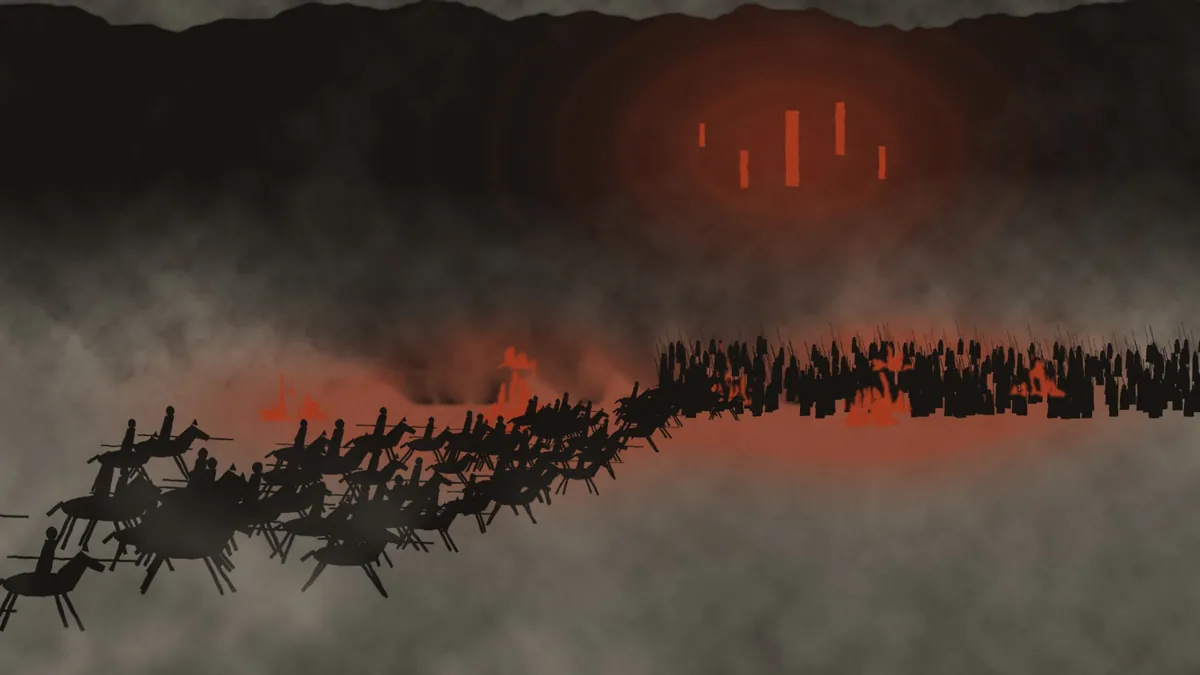
The basin of Dhor Kharad opened below them as the light went. To the north the Kharad Wall stood up black against a green sky, and its face was pricked all over with lamps. Under it the lower city filled the floor, and across the near side of the city ran the outer wall, long and dark, with the Furnace Gate in the middle of it. The coalition's colors hung over the gate. Between the wall and where Garrick sat lay the outer field, a mile and more of stubble and slag heaps and black earth, with the Ashgate road running straight across it from the gate to the mouth of the Gullet on his left. And pouring out onto that field from the Eastway's valley below him, in a long dark flood, came Serath's army.
"She's beaten us here," Lucan said.
"By an hour, my dear Lucan, which is a great deal better than a day." Garrick shaded his eyes. "Look at them. They're strung out from here to the valley floor. She's left her baggage, her guns, her cooks and half her horse on the road behind her. She must have marched them all last night and all today without a halt."
"Compelled men don't halt," Lucan said.
"Compelled men fall down dead in the traces, the same as horses, if you drive them far enough. She knows that." Garrick watched the head of the enemy army turn on the outer field and begin to spread out toward the gate. "She's gambled, and it's paid her. She's here before midnight."
He could see the bells. There were three of them, great dark shapes on their wagons in the middle of the flood. Each one had a twenty-horse team and a crowd of men around it. Ahead of them marched the compelled regiments, the royal army of Auren that had turned at Callan Downs, perhaps seven thousand men in the old blue coats. Behind them marched the Kharadi volunteers in gray, two thousand or more, who served Serath because they chose to.
"Pass the word," Garrick said. "Dismount. Water the horses at the stream if they'll drink, and loosen everything. Nobody sits a saddle until I say. They've done enough today for any horses in the world."
"And then, my lord?"
Garrick put his hand inside his coat. The prince's letter was there, as it had been for nearly four weeks, folded small, a little charred along one edge. Bring the cavalry home. He could feel the stiff paper through his shirt.
"Then we shall see," he said.
Rovan Tal came out of the Furnace Gate at half past eight with a dozen riders, and they met at the old toll-house on the Ashgate road.
It stood a little way short of halfway between the gate and the Gullet, a roofless stone shell with a bar across the road that had not been lowered in a generation. Garrick had brought his riders round the south of the field to reach it, keeping wide of Serath's flank. Hessa Dorn was already there, sitting on a mounting-block with her boots off, and her company was coming in behind her down the Gullet. They were riding on carts. They were riding on farm wagons, on mules, on brewers' drays, two and three to an animal, with their pikes bristling up over them.
"Don't," Hessa said, as Garrick dismounted. "Not one word. I hired every cart between Ashgate and the Gullet mouth at robbers' rates, and I'll be paying it off until I'm sixty. If the Seat lives through tonight, I'll send him the bill."
"Madam, I was going to say only that you've never looked lovelier."
"You were going to say I look like a drover's wife," Hessa said.
"That too," said Garrick, "but lovelier."
Rovan reined in beside them. The man was worn to the bone. His left wrist was bandaged, and badly. He swung down from the saddle and stood looking east across the field at Serath's army, and for a while he said nothing at all. Garrick had learned in six months to let him look. The commander of Karthen read ground as other men read letters, and he did not like to be interrupted in the middle of a sentence.
Maelin Rennick came up behind him on foot. She had a coat of black leather down to her knees and iron-shod gloves, and she was grinning.
"Garrick, you lovely peacock. I thought you'd gone home."
"My prince thinks so too, Mistress Rennick," Garrick said. "We are neither of us well informed."
"Here's how it lies," Rovan said. He turned from the field. "Edran went into the city at dusk for the king. If he's got him, he'll bring him out through the water conduit under the city. It comes out in the ditch two hundred yards west of the gate. From there the king has to cross this field to the Gullet before midnight."
"Why midnight?" Hessa said.
"Because at midnight they strike the great bell, and Anke says its field reaches three miles from the cliff. That takes it over the whole city and the outer wall and half a mile of this field, to about here." Rovan put his hand on the toll-house's broken wall. "The king swore the words at his coronation. If he's inside that line when the bell strikes, he's theirs again. So is every freed man of ours in the city."
"And if the bell doesn't stop?" Hessa asked.
"Then at the end of the ceremony its reach goes to twenty miles, and stays there, and every bound soul inside it belongs to the Seat until the end of the world." Rovan looked at Maelin. "So I'm going into the mountain to stop it. I'll take Maelin and Anke and Dace, Callum and his clansmen, and some of the old provincial men. Two hundred, no more. Never-sworn, every one I can find. That leaves the gate with the men already on it, and a thousand of my reserve with nothing to do."
He turned to Hessa. "I'm asking you to take the field outside, Captain," he said. "The thousand are yours, and your company, and whatever else you can find. I can't fight Serath from inside the mountain. Somebody has to stop her short of the gate, or she'll be in the lower city behind us by midnight, and we'll be finished."
Hessa looked at him for a breath. Then she reached for her boots.
"What are your terms?" she said.
"The same as yours," Rovan said. "Whatever you think fit."
"Then I'll think of something expensive." She stamped her foot into the boot. "Go on. Get into your mountain. I've got her."
Rovan turned to Garrick. Garrick had been waiting for it, and found to his surprise that he dreaded it.
"My lord Aras," Rovan said. "I know your orders. I won't ask you to break them."
"That," said Garrick, "is the unkindest thing anyone has said to me this year."
Rovan almost smiled. "Then I'll ask you something else. If the king comes out of that ditch, keep the road open between the gate and the Gullet. That's all. Keep it open till he's through."
He put out his hand. Garrick took it. Rovan mounted, and Maelin swung up behind one of his riders, and they went back up the road to the gate at a canter. Halfway there, Maelin turned on the horse's rump and waved her iron glove at them over her shoulder. Garrick lifted his hat to her.
"Well, my lord?" said Hessa.
Garrick took the prince's letter out of his coat. He unfolded it and read it again, slowly, by the last of the light. It was courteous and short. It thanked him for his service, and it ordered him to bring the cavalry of Teshar home before the harvest, while it was whole.
He folded it again and put it away.
"I shall answer my prince honestly," he said. "Afterward. In person, I hope. Lucan! Mount them."
Serath came at the gate at a quarter to ten.
Garrick watched her do it from the stubble field south of the toll-house, where his nine hundred sat their horses in a long double line in the dark. He had to admire it. She did not wait to rest her men. She put four regiments of compelled Aureners into a single deep column on the road, with the three bells behind them in a line, a few hundred yards apart. The bells were struck as the regiments moved off. He felt the first note come across the field through the ground. It was a deep, dull pressure in his breastbone, and his horse shifted under him and snorted, but it did nothing else to him. Teshar men swore to their princes, never to the Seat. He thanked the gods of his grandmother for that, and for the thousandth time.
The compelled men went at the gate as if they had been fresh. Their own ladders were somewhere back on the Eastway, so they had made more from the timbers of the farm buildings on the field. Garrick watched them run in under the outer wall with the ladders on their shoulders, in the light of the burning barns, and he watched the coalition men on the wall throw them down. They came again. Behind them, in the dark mass by the bells, Serath's Kharadi stood in reserve with their shields grounded.
"She's not using the Kharadi," said Lucan.
"She doesn't need to. Every compelled man who dies on that wall is a man of Auren. She loses nothing she values." Garrick watched. "She'll wear the gate down with them, and when it breaks, she'll send the gray men through."
Hessa's pikes were moving out across the field on his left. In the light of the burning barns he could see her company in the front, the five hundred of Lissen, with their pikes sloped, and the others behind. She had put them in a long line across the road between the toll-house and the enemy's flank, facing east. Rovan's thousand were drawn up beside them, wrapped round the toll-house. It was a thin line, a little more than three thousand in all, against nine.
"She'll not stop them with that," said Lucan.
"No. She means to make Serath turn and look at her." Garrick took a long breath. He looked down the double line of his riders, their faces lit red by the fires. He had brought twelve hundred north out of Teshar in February. He had nine hundred left. He knew most of their names. "And while Serath is looking at Hessa, we shall make her look at us."
He let go of Merivel's rein and raised both his hands.
The barns were burning on his right. Garrick reached for the nearest, as he had reached for the coal in the pot at Hatherley. Its heat came into his palms with a taste of iron at the back of his tongue. He drew the fire out of it and threw it into the dark in front of him.
It came as glare, white and shuddering, a wall of light a quarter of a mile long that rose out of the stubble between Serath's regiments and her reserve. It made no heat to speak of. It would scorch a man's cloak, but it could never burn him. What it did was blind. It stood in the night like a sheet of the noon sun, and every man who had been looking toward it was suddenly looking at nothing. Garrick heard the shout go up from the Kharadi reserve. He felt the cost of it in his arms and in his chest, a dragging weariness, as if he were holding up a wall with his hands.
He held it, and he let the second thing go.
The stubble on the field had been cut a week ago and left to dry, and the night wind came down off the western rim of the basin. Garrick took a second thread from the barns and laid it into the stubble at the western edge of the field, and the wind took it. Smoke rolled east across the field in a low, thick, choking bank, between the glare and the burning barns. In a few minutes, from where Serath sat her horse behind her bells, the whole southern half of the field was a dazzle of white light and a wall of rolling smoke.
"Now," said Garrick, and dropped his hands, and took up his rein. "Lucan, take your squadron round by the south and watch the road for the king. Nobody touches him or anyone with him. The rest of you, with me. At the bells. The crews and the ringers. Nothing else. I don't care if Serath herself rides up and asks you to dance."
They went out of the smoke at a canter, nine hundred horse knee to knee, and hit the Kharadi reserve in the flank before the glare had left their eyes.
The first rank of gray infantry never saw them. Merivel went into the line shoulder first and knocked a man flat. Garrick cut down at the next across the helmet and felt the blade bite and turn, and then he was through. Beyond the line was open ground, lit by the barns, and the bell. Its wagon stood a hundred yards off with its team of twenty and its crew around it. A tall man in a leather apron was hauling back the great beam on its chains for the next stroke.
Garrick put his heels in.
Merivel flew. Thirty riders went with him, yelling. The bell crew heard them coming and turned, and some ran and some caught up spears. The man in the apron let go of the beam. It swung forward of its own weight and struck the bell, not hard, and the note came out half-hearted and shuddering. Garrick felt it in his ribs. The man ran. Garrick rode him down at the wagon's tail and cut him across the back, and he fell under the wheels.
The fight around the wagon was short and ugly. The crew were engineers and drivers, not soldiers, but there were forty of them, and they fought with spears and hammers and the iron bars they used to lever the wagon out of ruts. A boy with a hammer struck at Merivel's head, and she reared and came down on him. A spear took a rider beside Garrick in the chest and lifted him out of the saddle. Garrick killed the spearman. The crew broke and ran into the dark, and the teamsters with them, and the riders let them go.
"Cut the traces," Garrick said. "Kill nothing more here. And nobody strikes that thing, for the love of all the gods."
Garrick looked across at the road. One bell was silent now. But the other two stood behind the regiments at their intervals, and as he looked, the middle one was struck again. He felt the note. Its field and this one's overlapped on every man on the road, and the men on the road fought on under the wall, as they had before. Nothing had changed.
Nothing would change until all three were silent. And then ten more minutes, before the last field faded.
"The next," he said. "Quickly."
Serath was not a fool, and she had seen them by now. The second bell was ringed with gray infantry when they came at it. The Kharadi had turned their shields outward and grounded their spears, and the crew went on striking behind them, steady as a heartbeat.
Garrick reined in out of spear-reach and looked at it, while his riders milled round him and the horses blew. Spears would not break for horses. A cavalryman knew that better than anyone.
"Lucan has the south road," he said, half to himself. "Hessa is in front. Very well."
He raised his hands again and reached back for the barns. This time he did not throw glare. He put their fire into the air directly over the ringed spears, a great white flash, so close that it hurt his own eyes through their lids. The Kharadi in the ring flinched and threw up their arms. For three heartbeats the ring was blind.
"Now!"
They went in. Merivel took a spear-shaft across the chest and staggered and kept going. Garrick cut left and right. A gray soldier caught at his leg to drag him down, and he kicked him in the face. Then a spear came up from the ground on his right, out of the smoke, from a man he never saw. It went in above his knee, through the meat of his thigh, and grated on the saddle-tree.
He felt nothing for a moment. Then it hurt, enormously. He shouted, partly from the pain and partly at the man, and cut down at him and missed. A rider of his own, Ishaan the farrier's son, rode the man down.
They were through the ring. The crew were around the wagon, and the ringer had the beam drawn back. Garrick drove Merivel at him with the spear still in his leg, its shaft knocking against her flank at every stride. The ringer saw him coming. He let the beam go too early and ran. The bell boomed. The ringer ran for the gray infantry, and Ishaan caught him and killed him at the wheel.
Merivel went down.
She went down all at once, forelegs folding, and Garrick was thrown over her shoulder onto the burnt stubble. He lay there with the breath knocked out of him and the spear-shaft snapped off in his leg. When he could lift his head, he saw his mare lying on her side a few yards away. A Kharadi spear stood out of her chest, low, behind the foreleg, where it must have gone in at the ring. She had carried it the last thirty yards without breaking stride.
He crawled to her and got his hand on her neck. She was breathing in long, terrible, sobbing breaths, and her eye rolled at him, white-rimmed in the firelight.
"Oh, my lady," Garrick said. "Oh, my dear. I am so sorry."
He had a knife in his boot. He used it, talking to her in his grandmother's language until she was quiet, and the warmth ran over his hand.
Ishaan got him up. His leg would bear him, just. He tore a strip off his shirt and tied it above the wound as tight as he could stand, and the stump of the shaft stuck out through the cloth. Somebody brought him a horse whose rider was dead, a big raw-boned gelding from the remounts, and he looked at it and shook his head. He could not have got his leg over a saddle.
"My lord, the third bell," Ishaan said.
"I can see it, Ishaan. One bell left." Garrick leaned on the dead mare's saddle. Through the smoke he could see the third bell, the westernmost, standing behind the compelled men on the road, close under the wall. It was a hundred and fifty yards from the gate, deep in Serath's ranks, beyond the reach of any horse. "We can't come at that one."
"Then what, my lord?" Ishaan asked.
Garrick did not know. He stood and looked at the third bell with the blood running down into his boot, and found that his mind had gone empty. Two bells silent, and the third ringing on, and every man on the road still the Seat's.
Then the gate opened.
He saw it from a quarter-mile off: the Furnace Gate's leaves swinging out, and men pouring through them onto the road. They were the coalition's men from the gate, two or three hundred of them, never-sworn by their coats, the free-city sappers and the old provincial veterans. They had a great wheeled ram before them, one of the ones they had built for the assault yesterday, and a short man in a Lissen helmet rode its frame like a carter, bawling at the men on the bars. They came out of the gate behind it at a run and drove it straight down the road into the head of the compelled column.
The compelled men were facing the wall. They had been climbing ladders for an hour. The ram took them in the flank where the road ran close under the gatehouse, and the men behind the ram went in after it with axes. Garrick could hear the roar of it over the fire. He saw the whole mass bend and give. He saw the coalition men cut their way through toward the third bell, and the Kharadi reserve, half-blind still, trying to come forward to meet them through the smoke and the fallen.
And he saw Hessa's line come in from the south. It came at a steady walk, pikes leveled, with the five hundred of Lissen in front. It went into the other flank like a door closing.
The third bell was struck again. Its crew were fighting for their lives around it now. Then Garrick saw a sapper climb the wagon's wheel with an axe, and swing at the hand on the beam, and the beam swing free.
The bell made no more sound.
"Ten minutes," Garrick said aloud. "Ten minutes, Ishaan. Mark it."
He spent the ten minutes on his feet on the burnt stubble, leaning on a borrowed spear, with forty riders round him and Merivel dead at his back.
The fight went on. That was what nobody had told him about the ten minutes. The compelled men went on fighting all through them, as hard as before. They fought the sappers at the ram and Hessa's pikes and each other, in the dark, in the smoke. Men died in those ten minutes who would have lived if they had come a quarter-hour later. Garrick watched a compelled pikeman kill a Lissen woman at the end of Hessa's line, and saw his face in the firelight as he did it.
Serath tried to reach the third bell. Garrick saw her gray horse in the smoke behind the regiments. She had a dozen riders round her and she was waving the Kharadi forward. The Kharadi came. They were good. They pushed the sappers back from the bell wagon, step by step, and a Kharadi officer climbed onto the wagon bed to take the beam.
"No, you don't," said Garrick, and raised his hands.
It hurt now. His arms shook, and his chest was tight, and there was a taste of iron in his mouth that had nothing to do with the fire. He dragged a last thread out of the barns and put a flash of white fire in the air over the bell wagon, close as he could, and the man on the wagon bed flinched and threw his arm across his eyes. A sapper's axe took him across the legs, and he fell.
Garrick dropped to one knee. Ishaan caught him.
"My lord. My lord, it's enough."
"It's nine minutes," Garrick said. "Hold me up."
At the tenth minute, he saw the compelled men falter.
It happened all along the line at once, from the gate back down the road into the smoke. Men stopped fighting. They stood, swaying, with their weapons in their hands, and looked about them in the firelight. Some sat down where they stood. Some dropped their pikes. A man near the ram turned to the sapper he had been trying to kill, and said something, and the sapper lowered his axe. Garrick heard it come down the road toward him as a sound, a long, broken, rising murmur of thousands of voices. It was the sound of seven thousand men waking.
And the gray reserve stood behind them, suddenly alone on the field with three thousand of Hessa's and Rovan's in front and the Teshar horse on their flank.
Serath's horn blew. The gray men began to fall back, east, toward the Eastway, in good order. They left the Aureners standing in the road with their weapons in their hands, and the three bells silent behind them.
"She's stopped," Ishaan said. "My lord, she's stopped. Short of the gate."
"For now," Garrick said.
Lucan found him half an hour later, still on his knee by the dead mare.
"The king, my lord," said Lucan. "He came out of the ditch at a quarter past eleven, with a dozen clansmen and a one-legged man who swore at me. Serath's riders saw the white robe before we did. A dozen of them came for him out of the smoke, and we went in, and the one-legged man put two of them down from the ground with an axe while we were about it. We took them across the field between us. He's in the Gullet mouth. Beyond the toll-house, my lord, beyond the line."
"Is he well?"
"He's wet to the waist and he wanted to know my name and my family," Lucan said. "I told him. He said he would remember it."
"Princes always say so," said Garrick. "It's the one promise they keep." He looked toward the road, where the ram stood abandoned among the dead. "And the man on the ram. Who brought that out?"
"A Lissen captain called Ferris. Captain Dorn says he sells fish."
"Then I shall buy a great deal of fish," Garrick said. He tried to stand, and his leg would not have it, and Lucan got an arm under him. "And our people?"
"We've lost a hundred and some," Lucan said. "I don't know yet. The surgeons are coming up from the Gullet."
A hundred and some. Garrick thought of the letter in his coat, and of the prince who would read his answer, and of the cavalry of Teshar that he was to have brought home whole.
"Write their names down, Lucan," he said. "All of them. Tonight, before we forget the faces. I'll want them for my prince."
He looked across the field. The fires were burning down. The smoke lay in long gray banks across the stubble, and through it, in the road under the wall, the freed regiments stood in their thousands. They were waiting, and they did not know what for. Some of them had begun to walk toward Hessa's line with their hands open. Behind them stood the city wall and the lower city's roofs, and behind those, the Kharad Wall, black against the stars.
Its face lit up as he watched.
It began high in the cliff, at the great shafts. One after another the shafts filled with light, as if fires had been kindled in every one at the same moment, until the whole black face of the mountain was hung with burning windows. It was beautiful. Garrick had time to think so, and to hate himself for thinking it.
Then the great bell sounded.
The note came out of the mountain and down over the city and the wall and the field. It came up through the burnt ground into his knees and through Lucan's arm into his side. It was a pressure so huge and so low that the smoke itself seemed to shake. It meant nothing to Garrick Aras, who had never sworn it anything. He felt it go past him like a wind.
In the road, seven thousand men who had been free for half an hour went down on their knees together, and turned their faces to the cliff.