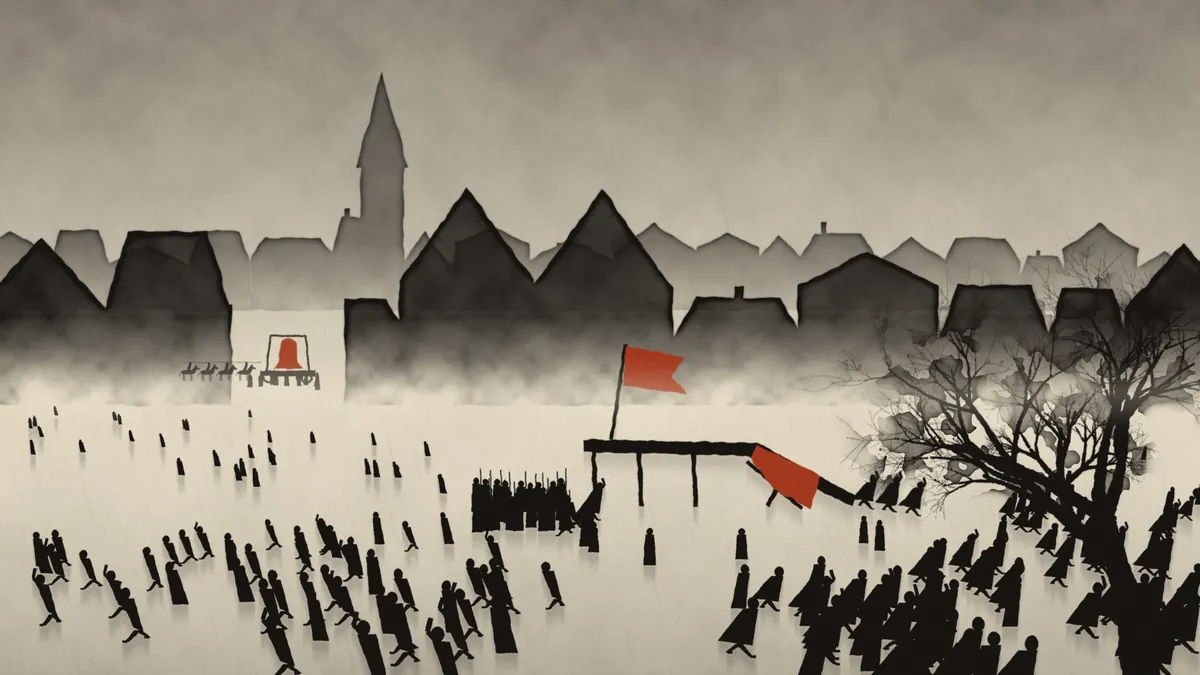
The Proclamation
The decree reached Merrow Ford three days after Callan Downs, nailed to the door of the Corn Exchange, and by noon half the town had read it.
Rovan read it in the afternoon. He stood in the market square in the heat with the dust of the Callan road on him, and Alderwoman Joan Tull stood beside him. She was a thin, gray, fierce woman in a black coat, and she had counted every sack of flour in Merrow for twenty years. She held her hands folded in front of her and did not speak while he went through it.
It was printed in heavy black letter on good paper, and the Great Seal hung off the bottom of it in red wax, the size of a saucer. It began with the king's titles. It went on to speak of the danger to the realm, and the treason of certain officers, and the king's love for his people. Then it came to the matter.
Every subject of the Crown of full age, it said, was to speak a pledge for the protection of the realm, personally, before the commissioner appointed for the district. No man might speak it for his wife, nor any master for his household, nor any parent for a child. Children under sixteen were exempt.
Below that were the words themselves, in larger type. Rovan had heard them spoken in his own hall seven months ago, by six boys kneeling on the flags before the fire. I bind my service to the Undying Throne, and to the Crown that holds its charge.
He read it through to the end. Then he read it again.
"Given under our hand and seal at our camp," said Joan Tull. "Whose camp? That's what I'd like to know. It doesn't say."
"Serath's."
"I thought so." She unfolded her hands. "The commissioner for this district came in this morning, riding hard from the south, with the decree and a book to write the names in. He's sitting in the Exchange now, at a table, very civil. He means to start tomorrow. I told him he could start when the council said so, and the council hasn't said." She looked at Rovan sharply. "But I can't hold them long, Commander. People are frightened. They saw the army go south past this town in June, twenty thousand men with banners, and they've seen what came back up the road. They'll swear anything the king's seal tells them to, if they think it'll keep the Kharadi out of their streets."
"It will bring the Kharadi into their streets," Rovan said.
"Then you'd best tell them so. They'll not believe me." She turned to go. "And they may not believe you either. You're the man who lost Karthen. They haven't forgotten."
Maelin had found a table in the back room of the Bell and Barley, which was the wrong name for an inn that week, and nobody had thought to change it. She sat with her right arm in a sling from the Lancers' hooves at Callan Downs and a copy of the decree spread flat in front of her, weighted at the corners with cups. Edran sat across from her. He had the chain round his ankle that he wore at night, though it was afternoon, and it ran to the leg of the table.
"Personally speak," Maelin said, as Rovan sat down. "Personally. Nobody may speak for another. Children exempt." She tapped the paper. "Whoever wrote this knows the rules better than we do. Better than we did a month ago. They knew a man's word binds only himself. They knew the children wouldn't take it. So they've made it legal, all of it, and they've given it the king's seal."
"Who wrote it?" Edran said.
"Serath, I'd guess. Or somebody under the mountain who's been doing this for five hundred years." Maelin looked up at Rovan. "Every soul in Auren over sixteen, Rovan. Every farmer and alewife and clerk. They'll stand up in their market squares and say the words because the king told them to. And from that day, any wagon bell that comes within half a mile of them will take them. Every village becomes a garrison for the north. Every town square becomes Karthen's outer ward."
Rovan sat with his hands on the table. Through the window he could hear the market: a woman crying fish, a cart, a dog.
"How many commissioners?" he said.
"One in every district, it says. Fifty, sixty. With a squad of soldiers each to keep the peace." Maelin leaned back. "And a bell behind them, sooner or later. There's no sense in swearing a town if you never come back to ring it."
"Then we stop them," Rovan said.
"We can stop one. Two. Ten." She looked at him. "We can't stop sixty, Rovan. Not with what came back from Callan Downs."
"Then we stop the nearest," said Rovan. "And see what it teaches us."
The nearest was at Hollin, and a carter brought word of it that evening. Hollin was a market town on the Dunmere road, forty miles north of Merrow, and the commissioner for the March of Dunmere had already arrived there with his squad and his book. The swearing would be held in Hollin market square the day after tomorrow, which was market day, when the whole country round would be in town. And the carter had heard something else, from a drover coming in off the hills. A wagon was coming west along the drove road from the Marshal's country, under canvas, drawn by twenty horses, with a Kharadi escort.
They rode at dawn, sixty of Rovan's Karthen veterans and Maelin, and every one of them free. Edran had already gone north the night before, by the hill tracks to the west, with his two clansmen guards and orders to come nowhere near the Dunmere road.
They rode hard. They slept four hours in a barn and were in the saddle again before light. A little after nine the next morning, they came over the last rise and saw Hollin below them.
Rovan took it in from the saddle. It was a small, prosperous town of gray stone, set in the shallow bowl of a brook. The Dunmere road came in from the south across a bridge and ran straight through the middle of the town. It went out the north side and up a long, bare hill to the skyline, a mile off. In the middle of the town, where the road widened, was the market square. It was full of people.
"They've started," Maelin said.
The commissioner had built himself a dais in the middle of the square. It was a platform of planks on trestles, set up around the old stone market cross, so that the cross stood up through the middle of it like a mast. He sat on the dais at a table with his book open in front of him and two clerks beside him. He was a thin, earnest man in a black coat with a chain of office.
In front of the dais the people of Hollin and its farms stood in a long line that curled round the square, four and five deep. They went up the steps of the dais ten at a time. They stood in a row before the commissioner and raised their right hands, and spoke the words after him. Then they gave their names to the clerks, and went down the other side.
Twelve soldiers in royal coats stood around the dais with spears, keeping the line in order. They were bored. One of them was eating an apple.
Rovan rode into the square at a walk, with Maelin beside him and the sixty behind, and the crowd parted before the horses. Faces turned. A murmur went round, and he heard his name in it. The ten on the dais had their hands raised. The commissioner looked up from his book with his mouth open in the middle of a word.
"Stop," Rovan said.
"I beg your pardon?" the commissioner said.
"Master Commissioner. I'm Rovan Tal, of Karthen. I ask you to stop this swearing, and send these people home." He kept his voice level, and pitched it to carry across the square. "The words in that decree are the words the Kharadi bells answer to. I watched them take my garrison. Any man or woman who speaks them today can be taken by the next bell that comes within half a mile."
The commissioner stood up. He was pale, but he was not a coward.
"Commander Tal. I know who you are. I know what is said of you." He put his hand on the decree on his table, with its great red seal. "This is the king's own hand and seal. The king commands it for the protection of the realm. I have no authority to stop it, and you have none to ask."
"The king is in Serath's camp, sir," Rovan said. "Under her bell. He wrote what he was told."
"That is treason," said the commissioner.
"It's true."
"Sergeant," said the commissioner, "arrest this man."
The sergeant was a heavy, sandy man of forty, and he did not want to do it. Rovan saw that in his face. But he had been given an order by a man in a chain, and he was a sergeant. He came down the steps of the dais with his spear, and his eleven came with him.
"Commander," he said. "I'll ask you to get down off that horse."
"I'll ask you not to make me," Rovan said. "I don't want to fight you, Sergeant."
"Nor I you, sir. But orders." He reached for the bridle. Rovan's horse threw up its head. A soldier behind the sergeant, a young one, panicked at the stamp of hooves and thrust with his spear. It went into the thigh of the trooper at Rovan's left, a gray old veteran named Yarrow. Yarrow cried out and kicked the boy in the face, and then it was a fight.
It was a small, ugly scuffle in the press of the crowd, with people screaming and scattering in every direction. Rovan came down off his horse because he could not fight from it among the women and children. He drew the old sword. The sergeant came at him with the spear, low, and he beat it aside and stepped in. He struck the man across the side of the head with the flat of his blade, and the sergeant went down on one knee, dazed. Another came at him from the left. Rovan caught the spear-shaft under his arm, wrenched it out of the man's hands, and broke his nose with the pommel. Around him his veterans were doing the same, with fists and the flats of swords, trying not to kill. One of them failed. A royal soldier went down with a cut throat, and lay in the dung of the market square, and a woman screamed and went on screaming.
On the dais, the commissioner was on his feet, shouting at the soldiers, at the crowd, at Rovan. The ten who had been swearing stood frozen in their row with their hands half raised.
Maelin rode her horse straight at the dais. She came off it at the bottom of the steps and put her good left hand flat on the old market cross, where it stood up through the planks.
The cross was granite, four hundred years old, sunk in the rock of the square. It cracked from top to bottom with a sound like a whipcrack. Then it burst apart at its foot and fell, and the trestles under the dais went with it. The planks tipped and slid. The commissioner and his clerks and his table and his book and the ten would-be swearers all went down together in a heap of timber in the dust.
The square went very quiet.
Maelin stood at the bottom of what had been the steps, shaking her hand and swearing under her breath.
"That," she said, loudly, to the square at large, "is enough of that."
The lookout Rovan had left on the bridge came into the square at a gallop.
"Commander! Wagon on the north hill! Just come over the skyline, where the drove road comes in. Kharadi riders round it, fifty or sixty. And a big thing under canvas. They're stripping the canvas off it now, sir."
Rovan looked north. Over the roofs, at the top of the long bare hill a mile off, he could see it: a dark shape on the road, men swarming about it, and a glint of red-gold where the canvas came away.
A mile. He had perhaps a few minutes.
"They'll come down the hill," he said to Maelin. "Half a mile, and they'll ring it."
"They'll ring it sooner. They'll not wait to be sure." Maelin's face was hard. "From the middle of the slope, its field reaches this square. They'll ring it as soon as it does."
Rovan climbed up onto the wreck of the dais and stood on it, among the broken planks, so that the whole square could see him.
"Listen to me!" he shouted. "There's a bell on that hill! A Kharadi bell! Everyone who has sworn those words today, run! Run south, over the bridge, and keep running! Run half a mile, a mile, run till you can't hear it! If you stay inside its reach when it rings, it will take you, and you'll do what the Kharadi tell you, and you'll be awake while you do it! Run!"
For a breath nobody moved. Then a woman at the edge of the crowd turned and ran, dragging a child, and the square broke.
They ran south, hundreds of them, out of the square and down the road toward the bridge. Rovan's veterans rode with them and along their edges, herding, shouting. Maelin was on her knees among the wreckage of the dais, digging. She came up with the commissioner's book in her good hand, its pages full of names.
"Two hundred and sixty," she said, turning pages. "Since eight o'clock. Two hundred and sixty of them."
Rovan looked at the crowd streaming south. He could not tell which of them were in the book.
The bell rang when the wagon was halfway down the hill.
He felt it come through the cobbles of the square and up into the planks under his feet. It was a long, deep note, rolling down the slope and through the town. Every window in Hollin shivered. The bell stood seven or eight hundred yards from the square. Its field reached half a mile around it in every direction, over the north side of the town and the square, and out to the far end of the south road where it ran down to the brook. The bridge, at the bottom of the town, lay just beyond.
Most of them had reached the bridge. Not all.
He saw it happen in the square. The royal soldiers who could stand, the sergeant among them, turned all at once and came at his men. They had sworn the old words long ago. And in the crowd pressing south out of the square, people stopped.
There were perhaps thirty of them. A stout man in a leather apron stopped in the middle of the road with a basket of eggs on his arm. A girl of seventeen or so, with red hair in a plait, stood beside him. An old man with two sticks. A woman with a baby on her hip and a little boy holding her skirt. They stood unmoving, all together, and their faces turned north toward the hill, toward a voice only they could hear.
Rovan saw their faces. He saw the woman with the baby look down at her little boy, who was pulling at her skirt and crying. She looked at him as if from very far away, and he saw her try to bend to him, and fail.
The little boy had not sworn. He was five. The bell did nothing to him at all.
"Hold the square!" Rovan shouted. "Hold the south end! Let them through! Let the others through!"
His veterans held it. They held the south end of the square with their horses and their swords. The compelled royal soldiers came at them, and they beat them back. Beyond the soldiers, the thirty stood in the road, waiting for orders that had not yet come. Behind his line, the rest of Hollin streamed down to the bridge and over it and away.
"Maelin," Rovan said. "Can you reach it?"
She was standing beside him on the broken dais, white-faced. "Through the paving? No. It's seven hundred yards of road and dirt. I need to touch it."
"Then we go and touch it," Rovan said.
He took forty of his men. He left twenty with Yarrow to hold the square, and he and Maelin went out of the town by the back lanes, east, to the brook. They rode up the brook-bed under the willows, where the bank hid them from the road, until they were level with the wagon on the hill.
The wagon had stopped in the road halfway down the slope, with its twenty horses in the traces and its crew at the beam. But the riders had not gone down into the town. Rovan had counted on that. At the Sorrel Bridge the escort had ridden on ahead of its bells and left them to be taken, and he had built the morning on the Kharadi doing it again. Somebody had learned from the Sorrel Bridge. Fifty gray riders sat their horses in a ring round the wagon, facing outward, with their spears grounded. Only a dozen had gone down the north street, with an officer at their head, to fetch the thirty.
"Blood and iron," Maelin said. "She's taught them."
"Can you reach it from here?"
"From a brook-bed? Through fifty horse?" She was looking at the ring, and at her right arm in its sling. "Get me to the wheel and I'll break it. I can't get myself there."
Ten minutes since the first stroke. The crew drew back the beam.
"Now," Rovan said.
They came up out of the brook-bed at the gallop, forty horse in a line across the slope, and the ring turned to meet them, and it did not break. Rovan rode at the nearest gap. A spear came up out of it and took his horse in the chest, and the horse went down and threw him over its head onto the turf. He came up with the old sword in his hand and a rider's hooves going past his ear. He cut at the rider's leg and missed, and cut at the horse and did not miss, and it screamed and fell, and he killed the man as he came off it. Around him his forty had hit the ring and stuck in it, horse against horse, the long gray spears against swords. Yarrow's nephew went down beside him with a spear through the body. A man named Oakes, who had held the Long Passage in December, lost his horse and stood over it and fought three riders on foot until they rode him down.
The bell rang a second time, so close that it nearly took him off his feet. It hit him like a wall of water. Through the ringing in his skull he saw Maelin thirty yards off, on her horse still, with four of his men round her, forcing a way toward the wheel. A gray rider leaned out and put his spear into her horse's neck. The horse reared and fell sideways. Maelin went down under it on her bad arm, and he heard her cry out across the whole width of the hill.
Then the wagon moved.
It moved up the hill, not down. The drivers had turned the twenty horses in the road. The great wheels ground round, and the bell on its frame swung and steadied and began to climb back toward the skyline at a walk, with its crew on the box and the ring of riders drawing in behind it. The officer in the town had done his work. Up the north street out of Hollin came the thirty, walking. The stout man in the apron walked in front with his basket on his arm. The girl with the red plait walked beside him. The old man with two sticks came last, slowly, and none of them waited for him, and he kept on. The woman with the baby on her hip walked in the middle of them. Her little boy ran after her in the road, crying, and caught at her skirt, and she walked on. He fell, and got up, and ran after her again. Behind them, with their spears at the slope, walked the sergeant and his eleven.
Rovan got Maelin out from under the horse. Her face was gray and she was swearing in a whisper, steadily, with her eyes shut. Her sling was torn off, and the arm hung at an angle he could not look at for long.
"Get me up," she said. "Get me to the wheel."
"They're walking it away."
"Then walk me after it," Maelin said.
He looked up the hill. The wagon was two hundred yards off, climbing. Fifty riders rode behind it in a line across the road with their spears leveled, keeping pace with it. Behind them walked the thirty and the soldiers, inside the half-mile that walked with the bell. He had thirty-two men left on their feet. He could follow the wagon up the open slope, and the riders would turn and ride him down, and the bell would ring, and the thirty would go on walking. He could reach the thirty, perhaps. The sergeant and his eleven would fight him for every yard of road, and the thirty would stand and watch, and do whatever the officer told them, and nothing he could tell them would hold.
He had known all of this at Karthen, in December, on the inner stair with Brand's blood on his sword. He had learned nothing since that made it different.
"Yarrow!" he shouted, toward the town. "Yarrow, to me!"
Yarrow's twenty came up the north street at a canter and found the thirty-two standing in the road among their dead, with the wagon going over the skyline. They followed it. Rovan put Maelin on a horse and they went up the hill after the bell at a walk, a quarter of a mile behind. Every time the slope opened, the riders turned to face them and the bell rang, and they fell back out of its reach and came on again. At the top of the hill the drove road ran east along the ridge toward Serath's country, and the wagon took it. The thirty walked behind it, in the field, into the long afternoon. The last Rovan saw of them was the woman with the baby, small against the sky, and a long way behind her, where the field ended, a child alone in the road.
He rode back down the hill and picked the boy up.
Hollin was empty when they came back into it at dusk. The people who had run to the bridge had not come back yet, and the commissioner and his clerks had gone with the soldiers, walking. The eggs lay broken in the north street where the stout man had stood. Rovan's veterans carried the dead royal soldier out of the dung of the square and laid him in the church, and laid their own eight beside him.
The boy had no name he would give them. He sat on the church step with Maelin's good hand on his shoulder and watched the north road, and when anyone spoke to him he looked at them, and then back at the road.
"His mother's name is in the book," Maelin said. She had it under her good arm, the commissioner's book, with the dust of the dais still on it. "I'll find it tonight. He'll have grandparents somewhere, or an aunt. They'll have run with the rest, and they'll come back tomorrow when they hear the bell's gone over the hill, and they'll find him here."
"And her?" Rovan asked.
"She's walking to Serath's camp with an egg basket and a baby, Rovan, and she'll go on walking until somebody breaks the thing that's holding her. We both know where it is." She looked at the north road. "I'd like to kill something. I'd settle for a mountain."
He decided it on the second day of the ride north, somewhere between Dunmere and the pass. The boy was asleep against his chest, and Maelin rode beside him with her arm strapped across her body and her mouth shut on the pain of it. He never told her. He told the hall.
Karthen's great hall was full two nights later.
Rovan stood at the high table with the fire behind him and looked down the hall at them. There were the officers of the coalition's northern army, and the royal officers who had come north from Callan Downs with what was left of their companies. There were Brand on his stick and Mabry, and the clan captains with Callum among them. Hessa's lieutenant Tobin was there, with his hands bandaged, come north with letters from Lissen. And at the back, by the door, the free-city captains stood with their arms folded.
He had asked them to come. He had told them why. He did not make a speech.
"The king is in Serath's camp," he said. "He's under her bell. Everything that comes out under his seal from now on comes from her. I watched thirty people walk east under that seal two days ago, with a Kharadi bell in front of them, and I couldn't stop it. I'll take no order sealed with it while he's there. Nor will any man under my command." He paused. "I renounce the king's military authority over this army, from tonight, until he's free. And I mean to go and get him."
The hall was silent. Then, at the side, a royal officer stood up.
He was Major Aldric Quarle, of the Kingsholm Foot, a thin, upright man with a gray mustache. He had been on the far wing at Callan Downs and brought his three companies off the field intact.
"With respect, Commander," he said, "the king's seal is the king's seal. I swore to obey it. I'll not stay in an army that says otherwise." He bowed, stiffly. "I'll take my companies south in the morning, to Kingsholm, and report myself to whatever authority I find there."
"Your men are free to go with you, Major," Rovan said. "Or to stay."
"I understand." Quarle looked round the hall. A dozen royal officers stood up with him. He went out with them, and the door shut behind him.
Then Brand got up and came up the hall on his stick, slowly, with his bad leg dragging. He reached the high table, and the fire behind it. He took a paper from inside his coat. It was folded and worn, with a royal seal on it. It was his captain's commission, which he had carried through the winter under the bell.
"It won't change anything," he said. "I know that. I'm bound yet, and the words will sit in me till somebody breaks the Seat." He held the commission out over the hearth. "But I'd like it known whose side I'm on, while I'm awake to choose."
He dropped it in. The paper caught and curled and went up in a bright flare.
Mabry came up after him, and dropped his. Then a young royal captain from Callan Downs, and another, and Major Fane, the old major of horse who had kept the arsenal at Brackwater. They came up the hall one by one, and the fire flared up again and again, and nobody spoke. When it was done, there were thirty commissions burning in the grate of Karthen's great hall. Rovan watched them burn, and knew that every man who had dropped one in was as bound as he had been that morning.
Afterward, when the hall had emptied, Maelin sat on the end of the high table with her arm strapped across her chest. She had the commissioner's book from Hollin open on her knee. Edran sat on the bench below, with his chain looped over his arm, come in from the hills that evening. Rovan stood by the fire, watching the last of the commissions go to black flakes.
"Two hundred and sixty," Maelin said. "In one morning, in one town. And there are sixty commissioners, Rovan. Sixty towns a day, every day, all summer. Two hundred and sixty in each." She closed the book. "We can't chase every swearing. We'd need a thousand of us. We have to break the Seat."
Rovan looked into the embers.
"Then we go north," he said.
Maelin held the book out to him. "And this? Burn it?"
Rovan took it. He turned the pages. Two hundred and sixty names, in a clerk's neat hand, with their farms and their trades beside them, and thirty of them on the road east tonight behind a bell.
"No," he said. "Keep it. When the Seat breaks, somebody will have to ride round and tell every one of them."