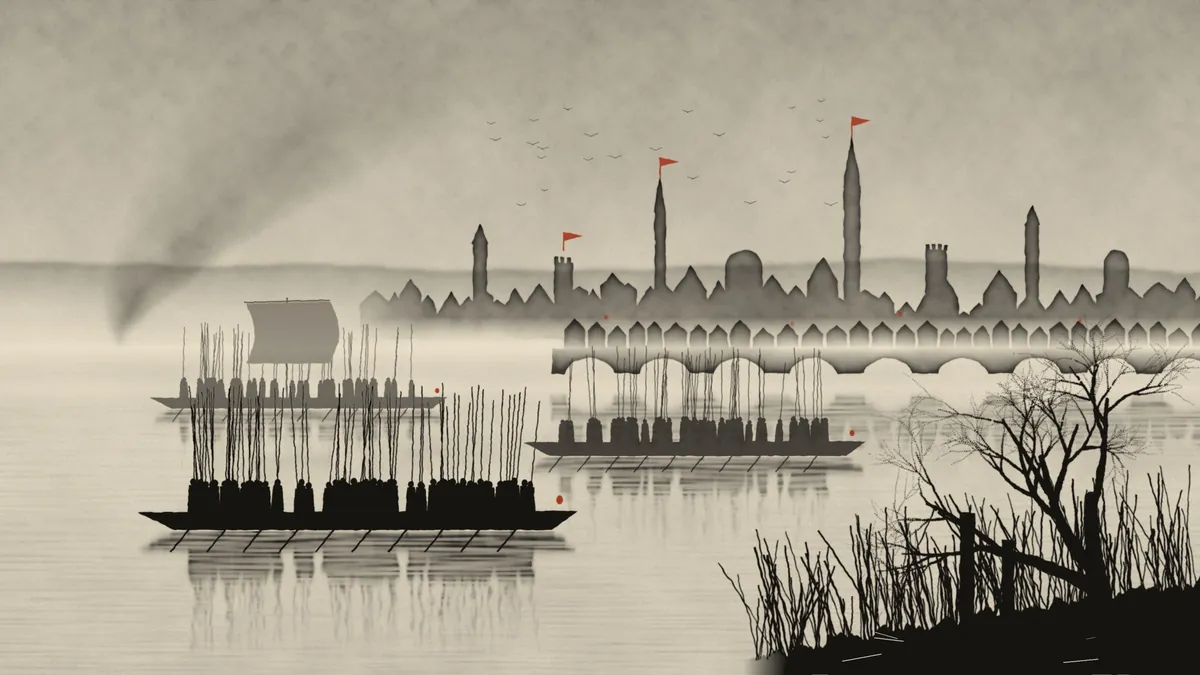
The Free Cities
Hessa Dorn went home to Lissen in the stern of a hired barge with the pay-roll on her knee, doing sums she disliked. Nine barges carried the Lissen Free Company down the Arle, and hers was the first of them.
Merrow owed her company more than it would ever pay, in a paper of Joan Tull's that promised Midsummer, and nineteen of her dead were owed death money besides.
"You're frowning at it again," said Tobin Reave.
He sat on the deck by her feet with his back against the steering-box, mending a pike-sling with fingers as thick as tent pegs. Tobin was the biggest man in the company and the gentlest. He was her lieutenant because the company had elected him, and they had elected him because in eleven years he had never lost his temper.
"I'm frowning at Merrow," Hessa said. "Merrow's a fine town, and it fights well, and I'll be paid by it about the time my grandchildren are old enough to spend it."
"You've no grandchildren," Tobin said.
"That's what I'm saying."
The river was high and brown and fast with the winter rains, and the barges went down it at a good pace with the current under them and two men at each sweep. The banks were low here, water-meadows and willow and the bare black hedges of the river farms. A heron got up ahead of them and flapped away downstream, complaining.
Hessa liked barges. They were slow and wide and honest, and they spared the feet. She liked her company better than either, though she would have denied it to her last breath. Five hundred and ninety pikes, sitting along the decks on their packs with the pikes laid down the middle of each barge like the masts of fallen ships. She knew every face. She knew who snored and who cheated at dice and whose wife was carrying, and which three of them would desert if they were ever paid in full on the same day.
"Lune water ahead, Captain," called the steersman.
The river Lune came in from the west, from the right hand as the barges went down. Hessa stood up to look at it.
It was a big tributary, near as wide as the Arle where they met, and it came in slow and gray off the high ground where Kingsholm stood, forty-odd miles up it. Where the two waters met, the Lune had pushed a long gravel spit out into the Arle, grown over with willow scrub. The main channel ran hard round the spit's point and in under the right bank. A barge going down had to come in within thirty yards of that bank to stay in deep water. Beyond the spit, on the right bank at the angle of the two rivers, stood an old stone toll-house with no roof. A long boat lay moored at its landing-stage with a dozen men in it.
A tall figure in a long leather coat stood on the landing with her hands in her pockets.
"There they are," said Tobin. "The Commander and the mage."
"On time, too." Hessa shaded her eyes. Rovan Tal stood beside Maelin Rennick, a square, quiet shape in a dark coat. He lifted an arm to them. Hessa lifted hers back. "Bring us in to the stage, Stubbs. We'll take them aboard and the boat in tow, and we'll be in Lissen by dark."
The willows on the spit moved.
Hessa saw it from the corner of her eye. It was a long ripple of movement, all along the scrub of the gravel spit on her left, as if a wind had gone through it. There was no wind.
"Shields," she said. Then she shouted it. "Shields! Down on the decks! Stubbs, keep her in the channel!"
The arrows came out of the willows in a dark sheet.
They came from the left, from the spit, at forty yards. Hessa heard them before she saw them, the flat hiss of a hundred shafts in the air together, and she threw herself down behind the steering-box. The shafts went into the deck and the packs and the gunwales with a sound like hail on a roof. A man screamed on the second barge. Somebody was shouting her name. She looked up over the box and saw them.
Gray cloaks. Gray riders on shaggy northern horses, a long line of them, coming out of the willows onto the gravel at the water's edge. A hundred of them, two hundred. They had bows across their saddles and they were shooting from horseback, fast and well. Others behind them carried coils of chain over their shoulders, and on the ends of the chains, iron grapnels with four hooks apiece.
Kharadi, she thought. Down here. Fifty miles south of anywhere they ought to be.
The first grapnel came whirling out over the water and fell across the bow of the third barge. Its hooks bit into the gunwale. The rider who had thrown it took a turn of the chain round his saddle-horn and wheeled his horse up the gravel. The chain came taut out of the water, and the barge's bow swung toward the spit.
"Pikes!" Hessa was on her feet. "Pikes up! Second rank, kneel! Cut those lines!"
They could not cut them. They were chains.
The ground was simple, and all of it bad. Behind her on the right was the bank and the toll-house, with deep water under it. In front, downstream, the channel ran round the spit's point. On her left, the gravel shoals of the spit, knee-deep and waist-deep, with the riders coming down into the water. And the barges strung out in a line along the channel, nine of them, with their sweeps flailing and their decks full of her people trying to get their pikes up under the arrows.
The riders meant to haul the barges onto the shoals by main force, a horse to each chain, and board them in the shallows where a pike was too long to swing.
Three barges were chained now. A fourth. The fifth barge was the baggage barge, with the company's tents and kettles and the Merrow flour. Two grapnels went into it together and dragged it round broadside to the stream. Its steersman went over the side with an arrow in him.
"Tobin," said Hessa. "Take the sweeps. Get us to the bank. The bank, not the spit. Stubbs, you whoreson, steer!"
Stubbs was dead. He lay across the steering-oar with a gray-fletched shaft through his throat, and the barge was swinging. Tobin took him off the oar as gently as if he were asleep and put his weight against it. The barge came round. Hessa ran forward down the deck between her kneeling pikemen.
"Up! On your feet. On the left side. Level!"
They came up. Sixty pikes came up off the deck and swung out over the left gunwale, eighteen feet of ash and steel, and leveled at the water. A gray rider was coming out through the shallows at them on his horse with his sword up, splashing, and the first pike took him in the chest and lifted him off the saddle. The horse went on into the river. Two more riders came behind. Hessa's front rank met them and threw them back into the water, and the men behind the riders, wading, stopped at the wall of points and began to shoot instead.
The barge ground against the bank under the toll-house. Hessa nearly went over the bow. And Rovan Tal came down the bank and jumped onto the deck beside her with his sword in his hand. Maelin Rennick came after him in her long coat and landed on the boards with a crash that shook the barge.
"Afternoon, Captain," said Maelin. "Lively, isn't it?"
"They've got my baggage barge." Hessa pointed. Out in the stream the fifth barge was half out of the channel already, three horses heaving at its chains and its bow grounding on the gravel of the spit. Gray riders were wading round it. Her people on its deck were fighting with pikes too long to use and swords too few to matter. "That's the tents and the kettles and the flour. And forty of my company. Can you get to it?"
"Not from here." Maelin was looking at the chains. "I need my hands on them. Get me alongside."
They got her alongside. It took the fourth barge and the sixth, and two hundred pikes, and Rovan.
Hessa did it the only way she could think of, which was to bring the barges that were still free down onto the barges that were chained, so that the decks made a bridge. Tobin drove theirs off the bank and down the current with the sweeps while Rovan took the steering-oar. They came down on the fourth barge's stern with a crash that threw half her pikemen off their feet. Hessa went across the gap with Maelin at her back and her pikes after her.
The fourth barge's deck was a shambles. Kharadi were coming over its left gunwale out of the water, and the company's people were fighting them hand to hand among the packs. Hessa drew her short sword. A gray-cloaked man came at her over a heap of packs with an ax, and she went in under it and stabbed him in the thigh and shoved him back over the side. Another took his place. Tobin came past her and hit that one with the butt of a pike, and he went down too.
"The chain!" Maelin shouted. "Get me to the bloody chain!"
It came over the bow, taut as a bar, from a grapnel bitten into the gunwale up to a rider on the gravel thirty yards off. Hessa cut her way to it with six pikemen round her. Maelin came behind them and dropped on her knees at the bow and seized the grapnel with both gloved hands.
Hessa had heard about her. Every soldier in the river country had heard about her since Merrow. She had not seen it up close.
The mage put her head down. Hessa heard her speak, a few low words, as a carter talks to a horse at a hill. The iron of the grapnel groaned. Then it bent. The four great hooks straightened out of the wood of the gunwale one after another, slowly, as if they were candle-wax. The grapnel came free in Maelin's hands with the chain still singing from it.
Maelin kept hold of it. She held the chain and put her weight into it, and Hessa saw her shoulders lock.
Down the length of the chain, link after link, the iron burst. It went from the barge's bow out over the water to the gravel, in a running series of cracks as sharp as breaking ice, each link springing apart into the river. The last of them went at the saddle-horn. The rider's horse, braced against the pull, went over backward on the gravel with the rider under it.
"One," said Maelin, and spat over the side. "Next."
They took the chains off the fourth barge, and the third. Each one was the same. Hessa's pikes cleared the deck round the chain, and Maelin put her hands on the grapnel and bent it out of the wood and broke the chain back to the horse. The third chain she left whole. She sent something down it instead, and the rider who held it came off his saddle as if he had been kicked, and lay on the gravel holding his arm.
By the fourth chain she had stopped joking.
The baggage barge was the worst. It was grounded on the spit by the time they reached it, and the Kharadi were all over it. They had come in from the shallows in a mass, wading and on horseback. Its forty pikes had been driven back into the stern, where they stood in a knot round the steering-box with their pikes shortened, fighting for their lives. A gray rider had a torch. He was laying it to the canvas of the stacked tents.
"Hessa!" Rovan was beside her. He had been beside her for some time, she realized, without her seeing him come. His sword was red to the hilt. "If they fire it, let it go. Get your people off."
"That's the tents," Hessa said. "That's the flour."
"Let it go."
The tents caught. The canvas went up with a roar, and the flame ran along the stacked bales. The gray rider with the torch threw it into the flour sacks and spurred his horse off the barge into the shallows. Smoke came rolling across the water.
Hessa looked at it for the space of one breath. Then she swore, long and filthily, about Merrow and Midsummer and the price of canvas. She went over onto the baggage barge's bow with Tobin and thirty pikes behind her, through the smoke.
It was a short fight and an ugly one. The Kharadi on the deck were cut off from their horses by the fire, and they fought like men who knew it. Hessa took a sword-cut on her helmet that put her on one knee with her ears singing. Tobin stood over her with his pike and killed the man who had done it. Rovan came past them both. He fought without hurry, the old heavy sword going in short strokes, and he killed two Kharadi on the bow in the time it took Hessa to get up. She saw one of hers, Gil Fowey, a cooper's boy from the Corn Quay, go down with an ax in his shoulder. She saw old Prue Hatch, twenty years a pikewoman, put her pike through the man who had done it and then fall herself with an arrow in her back.
They broke through to the stern. The knot of pikemen there came out to them, black-faced and coughing, and Hessa got her hand on the arm of the first and shoved him toward the bow.
"Off! Off! Into the fourth barge! Go!"
They went. Fire was coming down the deck behind them. Hessa went last, with Tobin, and Rovan held the bow for them with his sword until they were across.
The flour sacks went up behind her with a soft great roar, a cloud of white fire that rolled across the spit and made the gray horses scream.
Out on the gravel the Kharadi broke off.
They did it well. Hessa gave them that afterward, when she could give anyone anything. A horn blew two long notes from the willows. The riders in the shallows turned and went back across the spit at a canter, picking up their wounded as they went, without a man looking back. The bowmen in the scrub covered them. Within a minute the gravel was empty, but for the dead and the horses that would not get up, and the willows were moving again, going away westward up the Lune.
Hessa stood on the deck of the fourth barge and watched her baggage burn.
It burned to the waterline. Tents, kettles, the spare pikes, the cook's iron, the paymaster's box with the company's papers, and the Merrow flour that was half her pay. All of it went up into the gray January sky in a pillar of smoke that they would see from Lissen. She stood and watched it until it was a black hulk sitting on the gravel with the river going round it.
She had lost eleven. Gil Fowey and Prue Hatch, and Stubbs the steersman, who was not hers but who was owed for the trip. Nine more she would name tonight, after she had looked at their faces. Twenty-three wounded. Thirty Kharadi dead on the gravel and in the water, and a dozen horses.
"Captain."
Maelin was sitting on a coil of rope behind her, with her head tipped back and her eyes shut. Her gloves were smoking a little in the cold air.
"You saved four barges," Hessa said. "Maybe five. I'll put it in writing."
"Put me down for a drink, too." Maelin opened her eyes. "They had chains, Captain. Not ropes. They knew they'd need chains, so they knew there'd be someone on these barges who could cut a rope. They knew exactly where to wait." She shut her eyes again. "Rovan."
Rovan had come back along the deck from the bow. He was wiping his sword on a piece of somebody's cloak. His face was gray with smoke under the stubble, and his eyes were on the willows.
"She knew I'd be here," he said. "She knew the day, and the place. It's the second time."
"Then somebody at court talks to her," said Hessa. "Or somebody in Merrow."
"Or both." He sheathed the sword, and turned to the Teshar boy who held his horse on the bank. "Benno. The man who knifed me at Kingsholm came in on a letter from a wine merchant in Merrow. Sutton gave me the name. Ride back up to Merrow with it, to Alderwoman Tull, and ask her to open that man's house. I'll be at Lissen." He turned back to Hessa. "I'm sorry for your people, Captain. And for your baggage."
Hessa looked at him. She had not liked him at Merrow, with his quiet voice and his royal manners and his ninety bound men. She had come to respect him there, which was a different thing. Now she watched him look at the dead on her deck, and she saw him take their faces one by one, as she did, as if he meant to remember them.
"The baggage and the tents," she said, "I'll be billing to the king. I hear you've got his warrant."
"I have."
"Good." She turned to the steersman of the fourth barge. "Get us off. We'll take the dead to Lissen. They're owed a city burial, and they'll get one, and the city will pay for it."
Lissen came up out of the river mist on the second morning. Hessa saw the walled upper city on its hill and the gray towers of the Hall of the Companies, and below them the lower town along the water, all quays and cranes and warehouse gables. Hessa had been born in a tannery yard behind the Corn Quay. She had never once come home down the river without wanting to kneel and kiss the stones, and she had never once done it.
The council of the three cities met four days after the Lune water, in the long upper room of the Hall of the Companies, with the windows shuttered against the cold and a fire at each end.
Matthias Orme sat in the chair for Lissen. He was a thin, clever merchant of sixty with spectacles and long ink-stained fingers. He had paid Hessa's company for six years and never once on time, and she was fond of him, as one is fond of an old knee that aches before rain. For Saltmere sat Ysolde Wynn of the House of Wynn, a handsome, silver-haired woman in black velvet whose family owned a fifth of the warehouses on the lower Arle. She had been appointed by the Houses to speak for them and to promise nothing. For Torrin, at the river's mouth, came Rafe Colley, a ropemaker with a ropemaker's forearms, elected by the neighborhood associations and told by them to come home with the city's money still in his purse.
Rovan Tal laid the king's warrant on the table before them, and told them what had happened at Karthen and Hallam and Merrow, and at the Lune water.
He told it well, Hessa thought. Short, without heat, and with the names in. When he had finished, the three of them sat and looked at the warrant and said nothing for some time.
"The king asks us for an army," said Ysolde Wynn at last.
"The king asks you for free men," said Rovan. "Men who never swore the royal oath. You have them. Your companies swear to the cities and to their captains. Your watchmen swear to the wards. Your bargemen swear to their tolls and their beer. Every one of them can stand in front of a bell and come away himself."
"And the king's army?" said Colley. "The real one?"
"Most of it is sworn. Some of it is marching north under Lord Marshal Tierney to take back Dunmere." Rovan made it sound no better than it was. "I hope he does. I'm afraid he won't."
"So we are to raise an army," said Orme slowly. "Under a royal warrant, to fight the king's enemies. Beside a royal army that may at any moment become the king's enemies. Under a royal commander who was arrested three weeks ago for losing a royal fortress." He took off his spectacles and polished them. "Forgive me, Commander. I'm a wool merchant. I try to know what I'm buying."
That was the first day. There were six more.
Hessa did the work. She had known she would. Rovan could talk to soldiers and kings. He could not talk to merchants, because merchants did not want to be told what was necessary. They wanted to be told what it would cost, and who would pay, and what happened if it went wrong.
So she told them.
She sat at the long table in the Hall of the Companies with the clerks of three cities scratching round her. She wrote the compact clause by clause, as she had written every contract of her life. There would be a war council: one voice for each city, one for Rovan as the king's commander, and one for the captains of the free companies, which would be hers. The war council would decide where the army went. Rovan would command it in the field, and nobody would argue with him in the field, and he would answer to the council afterward.
Each city's men and money went into it, to the man and the crown.
"No requisitions," Hessa said, on the fourth day. "Not without payment at the market price, in coin, with a receipt. No soldier of this army takes a cow from a farm or a cart from a carter without a paper that the war council will honor. I've seen what royal armies do to the country they march through. They do it to their neighbors. This one won't."
"That'll cost," said Colley.
"Less than having every farmer from here to Merrow hate us." She wrote it down. "Next."
The fifth day was the oath.
That was the clause they fought over hardest, because it touched every man in every city who had ever worn the king's coat. There were hundreds of them: old soldiers in the city watch, bargemen who had done ten years in the river regiments, sergeants who had taken their pensions and come south to drink them. Ysolde Wynn wanted them all dismissed from every company, for safety. Colley wanted them all kept, because Torrin's associations were full of them and they were the only ones who knew which end of a pike went forward.
"Neither," said Hessa. "Every man who's served the Crown is asked what he swore, and when. Asked by his captain, before witnesses, and it's written down. If he came in under the old articles, or the provincial ones, or swore to a city and nothing else, he's free and he serves where he's put. If he swore the new words, he's bound. He still serves. He serves at the back, and on the walls, and with the baggage, and he's kept away from the fighting line whenever there's a bell within miles." She looked round the table. "He's no traitor. He's a man with a knife at his back that he didn't put there. We judge him by his oath, not by his coat."
"And the watchmen?" said Orme.
"The same. Tested, written down, and sent up the hill if a bell comes."
It went into the compact on the fifth evening.
On the sixth day Rovan came to her room in the Hall after the council rose and stood by her fire. She could see the anger in him from across the room, though his voice was quiet.
"Tierney marched north two weeks ago," he said. "Serath has been in Dunmere since Midwinter. Every day we sit here writing down the price of tents, she sends riders further south, and she takes another garrison in the March, and she knows where I sleep. We need to be in the field, Captain. We need to be in the field now."
"We'll be in the field when there's a field to be in." Hessa stayed in her chair. She was working on the clause for death money, which was the one she cared about most and the one the merchants had fought least, because they did not expect to pay it. "Sit down, Commander. You're blocking my fire."
He did not sit. "Every day."
"Listen to me." She put the pen down. "Seven weeks ago the royal army of Auren turned on the people of Hallam in the middle of the road and tried to kill them. Their own army. Sworn to protect them. Two weeks ago the king sent you to these people with a warrant and three thousand crowns he hasn't paid you, and asked them to hand over their sons. You're asking them to trust a system whose army just turned on them. Let them count." She picked up the pen again. "They're merchants. When they've done their sums, they'll pay. And when a merchant has paid, he'll fight like a cat for what he's bought."
Rovan stood at her fire a moment longer. At last he sat down, slowly, on the bench by the wall, and rubbed his face with both hands.
"Edran's in the north," he said. "My nephew. Somewhere. Under a bell."
"I know." She did, too. Maelin had told her on the barge. "I'll get you your army, Commander. Go and get some sleep. You look like a man who's been knifed."
"I was knifed," Rovan said.
"Then you've an excuse."
The trooper came the next morning, while the council sat.
He came up from the Water Gate on a horse that was blowing foam, in the king's colors under a cloak black with rain, and the doorkeeper of the Hall brought him up the stair because he would not be put anywhere else. Hessa saw him come in at the end of the long room and stop. He was a man of thirty or so in the gray-blue of the Western Horse, with the look of a man who had ridden two days without getting off. He had a letter under his cloak. He gave it to Rovan, and then he would not sit.
Rovan broke the seal and read it, and read it again, and put it down on the table.
"Tierney," he said. "The king writes that one man came in to Kingsholm. Alone, out of the rain, from Dunmere." He looked at the trooper. "You."
The man stood at the door in his wet cloak with his hands clenched in the cloth, and told it to the floor.
"I was on scout, sir. Two mile west of the walls, on the rise, where the Lord Marshal put me. I heard it. The bell. It came from inside the town, from the walls. I saw the van stop. I saw them turn round in the road, the whole column, like a rope going slack. The old companies in front stood. The young ones behind cut them down where they stood, sir, and never a shout. Then the gray came out of the gate and walked them in, regiment by regiment, with the drums still going." He looked up. "The Queen's Foot. The Western Horse. My troop. I watched my own troop walk in at the gate. Eight thousand, sir, and the Lord Marshal with them. I've not stopped shaking yet."
No one at the table spoke. Ysolde Wynn had put her hand over the clause in front of her and left it there. Colley was staring at the trooper's boots.
Orme took off his spectacles. He did not polish them. He put them down on the table beside the compact, and held out his hand to his clerk.
"Give me the pen," he said.
He signed first, for Lissen, in his long spidery hand, with the trooper still standing dripping at the door. Ysolde Wynn signed for Saltmere and dusted the ink with sand from a silver box she had brought for the purpose. Colley signed for Torrin, carefully, with his tongue between his teeth. Rovan signed as the king's commander for the northern war, with the right to make terms there, and Hessa signed for the free companies. Maelin witnessed it, in a hand like a hedge in winter, and blotted it with her sleeve.
Then the bells of the city rang for it, the real bells, the church bells and the guild bells of Lissen from the hill down to the river. Hessa stood in the Companies' Square in the cold with her company drawn up round her, and watched the faces of her people as the sound came down over them. She saw every one of them flinch at the first stroke. Then they let their breath go, and looked at each other, and laughed, ashamed.
Recruits began coming to the tables in the square the next morning, and kept coming. Within the week there were three thousand under arms in Lissen and the river towns. Saltmere's money came down the river in sealed bags on a guarded barge, and Hessa weighed every bag herself.
Benno came back from Merrow the day after the money.
He came in at dusk on a horse that was finished, and the horse lay down in the yard of the Hall and did not get up. Hessa took him up the stair to the long room, where Rovan and Maelin were bent over a map with Orme, and the boy told it with his cap in his hands.
The wine merchant of the letter of character had a house on the Corn Street in Merrow and a cellar under it, and the house was shut. Alderwoman Tull's people had opened it. The cellar was empty and the strongbox was empty and the merchant was gone, over the river, with his clerk and his two best horses, in the week before Midwinter: a fortnight before the assassin had reached Kingsholm. Joan Tull had put the man's name on the door of the guildhall with a price under it, and had sent Benno back with her compliments and a question. What else had the Commander told the council of Merrow, in the guildhall, with the rain on the windows, that the Marshal might like to know?
"Everything," said Rovan. "I told them everything I had."
"There's more, sir," Benno said. "I was told to say it myself. The Marshal's left Dunmere. Her army was on the Merrow road four days ago, coming south, gathering up the March garrisons as it comes. All of it. Nine or ten thousand, the alderwoman's riders say, and most of them in royal blue."
"South," said Rovan. "To where?"
But Hessa had seen it already. She had seen it on the map, under his hands, in the low hills twenty-five miles south-west of Merrow Ford. She had been paid to guard it, once, years ago, for a summer, and had walked its long magazines with a royal quartermaster and counted pikes by the thousand.
She put her finger on it. Brackwater, the King's Arsenal, with eight thousand new soldiers marching toward it who had come north with weapons of their own and laid them down in the road at Dunmere.
None of them said the name aloud. Down in the yard, in the dusk, somebody was shouting for a farrier, and then stopped shouting, because the horse had no more need of one.