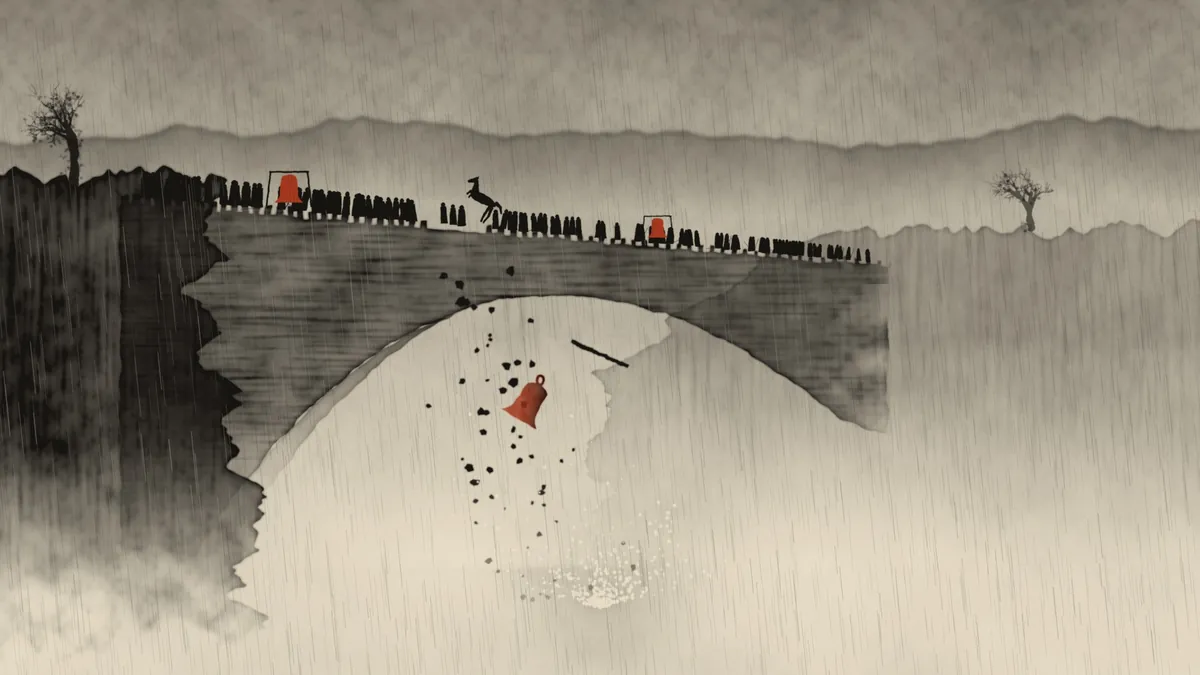
The Attack on the Bell Convoy
Maelin had been lying on the ledge under the Sorrel Bridge since an hour before dawn. It was eighteen inches wide.
She lay on her side with her back to the gorge wall and her face to the stone of the arch. The arch went up over her head in one long curve of dressed granite, black with wet, and came down a hundred feet away on the far side of the gorge. Below her the Sorrel went through its slot in the rock, a hundred feet down, white and roaring with the snow of the whole high country behind it. The noise of it came up through the stone into her ribs. The gorge ran east into the mountains and west to the Kell, which flowed south beside the road beyond the bridge's end. Above her, on the north side, the road ran straight for a quarter-mile between the river and a steep bank of pines, toward Karthen, nine miles off. On the south side, in the pines below the bend, six hundred of Hessa's pikes lay in the needles and waited.
She had her right glove off and her bare palm against the springing-stone of the arch, where the curve began. She had been talking to it, on and off, all night.
"You're a good old thing," she told it now, under the roar of the water. "You've stood here three hundred years and carried every fool in the March, and never a word of thanks. I'm going to thank you. And then I'm going to ask a favor, and you'll not like it."
The bridge felt like a bridge. It felt like weight going down into rock, a long settled patience, with the cold of the night in it. She could feel the paving of the roadway above, each slab on its bed of rubble, and the iron cramps the old masons had leaded in to tie the parapet stones. She could feel where the parapet stopped.
Dace had pulled down nine yards of its west side in December, to make a wall across the road against the bell. The Kharadi had cleared the blocks off the roadway afterward and tipped them into the gorge, and had never built the wall up again. The bridge's western edge had a gap in it now, nine yards long, with nothing between the road and a hundred feet of air.
Edran had told them it could be cleared. He had said so in January, at Thornwick, writing up the road for the spring. He had said it again a month ago, chained to a beech tree, with his face in his hands.
"So we'll use it," Rovan had said.
Maelin had liked him very much just then.
The light came up gray. A dipper went past under the arch, low over the water. Maelin flexed her fingers on the stone, slowly, to keep them warm, and waited for the bells.
They came at the third hour of the morning. She felt them before she heard them.
It started as a tremble in the bridge, so faint she thought at first it was the river. Then it was a rhythm. Iron tires on stone, a long way north on the road, grinding. A great many hooves. Under them, deeper, something she had no name for, a weight that came through the road and the bank and the bedrock and into the arch, deep as a drum.
"There you are," she whispered. "Come to Mother."
She could not see them. She could only feel them coming, and count the wagons by their weight. Three of them, spaced out on the straight, two hundred yards or more between each. Heavier than any cart. Three bells.
Men were above her now. She heard voices on the road, horses, the jingle of harness, a man laughing. A scout had come over the bridge and back. She heard him shout something in the northern tongue, and another voice answer, deep and impatient, and the wagons came on.
Hessa had a man in a tree on the south bank who could see the whole straight, and he had told them at dawn what to expect. Kharadi riders in front, sixty or so. Then the first wagon, with its team of twelve and its crew on the box. Then foot, gray Kharadi with spears, two hundred of them. Then the second wagon, and a long straggle of men with picks and shovels and mattocks, who had dug the wagons through the snow at the top of the pass. Then the third wagon, and more horse. Four hundred fighting men, perhaps, and three hundred laborers.
The laborers were northerners. Every soul in the iron valleys had sworn the Seat's words two winters ago, Old Hild had said, or been burned out. The moment a bell was struck, every one of those men with a shovel would belong to the man who struck it.
The Kharadi riders went over the arch above her head. She felt their horses' hooves in the stone like rain. They went on south, round the bend. Somewhere down there in the pines, Hessa was letting them go by.
Then the first wagon came onto the bridge.
It came slowly. They were careful with it; she would give them that. She felt the leading pair step onto the paving, two by two. The weight of the wagon came onto the north end of the arch behind them, and the bridge took it and settled. Iron tires. Four wheels, each as heavy as a millstone, and between them, on its frame, the bell. She felt the bronze through the wheels and the axles and the stone. It was new bronze, sharp and raw.
She let the first two wheels come on, a yard, three yards, five. The rear wheels came onto the arch. The wagon was all on the bridge now, with the gap in the west parapet a few yards ahead of its front wheels on the right hand.
Maelin took hold of the bridge. She did not take all of it. She took the roadway, the long ribbon of paving slabs from the east parapet to the middle of the road, and she lifted it. She lifted it as a housewife lifts the edge of a carpet. The slabs groaned and came up off their bed of rubble, one after another down the length of the arch. The east side of the road rose a foot, then two, under the wagon's left-hand wheels.
The wagon tilted and slid. On the road above her a man screamed. Horses were plunging and screaming too. The deep voice roared an order in the northern tongue, and she heard an axe go into wood, again and again: someone cutting the traces. The wagon slid right on the tilted road toward the gap. Its front wheel went over the edge where the parapet should have been and dropped and caught, and the whole wagon hung there with its weight going over.
Somebody on it struck the bell. The sound went through the bridge and through Maelin's hand and arm and into her teeth. She felt it take hold. The hum came up out of the stone and the road and the length of the straight to the north. It hummed, steady and deep, and did not die. A field. The first bell's field, reaching out nobody yet knew how far, and on the road inside it were three hundred northern laborers, and every one of them was now a soldier.
"Over you go," Maelin said, and pushed.
The wagon went over. She heard the last of the traces part with a crack. The two wheel-horses went with it, thrashing, and she heard a man go too, shouting. The wagon fell past her ledge an arm's length away in a rush of air, end over end, with the bell tearing loose from its frame and spinning. It hit the rocks of the torrent a hundred feet below with a noise like the end of the world.
The hum went out of the stone. It went all at once, cut through.
Then, from two hundred yards up the straight, the second bell rang, and it was back.
Lise Fenwick had the rope down to her before the second stroke had finished. Maelin went up it hand over hand with her bare palms on the wet hemp and her boots on the arch's face.
She came over the north end of the bridge into a fight.
The road at the end of the arch was full of men. Gray Kharadi spearmen had come forward at a run when the first wagon went. The laborers were pouring after them down the straight with their picks and shovels, and Hessa's pikes were coming over the bridge from the south to meet them. The arch was four men wide. Hessa had put her best ranks across it in a block, and the block came over at a steady walk with pikes leveled. Maelin could hear Hessa somewhere in it swearing at the top of her voice.
Coll Fenwick was beside her at the rope's head with a short sword. Noll Trask was behind him, white as cheese, with a hand-axe he had borrowed and no idea what to do with it.
"Stay behind me, Noll," Maelin said. "Coll. On my left."
A laborer came at her out of the press. He was a big man in a leather apron, with a mattock up over his shoulder, and his face was open and terrified. She caught the mattock-head as it came down. She took the iron of it in her bare hand and closed her fingers, and the iron folded up round them like dough. The man stared at the lump on the end of his helve. Coll hit him with the flat of his sword, and he went down.
Another came, and another. They were no soldiers. They came on with their tools as if digging a ditch, and the Kharadi spearmen came through them and among them. Maelin put on her right glove. A spearman thrust at her and she caught the shaft below the head, and drew the iron of the head off the wood, and threw it back in his face. He fell, holding his eyes.
"Don't kill the diggers!" she shouted. "Knock them down! Kill the gray ones!"
Somebody in the pike block heard her and took it up. "The diggers! Mind the diggers!"
A boy came at her with a pick-helve, no head on it, swinging it two-handed. He was perhaps seventeen, thin, with fair hair cropped to the scalp, and he was sobbing as he swung. She took the helve on her gloved forearm and stepped in and hit him in the mouth with the back of her bare hand. His lip burst. He sat down hard in the road with the helve across his knees.
"Coll," she said. "Sit on this one."
Coll sat on him.
The second bell rang again. Its note came down the straight from the north, high and hard, and Maelin felt every laborer in the road answer it. They straightened at the sound, all together, and came on harder.
She looked up the road. The second wagon stood two hundred yards off, between the river and the pines, with its team rearing in the traces and a ring of gray spearmen round it. Its crew were hauling the striking beam back for another stroke. The pine bank above it was moving.
Rovan's veterans came down the bank out of the trees. Three hundred of them came, the free men of Karthen and the March, down the steep slope in a sliding, running mass with their swords out. They had waited all morning lying in the needles with their faces in the dirt, and now they hit the gray ring round the wagon from the side. Rovan was at the front of them, bareheaded, with the old heavy sword. He killed a spearman with a cut that started at the man's shoulder.
"Hessa!" she shouted. "I'm for the wagon!"
"Then go for it, and the plague take you! We're coming!"
She went up the straight with Coll and Lise at her sides and Noll somewhere behind, and the pike block came grinding after her. The road was a mess of men. The laborers were the worst of it. They came at the pikes in knots and ran onto the points, or tried to wrestle the shafts aside with their bare hands. The pikemen of Lissen cursed and pleaded and shoved them back with the butts. Some of the diggers died. No help could be had for it. A gray-bearded man with a shovel got past the pikes and came at Maelin, and Lise hamstrung him from behind, and he fell in the road and lay there trying to crawl after her.
Fifty yards from the wagon a Kharadi officer met her. He had a long sword and a mail shirt and a scar through his beard, and he knew who she was. He did not try to fight her. He came straight in at her bare left side with the point, fast, as men are taught to come at a mage.
Coll took the thrust. He took it on his short sword and it slid down his blade and went into his upper arm, and he yelled. The officer pulled it out and drew back for the next. Maelin put her gloved hand on his mail.
Iron is iron. She closed her fingers on the rings and pulled them together, and the shirt drew tight round his chest, ring by ring. He could not breathe. His sword dropped. He went down on his knees, clawing at the mail, and she let go of him and left him there.
"Coll?"
"It's my arm, Mistress," Coll said. "It's only my arm."
"Lise, tie it up. Stay with him."
The wagon was ahead of her. Rovan's people had cut down its ring of spearmen and were at the team's heads, hacking at the traces. Rovan himself was on the wagon bed. Two of the crew lay at his feet, and a third was going over the tailboard with a hand pressed to his side. The fourth had his hands on the beam yet. He was a young Kharadi with a thin beard, and he was hauling it back alone, grunting with the effort, to strike again.
Rovan said something to him. The young man shook his head and hauled. Rovan killed him.
Maelin climbed onto the wagon bed. The bell stood over her in its frame of black oak and iron, taller than Rovan by a head, raw new bronze with the casting marks on it. She put both bare hands on the crown.
"Sorry, my lovely," she said. "You never had a chance to do any harm. It's not your fault."
The bronze was stubborn. New bronze always was. She felt it fight her up to the elbows and the shoulders and into her back, a long ringing resistance, every grain of the metal humming with the note it had been made to sing. She leaned on it. She put her weight into it and her breath and the ache in her knees, and the crown cracked under her hands with a sound like a beam breaking in a fire. The crack ran down the shoulder of the bell and on down to the lip. The two halves leaned apart in the frame.
Her palms were raw and the surface of the bronze smoked under them. When she took them off the crown her fingers would not straighten, and she had to work them open one at a time against her coat.
The hum was in the wagon yet. It was in the axle-iron and the tires, faint but steady, coming in from the north.
"Blood and iron," Maelin said. "The third one. Rovan, the third one's ringing."
Garrick took the third bell with four hundred horse and a wall of fire.
Maelin saw it from the wagon bed, looking north up the straight. The third wagon was three hundred yards beyond her, at the top of the straight where the road came round a shoulder of rock from the north. Its escort of Kharadi horse had drawn up across the road in front of it to come down to the fight. Behind the wagon, out of a gully in the pines on the east side of the road, came the Teshar cavalry in their red cloaks.
They had lain all night in that gully, a mile north of the bridge, with the horses' muzzles tied. Now they came down out of the trees onto the road behind the wagon at a gallop, two hundred abreast, the red-and-gold pennons streaming.
Garrick was at the front of them on his bay mare. He rose in his stirrups with his hand out. A thread of fire went out from the pot on his saddle-bow and ran along the road in front of him, between his riders and the Kharadi horse beyond the wagon, and stood up. It stood up white, a wall of glare higher than a lance across the whole width of the road. The Kharadi horse turned from it with their arms over their eyes and their horses screaming.
The Teshar went round both ends of the glare and over the wagon.
The Teshar killed the bell crew. It was done in the time it took her to draw breath. One of the crew got the beam back and let it swing; it struck, and the note came down the straight. A Teshar lancer rode him down before he could haul it back again. Then a dozen of Garrick's riders were off their horses and on the wagon bed, and they had the beam and held it.
"Ten minutes," Maelin said aloud. "Ten minutes from that one."
Rovan had jumped down from the wagon. He was shouting along the road. "Hold them off! Hold them, don't kill them! Ten minutes! Captain Dorn! Ten minutes, and they're free!"
"I heard you the first time!" That was Hessa, from somewhere in the press. "Ranks! Shields up and pikes level and walk them back! Walk them back, you whoresons, and don't stick them!"
The laborers fought on through all of it, with no officer left to tell them to stop, and Hessa's pikes walked them back up the road a yard at a time with the butts. Maelin stood on the wagon bed with her raw hands under her armpits and watched the Teshar hold the beam, and watched the glare-wall go out, and Garrick sway in his saddle at the top of the straight with a trooper holding him up. Somewhere at the back of the pikes a woman's voice was calling the minutes off a sand-glass, because Hessa had brought one, and at ten the laborers stopped where they stood.
The gray-bearded man whom Lise had hamstrung had crawled as far as the wagon wheel. Maelin climbed down and knelt by him and took his wrist, and felt it go slack in her fingers. He asked her something in the northern tongue, and she could not understand a word of it.
"I know, my dear," said Maelin. "It's gone. Lie still."
They found the bellmaster at noon, forty feet down the gorge wall on the north side, in the roots of a pine that grew out of a crack in the rock.
He had gone over with the first wagon. He had been on its box, and he had jumped as it fell, and the pine had caught him. He had been hanging there for three hours above the torrent with one arm round the trunk. Two of Hessa's people went down on ropes and got a loop round him, and the pikemen hauled him up over the lip. He came over the edge swearing. He swore in the northern tongue and then in good southern, with an accent, and he held his right arm against his chest because the wrist was broken.
He was a big man, heavy in the shoulder, in a black coat with a fur collar soaked dark by the spray. He had a bronze collar round his throat on a chain. When they stood him up on the road he looked round at the broken wagon and the bell lying in halves on its bed. He looked at the third wagon the Teshar had brought down the straight under guard. Then he looked at Maelin.
"You are the Rennick woman," he said.
"I am. And you're the bellmaster."
"Orrin Voss. Master of bells to the Sovereign." He inclined his head to her, holding his wrist. "Four of my bells have been broken since the winter, madam, by you or by your friends with their chisels, and today you drowned a fifth. These were the best I ever made."
"I'm sorry for it," said Maelin. "I truly am. It was lovely bronze."
He looked at her a while with his pale, heavy face, and she saw that he believed her, and that it made him hate her more.
The laborers sat in the road all afternoon, under guard, with their tools taken away. Nearly three hundred had come through. Forty were dead on the straight, and more hurt. They sat in rows with their arms round their knees and looked at the gorge and the pines and the southern soldiers. Most of them looked at nothing at all.
Maelin went among them with Edran, who had been brought up from the farm three miles south when the last bell was safe and Rovan had seen it chained. Edran spoke the northern tongue. He had learned it in the winter, without wanting to. He walked with a chain between his wrists and a big Lissen pikeman holding its end, and the laborers flinched from him until he spoke to them.
The boy with the cut lip was called Sten. He was seventeen, a furnace-boy from Ashgate, and he had learned his letters at the school in the Weighhouse there. He had good common speech. He sat with his split mouth swelling and his eyes on Maelin's hands.
"They told us the rebels had killed the southern king," he said. "In the winter. They said the rebels burned the villages on the Kell and the Sovereign was sending his bells to bring peace. We were to dig the road. That's all. We were only to dig."
"There's a king at Kingsholm," Maelin said. "Osric. He's alive. He has a cold, I expect. He usually does in spring."
Sten stared at her. Then he turned to Edran and said something quick in the northern tongue.
"He asks," Edran said, "whether it's true the south has no Seat."
Maelin sat back on her heels.
"It's true," she said. "We have a king, and he's only a man, and when he dies they'll bury him and that's the end of him. Not a soul down here ever swore to anything under a mountain. Not till lately."
Sten put his fingers to his lip and looked at the blood on them.
"Then who keeps you safe?" he said.
They tested the field the next morning, on the straight above the bridge, because Edran would not let them leave until they had.
"You need the number," he said to Rovan. He said it at the camp-fire the night before, and again at dawn, and again on the bridge with the rope already round his waist. "Every plan you make from now till the end of this hangs on how far it reaches. You've been guessing since December. You sent the bound men three miles off at Merrow because you didn't know. You'll want to know at Karthen. And there's only one man in this army who swore, and is on your side, and knows how it feels." He held up his chained wrists. "Besides, I want to know if paper does anything. I've renounced the old words three times in writing, before witnesses. The king's clerks struck me off the rolls for desertion last month. Let's see if the bell has heard."
"I don't like it," said Rovan.
"Nor do I, Uncle. Hold the rope tighter."
Maelin had made her own trial first, at sunrise. She had struck the captured bell herself with the beam. After that she had walked away from it south down the road with her bare hand trailing on the parapet and the paving, feeling the hum in the stone. It ran along under her hand down the straight and over the bridge and round the bend. Then, a long way down the road, between one yard and the next, it was gone. She had marked the spot with a stone. She had gone back and struck the bell as hard as three men could swing the beam, and walked down again. The hum had stopped at the same stone.
"That's only my hum, though," she said. "That's the stone talking. It's not a man's will."
So they did it Edran's way. The bell stood on its wagon at the top of the straight, where the Teshar had taken it. Voss was held beside it in irons with two guards, because Maelin had been questioning him about the fittings all morning and had got nothing from him but contempt. Edran started a mile down the road, south of the bridge, with a rope round his middle and Tobin Reave and two of Hessa's biggest pikemen on the end of it. Lise and Coll walked beside him with a land-chain borrowed from the Dunmere clerks, measuring as they went. Maelin struck the bell, set one of Garrick's troopers at the beam to strike it again every five minutes, and walked down to meet him.
He came up the road a yard at a time. He came round the bend, and past her stone, and stopped.
"Here," he said. His face had gone gray. "Here. A hand. On the back of my neck."
"Come back," said Rovan.
"No. One more."
He took one more step, and it had him.
Maelin saw it happen. He straightened, as the laborers had straightened in the road the day before. His chained hands came up. Up at the wagon, Voss saw it too, and shouted, a single word in the northern tongue. Edran turned on the men holding the rope.
He went for Tobin first, because Tobin was nearest. He got the chain between his wrists round the big man's throat. Tobin threw him off, and Edran came up and went for him again, and the other two pikemen had him by the arms. He fought them with everything he had. He was crying out, the same three words, over and over.
"Haul!" Maelin shouted. "Haul him, blood and iron, haul!"
They hauled. Tobin and the pikemen took the rope and threw their weight back down the road, and Edran came after them across the stones on his back, kicking, clawing at the rope. Six yards, eight. He stopped kicking. He lay in the road on the south side of Maelin's stone with the rope round him and his eyes on the sky.
"Wake up," Maelin said, kneeling by him. "Edran. Wake up, you bloody fool."
"I'm awake." His voice shook. "I was awake the whole time. I'm sorry, Tobin."
Coll had already stretched the chain. Maelin worked it out on her fingers twice over, because it mattered too much to get wrong. From the bell to the stone was eight hundred and eighty yards, near enough.
"Half a mile," she said. "Half a mile, and no further, however hard you ring it."
Rovan took Edran's hands and helped him sit up. Up at the wagon, Voss stood between his guards in his wet fur collar with his broken wrist against his chest and watched them all. He did not smile.
Voss killed his guard that night.
The guard was a Saltmere man called Davy Ingle, a carter's son of nineteen who had joined the hired foot in February. Voss had been chained to the wheel of the captured wagon, at his own request, so that he could be near his bell. Some time after midnight he forced his swollen right hand out through the iron at the wrist. The sentries heard nothing. He must have broken the hand again to do it. He put the loose end of the chain round Davy Ingle's throat, and took his knife and his cloak, and went north into the pines toward Karthen.
Maelin found the boy herself at the change of the watch, lying under the wagon. She knelt by him a while with her raw hands on her knees. Then she got up and looked at the bell. It stood on its wagon untouched. He had had all the dark to strike it and bring every bound man in the valley running, and he had not. He had wanted to get away more than he wanted to do harm. That was the only comfort she could find in it, and it was not much.
Sten was sitting by the dead fire among the laborers, awake, with his knees drawn up. He had watched them carry Davy Ingle out.
"He'll go to Karthen," the boy said. "And then home."
"Then you'll be home before him," said Maelin. "If you want. Nobody will stop you going. You can walk back up that road tomorrow."
Sten looked up at her with his split lip and his tired, puzzled eyes.
"To what?" he said. "Every soul in the valleys swore. My mother. My sisters. The furnace-master and his children. The priests came round with the words and you said them or you were burned out." He wiped his mouth. "There's forty thousand of us up there. Did nobody tell you?"
Maelin sat down beside him in the cold ash and looked north up the road, toward the pass and the forty thousand beyond it, and found she had no answer for him at all.