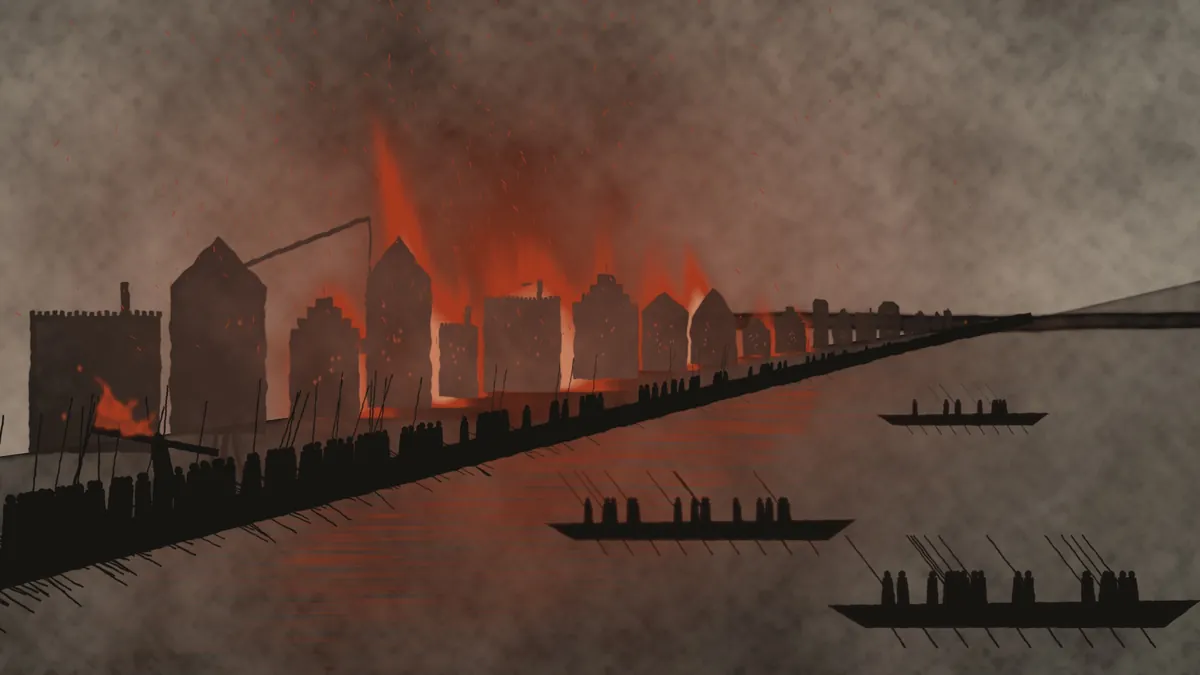
Serath's Counterstroke
The first barge out of Saltmere passed them eight days out of Karthen, a mile above Lissen, loaded to the gunwales with people who had paid too much for the passage.
Hessa stood in the bow of the leading barge and watched it come up the river toward them. It was a big flat-bottomed grain barge, the kind Saltmere built by the hundred, and it was crammed with families sitting on their bundles among chests and rolled carpets and a cage of hens, and a fat man in a fur hat sat on a strongbox in the stern. The bargemen were poling hard against the current. Their faces were set like men rowing away from a fire.
"Ho, the barge!" Hessa shouted across the water. "What news from Saltmere?"
The fat man in the fur hat stood up on his strongbox.
"Saltmere's open!" he called. "Opened her gates three days since! The Houses voted it at dawn!"
"Opened to whom?" Hessa called.
"To the Marshal, woman, who else?" He sat down again, heavily. "Fourteen thousand men and three bells, sitting on the downs above the city. What would you have had them do? Fight?"
The barges passed each other in the current. Hessa watched the fat man go by with his strongbox between his knees. Behind her on the deck, five hundred of the Lissen Free Company sat on their packs with their pikes laid along the gunwales, and none of them said a word.
"Fourteen thousand," said Tobin Reave at her shoulder. Tobin had not raised his voice in eleven years and did not now. "That's a lot of men to feed, Captain."
"It is."
"And Saltmere's warehouses are full," Tobin said.
"They are. Saltmere sold us a summer's salt beef in March and never delivered it. I expect the Marshal's eating it now." Hessa spat over the side into the Arle. "Rot their eyes. The Houses will have made her sign for it."
She had been at Karthen when Orme's letter came, on the first of June, sitting in Wenna Cole's half-mended kitchen with a cup of beer and the company's pay-roll open on the table. The company had not been paid since April, and she had been working out how much of what it was owed she would ever see. Then a rider had come in on a lathered horse with a letter under Orme's seal, and the answer had turned out to be none of it, unless she came home.
The letter was short, for Orme. Serath had come out of the Eastway, the old drove road over the eastern hills, with a second army, fresh from the north. She was marching on Saltmere. The council recalled the Lissen Free Company under the terms of its charter, to defend the city that paid it.
She had read it twice, and then she had gone to find Rovan.
He had been on the outer wall, watching masons rebuild the gate-tower that Maelin had brought down. He read the letter standing up, and gave it back.
"Go," he said.
"You'll lose five hundred pikes. Half your center."
"I'll lose them anyway if Lissen falls. So will you." He had looked at her for a moment in the wind. "She's not coming here. She told me so herself, on a sheet of paper in my own room, and I only half believed her. She's going for our money."
"She's going for my money," Hessa had said. "I take that personally."
Lissen sat on its hill above the Arle, as it had for six hundred years, with its towers and its domes and its walls the color of honey in the evening light. Below the walls, along the river, lay the lower town: the quays and the boatyards, the ropewalks and the tanneries, and the great warehouses of the free cities' trade. There were forty of them in a row along the water, stone below and timber above, with cranes on their gables and their names painted on their doors in letters a yard high. The lower town had no wall on its river side. It never had. Nobody built walls against the river that fed them.
The council met that night in the Hall of the Companies, and Hessa went to it in her mail with the river mud on her boots.
Matthias Orme was in the chair. Orme had not slept in a week, and looked it. He listened while Hessa told them what she had seen on the river, and afterward he told them what he knew.
"Serath's terms to Saltmere were generous," he said. "Very generous. The Houses keep their warehouses, their ships and their trade. The city keeps its laws. No soldier of hers enters the walls without the Houses' leave. She asks only that Saltmere feed her army at fair prices, and send its barges where she needs them." He took off his spectacles and rubbed his eyes. "And she'll keep every word of it. My cousin wrote to me from Saltmere yesterday. Her quartermasters are paying in good silver, and on time. Better than we ever paid you, Captain."
"That's not hard," Hessa said, and a few people laughed, though not many.
"She will come here next," Orme said. "She'll offer us the same terms. And this council will have to decide whether to take them."
"No," Hessa said.
Every head turned as she stood up.
"She'll come here next, you're right. But she won't offer terms first. She's no fool. She'll take the lower town first, the quays and the warehouses, with her river men, before we can do anything about it. After that she'll offer terms. And then she won't need them, because she'll have what she came for." She pointed out of the tall windows, down the hill, to the long row of warehouse roofs along the river in the dusk. "There's grain down there for the whole coalition until harvest. There's the wool and the leather and the iron. There's the money from the sale of all of it, in the counting-houses, and the coalition's war chest in the Guild vaults. If she takes the lower town, she feeds fourteen thousand men all summer on our bread, and pays them in our silver. And the army at Karthen starves."
"We can defend the lower town," someone said.
"With what? My five hundred, and your watch? Against fourteen thousand? Along a mile of open quay?" Hessa shook her head. "I can hold your walls, Councillor. I can't hold your river. Nobody can."
"Then what do you propose?" the councillor asked.
Hessa looked at Orme. He was looking at her already, and his face had gone the color of old paper. He knew. He had known before she stood up.
"Burn them," she said. "Every warehouse on the river. Before she gets here."
They argued until three in the morning.
The merchants shouted. The guildmasters shouted louder. A woman from the Weavers' Guild wept openly, and a man from the Brewers threatened to call out his apprentices. Hessa stood by the window through most of it with her arms folded and let them shout. She had learned long ago that councils had to spend their fear before they could spend anything else.
At three o'clock, Orme stood up from the chair.
"Eleven of those warehouses are mine," he said into the silence. "My grandfather built the first of them. There's eight thousand crowns of my wool in the Long Store alone." He put his spectacles back on and looked down the long table. "I vote with the captain. Burn them."
The vote carried by four, and no cheer went up.
Serath's river men came on the seventh night, two hours after moonset, while the warehouses were being emptied.
They had been emptying them for six days. Every cart in Lissen and every barge on the upper river had been hauling grain and wool and iron up the hill into the city or away upstream toward Merrow. They had moved half of it. The other half lay on the quays when the scouts came in from the east bank, white-faced, to say that a fleet of barges was coming up the river from Saltmere in the dark.
Hessa was on the Corn Quay when the word reached her. She stood on the wet stone in the torchlight and looked downstream, east, toward Saltmere. The Arle ran past the quays from west to east, broad and black and fast with the spring rains. The forty warehouses stood in a row along its bank. Behind them, the lanes of the lower town climbed the hill to the Weavers' Gate in the city wall, half a mile from the water. Downstream, round the bend, she could see a great many lights on the river.
"How many barges?" she said.
"Thirty," said the scout. "Forty. Captain, they've a bell. On the biggest barge, in the middle. I saw it under the torches."
Hessa felt her stomach turn over. "How far out?"
"A mile. Less, by now."
She turned on her heel. "Tobin! Torches to every warehouse, now, the ones that are empty first. Fire them. Don't wait for orders." She raised her voice. "Watch-sergeant Wardle! Where's Wardle?"
He came at a run, a heavy gray man in the city watch's blue coat. Wardle had been a royal sergeant for twenty years before he took Lissen's pay, and he had sworn the old words in Kingsholm when he was eighteen. Nineteen more like him served in the watch. Under the compact Hessa had written in January, every one of them had been tested on his oath, and every one of them was kept from the fighting line whenever a bell might be near.
"You heard?" she said.
"Yes, Captain," Wardle said.
"Take every bound man you have and get them up the hill. Through the Weavers' Gate and beyond it. That bell's field is half a mile round wherever the barge is. If they bring it up to the quays, half a mile's the top of the hill. I want you all past the gate before the first stroke."
"We can fight, Captain," Wardle said.
"You can fight for her. That's what I'm afraid of." She put her hand on his arm. "Go, Wardle. Run."
He went, shouting for his men.
The first warehouse went up as the barges came round the bend.
It was the old Salt House at the downstream end of the row, empty since Tuesday. It was full of dry timber and the dust of fifty years, and it went up as if it had been waiting to. The flames came out of its doors and climbed its walls and burst through its roof in a great roaring column of orange. The whole river turned to fire in the light of it. The second warehouse caught, and the third. Hessa stood on the Corn Quay with her pikes in a line along the water's edge and watched Serath's barges come on through the glare.
They were low, black barges, full of men. In the bow of the nearest, a man in a gray cloak was shouting orders. The men behind him had grapnels and ladders and short axes, and the light of the burning warehouses glinted on their helmets. They were Kharadi volunteers, free men who had come south for the Marshal and for reasons of their making, and no bell had anything to do with them.
In the middle of the fleet, on a broad barge with a timber frame built over it, hung the bell.
It swung in the frame as the barge came up the current. Hessa saw its lip glint in the firelight. The men around it were at the beam, drawing it back.
The note came across the water and up through the stones of the quay into her feet. It shook the windows of the warehouses, and sent a shower of sparks up from the burning roofs. Every pikeman on the quay flinched and swore. None of them turned. They were Lissen men and women, sworn to their company and their city, and they had never spoken a word to any throne in their lives.
Hessa looked over her shoulder, up the hill. Far up the lanes, by the Weavers' Gate, she could see the blue coats of the watch going through it at a run, nineteen of them. She counted again. Nineteen.
"Wardle," she said. "Where's Wardle?"
At last she saw him, halfway up the hill in the middle of the lane, standing motionless. As she watched he turned round and started back down toward the river, toward the bell. He was walking steadily. He had his sword out.
"Bannock!" Hessa shouted. "Kale! Get Wardle! He's turned! Get him up the hill and through the gate and sit on him!"
Old Bannock and Dorrit Kale went up the lane at a run. Hessa did not see what happened. She turned back to the river, because the first barge had hit the quay.
The grapnels came over the edge of the quay stones in a long rattling line. Men came up the ladders behind them. Hessa's front rank put their pikes down and met them at the top.
It was a short, savage fight at the water's edge. The Kharadi came up onto the quay three and four at a time, and the pikes took them as they came. Some fell back into the river. Some got onto the stones and came in under the pike-heads with their short axes, and the second rank met them with swords. Hessa was in the second rank. A man came over the edge in front of her with an ax in each hand. She stepped in close and took him under the chin with the boss of her shield, and as his head went back she drove her short sword into his body. He fell backward off the quay. Another came up the ladder behind him, and she stamped on his fingers and he fell too.
Down the quay to her left a barge had come in among the burning warehouses. Its men were going in through the doors of the Long Store, Orme's store, its wool unburned.
"Tobin!" she yelled. "The Long Store!"
Tobin was already going, with twenty pikes behind him and a torch in his fist, and Hessa saw him go into the Long Store's great door with the Kharadi inside. Smoke rolled out of the door after him. She heard shouting and steel.
The bell rang again, closer now. The bell-barge had come up the current to the middle of the river opposite the Corn Quay, a hundred yards out, and moored there on its anchors. The note shook the quay. A pikeman beside Hessa named Coker dropped his pike and clutched at his throat, and Hessa saw the arrow from the barge standing in his neck. He went down, and Hessa stepped over him and took his place.
Eight minutes, she thought. Every eight minutes they'll ring it, to keep the field up, for when they have Wardle's men in it. And it does nothing to us. Nothing. It's a bloody waste of bronze.
But it did something. It frightened her people every time it rang. She could see it in their faces. They had heard about Karthen. They had heard about Tierney's eight thousand. Each time the note came through the stones they waited for it to take them, and each time they found their hands their own, and they had to steady themselves to fight again.
"It can't touch you!" she roared down the line. "It's a church bell to you! It's a damned dinner gong! Hold your pikes!"
Tobin came out of the Long Store with the roof on fire.
He came out backward through the great door, at the head of his twenty, fighting. Behind them the store was burning from end to end, and the Kharadi who had gone in were coming out after them through the smoke. Tobin's men gave ground across the quay toward the water. The Kharadi pressed them. Behind both, the roof of the Long Store sagged and began to come down, beam by beam, in showers of fire.
Then Tobin did something Hessa would describe to the council a week later, and they would not believe her.
A beam had fallen from the Long Store's gable onto the quay, a great squared timber twenty feet long, burning along half its length. Tobin dropped his pike. He bent down and got his arms round the unburned end of that beam and lifted it. He lifted it off the stones, one end up on his shoulder and the burning end out in front of him like a lance, and he ran with it across the quay. He ran through his men and through the Kharadi. Men threw themselves out of his way. He ran down the steps of the Corn Quay to the water. The fire roared along the beam beside his face. His hair caught.
The bell-barge's mooring boat was at the foot of the steps, roped to the barge itself, and a Kharadi was in it with a boat-hook. Tobin went down the steps into the boat, and the boat went half under, and the Kharadi went over the side. Tobin heaved the beam. He threw it, burning, across the gap onto the bell-barge's deck, where the oil for the beam's chains stood in jars beside the frame.
The deck of the bell-barge went up in a sheet of flame, and Tobin went into the river.
Hessa got him out herself. She went down the steps and into the water to her waist, and Bannock came down after her, back from the hill. Between them they got their hands in Tobin's coat and hauled him up the steps onto the quay. His hair was half burned off and his hands were raw and black, and he was coughing up the Arle. But he was alive, and when he could speak he asked whether the barge had caught.
It had caught. Out on the river, the bell-barge burned from end to end. Its crew cut its anchor cables and went over the side. The current took it, and it turned slowly in the black water, burning, and went away downstream past the burning warehouses toward Saltmere. Through the flames, Hessa could see the bell hanging in its frame, dark against the fire. Nobody was left to ring it.
"Ten minutes," she said. "Ten minutes, and its field's gone. And it's floating away from us." She sat down on the wet stones beside Tobin and started to laugh. "Bannock. Where's Wardle?"
"Through the gate, Captain. Kale and I carried him. Kicking like a mule." The old pikeman wiped his face. "He came back to himself at the top of the hill. Just stopped, and looked at us, and asked us what he'd been doing. Said he'd have killed us both, and we were his friends. We sat him on a bench by the gate. He's sitting there now. He won't get up."
The Kharadi drew off an hour before dawn. They took their barges back down the river, and left a hundred dead on the quays and in the water. Hessa's company had lost twenty-two. She walked the quay at dawn and took their names. Coker. Wil Mortlake. Big Agna. Two of the Hanley brothers, and the third at the surgeon's. Ruth Carver, who had joined in January and could not hold a pike straight. She knew all their faces. She knew what was owed to each of them, to the crown, and to whom it would have to be paid.
Behind her the lower town of Lissen burned all day. When the wind turned in the afternoon, the smoke went up over the hill and darkened the sun over the city, and everyone in Lissen knew what it had cost them.
The price of bread in Lissen doubled in a week, and then doubled again.
Nobody came to enlist. The recruiting tables in the Companies' Square stood empty in the sun. Merchants who had promised money for the coalition's summer campaign found reasons to delay. Torrin's neighborhood companies went home, all four hundred of them, to guard Torrin. Saltmere's barges were working for Serath now, and the river below Lissen belonged to her.
A letter came from Rovan at Karthen three days after the fire. It was short. With the river cities under attack, he wrote, and the grain gone, and the money uncertain, there would be no northern offensive this summer. He would hold the pass. He would not march on Ashgate. He was sorry, and he asked to know what Lissen needed.
Hessa read it in her quarters in the Companies' Hall, with the smell of smoke in her clothes. She sat for a long while with it in her hands. At last she put it down and took out the pay-roll. What was left would keep the company six weeks.
Serath's herald came up the east road under a white flag the next morning.
The Marshal asked for a meeting with the captain of the Lissen Free Company, in person, at the ferry-house on the island in the river a mile below the city. She would come alone but for two officers. The captain could bring whom she liked. There would be no bell within ten miles, on the Marshal's word.
"It's a trap," said Orme.
"It's not," said Hessa. "She doesn't need one."
She went with Bannock and Dorrit Kale, in a skiff, at noon. The island was a low hump of willows and grass in the middle of the Arle, and the ferry-house was a stone cottage on its downstream end with a jetty. Serath was waiting on the jetty.
Hessa had seen her once, across the field at Brackwater, on a gray horse. Up close she was a tall, spare woman of forty-odd, with short dark hair going gray and a long, intelligent face. She wore a plain gray coat without insignia and no sword. She looked like a schoolmistress, or a banker. She gave Hessa her hand to help her out of the skiff, and her grip was dry and firm.
"Captain Dorn," she said. "Thank you for coming. I've wanted to meet you since Brackwater. Your flank march there was the best thing I saw all winter."
"It nearly worked," Hessa said.
"It did work. I lost the arsenal because of it." Serath smiled. "Come inside. There's wine, and it's from Saltmere, so you'll know it's been paid for."
They sat at a table in the ferry-house kitchen. Serath poured the wine herself. She talked for a while about Brackwater and the barge fight, frankly and well, as one soldier to another. She knew the names of Hessa's sergeants. She knew the size of the company's pay arrears, to the crown. At last she put down her cup and laid out her offer, and it was very good.
Lissen would be untouched, and the promise would outlast the war. Serath would put it in writing under her seal and the Sovereign's. No bell would ever come within ten miles of its walls. No Kharadi soldier would enter it without the council's leave. Its trade would go on, and its laws, and its companies. The Lissen Free Company would be paid its arrears in full, in Saltmere silver, this week. It would be taken into the Marshal's service at double its present rates, to garrison Lissen and keep the river. It would never be asked to fight against Auren, or against Karthen, or against any man it had stood beside.
"And all I ask," said Serath, "is that you stop. You've been the best soldiers in this war, Captain. You've cost me more than any of them, except Tal. I'd rather pay you than bury you."
Hessa sat at the table and looked at her wine.
She thought about Coker with an arrow in his neck. She thought about Ruth Carver, who could not hold a pike straight. She thought about Tobin's hands, and the six weeks of pay, and the bread at four times its price. Five hundred people trusted her with their lives, and they could vote her out of her captaincy tomorrow. Here was a woman offering to give every one of them their lives back, in writing, and to pay for the privilege.
"You'd keep it," Hessa said. "Wouldn't you? All of it."
"Every word," Serath said. "I always do. It's why they open their gates to me."
Hessa nodded. She drank her wine, which was very good, and set the cup down.
"No," she said.
Serath raised her eyebrows. "May I ask why?"
"Because you'd keep it." Hessa stood up. "Every town on this river would open its gates for your paper, and sleep well, and never need a wall or a council or a king again. Only a Marshal. That's how he takes a country, isn't it. Not with the bells. With you." She set the cup down. "Thank you for the wine."
She was halfway back across the river in the skiff when the second boat came out from the city to meet her. It was the ferry-boat from the Water Gate, with a royal courier standing in its bow in the king's colors. His horse was blown, the ferryman said; he had ridden it into the ground from Kingsholm.
He shouted across the water before the boats had touched.
"Captain Dorn? Captain Dorn of the Lissen company?"
"I'm Dorn."
"Proclamation of the king!" He held up a sealed paper, as if she might not believe him. "His Majesty summons every soldier of the Crown to Kingsholm by the end of June. Every man who's held a royal commission or taken royal pay, wherever he is and whoever he serves now. The king will take the field himself, Captain. He's going to fight the Marshal with his army, in one battle, and finish it."
Hessa sat in the stern of the skiff with the river running past and looked at the paper in his hand.
"Every soldier," she said. "Every soldier who swore."
The courier only held the paper higher.
"Blood and money," said Hessa. "He'll hand her the whole bloody army."