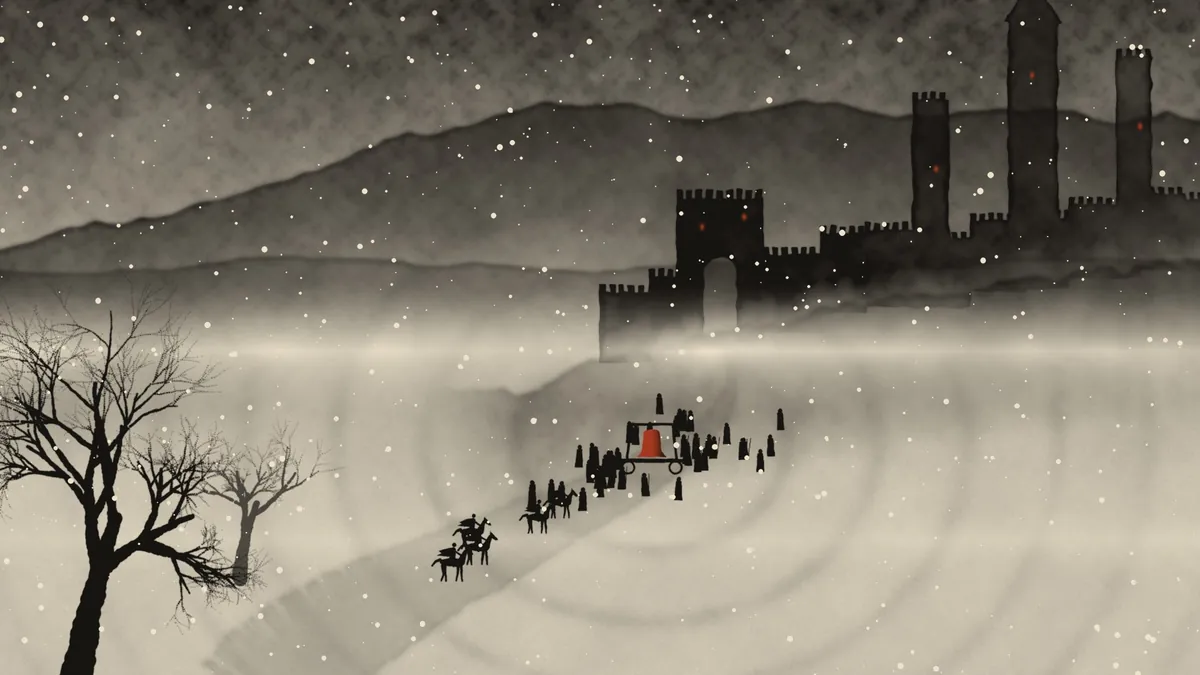
The First Ringing
The bell spoke an hour before dawn.
Rovan was on his back in the dark with his eyes open when it came, and for the rest of his life he was glad of that. He felt it before he heard it. It came up out of the north through the mountain and the walls and the frame of the bed, a single enormous weight of sound, so low it was hardly sound at all. It pressed on his chest. His teeth sang in his jaw. Dust sifted down from the beams of the ceiling onto his face, and the water in the jug on the table shivered into rings.
Then he heard it with his ears as well: a long, deep, bronze note, rolling up the pass and breaking against the fortress like surf. It went on and on. When at last it faded, it sank into the stone and stayed there, humming.
Rovan was out of bed with his feet in his boots and his sword in his hand before the floor stopped shaking.
The inner ward was full of people in their nightclothes, and more were coming every moment.
They had come out of the families' houses and the barracks of the duty company and the stables, with lanterns and candles and nothing, and they stood about on the frozen cobbles, staring north. Children were crying, and somewhere a dog was barking itself hoarse. The sky over the eastern wall was just beginning to go from black to iron, and the stars were going out.
"What was it?" A woman caught at Rovan's sleeve as he passed. "Commander, what was it? Was it a rockfall?"
"Get back indoors and bar the door," he said, and went on.
He took the stair to the inner gatehouse at a run. The inner gate stood open. It always did, at night, so that the guard could pass between the wards. Its gatehouse was a squat stone tower over the archway. From its roof you could see down the slope of the outer ward to the outer gate, a hundred and sixty yards away, and to the road beyond. Edran was already on the roof with a dozen of his company, half-dressed, with their swords out. They all turned when Rovan came up, and he saw their faces in the gray light, and saw that they had no more idea than he did.
"North," Edran said. "Something on the road. I saw lights."
Rovan went to the parapet. Below him the outer ward lay open: the long barracks on the left, the stables on the right, the parade ground between, the armory against the wall by the outer gate. Lanterns were moving down there. Men were coming out of the barracks. And beyond the outer gate, out on the road to the north, something stood in a ring of torches. It was huge and dark, taller than a house, mounted high on a wagon bed. The canvas had been stripped off it and lay in folds on the road. In the torchlight its curve gleamed dull red-gold. Men stood around it with long poles. One of them was drawing back a great beam on chains, slow and heavy, as an archer draws.
"By the Teeth," said someone behind him. "It's a bell."
The beam swung. This time Rovan was looking, and the bell moved. It shuddered on its frame, and the sound came out of it and up the slope and through the gatehouse and through him. The parapet buzzed under his hands. A loose stone fell from the wall somewhere and cracked on the cobbles below. The men on the roof around him flinched and crouched and put their hands to their ears, but it did no good, because the sound came up through their feet.
And in the outer ward, the men coming out of the barracks stopped.
All of them stopped at once. They had been running, stumbling, shouting, pulling on coats. Then the note went through them and they stood where they were. Rovan saw two hundred men stand in the frozen yard, turning their faces north, as men turn toward someone who has called their name. For a breath nothing moved but the lanterns swinging in their hands.
Then they moved, all together, and with purpose.
It was quiet at first, and orderly.
There was no shouting, no cheering. They went about it as a good company goes about a drill it knows. A file of men went to the armory door and broke it in with a bench. Others went to the barracks racks and came out armed. A dozen went running down to the outer gate. The duty company there, the men he had posted on the gate himself in the night, turned to meet them, and he waited for the fight. It never came. The duty company went to the gate with them and laid hands on the great bar, and began to haul at the chain.
A man came out of the barracks late, a young trooper in his shirt, shouting something. He ran to the man nearest him and caught his arm and shook it. The other turned and ran him through, without hurry, and went on toward the gate.
"No," Edran said, beside him. "No. That's Nash's brother. That's young Nash." He leaned out over the parapet and bellowed down into the yard. "Halt! Halt there! Stand where you are!"
Some of them looked up at him. Their faces in the lantern-light were white and staring. A soldier with a spear was crying openly as he ran, his mouth square with it, and still he ran.
A big man came out of the barracks at the head of a file, with a sword. He looked up at the gatehouse and Rovan knew him by his cropped gray head before he saw his face.
"Commander!" Mabry's voice came up out of the yard, ragged and enormous. "Commander, get back! Get the gate shut! I can't stop, sir, I can't hold it!" His feet kept moving. He was coming up the slope toward the inner gate, and the men behind him came with him, and the sword in his hand came up. "Get it shut, damn you, Rovan, I can't stop!"
Rovan looked down at the outer gate. The bar came off its brackets and fell. The great leaves swung inward. And standing in the gateway was a tall man in a captain's coat with his hand on the chain, giving the orders to haul. It was Ivo Brand.
Gray riders came in through the gate behind him at the gallop. Behind them came infantry, close-packed, with shields: the men who had been carrying the torches on the road all night.
"Shut the inner gate," Rovan said.
It would not shut. The inner gate's leaves were oak and iron and four hundred years old, and they took twenty men to move. Half the people who had been in the outer ward when the bell spoke were running toward it now, up the slope, the ones who had not stopped and turned. They were soldiers in their shirts, stable boys, a farrier, the barracks cook, and the families of the men in the outer houses. They came pouring up into the archway with the compelled men behind them. Rovan could not shut the gate on them, and he could not hold the gate open, and he could not tell them apart.
He went down the gatehouse stair and stood in the archway with his sword, and Edran's company came down after him and formed across the opening. The runners came up the slope and through and past them into the inner ward. Behind the runners came the first of the compelled men, with Mabry at their head, and behind those came the gray-cloaked infantry with shields.
Then came something he could not understand.
A boy was running up the slope toward the gate: Kit, Wenna's grandson, who slept in the stable loft with the grooms. He was barefoot on the frozen cobbles, running with his arms going like windmills. Behind him, gaining, came a soldier with a short sword. It was the big fair recruit from the supper, Wylie, who had shaken as he knelt on the flags to swear. His lips were moving on the words he had sworn. He was a yard behind the boy, then a foot, and he raised the sword.
Then, halfway up the slope, between the barracks and the inner gate, Wylie stopped.
He stopped as if he had run into a wall. The sword came down to his side. He staggered, and put out his free hand to nothing, and stood in the open ground in the gray light, gasping. Kit ran on up through the gate and past Rovan and was gone.
Wylie looked at the sword in his hand. He looked up at Rovan in the archway. His face worked.
"I'd have," he said. "Sir. I'd have done it."
He dropped the sword and fell on his knees on the cobbles, and put his hands over his face.
Behind him, Mabry and his file came on up the slope at a run. When they reached the same place, Mabry slowed. The big man's face changed. He shook his head hard, as a swimmer shakes off water, and started to turn.
Somewhere behind him, a voice called out in the northern tongue, sharp and clear. It was one of the gray officers, coming up the slope behind the shields. Mabry flinched as if he had been struck. He turned back, and the file with him, and they fell back down the slope ten yards, and fifteen, and formed a line there, facing the gate, with their swords out and their jaws set.
They came no further. Behind them the gray infantry came on through them with their shields up and their spears leveled, and those men came on all the way.
"Here they come," said Edran.
The fight at the inner gate lasted a quarter of an hour, and it was the worst of Rovan's life until then.
The northern infantry came up the slope in a wedge, close and steady, shield to shield, eight or nine men across and a dozen deep. They took their time. They had good shields, round and iron-rimmed, and long spears, and short heavy swords at their hips, and they fought as Rovan had seen only the best of the Teshar regiments fight. They came into the archway and the front rank went down on one knee, and the second rank put their spears over the first, and they pushed.
Edran's company met them in the arch: perhaps forty men by then, and a few more coming down from the walls. They had no shields and no armor, only swords and a few spears snatched from the guardroom. In the narrow space of the arch it hardly mattered. Rovan found himself in the second rank with a man's back against his chest. He stabbed past the man's shoulder at a face behind a shield and felt the point catch and turn on bone.
The front of his line gave a yard, and held, and gave another.
"Dace!" he shouted. "Where's Dace?"
"Here." The old armorer was at his elbow, in his nightshirt and a leather apron, with a long-handled forge hammer in his hands. His bald head was bleeding. "Who in the Hells are these whoresons?"
"Northerners," Rovan said. "Kharadi, by those shields. The iron valleys. Get men on the gatehouse roof. Anything heavy. Stones, the cooking pots, anything. Drop it on the back of that wedge."
Dace went. The wedge came on, step by grinding step. A spear came through the front rank beside Rovan and took a man in the throat, and he went down without a sound, and the gap opened. Rovan stepped into it. A shield slammed into him. He set his feet and took it on his shoulder and drove up under its rim with his sword, two-handed. The man behind it grunted and sagged. Rovan wrenched the blade free and cut sideways at the next and felt his blade bite the rim of a shield and jar his arm to the elbow.
On his left Edran fought like a man possessed. He had lost his sword somewhere and had a Kharadi spear, and he was swinging it as a drover swings his staff, cracking heads and knees. On Rovan's right a corporal named Lowell was down on one knee, holding his belly. The man behind Lowell stepped over him to take his place, and it was a cook's boy of sixteen with a kitchen cleaver.
Then the stones came down. Dace and a dozen others were on the gatehouse roof. They dropped everything they could lift onto the back of the wedge: coping stones pried from the parapet, a quern, a cauldron full of cold water, a barrel of nails. The wedge buckled from the back. Men went down. The shields came up over heads, and as they came up the front rank opened, and Rovan's line went into it.
It was close and filthy and very loud, a shoving, stabbing crush in the dark of the arch. Rovan struck and struck, with no thought in him but the next blow. He took a cut on the forearm and felt nothing. He killed a man by the gatepost with a blow across the neck, and the man's shield fell on his foot and broke a toe. The Kharadi gave a yard, and another. All at once they were backing out of the arch and down the slope in good order, shields up. They left a dozen of their dead in the gateway.
"Shut it!" Rovan roared. "Now! Get on it!"
They got on it, every hand that could reach. Thirty men and women hauled the great leaves round, through the dead, and the bar went down into its brackets. The bar on the inner gate had no chain. Dace and two others found a wagon axle and jammed it across the bar into the iron rings in the wall, and hammered it home with the forge hammer.
Rovan stood with his back against the shut gate, breathing hard. The sky over the east wall was pale gray now. In the inner ward behind him, hundreds of people were milling in the half-light. They were the families, the runners from the outer ward, Grimsel's women, the grooms, the kitchen girls, Edran's company with their wounded.
Out on the road beyond the outer gate, the bell spoke again.
Rovan felt it come up through the gate at his back. It went through the oak and iron into his spine. He braced for it, braced for himself, braced to see the men around him stop and turn.
No one stopped. They flinched, and covered their ears, and swore, and looked at one another. The man nearest him, the cook's boy with the cleaver, was shaking so hard his teeth clattered. But no one turned. Here, in the inner ward, nothing happened to anyone at all.
Rovan went back up to the gatehouse roof, and looked, and saw what they were doing.
The bell was still out on the road beyond the outer gate, but it would not stay there. While they had been fighting in the arch, the Kharadi had brought up new teams, twenty horses at least, and were backing them into the traces. Rovan could see its great bronze curve riding high over the heads of the men around it, and the crew on the wagon bed hauling back the beam. Below the gate, men were laying planks on the steep last pitch of the road, and others were running long ropes up it from the front of the team. They meant to bring it into the fortress.
Rovan had no notion what the thing was, or who had made it. He could not tell why the men in the outer ward had turned when it rang and the men in the inner ward had not. He could not tell why Wylie had stopped in the middle of the slope, or why Mabry had wavered there and turned back.
He knew only that the thing meant to come closer, and that he wanted it no closer.
"Archers," he said. "Every bow we have. When the teams come through that gate, kill the horses."
They had eleven bows on the inner wall, and the archers strung them and waited. Out on the road the bell spoke again, and again, every few minutes, while the Kharadi worked at the teams. Below the inner wall, in a dark mass around the barracks, the compelled garrison stood waiting, three or four hundred of them, armed and silent, with their faces turned toward the gate.
"It's the bell," Edran said. He had come up beside Rovan with blood in his hair. "Isn't it? When it rang, they turned. It's doing something to them."
"Yes."
"Then why aren't we turning?" Edran asked.
"I don't know." Rovan watched the teams going into the traces. "I don't know, and I'm not waiting to find out. Edran. Get the families into the Long Passage. All of them. Everyone who isn't holding a weapon, and the wounded who can walk. Send them through to the supply gate and down the mule track to the south road. Don't let them stop for anything. Tell them to keep going south past the town and not look back."
"The wounded who can't walk?" Edran asked.
Rovan looked at him. Edran held his eyes for a breath. Then he nodded and went.
"Dace," Rovan said.
"Here," said Dace.
"I want every soldier we've got who can stand. Them too, after the families. Through the passage and out. Send them in companies, with officers if we have any. Tell them to form up on the road below the mule track and wait for me there."
"You'll want a rear guard," said Dace.
"Yes."
"I'll stay," said Dace. "And don't argue with me, Commander. I'm sixty-three and I've a bad knee, and I'll slow your road down to nothing. I'd rather be useful here."
"Thank you, Dace."
"Don't thank me," Dace said. "Thank me when we're out." He spat over the parapet at the bell. "Mother of all the Hells. Look at the size of it."
It took them most of an hour to empty the inner ward, and out on the road the Kharadi worked at the bell all the while.
Rovan stayed on the gatehouse roof and watched the road. He had perhaps sixty men with him now on the walls and in the gate below: volunteers, the ones who would not go. He had the cook's boy and Ellery and a handful of Edran's company. He had old veterans in their fifties, who had come up out of the families' houses with swords taken down from their walls. And he had Dace, with his hammer.
Behind him, in the inner ward, Wenna Cole was organizing the families as she organized a feast. They went in at the mouth of the Long Passage in a column four abreast, mothers with babies, old men with sticks, children holding hands in lines. Wenna stood at the passage mouth with her great arms folded. She had a word or a touch for each one as they went past, and they went in under the vaulted rock and down into the dark. Old Hild went past her in her shawls, leaning on a Grimsel woman's arm. She looked back once, toward the north and the sound of the bell, and went on.
The girl in the red hood went past. Kit went past, carrying another child on his back.
Edran stood at the passage mouth with a dozen of his men, to keep the order. When the last of the families had gone in, he sent the soldiers in after them, company by company. Rovan watched from the gatehouse roof and thought: it will work. We'll get them out.
Then the gray riders came over the wall, where no guard had been set.
They had come round by the terraces on the west side, where the kitchen gardens stepped down the slope of the shoulder below the inner ward. The wall there was old and low and in poor repair, and no one had thought to guard it. Rovan heard the shout from the kitchens and turned and saw them coming up through the gardens, thirty or forty men on foot with their gray cloaks thrown back, running for the passage mouth.
"Edran!"
Edran had seen them before Rovan shouted. He put his dozen across the passage mouth, and the last company of soldiers turned round in the archway and came back to help. The gray men hit them as a wave hits a breakwater. Edran was fighting in the middle of the press with his captured spear, giving ground, a yard and then another, into the archway of the passage, and holding it there.
Out beyond the outer gate, the great team leaned into the traces at last. The bell came lurching up the last pitch of the road and in through the gateway, with men heaving at the wheels. The archers on the inner wall shot at the horses and brought two of them down in the gate. The Kharadi cut them out and dragged the wagon on into the outer ward.
Rovan started down the gatehouse stair to go to him.
The bell spoke. It was close now, very close. It was inside the outer gate, in the outer ward, so near that he felt it in his eyes and his ears and the roots of his hair. It shook the stair under his feet. It shook the gate. Dust and pebbles rained down off the walls of the inner ward. Somewhere a window broke.
All around him, men turned.
He saw it happen from the stair, as he had seen it from the roof an hour before. But this time they were his men.
Ellery was on the stair below him, coming up. Ellery stopped. His face went slack, then tight, and he looked up at Rovan with eyes full of horror, and came up the stair at him with his sword.
Rovan caught the blow on his blade and shoved, and Ellery went backward down the stair and fell sprawling at the bottom.
On the wall to his left, men who had been standing shoulder to shoulder for an hour turned on each other. A gray-headed veteran went off the parapet, knocked there by the cook's boy with the cleaver. The boy was screaming as he did it. At the gate below, half the rear guard had turned toward the bar. The other half were trying to stop them, and they fought in the archway in a tangle of swords and fists.
And on the inner ward cobbles below, Wylie the recruit was walking toward the passage mouth with a sword in his hand. His face was white and blank.
Rovan went down the stair slowly, because he knew already what he would find at the bottom.
The gate was open, because somebody had got the axle out and the bar up. The compelled garrison was coming in through it, the men from the outer ward, Mabry among them. And at the foot of the stair, with his sword drawn and blood on his coat, stood Ivo Brand.
They looked at each other. Brand's face was the face Rovan knew: long and plain and patient, a farmer's face. It was gray now, and running with sweat in the cold, and his eyes were the eyes of a man in a burning house.
"Rovan," he said. His voice was quite steady. "Kill me."
He came up the stair. He was a good swordsman. He always had been. He came up fast, and his first cut was meant for Rovan's neck, and Rovan only just got his blade up to it. The second came low, at the knee. Rovan stepped up and back, and it struck sparks off the stair. Brand came on. His face was working, but his sword was perfectly steady.
"Kill me," he said. "Rovan, I can feel what I'm doing. Every bit of it. For pity's sake, do it."
Rovan took the third cut on his blade, close, and turned it, and kicked Brand in the chest. Brand reeled back and caught himself on the wall. He came on again.
Rovan had sparred with him a thousand times. He knew Brand's sword as well as his right hand: that he dropped his point after a high cut, and that he favored his left knee in the cold. He knew that he could kill him with the next stroke. He saw the opening come, as Brand's point dropped, and he saw the place under the arm where the blade would go in.
He cut down instead and opened Brand's thigh to the bone.
Brand cried out, and his leg went from under him on the narrow stone. Rovan kicked him again, hard, in the chest, and Brand went down the stair backward, end over end, and lay at the bottom on the cobbles. He was trying to get up. He was still trying to get up when Rovan jumped down past him.
The inner ward was a slaughterhouse. Half the rear guard was fighting the other half. The compelled garrison was coming in through the gate. And at the passage mouth, where the last of the soldiers had gone in, the gray riders were in the archway now. They were fighting in the mouth of the passage, and beyond them in the vaulted dark, Rovan could hear screaming.
He went across the ward at a run, over the bodies and through the brawling. Dace came out of nowhere and fell in at his side with his hammer, limping and swearing. Four others came with them, men who had not turned. They hit the gray riders in the archway from behind. Rovan killed one with a cut across the back of the neck, and Dace broke another's spine with the hammer, and they were through, into the mouth of the Long Passage.
Edran was there. He stood in the passage just inside its mouth, with his back to the dark and his face to the ward. His captured spear was gone. He had a sword, and it was dripping. At his feet lay three gray riders, and one of his men, and a boy from the stables. The families were gone; the last of them had gone down into the dark ahead of him, far down the passage, and Rovan could hear them now only as a far-off clamor in the rock. Edran had held the mouth. He had held it alone at the end, and he had held it long enough.
He looked up as Rovan came in under the arch, and Rovan saw his face.
His nephew's face was gray and slick with sweat, and his lips were bloodless. His sword came up. The point steadied on his chest.
"No," Edran said. "No, no. Uncle. Go. Go, before he tells me to kill you."
He came forward. He was not fast. He fought as men fight in nightmares, with his feet stuck, but the sword came on all the same. Rovan parried. Edran cut again. Rovan parried again. He could have killed him a dozen ways, and he could not make his hands do any of them.
Dace pushed past him. The old man swung the forge hammer, and Rovan shouted, but Dace had turned it in his hands at the last moment and struck with the flat of the head. It took Edran on the shoulder and spun him round and slammed him into the passage wall. He went down on his knees.
"Go!" Dace bellowed in Rovan's ear. "He'll be up in a breath. Go, Commander! Run!"
Rovan ran, and Dace and the four men ran with him.
The Long Passage was three hundred yards of dark rock, and it had never seemed so long. He ran it with Dace beside him and four men behind. They ran by the light of a lantern someone had dropped halfway down, still burning on the floor. After that they ran blind. The vault went on and on. His breath roared in it. Behind him he heard feet: many feet, running, and the clatter of weapons on stone.
The supply gate came out of the dark ahead as a square of gray light. It stood open. Beyond it lay the mountainside and the mule track going down. And there, by the gate, two men of Edran's company had stayed to hold it. They stood braced with their swords out against the dark of the passage, as if they had been there all their lives.
"Out," Rovan said. "Out, out, out."
They came out onto the mountainside in the cold dawn. The wind came at them off the snow. Rovan turned, and he and Dace and the two gate guards set their shoulders to the leaves of the supply gate. It was small, oak and iron like all the gates of Karthen, and it moved. It swung. It came round toward the frame.
In the dark of the passage, running toward him, was Edran.
He came out of the black at a dead run with the compelled men behind him. His face showed in the gap of the closing gate, white in the dawn light. His mouth opened. Rovan could not tell whether it would be an order, or a warning, or his name.
The gate shut, and Dace dropped the bar into its brackets. Something hit it from the other side, hard, and again. Then whoever was there began hammering on the oak with a sword-hilt. Rovan stood with his hand flat on the cold iron of the bar and felt every blow through his palm. Behind the gate, through a crack in the timbers, he heard his nephew's voice.
"Go," Edran was saying. He was hammering on the gate with his sword-hilt, and saying it, over and over. "Go, go, go."
Rovan went down the mountain, and kept his eyes on the track.
The mule track dropped down the face of the shoulder in tight bends, steep and icy. At its foot it joined the road south of the town. When Rovan came down the last bend with Dace leaning on his arm, the sun was coming up over the eastern wall of the pass, and the road below was full of people. The families stood there, with Wenna and Kit and the girl in the red hood among them, and the women of Grimsel, with Old Hild on a mule. And soldiers stood there too, four hundred of them perhaps, in their shirts and nightclothes, some armed, some not, some wounded, standing in loose clumps on the frozen road. They watched Rovan come down in silence.
He walked out into the middle of them and stood there, and looked back up at Karthen.
From here the fortress stood over the town against the morning sky. Its walls were gray and gold in the first sun. Smoke went up from its chimneys. A flag flew from the north tower, and it was the flag of Auren, because nobody had taken it down.
The bell spoke. It came down to them across the roofs of the town and the morning air, huge and soft and bronze. In the road, people flinched and caught each other's arms. Rovan saw some of his soldiers stiffen, and their hands go to their swords, and fall away again, as nothing happened.
Then, from the walls of Karthen, there came another sound.
It was a shout. Hundreds of voices together, perfectly together, as a choir sings. It was one word, in the northern tongue, and they shouted it three times. Rovan knew the voices. He had heard them in the hall last night, roaring at Gant's jokes. He had heard them on parade every morning for thirteen years. He had heard them swear.
"Commander," said Dace, beside him, very quietly. "We have to go."
Rovan turned his back on Karthen and walked south.