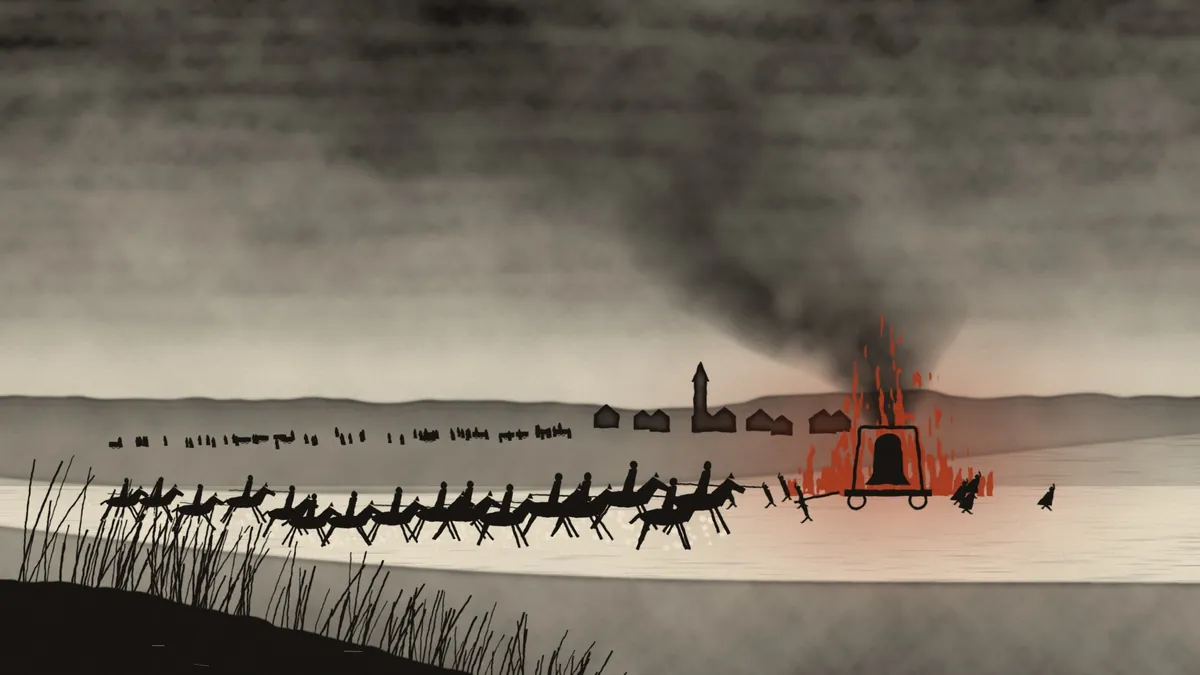
The Southern Holding Campaign
Garrick Aras had been ordered by his prince to preserve his force, and he had brought it to a hill above an Auren village at dawn to watch a man take an oath.
He lay on his cloak in the wet grass under a beech hanger, to spare his coat, and looked down at Hatherley. The village sat a mile south of him in a fold of the downs: a church, a green, a duck pond and some forty roofs of thatch. The Saltmere road ran past it from east to west. Five miles behind him, to the north, the Arle went down toward the sea between its willows, and beyond the Arle lay Lissen and everything Hessa Dorn had left to hold.
On the green stood a wagon. It was a heavy, ugly thing on six wheels, drawn by a team of twelve. The shape under its canvas was the shape every child in the river country had learned to fear since June. In front of it the commissioners had set up a trestle table with a cloth on it and a book. The men of Hatherley were lining up before the table in their Sunday coats. Their wives watched them from the doorways.
"They've dressed for it," said Lieutenant Corvo, beside him. "Look. Clean collars."
"They have been told it will protect them. When a man is told a thing will protect his children, he puts on a clean collar." Garrick took the glass from his eye and wiped it on his sleeve. "How many of the gray gentlemen?"
"Sixty in the escort, on foot, with spears. Eight on the bell. Two clerks, and the commissioner."
"The commissioner is mine," said Garrick.
"You said that at Brennan's Mill, my lord."
"I have since revised my opinion of royal commissioners." Garrick put the glass back to his eye. A man in a black coat stood behind the trestle with a paper in his hands. The first villager knelt on the grass. "Plague and pestilence. They have started. Corvo, take your half-squadron round by the hollow lane, and come in from the east when you see my light. Not before."
"And you?"
"I shall go down through the hedges and make myself conspicuous." Garrick got up onto his knees and began to fold his cloak. "Every man who kneels at that table is bound until the Seat itself is broken, and the Seat is a long way north. I would rather not stand here admiring the view while the whole village is given away."
Corvo went, crouching, back through the beeches to the horses. Garrick finished folding his cloak, because there was no sense in creasing good wool, and went after him.
His mare was called Merivel. She was a bay Teshar mare of eleven, of the Ashar line on her dam's side, with a white sock on the near fore, a mouth like silk and the temper of a dowager, and she had carried him through two wars and a great many arguments. She disapproved of hedges. She took the first one below the hanger with a flick of her heels to say so. The forty riders behind him came over it in a ragged wave and spread out along the field beyond.
On his saddle-bow, in a cradle of iron hoops, rode a brass pot with a pierced lid. Inside it, packed in ash, a coal from last night's fire glowed red. Garrick's fire had to start from fire. It could not be called out of the air, whatever the ballads said about southern mages. He needed a live flame to begin with. After that he could take it and make it into many things: a wall of glare, a flash, a roll of smoke, a running line of grass-fire. He could not make it hot enough to kill a man where he stood. He had tried once, young and very angry, in the border war. It had cost the other man his eyebrows and Garrick two days of fever.
They went down the second field at a trot, and the third at a canter. The village came up toward them, roofs and smoke and the square church tower. Garrick could see the green clearly now. Four men had sworn and stood aside by the church wall. A fifth was kneeling.
Somebody on the green saw them. A gray-cloaked spearman shouted, and the escort turned, quick and orderly, and began to form a line across the top of the green between the riders and the wagon. On the wagon, the bell crew threw back the canvas.
The bell came out of its covering, dull bronze in the gray morning, as tall as a man and broader than a cart. Two of the crew sprang for the striking-beam, which hung beside it on chains. They began to draw it back.
Garrick opened the lid of the brass pot and put his bare hand over the coal.
He felt it come up into his palm, the small, fierce heat of it. He took it, and he pulled, and it came out of the pot after his hand like a thread out of a spool, and he threw it ahead of him across the green.
It went up over the green and burst. There was no wall this time and no sheet of glare, only a single white crack of light, there and gone, that left every man on the green blinking at a green sun. The spearmen in the line reeled and threw up their arms. The two men on the striking-beam let go of it and clawed at their faces. The beam swung back on its chains, halfway drawn, and knocked one of them off the wagon.
Garrick had shut his eyes for it. He had learned that at nine years old, the hard way, and had worn a bandage for a week. He looked at the ground in front of Merivel and put his heels in.
They hit the escort line at the gallop.
The spearmen were good. Even blind, half of them got their points up, and Merivel had to swerve round one who stood his ground with his eyes streaming. Garrick cut at him in passing and felt the blade bite on the man's shoulder. He went through the line. Behind him he heard his riders strike it, the crash and the screaming of horses and men. A moment later he was among the clerks at the trestle table, the book was on the grass, and the commissioner was running.
Garrick rode him down beside the duck pond and struck him on the back of the head with the flat of the blade, and he went face first into the water.
On the wagon, a ringer had found the striking-beam again.
He was blinking, and wet-faced, and he groped along the chain to the beam and hauled it back with both hands. The beam rose. Garrick turned Merivel on her haunches and drove her at the wagon. It was ten yards. He saw the beam reach the top of its swing. He saw the man set his feet to throw it.
Merivel reached the wagon's side and Garrick stood in his stirrups and cut the man across the thigh, under the beam. The ringer screamed and fell sideways. The beam came down by itself, without his weight behind it, and touched the bell.
It was hardly a stroke. It made a dull, small note that died before the end of the green. Garrick sat frozen in the saddle, with the hair standing on his arms, and waited to see whether the four men who had sworn would turn.
They stayed by the church wall with their mouths open, staring at the fighting on the green.
"Corvo!" he roared. "The beam! Get the beam!"
Corvo's half-squadron had come in from the east, through the hollow lane, as he had told them. Three troopers were already at the wagon. One of them climbed the wheel and cut the chains of the beam with an axe. It fell off the wagon bed into the mud and lay there, a long baulk of oak shod with iron. The other two killed the last of the crew on the wagon. It was quick, and it was ugly, and when it was done the bell stood alone on the wagon bed and nobody touched it.
A flash cost less than a wall, and the cold came into his hands all the same, a deep ache in the finger bones. The escort had broken. A dozen of them were running south across the fields toward the woods. The rest were down on the green, or kneeling with their hands up, or holding off a ring of riders with their spears and calling for terms in the northern tongue.
"Give them terms," Garrick said. "Take their spears and their boots and send them back to their marshal. Tell them to say that Garrick Aras of Teshar sends his compliments." He looked at the bell. "Teodor. Bastien. Bring the irons."
The irons were Maelin Rennick's invention, or rather Maelin's notes, which she had written for him in May in a hand like a fence in a gale. "The crown is the weak place," she had written. "That is where the canons join the shoulder, the loops it hangs by. Bronze is hard and brittle. Drive a wedge into the joint and hit it with something heavy and honest, and the crown will crack. A cracked crown is a dead bell. Do not waste time on the body. Do not waste time on the wagon. I have seen fools do both."
Teodor and Bastien were the two largest men in the Teshar horse. They climbed onto the wagon with a sack of iron wedges and two long-handled sledges, and set to work at the crown of the bell. The noise was terrible. The villagers came out of their doorways to watch.
The fourth wedge went in, and Bastien swung, and something in the bell gave with a sharp, dry crack. Teodor lifted away a long, jagged piece of bronze and held it up for the village to see.
The man who had been kneeling at the table when the riders came was standing by the trestle. He was in his fifties, thick and gray, and his clean collar was crooked. He had not finished his oath. He looked at the broken bell, at Garrick, and at the four men by the church wall.
"Will it hold them?" he said. "The ones who swore. Now it's broken."
"This one will hold nobody." Garrick took off his hat to him. "But they have sworn, sir, and the oath stays. Another bell can take them. They had better come north with us, over the river, and keep well away from anything with a clapper in it."
"North," the man said. "To Lissen."
"To Lissen, or beyond," Garrick said. "Captain Dorn will feed them, and complain to me about the cost."
The man looked at him for a while. Then he said, "I'm Amos Tarrant. I'm reeve here. I spat at your riders, last month, when they came asking for remounts. I'm sorry for that now."
"My riders have been spat at by better men than you, Master Tarrant, and by several worse. Get your people moving. You have an hour."
They were on the road in less. Garrick sat Merivel at the edge of the green and watched them go: carts, barrows, a priest with the church plate in a sack, children leading goats. Corvo rode up with the commissioner over his saddle, wet and groaning, and said that four sworn out of three hundred was better than Corley.
"Four too many," said Garrick, flexing his cold hands. "And there will be another village tomorrow, and another bell."
There were, as it turned out, a great many villages, and a great many bells.
Through the rest of July the war on the Arle came down to that. Marshal Serath held the south bank with twenty thousand men, most of them Aureners compelled by her bells. She meant to cross, take Lissen, and stitch the free cities into a province that would feed her. Against her stood Hessa's pikes, the Lissen militia, and Garrick with eleven hundred horse.
They could not beat her, and they never tried. They held the fords. They kept her columns moving and her foragers hungry. They rode into the south bank at night and broke up the swearings, and when they could not break them up they emptied the villages before the commissioners came. Garrick's riders killed bell crews in four places and cracked three bells. Hessa's barges carried the people north: farmers, priests, millers, whole parishes with their pigs. The free cities, which had squabbled all spring over the cost of the war, began to send boats and bread unasked.
In the third week of July, Serath came for Otter Ford.
Garrick saw the whole field from the north bank, sitting Merivel on the low rise where the Lissen road came down to the water. The Arle here ran from his right hand to his left, west to east, two hundred yards wide and waist-deep over a gravel bar. On the south bank the meadows rose gently to a line of elms. Serath's column was coming out of the elms in a long, steady mass, with banners and drums and a bell wagon in the center of it.
Hessa had her pikes in the water.
She had put them on the gravel bar itself, in a block twelve deep, with the river round their knees and the current pulling at them. It was the only place on the ford where a man could stand. On either side of the bar the channel dropped to six feet, fast and green. Anyone who came at Hessa's pikes had to come at them head on, across the bar, through two hundred yards of water.
Garrick rode down to the bank where she stood at the back of her block, up to her thighs in the river, with her sword under her arm and her helmet pushed back.
"Good morning, Captain."
"It's a bloody awful morning, my lord." Her eyes were on the far bank. "How many, would you say?"
"Four thousand," Garrick said. "Perhaps four and a half. A regiment of Aureners in the front, under the bell. They are wearing the Lune facings, poor devils. Kharadi behind."
"And the bell's coming into the river," Hessa said.
"If she means to cross, it must. If it stays on the south bank, its field stops a few hundred yards up the Lissen road, and her Aureners wake up there." Garrick looked at the wagon, rolling down through the meadow behind the front ranks. "She will bring it to the edge of the bank at least. From the water's edge its field reaches well up the road behind you. You will have the Lune regiment on your pikes, and they will not stop until they are dead or you are."
"I know what a half-mile is, my lord." She raised her voice. "Tobin."
Tobin Reave came wading down the back of the block. His hands, burned raw at Lissen in June, had healed pink and shiny. One held a sledge, and Maelin's wedges hung in a sack from his belt.
"Captain."
"When that wagon comes into the river, I want it," Hessa said. "If it comes into the water, it will be on the gravel, and it will be in reach. You take the breakers and you go for it. Lord Garrick will blind the team for you."
"Will I," said Garrick.
"You will, my lord, because it can't be done without you." Hessa looked at him at last. "And then you'll keep the Kharadi off Tobin while he works, because I can't spare a man off this bar."
Garrick bowed from the saddle.
The Lune regiment came down into the river at a walk, with their drums beating and their pikes sloped.
They were Aureners. Garrick could see their faces as they came out into the water, and he made himself look at them. They were farm boys and town boys, tanned from the summer's marching, in the red-and-white facings of the Lune country. They had taken the old oath, and their bodies came on as one body. Their faces were another matter. Some were calm, as though they were sleepwalking. Some were working and twisting. A sergeant in the front rank was shouting something over and over at the pikes ahead of him, and when they came close enough Garrick heard what it was.
"Kill us! Kill us first! Don't let us through!"
The bell spoke behind them.
It had come down to the water's edge on the far bank and stopped there, with its crew around it and a company of Kharadi spearmen in a ring outside the crew. The note came across the water as a pressure, low and heavy, and Garrick felt it in his breastbone. Merivel laid her ears back. On the bar, Hessa's pikemen flinched and set their feet. They were Lissen men and Lissen women, contract soldiers, and no bell had ever held them. They had learned what the sound meant all the same.
The two blocks met in the middle of the ford.
The Lune men came on into Hessa's points without flinching, because they could not flinch, and the front ranks of both blocks locked and heaved and screamed. Pikes went into men. Men went down into the water, and the current took them, and some of them came up again downstream and some never came up. Hessa's block gave a yard. It held. It gave another.
On the far bank, the bell crew drew back the beam. The drivers whipped up the team, and the wagon lurched forward and rolled off the bank into the river.
"There she comes," Garrick said aloud. "Plague take her for a clever woman. She means to bring it over behind them and carry the field across with her."
The wagon came down into the water with a great sheet of spray. Twelve horses dragged it out across the shallows at the edge of the bar, the bell swaying high on its frame, the crew clinging to the side-rails. Kharadi spearmen waded on either side of it, and the field came with it.
Garrick opened the brass pot.
This time he made no light at all. He laid the thread on the water and let it smolder, and the smoke came off it thick and yellow-white and rolled low across the ford on the breeze, into the faces of the team. Twelve horses went blind in a reeking fog that stank of burnt weed. They reared and screamed and tried to turn all at once, and the wagon slewed sideways across the current. Its off-side wheels went over the edge of the gravel bar into the deep channel. The whole great frame tipped, and hung, and settled, canted over at an angle with the bell swinging hard against its chains and the river pouring white round its wheels.
The bell rang once, by itself, as it struck the frame. Garrick felt it in his ribs.
"Now, Tobin!" Hessa bellowed. "Now!"
Tobin went out of the back of the block with eight breakers behind him. They went round the flank of the bar, chest-deep, holding their sledges over their heads, and the current shoved them sideways and they leaned into it and kept going. The Kharadi spearmen around the wagon saw them coming and turned to meet them.
Garrick went with fifty riders into the river.
He had not meant to. It was a very bad idea to put cavalry into a ford, and he knew it. Merivel knew it better, and told him so all the way across the shallows, but she went. The water came up to her chest over a bottom of gravel and mud. A Kharadi spearman turned and braced in the water ahead of him. Garrick leaned down from the saddle and met the spear with his blade, rolled it off, and Merivel shouldered the man under. He came up behind them, choking. Garrick let him live.
Tobin had reached the wagon. He went up its tilted side on hands and feet, with his sledge in one fist. Two breakers went up after him. A Kharadi on the wagon bed met him at the top with a short sword and cut at his head. Tobin took it on the sledge-handle and hit the man in the chest with his free hand, and the man went backward off the wagon into the deep channel.
The crew were trying to strike again. Their chief had the beam in his hands. He hauled it back and threw it, and the bell spoke full and deep, and the field rolled out again over the river. On the bar, the Lune regiment, which had begun to falter, steadied and drove forward into the pikes.
He put Merivel at the wagon's low side, where the wheels were sunk in the channel, and stood in his stirrups and caught the side-rail. A spearman thrust at him from the wagon bed. He took it on his left forearm, through the coat, and felt the point go in and grate. He swore. It was a long, careful, inventive oath, with a duke and a goat in it, and he cut the man down in the middle of it.
"I beg your pardon," he said to nobody in particular, and pulled himself up.
On the wagon bed Tobin was at the crown with his sledge. Bastien had followed Garrick across and was holding the wedges. The first wedge went in. Tobin swung. The whole wagon shook, and the bell sang a short, shocked note, and Garrick felt his teeth jar in his jaw.
A Kharadi spearman came up over the far side-rail.
He came up quick and low, out of the water, with his spear short in his hands. He had been in the river under the wagon bed all along, unseen. Garrick shouted. Tobin turned on the slant of the boards, too slow, and the spear took him in the thigh and went through.
Tobin went down on one knee. He made no sound. He took hold of the spear-shaft with one hand and held it there, so the Kharadi could not pull it free, and with the other he swung the sledge sideways at the man's head. The sledge took him on the ear. The spearman dropped back into the river.
"Tobin," Garrick said.
"The crown, my lord," Tobin said, in his soft voice. "The second wedge. Quick, please."
Garrick took the wedge from Bastien's hand and set it himself, in the crack beside the first. Bastien swung. Bronze cracked like river ice in March. Tobin, kneeling on the slant of the boards with the spear through his leg, reached up and took hold of the canon and pulled, and a great piece of the crown came away in his hand.
On the bar, the Lune regiment stopped.
Garrick saw it from the wagon bed. The whole block halted in the water, and the sergeant who had been shouting "Kill us" turned and waded straight for the far bank, roaring at the Kharadi behind him to come and face him.
Hessa's pikes went forward over the bar.
The Kharadi did not wait to be pushed. They fell back through the shallows in good order, and up the far meadow, and into the elms. Behind them they left their dead, and the wrecked wagon, and three hundred men of the Lune regiment standing in the river with no idea what to do next.
Tobin Reave lay in the miller's kitchen at Otter Ford with a surgeon from Torrin bending over his leg.
The spear was out. It had gone through the meat of the thigh and missed the bone and the great vessel, and the surgeon said that was the Lord of Mercy's luck and he should light a candle. The bandage was red already. Tobin lay on the miller's table, with his boots hanging off the end because the table was too short for him, and listened to the surgeon's lecture with polite attention.
Hessa stood in the doorway with her arms crossed and her face shut.
"He'll keep the leg?" she said.
"If it doesn't go bad," the surgeon said. "If he lies still. If he doesn't try to march on it for a month."
"He won't." Hessa looked at Tobin. "Will you."
"No, Captain."
"Liar." She came and stood by the table and looked down at him. "That was a bloody stupid thing, holding on to that spear."
"It seemed the thing to do," Tobin said.
"It cost me a lieutenant for a month, and the surgeon's fee, and a new pair of breeches out of company stores." Hessa put her hand on his chest, quick and rough, and took it away again. "Go to sleep, you great ox."
She went out into the mill-yard, and Garrick went after her.
The yard was full. The Lune men were there, three hundred of them, sitting in rows against the barns. They were bound yet, every one of them, and would be until the Seat was broken. Hessa's people moved among them with bread and ale, and the Lune men took it without looking up.
"I'll send them north," Hessa said. "One bell in reach and I've got three hundred enemies inside my lines." She leaned on the gatepost. "We lost forty-one on the bar. Forty-one, for one bell and one ford. The cities will pay their families for twenty years."
"You will have put that in writing, I suppose," Garrick said.
"I put everything in the contract." She rubbed her face. "How's your arm?"
"Indifferent." Garrick's forearm was bound up in a strip of the miller's tablecloth. It throbbed with his heartbeat, excessively. "There is a letter for me in my tent. It came round by the western road this afternoon, under my prince's seal. I have not opened it."
Hessa looked at him. "I know what's in it," Garrick said.
He opened it that night, in his tent, by the light of the brazier.
It was short, and in his prince's beautiful hand, not a secretary's, which was worse. It thanked Garrick for his service. It commended his conduct at Brackwater and at Callan Downs. It observed that the war in Auren was Auren's war. The Crown of Auren was in the hands of its enemies now, and the Princes of Teshar had made their treaties with the Crown, never with the river cities. It reminded Garrick of his instructions, and ordered him to bring the cavalry of Teshar home before the harvest, while it was whole.
Garrick read it twice. Then he leaned forward on his camp stool and laid it on the coals of the brazier.
The edge of it curled and went brown. A little flame ran along the bottom of the page, blue, then yellow. He sat and watched it. He thought of eleven hundred riders, and their horses, and their mothers in the south. He thought of the Lune regiment standing in the river, and Amos Tarrant with his crooked collar, and Tobin kneeling on the wagon bed holding the spear fast in his leg so that the man could not pull it free.
He reached into the brazier and took the letter out again.
He did it with his bare fingers, quickly, and he burned them, and he swore. The flame went out between his fingers and thumb. Most of the page was whole. Only the bottom corner had gone, with the date and half the seal.
Garrick smoothed the letter on his knee and looked at it.
If he burned it, he could say that it had never come. He could tell his prince, in the autumn, that the roads had been closed and the couriers taken, and that he had acted on his last instructions as best he understood them. Princes expected that sort of thing, and forgave it. He would be lying to a man he had served for twenty years, and the man would know it, and they would both pretend.
If he kept it, he would have to answer it.
He sat for an hour with a pen in his hand, and at last wrote the date and the salutation. Then he folded the prince's letter, scorched as it was, and put it inside his coat, where he would feel it against his ribs every time he drew breath.
The rest he left for another night.
The scout came in ten days later, at noon.
He was a boy of nineteen called Pirro, one of the light riders who went out in threes and watched the roads. He slid off a lathered horse in front of Garrick's tent and stood swaying.
"My lord. Serath's moving."
Garrick was at his table with Hessa and the Torrin surgeon and a map of the south bank. He put down his pen.
"Moving where? Across?"
"No, my lord. East." Pirro took a breath. "The whole army's on the Saltmere road, going east at the double. Not raiding. Not swearing villages. They've left most of the bells with the garrisons, all but three, and they're marching hard, fifteen miles yesterday, more today. We followed them as far as the Saltmere hills. They've turned north-east at the crossroads past Saltmere. They're on the hill road."
Hessa looked up sharply.
"The hill road goes nowhere," she said. "Not for two hundred miles. Not until it gets to the mountains."
"The Eastway," said Garrick.
He got up and went to the door of the tent and looked out, east, toward the low blue hills where the Arle ran down to Saltmere and the sea. Somewhere beyond those hills the best part of her army was marching hard, along a slow, long road that ran north through the end of the mountains to the capital of the buried king.
"She has had word from the north," he said. "Something has happened up there. Something she does not like."
"Rovan," said Hessa.
"Rovan, or Maelin, or both of them. And the king went north on that road a month ago, with her guard around him." Garrick put his hand inside his coat and felt the stiff, scorched edge of his prince's letter against his ribs. "She is going home, Captain. And she is taking an army to the back door of the house where our friends are fighting."
Hessa was already on her feet. Garrick sat down at the table, took the scorched letter out of his coat, and turned it over to its blank side. He wrote one line under the date. "Highness. I have received your letter." Then he sanded it, and folded the two sheets together, the prince's and his own, and put them inside his coat against his ribs, and went out to see about the horses. It was two hundred miles to the Eastway, and Merivel disliked hills.