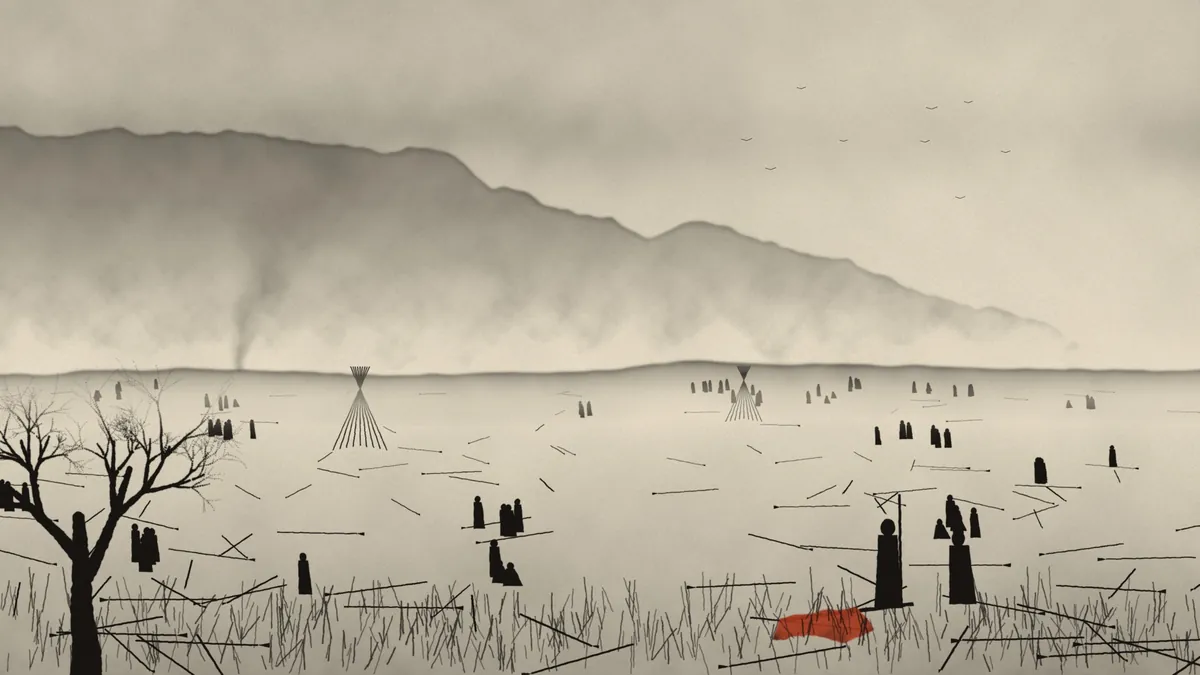
The Armies Released
Nobody told Hessa Dorn why seven thousand men stood up off their knees in the road below the Furnace Gate a little after one in the morning.
She had been watching them kneel for an hour. She had stood at the end of her line by the toll-house with her pike grounded and her company behind her, five hundred of Lissen and two thousand more. From there she had watched the whole royal army of Auren kneel in the road in the firelight, with its faces to the cliff. No orders had come to them. Serath's officers had pulled back east with her gray volunteers when the third bell stopped, and none of them had come back. So the Aureners had knelt there, and Hessa's people had stood and watched them, and neither side had known what to do.
Then, all at once, they stood up.
They did it raggedly. One here, a dozen there, then hundreds. They got up and stood swaying in the road, and looked at each other, and at the cliff. The sound came across the field to her: a long, low, broken murmur, rising, like a crowd at a hanging when the trap fails.
"What's happened?" said Tobin Reave. He was standing at her shoulder, a head and a half taller than she was, with his leg stiff yet from the summer. "Captain? What is it?"
"How should I know? I'm a pike captain, not a priest." Hessa watched. "Something's happened in the mountain. The great bell's stopped. Or they've stopped it."
"Then they're free."
"For now, Tobin, until somebody rings something else at them." She spat. "And I'm standing in a field at one in the morning looking at seven thousand men I can't feed. Somebody find me a cup of something. And find me where Serath's gone."
They found Serath at first light, on the Cinder Knoll.
Hessa went up the slag heap by the Eastway road herself to look, with Tobin and two of her sergeants. She lay on her belly on the sharp black cinders at the top, with the dawn coming up gray on her right. The basin lay spread out to the north. The Kharad Wall stood across the north with its shafts gone dark at last. Under it the lower city was smoking in a dozen places, and the coalition's colors hung over the Furnace Gate in the outer wall. In front of the wall, in the road and the burnt stubble, the freed Aureners stood or sat or lay about in their thousands. Hessa's line ran south from the toll-house to the Gullet.
And to the east, under her, on the lower slopes of the knoll where the Eastway came down onto the field, stood Serath's Kharadi.
About two thousand of them remained, in their gray coats, drawn up in a long hollow square on the slope with their round shields facing out. They had a good position, with the knoll at their backs and the Eastway open behind them. A gray horse stood in the middle of the square, with a rider on it.
"She's waiting," said Tobin.
"She's waiting to see what's happened, same as we are. She doesn't know yet either." Hessa wriggled back from the edge. "When she knows, she'll do one of two things. She'll go back up the Eastway, and we'll have her army in our backs for a year. Or she'll come down on those poor bastards in the road, who've thrown away their weapons and couldn't fight a goose."
"What do we do?"
"We don't let her do either," said Hessa.
She came down off the knoll and got them up. Everybody, all three thousand, before the sun was a hand above the Eastway. Tobin wanted to know why, if the great bell was down and the Aureners were free, and she told him.
"Because she was never bound, Tobin, and nor were they. They're volunteers. They chose. Whatever's happened in that mountain, they're as dangerous as they were last night, and now they've nothing to lose. Get them up."
Serath came down off the Cinder Knoll an hour after dawn, and she did not come for the road.
Hessa had been sure she would. She had put her pikes across the bottom of the knoll between the Kharadi and the road, in three ranks. The five hundred of Lissen stood in the middle, with the Otter Ford and Merrow companies on either side. Rovan's thousand stood behind them in reserve. The gray square opened on the slope into a wedge, two thousand shields, and came down at a run, and Hessa saw where it was pointed before it had finished forming.
Not at the road. At the wagons.
Three of them stood in the stubble east of the road where Garrick's riders had left them in the night, a few hundred yards apart. Their teams were cut loose and their crews dead or run. Three bells, silent since before midnight. Seven thousand men stood within half a mile of the nearest with their weapons thrown down. Serath knew nothing of what had happened in the mountain. All she knew was that her bells had been stopped, and a stopped bell was a bell waiting for a beam.
"Blood and iron," said Hessa. She had thought of two things Serath could do, and missed the third. "The wagons! Tobin! Left wheel, the whole line! Get me between her and the wagons!"
Three ranks of pikes do not wheel quickly. The Lissen five hundred swung on their left like a gate on its post. The Merrow company on the outside had to run to keep the line, and the Otter Ford men on the inside trod on each other's heels. The wedge was faster. Its point reached the nearest wagon a hundred yards ahead of the Lissen front, and the gray soldiers went up the wheels of it like ants up a sugar-loaf. An officer with a bronze gorget at his throat climbed onto the bed with four men behind him, and they laid hold of the beam on its chains and began to haul it back.
Hessa's line hit the wedge's flank at a run.
"Ground pikes!" she screamed. "Front rank, kneel. Second rank, over. Third rank, over. Wait for it. Wait for it, damn your eyes, wait!"
The Kharadi did not run onto the pikes, because they were not fools. They came in at the last moment with their shields up and their swords out, and knocked the pike-heads up and aside and tried to get in under. A gray soldier slapped a pike-head away and ducked under the shaft and came up into the front rank with his sword. He killed the kneeling pikeman there, a Lissen boy called Danno whose mother sold eels on the Water Stair, and the second rank stabbed him from above, and he fell across Danno's body.
Then the bell spoke.
Hessa felt it through the soles of her boots, the way she had felt a dozen of them that summer, and it meant nothing to her, because she had never sworn the Seat anything. She turned her head and looked at the road, and so did every man in the line who could spare the eyes.
Seven thousand Aureners stood in the road. They stood in the road and looked at the wagon.
Not one of them knelt. A few put their hands to their heads, as if the note had hurt them. One of them, a sergeant in the torn blue of Dunmere, picked up a stone off the road and threw it at the wagon. The officer on the bed stood with his hand on the beam and stared at them. He had his men haul the beam back and struck again. The note went out over the field, deep and long and useless, and seven thousand men stood where they were and let it pass over them like weather.
Along the gray wedge, Hessa saw the shields waver.
"Hold them!" she was screaming. "Hold them, Lissen! Hold them, you sons of bitches, you're paid to!"
All along the line it was the same. The Kharadi fought their way in under the pikes, and the pikes stabbed down at them, and the front rank fought with daggers and fists and the butts of their shafts. The noise was enormous, a roaring, grinding crush of men shoving at men, and the gray shields pushing, and the pikes going down and coming up wet. The line bowed. In the middle, where the five hundred of Lissen stood, it held.
Hessa fought in the third rank with a pike, where she had stood in every fight for eighteen years. She drove it over the shoulders of the two men in front of her, into the press, and felt it strike a shield and slide and strike something else. She pulled it back and drove it again. A gray soldier got in past the front rank and the second rank and came at her with a sword. Tobin, beside her, dropped his pike and took the man by the throat and the belt, and threw him back over the second rank onto the Kharadi like a bale of wool.
On the left, the Otter Ford company gave way.
She saw it go. The Kharadi had broken in among the Otter Ford pikes, and the pikes were too long to fight with at close quarters, and the Otter Ford men were dropping them and running. A gap opened in the line, twenty yards wide. Through it, Hessa could see the road, and the freed Aureners in it beginning to scatter.
"Tobin! The reserve! Get Rovan's thousand into that gap!"
But the gap was filling already, and not with Rovan's thousand.
They came out of the road. They were the freed Aureners, the men who had stood up off their knees in the night and had just heard a bell and kept their feet. A few hundred of them came up out of the road at a run and threw themselves into the gap. They wore the old blue coats, many without helmets or armor, some with weapons and some with none. They picked up the Otter Ford men's dropped pikes. They picked up stones. At their head was a tall, gaunt, gray-haired man in the torn coat of a lord marshal of Auren, with a sword in his hand.
Hessa knew him. She had seen him across the field at Callan Downs, leading the king's army against the king.
"Tierney," she said. "Gods help us. It's Tierney."
Lord Marshal Tierney went into the Kharadi in the gap at the head of his men, and fought them hand to hand among the dropped pikes. Hessa saw him kill one gray soldier and be knocked down by another and get up. The Aureners closed round him. They fought like men who had a long debt to pay, and they paid it there in the gap, and the Kharadi wedge broke against them.
It broke all at once, as such things do. One moment the gray shields were pushing; the next they were going back. They went back up the slope of the knoll, and Hessa's line went after them. Somebody had found Garrick's riders. Sixty or seventy Teshar horse came round the southern foot of the knoll at a canter and hit the Kharadi in the rear where they were trying to re-form, and that was the end.
The square was gone. The gray soldiers were going up the knoll and over it in twos and threes, throwing their shields away, running for the Eastway. Some were sitting down on the slag with their hands on their heads. Some, a few hundred, had drawn up round the gray horse in a ring at the knoll's foot, and were fighting on.
Hessa went for the ring.
She went with Tobin and fifty of her company, shoving through the wreck of the fight. The ring was tight and it was brave. The men in it were older than most, gray-bearded, and they stood shoulder to shoulder round their marshal with their shields locked and their swords out, and asked no quarter. Hessa saw a Lissen sergeant, Wexley, go down in front of them with a sword through his thigh. She saw Tobin catch a shield-rim across the face and stagger back with his nose broken.
"You're in good company," Hessa said, and stepped into the space he had left.
She had dropped her pike somewhere. She had a short sword now, a Kharadi one, picked up off the ground. A gray-bearded Kharadi came at her over his shield. She took his blow on the short sword's blade, and it jarred her to the shoulder. She was shorter than he was by a head, and she went in low under his shield and stabbed up into his leg, and he went down on one knee. She hit him in the face with the hilt. He fell. The ring opened in front of her.
The gray horse was standing in the middle of the ring with its head down, and its rider was on the ground beside it. The horse had come down on the slag and broken a foreleg, and the rider had been thrown. She was getting up. She had a long, straight, southern sword in her hand, and her gray coat was torn open at the shoulder, and her short dark hair was white with cinder-dust.
Hessa stopped in front of her, with the short sword in her hand.
"Marshal Serath," she said.
Serath studied her. She was a tall woman with a long, fine-boned face and level gray eyes, and the sword in her hand was quite steady. Around them the fighting was dying away. The last of the gray ring were throwing down their weapons, one by one, and Hessa's people were standing over them breathing hard.
"Captain Dorn," said Serath. "Of Lissen."
"That's right."
"I struck a bell at seven thousand bound men." Serath's voice was cool and level, an educated southern voice, the voice of a woman from the river country. "Twice. You saw it done."
"I saw it," Hessa said.
"Not one of them knelt." Serath looked past Hessa at the cliff, at the dark shafts in the face of it. She looked for a long breath, and whatever she was looking for, she did not find it. Then she turned the sword round in her hand and held it out to Hessa, hilt first. "Then the Seat is broken, and I have nothing left to fight for, and these men have fought enough."
Hessa took the sword. It was a good one.
"Get her horse seen to," she said over her shoulder. "Put it down if it can't be helped. And somebody find me a surgeon for Tobin's nose. It's the only thing about him that was ever any good."
The boy on the pony found her while they were still taking the swords off the ring. He was a highland boy, white with dust, and he had ridden from the Furnace Gate, and he pulled up beside her and gasped it out: from the commander, from Rovan Tal. The Seat was broken. The old one was dead. It was done, all of it, forever, and every bound man in the world was free.
"I know," said Hessa. "Go back and tell him I know. Tell him I watched it."
Lord Marshal Tierney found her an hour later, at the foot of the knoll, where her company was laying out its dead.
She had eleven of them in a row on the cinders with their cloaks over their faces. She knew every one. There was Danno, whose mother sold eels on the Water Stair, and who owed the company chest four silver for a pair of boots. There was Merrit, her best drummer, and an Otter Ford woman whose name she had to ask. Wexley would live, the surgeons said, and might keep the leg. Hessa went down the row writing the names in the back of her contract book, with the sum owed to each family beside it, because if she left it to a clerk it would be wrong.
Tierney stood a little way off until she had finished. He was a tall man, gaunt and gray, with a cut over one eye and blood dried in his beard. His coat was a lord marshal's, torn at the shoulder, and the gold on it was black with smoke.
"Captain Dorn," he said. "I've come to give myself up."
"To me? I'm a pike captain from Lissen. I can't arrest a lord marshal."
"Then to whoever can. I led the king's army against the king at Callan Downs. I gave the order that killed his guard, and I knew every word of it as I gave it." His voice was level. "Somebody must answer for that. I would rather it were me than my men."
Hessa studied him. She closed the book on her thumb.
"You'll answer to the king, my lord, when he's done answering for himself. He signed the decree. He knew every word of that too." She nodded at the road. "Meanwhile your men are standing about down there with no food, no orders and no officers. Somebody has to march them to the Gullet and feed them."
"You'd trust me with them?" Tierney asked.
"I watched you go into that gap at the head of three hundred men with no armor on. I'd trust you with a great deal. I wouldn't lend you money." Hessa held out her hand. "Take them to the Gullet, my lord. Ulric's people will feed them. Send me the bill."
He took her hand. His grip was weak, an old man's, and he held on a moment longer than he meant to. Then he turned and walked back toward the road, where seven thousand men were waiting for somebody to tell them anything at all.
The looting started on the second day.
Hessa had expected it. She had been a soldier for eighteen years, and she had never yet seen a captured city that was not looted. She had hoped it would not happen here, and she had made her arrangements as if it would.
It began in the Lamp Market, late on the second afternoon. A company of freed Aureners from the old Dunmere regiment, men who had been compelled since January, broke into a granary. Others followed them. By the time Hessa got there, with two hundred of her company at her back, there were three or four hundred soldiers in the market square. They were dragging sacks out of the granary and breaking into the houses round the square, and a house on the north side was burning.
In the middle of the square, a knot of soldiers had a family against a wall. A man and a woman and three children, northerners in their festival clothes, the barley twisted in the woman's hair. The man had a cut on his head. A big Aurener sergeant had him by the collar and was shouting in his face.
"Where is it? Where's your money, you Seat-licking whoreson? Seven months I've been his, seven months, and I'll have something for it."
Hessa walked across the square to him.
She did not hurry. Her company came behind her in a block, pikes sloped. The looters saw them coming, and some of them dropped what they were holding and backed away, and some held on. The big sergeant turned round with the northerner in his fist.
"What do you want?"
"I want you to let go of that man," said Hessa, "and go back to your billet."
"Who in the Hells are you?" the sergeant said.
"Hessa Dorn. Captain of the Lissen company. And you're Sergeant Jory Mott of the Dunmere regiment, because I asked who you were before I came over. Let him go."
"He's one of them," the sergeant said. "They all are. They had us seven months."
"He's a baker," said Hessa. "His name's Lenz, he has a shop on the Weavers' Row, and he's never sworn anything to anybody in his life, because the Seat didn't need bakers. I know, because I asked that too. Let him go."
The sergeant looked at her, and at the two hundred pikes behind her. He let go of the baker. Then he drew his sword.
Hessa had been expecting that also. Serath's sword hung sheathed at her hip, and she left it there. She stepped inside his swing as it began and drove her fist, with the hilt of her dagger in it, up into his face, and felt his nose go. He sat down hard on the cobbles with his hands to his face.
"Now we match," Hessa said. "Tobin. Take his sword."
A silence fell on the square. Into it, from the street on the south side, came Rovan Tal.
He was walking slowly. His ribs were bound up under his coat, and he held himself stiffly, like a man carrying something fragile in his chest. He had his old sword at his hip and no escort but Edran and a dozen highlanders. He came across the square and stood beside Hessa, and looked round at the soldiers, at the sacks, at the burning house.
"Put it back," he said.
Not a man in the square stirred. "Every sack," Rovan said. His voice was quite level, and it carried. "Captain Dorn is writing the terms, and my name goes on them tonight. Any man who loots from today hangs. Not for the grain. For what comes after it."
He looked down at the sergeant on the cobbles.
"The man who did this to you is dead. I watched him die. These people didn't do it."
The soldiers looked at him. Some of them had known him at Karthen. Hessa saw it in their faces.
Then one of them, at the back, put down his sack. Another did the same. Slowly, in ones and twos, they began to carry the sacks back into the granary.
When the square was clear, Rovan sat down on the granary step with his hand pressed to his side.
"Will you hang them?" Hessa said. "If they do it again."
"Yes."
"They're your men," Hessa said. "Karthen men, some of them."
"That's why it has to be me." He watched the baker, who stood in his doorway with his children behind him. "You've written it up? Grain, water, the houses, who answers to whom."
"By morning," said Hessa. "You'll not like what I charge for bread."
Hessa sat down beside him on the step. Across the square, Lenz the baker had gone back inside. After a while he came out again with a tray of flat brown loaves, hot from the oven, and stood holding it in his doorway, not knowing whom to give it to. Hessa got up and went over and took one, and paid him for it.
The surrenders came in for five days. Captain Ulric brought in the garrisons of the outer works on the first, and gave his sword to Rovan at the Furnace Gate. The Seat-guard swore to hold the Stair of Kings until they died, and on the third day went home instead, because the men had voted on it. Hessa liked that. Two Kharadi colonels went up the Eastway with eight hundred men, and nobody chased them.
On the second day Rovan walked out to the three silent wagons in the stubble, and Hessa went with him because he looked as if he might fall down. He stood a long while at the eastern one, the one Serath's officer had struck. Its crown was whole. No hand had ever been laid on it.
"Hollin," he said. "That's the Hollin bell. I chased it to the skyline in July with thirty people walking behind it, and I lost it."
"And now it's a wagon in a field," said Hessa. "Come away. Edran's lists have most of the thirty in the road, and the rest he's looking for."
The king was at the Gullet fort, with Ulric's men and his clansmen round him. He had written his revocation fair, in twenty copies, and Garrick's riders had taken them south on the second day, as far as the pass. Garrick himself was in a bed in the fort with his leg in a splint. The surgeons said he would keep it. Garrick said that was a pity, because it had been his worse leg anyway.
Hessa went to see Serath on the fifth day.
They had put her in a room at the top of the Furnace Gate tower, with a guard on the door and a window that looked north up the basin to the cliff. The room held a cot and a table and a jug of water. Serath was sitting at the table when Hessa came in. She had washed, and someone had given her a clean shirt, and she looked up and nodded as though Hessa had come about a contract.
"Captain."
"Marshal." Hessa sat down across from her. "They tell me you're not eating."
"I'm eating enough." Serath's gray eyes rested on her. "I want to know what's to be done with my men. The ones who surrendered on the knoll."
"They'll be marched south under guard to Ashgate, and fed, and kept until the council decides," Hessa said. "Most of them will go home in the end, I'd think. The Kharadi council will want them back to work the furnaces. And nobody's going to hang a man for being a volunteer, or we'd have to start with half of Lissen."
"And me?"
"You," said Hessa, "will be tried. In Kingsholm, probably, by the king's court, with the cities and the clans and the north sitting on it. I'd think they'll want your head. The king will want it most."
"He's welcome to it." Serath looked out of the window at the cliff. "I offered you a contract once, Captain. In June, at Lissen. I've thought about it a good deal since. You'd have been rich."
"I'd have been rich and owned," Hessa said. "It's a poor bargain. I've seen better at the fish market."
Serath almost smiled.
"I was born at Saltmere," she said. "Did you know that? My father was a sergeant in the king's army. He died at Selby Water in a border war with Teshar, when I was nine, in a battle that settled nothing at all. My brother died on the Lowe grazings a few years after, when the governors took them from the clans. I went north at twenty-four. I'd buried every man in my family before I was grown, and I'd heard there was a country beyond the mountains where nobody had fought a war in four hundred years." She turned back from the window. "It was true. There hadn't been. I thought that was worth the price."
"The price was them," Hessa said. "The ones in the road. Kneeling."
"Yes."
"And the next fifty thousand," Hessa said. "And the fifty thousand after that."
"Yes," said Serath. "I know what the price was, Captain. I paid it in other people's coin, and I knew I was doing it. I'd do it again." Her gray eyes were level. "You've broken the Seat. Good. I congratulate you. Now tell me, since you're so clever with contracts. Who stops the wars now? Who stops the next border war with Teshar, and the next grazing war with the clans, and the next fight between Lissen and Saltmere over the river tolls? The Seat stopped them. What stops them now?"
Hessa looked at her for a while. Outside the window, far off, came the sound of hammering. Somebody in the lower city was mending a roof.
"Who will stop your wars now, Captain?" Serath said again, more quietly.
"We will," said Hessa. "Badly. Ourselves."