The Capture of the Ironworks
Maelin Rennick hated the north mouth of the pass on sight. It smelled of charcoal.
She came out of the last bend of the road three weeks after Callan Downs at the head of seven thousand men, and the iron valleys opened in front of her like a bad hand of cards. The trees were gone. There had been trees once; she could see the stumps, thousands of them, gray and splintered, running up every slope as far as the ridgelines. Between the stumps the ground was black with old burning. Smoke from the charcoal clamps lay along the valley floor in long brown sheets, and through it, far off, she could see more smoke rising, thicker and darker, from the furnaces of the north.
"Mother of mountains," she said. "They've eaten it."
"Eaten what?" said Rovan, beside her.
"The forest. The whole bloody valley." She swung down from her horse, favoring the right arm a Lancer's horse had stood on at Callan Downs and her own had fallen on at Hollin. She pulled off her right glove and touched a boulder by the road. The rock was warm. It was warm the way bread is warm an hour out of the oven, from deep inside, and she could feel the heat moving in it, slow, along cracks that went down a long way. She felt no hum. No bell was ringing within reach of this stone. She told Rovan so, and put her glove back on.
"Hot springs," Rovan said. "Edran told me. The whole valley sits on them. The snow lies thin here even in January."
"I know what hot springs are, thank you. I'm a mage, not a turnip." Maelin got back on her horse. "It's still a waste of a forest."
Behind them the army came out of the pass and spread down into the valley. Rovan's Karthen veterans led. Callum Breck's clansmen came after them with their long axes on their shoulders, talking all the time. Then came the Lissen pikes under Ned Ferris, a fishmonger once, who still smelled faintly of it. Last of all, at a careful distance, marched the bound: two thousand freed men, Karthen men who had been compelled through the winter, Hallam men from Merrow, deserters from the king's broken army. Every one had once sworn the old words. None of them could stand within half a mile of a ringing bell without becoming the enemy's. They marched a mile behind the rest, guarding the baggage and the road, and they knew why, and some of them hated it.
Sergeant Mabry, who commanded the Karthen company among them, had told Rovan so to his face. Rovan had listened to him, and agreed with him, and kept him at the back.
The first fortified settlement was a place called Skarn, eight miles up the road. It was a ring of stone walls on a knoll around a furnace and a mine-head, with forty houses crowded inside. Its gate was open when they reached it. Its people were coming out to meet them, carrying bundles.
They were miners and furnace-workers and their families. They had been born in Skarn, and their parents before them, in hereditary service to the Seat. Their overseers had fled north in the night. A woman with a burned face walked straight up to Maelin's stirrup and asked, in thick common speech, whether it was true that the southern soldiers had come to break the Seat.
"It's true," Maelin said. "We have a king. He's not much, but he's alive."
The woman looked at her for a while. Then she turned round and shouted something in the northern tongue. The people of Skarn began to cry and laugh and push forward, and Maelin had to back her horse out of the crush before she trod on somebody.
The second settlement, Vardo, five miles further on, shut its gate.
Its walls were higher than Skarn's, and there were men on them with crossbows. They were not soldiers. Maelin could see that from the road. They wore leather aprons and had soot on their faces, and they held their crossbows as though they had been given them that morning. A Kharadi officer stood among them on the gate-tower in a gray cloak.
Rovan sent a herald. The officer sent him back with a bolt in his horse.
"Maelin," said Rovan.
"Yes, yes."
She went up the road to the gate with fifty clansmen behind her holding their shields over her head. Bolts thumped into the shields and skittered off the road. One went through a clansman's arm, and he swore in the highland tongue and kept his shield up. Maelin reached the gate and knelt and put both gloved hands flat on the iron strapping where it met the stone of the threshold.
Iron was easy. Iron always wanted to go somewhere. She found the shape of it under her hands, the long straps and the bolts and the great hinges sunk in the stone, and she pushed. The hinges came out of the wall with a shriek, and the gate fell inward and lay on the ground in the gateway.
The clansmen went in over it. The fight in Vardo lasted a quarter of an hour, and it was ugly. The furnace-workers fought with hammers and tongs and iron bars, and they fought hard, with their faces wet. No bell was ringing. Maelin had felt the stone before she touched the gate, and it was quiet. These men were not compelled. They were choosing.
She found out why from a boy of fourteen, whom a clansman had pinned to a wall with the haft of his axe. The boy was crying and shouting the same thing again and again, and at last Maelin got a worker's wife to put it into common speech for her.
"He says they took the children," the woman said. "All the foremen's children, from every settlement in the valley. They took them to Ashgate in May, to the Weighhouse school, to be taught. He says if Vardo opens its gate to the southerners, the children pay."
"And the Kharadi officer?" Maelin asked.
"Gone over the back wall when the gate came down."
Maelin looked at the boy against the wall. He was not much older than Kit in the kitchens at Karthen, and he had a bruise coming on his jaw.
"Let him go," she said to the clansman. "Let them all go. Take their bars off them and let them go home."
She walked out of Vardo and found Rovan on the road and told him. He listened without interrupting. When she had finished he looked north up the valley, at the dark smoke of Ashgate on the sky.
"How many children?" he said.
"Nobody knows. Hundreds."
Rovan said nothing more. He turned his horse and rode back down the column, and she heard him calling for Callum Breck.
They came in sight of Ashgate on the fourth evening.
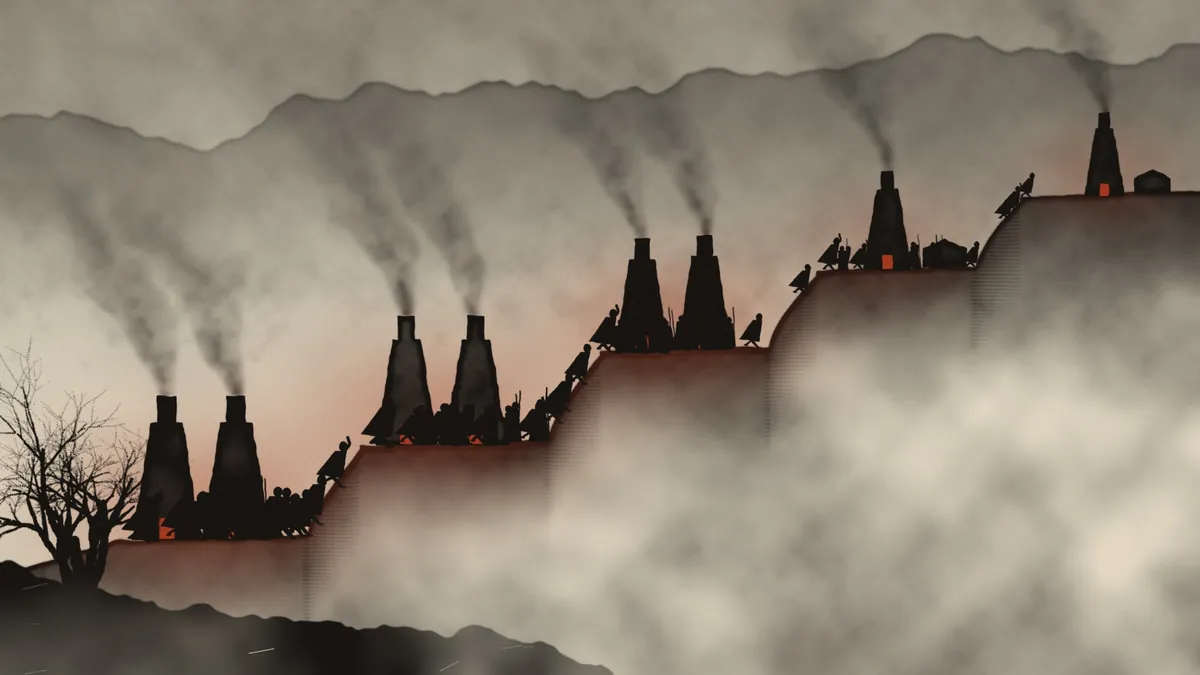
Maelin stood with Rovan and Callum and Ned Ferris on a spoil-heap above the road, a mile south of the town, and looked at it in the red light. The valley ran north from her feet. On the east side of it, on her right hand, the furnace terraces climbed the hillside in five great steps of black stone, each with its furnaces and sheds and chimneys. Above the top terrace stood the upper town behind its wall, with a square tower rising in the middle of it. On the west bank of the river, her left, the lower town lay crowded along the water: roofs, smoke, washing, the steam of bathhouses. A stone bridge crossed the river below the terraces and joined the two.
"The square tower is the Weighhouse," said Edran. He had come up behind them. He kept a careful distance from Rovan these days. "It's where they weighed the ore, in the old days. It's the school now, and the garrison's headquarters, and the bell's in its yard. The lad from the convoy told me, the one with the cut lip. He went to school there."
"You're sure the bell's there?" Rovan asked.
"I'm sure it was there in April," Edran said. "If it's anywhere, it's there."
As if to answer him, the bell spoke.
The note came down the valley over the roofs, deep and slow, and Maelin felt it come up through the spoil-heap under her boots. There it was, under the warmth of the deep rock: the hum. It was a low, fine trembling in the stone, constant, as if the ground were holding its breath. It would stay there for ten minutes. If it was struck again it would stay ten more.
"It's awake," she said. "And it's in the upper town, Edran's right. The field reaches down over the terraces and halfway across the river."
"The bridge?" said Rovan.
Edran had a cord with knots in it, and a map he had drawn himself in Karthen, with distances marked in a careful small hand. He stretched the cord on the map and checked it again.
"The Weighhouse yard to the bridge is a thousand yards," he said. "A bit over. The bridge is outside."
"Then Mabry's company holds the bridge, and the south end of the lower town, and goes no further." Rovan looked at Callum. "Every man who goes onto those terraces must never have sworn. Clans, Lissen men, my old provincial men. Nobody else. If a man isn't sure, he stays at the bridge."
"My lads have sworn nothing to anybody but their mothers," said Callum Breck cheerfully. "And not all of them to her."
"Then it's yours," Rovan said. "The terraces from the south end. Ned takes the ramp road up the middle. Maelin goes with Ned and opens what needs opening." Rovan looked at the upper town. "Not the upper wall. Not tomorrow. Tomorrow we take the furnaces and the bridge and the lower town. The children are behind that wall, and I want to know a great deal more before I knock on it."
They went in at dawn.
The terraces were worse than they had looked from the spoil-heap. Each one was a shelf of black stone fifty yards deep, crowded with sheds and furnace-stacks and ore-heaps and slag, and each was faced with a retaining wall twenty feet high. A single ramp road climbed them in switchbacks, from the bridge at the bottom to the gate of the upper town at the top. The Kharadi had barricaded every turn of it.
Behind the barricades stood the furnace-workers of Ashgate. They were bound, most of them, and compelled. Maelin could see it in the way they stood. A free man fighting for his children stands as though he might run. These men stood like posts.
The first barricade was carts and ore-tubs, chained together across the ramp at the second turn. Ned Ferris's pikes came up the road at it in a block, and the workers behind it met them with long iron bars, and the two lines locked and heaved. Maelin went up behind the pikes with her shoulders hunched, as bolts came down from the terrace above.
"Rennick!" Ned shouted. "The chains!"
She got to the barricade on her knees, under the pikes, and put her hand on the nearest chain where it was bolted into the cart-bed. It was good chain, Ashgate chain. She told it so, under her breath, and it parted for her link by link along its whole length, as fast as a man could run his thumb down a seam. The barricade came apart. The pikes went through.
A worker came at her through the gap with a bar raised over his head. He was a big man with burned forearms and a gray face, and he was shouting at her as he came.
"Move, woman! Move! I can't stop it!"
She did not move. She put her gloved hand up and caught the bar as it came down. The shock went through her arm into her shoulder, and she held it, and took hold of the iron inside the iron, and bent it. It folded round her glove like a wet rope. The man stared at it. A Lissen pikeman hit him on the side of the head with his pike-butt, and he went down across the ore-tubs. Two more pikemen dragged him back down the ramp toward the bridge, out of the field.
"Bind them!" Maelin shouted. "Don't kill them, damn you, bind them and get them out past the bridge! They'll wake up when they're out!"
They went on up. Second terrace, third. On the third, the Kharadi regulars were waiting, a hundred of them in gray, behind a wall of ore-carts. They were good, and willing, and they fought for every yard. The Lissen pikes took them in front, and Callum's clansmen came over the edge of the terrace from below, where they had climbed the retaining wall on ropes and each other's shoulders. They came over the lip with their axes, howling, and took the Kharadi in the flank, and it was over very fast after that.
Maelin leaned against a chimney-stack and breathed. Her hands were beginning to ache, deep in the bones, and she was very hungry, which was always the first sign. Callum came past her with blood on his axe and a grin on his face.
"One more," he said, and pointed.
The fourth terrace was the hard one. Its retaining wall rose sheer above the ramp, with no way up but the road. Along its top the Kharadi had a battery of stone-throwers and two hundred crossbowmen behind a breastwork of iron plates. They could see every foot of the road. Ned's pikes tried the switchback twice and came back down both times, leaving men on the road.
"Can you bring it down?" Rovan said. He had come up the ramp behind her with his sword drawn and his helmet dented. "The wall. Everything on it."
Maelin looked at the retaining wall. It was old work, big blocks of black stone, dressed and fitted, sitting on the bedrock of the hillside. She could feel it already, through the ramp under her boots. It was heavy and proud and full of weight, and it wanted to fall. All stone wanted to fall, in the end. She could tip the whole face of it out over the ramp, and the battery and the crossbows and the breastwork would come down with it into the road in a heap fifty feet long.
"Give me room," she said.
She knelt at the foot of the wall and pulled off both gloves and pressed her palms against the bottom course.
It was hot. The stone was hot under her hands, hotter than the warm rock at the pass, hot enough to make her snatch her palms back and then make herself put them there again. She went into it. Under the face of the wall, behind the fill, running through the bedrock along the whole length of the terrace, she found channels. They were long, smooth, man-made channels, cut in the rock and lined with fired clay, and they were full of moving water. Hot water. It came down from the hillside above, from somewhere under the upper town. It ran through the terraces under every furnace, and on down and down, branching and branching, under the river and into the lower town.
"Wait," she said.
"What is it?" Rovan asked.
"There's water in here. A great deal of water."
Somebody was screaming behind her. A woman's voice, in the common speech, high and furious. Maelin turned her head. One of the workers the pikemen had dragged out of the second barricade had got loose. It was a woman, gray-haired, in a leather apron, and two Lissen men were holding her by the arms halfway down the ramp. She was fighting them, and screaming at Maelin.
"Not the wall! Not the wall! You'll break the culverts! You'll break the culverts, you southern bitch!"
"Bring her," said Rovan.
They brought her up the ramp. Her name was Grete, and she was a furnace-keeper on the fourth terrace, and she had been free of the field since the bridge and was not compelled now. She was frightened half out of her wits and angrier than she was frightened.
"The springs," she said. "The hot springs come out under the upper town. The old ones cut the culverts four hundred years ago. The water runs through the terraces and heats the blast for the furnaces, and then it goes down under the river to the town. Every house. Every bathhouse. The washhouses. The water for drinking, when it's cooled. In winter it's the only heat we have, half of us. There's no wood. You've seen there's no wood."
"Yes," said Maelin.
"You bring that wall down, you crack the culverts under it. The water goes into the hillside. In December the whole lower town freezes, and the children with it." Grete was shaking. "Kill us if you want. Kill the Kharadi. But not the water."
Maelin looked at the wall. She could feel the water moving under her knees, warm and steady, like blood in a wrist. She could feel the crossbowmen on top, too, their weight on the breastwork.
She got up and pulled her gloves back on.
"No," she said.
"Maelin," said Rovan.
"No. Find another way. I'm not freezing a town of ten thousand people to save us an hour." She looked at him. "You'd have done the same, and you know it, so don't make a face at me."
Rovan looked at the wall, and at the woman, and at the switchback with his dead men lying on it.
"Then we do it the slow way," he said.
The slow way took all day. They went round. Callum's clansmen found the old ore-chutes, slanting tunnels cut through the terraces from the mine-heads above, which the workers used to send ore down to the furnaces. The chutes were steep and pitch-dark and full of loose ore, and they came out inside the furnace-houses on the fourth and fifth terraces. The clansmen went up them on their knees. Maelin went with them.
Inside the furnace-houses, the heat was a wall.
She had never felt anything like it. The air was thick and red and roaring, and it dried the sweat on her face before it could run. The furnaces stood in a row down the length of the long hall, five great squat towers of brick bound with iron, and the blast roared in them. Steam came up through gratings in the floor in sudden white bursts, where the hot water ran under. Men fought in the steam. They loomed up out of it and vanished into it again. Maelin could hear axes, and bars on shields, and men shouting in two languages, and could see almost nothing.
A Kharadi came at her out of the steam with a short sword. She saw his shape too late and threw up her arm, and the blade went along her leather sleeve and opened it from elbow to wrist. She caught his sword-hand by the wrist with her other hand and closed her iron-shod glove on it. The small bones of the wrist folded under the iron. He screamed. A clansman came out of the steam behind him and finished it.
They took the long hall of the fourth terrace room by room, and then the fifth.
They fought through a pattern-shop full of wooden shapes, wheels and brackets and the curved forms of bell-crowns, where a dozen workers made a stand with mallets and had to be dragged down one by one. Beyond it lay a blowing-house where the great bellows were worked by a water-wheel turned by the hot water, and the spray off the wheel was scalding. A clansman went into it backward and came out screaming with his face red. In the coal store three Kharadi held the door against everything Callum threw at it. At last Maelin knelt and found the iron bar across the door from the outside and drew it out through the wood like a nail from a plank.
Then they came into the casting hall.
It was the biggest room Maelin had ever stood in that was not a church. It ran the length of the fifth terrace under a roof of iron trusses black with soot. Down the middle of it ran the casting pits, long trenches in the floor lined with sand and clay, and over them hung chains and pulleys and great iron cranes. At the far end, the last furnace glowed, and a ladle the size of a cart hung in front of it, swinging slowly on its chain.
A man stood in front of the ladle with an iron bar in his hands. Behind him, crouched in the casting pits and behind the crane-legs, were forty or fifty workers with tools.
He was enormous. He was bald, and black with soot, and his forearms were burned shiny and hairless from wrist to elbow. He wore a leather apron and nothing else above the waist. When Callum's men came into the hall he did not shout a warning. He roared at his own workers, in the northern tongue, and struck one of them across the back with the flat of his bar when the man moved to put down his hammer. The man picked it up again.
"The foundry master is Jorund Falk," Edran had told them, the night before, from the edge of the firelight. "The Ashgate lad says he flogged a man in March for being late at the furnace. He says Falk loves it."
The foundry master came at the clansmen. He swung the bar in great flat sweeps that cleared a space round him, and a clansman who got too close went across the casting hall and into a pit and did not get up. His workers came out behind him. Callum's men met them, and the hall filled with the clang of iron on iron.
Maelin went for the cranes.
She ran along the edge of the nearest casting pit to the foot of the crane. She put her hand on its iron leg. She found the long chain that hung from its arm, and the hook on its end, and the pulley at the top, and she took the whole thing in her hand at once. She swung it.
The chain came down from the crane arm in a great loop, and Maelin brought it round in the air. It took the foundry master across the chest and wrapped him twice and pulled tight. His arms were pinned to his sides. The bar fell out of his hands and rang on the floor. He roared and fought it, and the chain held him, and Maelin held the chain.
"Get him out!" she shouted. "Get him out past the bridge, and his people with him! All of them!"
It took six clansmen to carry Jorund Falk down the ramp. He fought them every step. Maelin went with them, holding the chain through her glove, because she did not trust it to stay where she had put it without her. Her hands were burning now. She had bitten down so hard on the weight of the chain that something at the back of her jaw had given, and she could feel the broken edge of a tooth with her tongue, and taste it. She kept walking.
They got him down the five terraces and over the bridge, and fifty yards beyond it into the lower town. They passed where Mabry's company stood across the street with their swords out and their faces set. Then the foundry master stopped fighting.
He stood swaying in the middle of the street with six clansmen holding him, and looked at the bridge and the river and the smoke on the terraces, and at Maelin.
He spoke first in the northern tongue. Then, in common speech, slow and heavy:
"My son is in the Weighhouse."
Maelin let go of the chain. It fell off him in loose coils round his feet.
"He is nine," said Jorund Falk. "His name is Piet. The overseer captain told me, in May, that if the terraces fell, Piet would pay for it. I did what I could to keep them from falling." He looked at his burned hands. "They had the bell on us, you understand. Since the spring. But I would have done it anyway."
By nightfall they had the valley.
They had the terraces and the furnaces and the bridge and the lower town. They had three thousand prisoners, workers and Kharadi both, and the workers were sitting in the streets of the lower town with their families round them. They were crying, or laughing, or shouting questions at the southern soldiers in a language the southerners did not know. The Kharadi garrison had fallen back behind the upper wall. They had their bell, and they struck it every ten minutes through the evening, so that the hum in the stone never faded. They had the Weighhouse. They had the children.
Rovan had lost two hundred and twelve men killed and wounded, most of them on the switchback below the fourth terrace. Callum had lost ninety. Ned Ferris had lost more than either of them, and sat on the bridge with his helmet in his lap, and would not talk to anyone.
Maelin went back up to the casting hall alone after dark.
She could give no reason. She was tired to the bone and her hands shook and she had eaten an entire loaf and half a cheese and was still hungry. But something had caught her eye in the hall, in the middle of the fighting, and she wanted to see it again before she slept.
The furnace at the end of the hall had been banked, and gave a dull red light. The casting pits lay dark. In the farthest of them, half buried in sand, lay a piece of iron.
It was a bracket. It was the shape of a great hook, or a claw, with a thick curved arm and a heavy flange pierced with bolt-holes. Maelin knew that shape. In April she had spent a week with her hands on the intact bell from the Sorrel Bridge, learning its crown and its canons and the iron fittings that held it in its frame. This was the same shape exactly.
But it was the size of a horse.
She climbed down into the pit and put her bare hand on it. It was cold, and sound, and very well made. She could feel the grain of the iron running true through the curve of the arm. It was made to carry a weight beyond anything she had ever lifted. She sat back on her heels in the sand and looked at it, and tried to imagine the bell that would hang from four of these, and could not.
And while her hand lay on the iron, something turned toward her.
It was far off, north, beyond the valley and through a great thickness of rock, and it was not a hum. A bell was a sound in the stone. This was attention. It was the feeling of a room you had believed empty, when a chair creaks behind you. It had no interest in her that she could name. It simply knew where she was, as a smith knows where the hot iron is on the bench without looking. She took her hand off the bracket as if it had burned her, and the feeling went. She knelt in the sand with her heart going hard and told herself it had been the heat.
Something moved in the dark at the end of the pit.
Maelin was on her feet with her hand on the iron before she had thought about it. A figure stood up out of the sand at the far end of the trench, where it had been crouching. It was a young woman, tall, black with soot from head to foot, with her hair tied back in a rag. She held a hammer loosely in one hand, as a smith does when she has not yet decided whether she needs it.
"You're the mage," she said. "The southern one. The one who wouldn't break the wall."
"I am. Who are you?"
"Anke Falk. Jorund's daughter." The young woman looked past Maelin at the great iron bracket in the sand. She looked at Maelin's bare hand on it. Her mouth twisted. "You want the great bell. Of course you do. I cast its fittings."