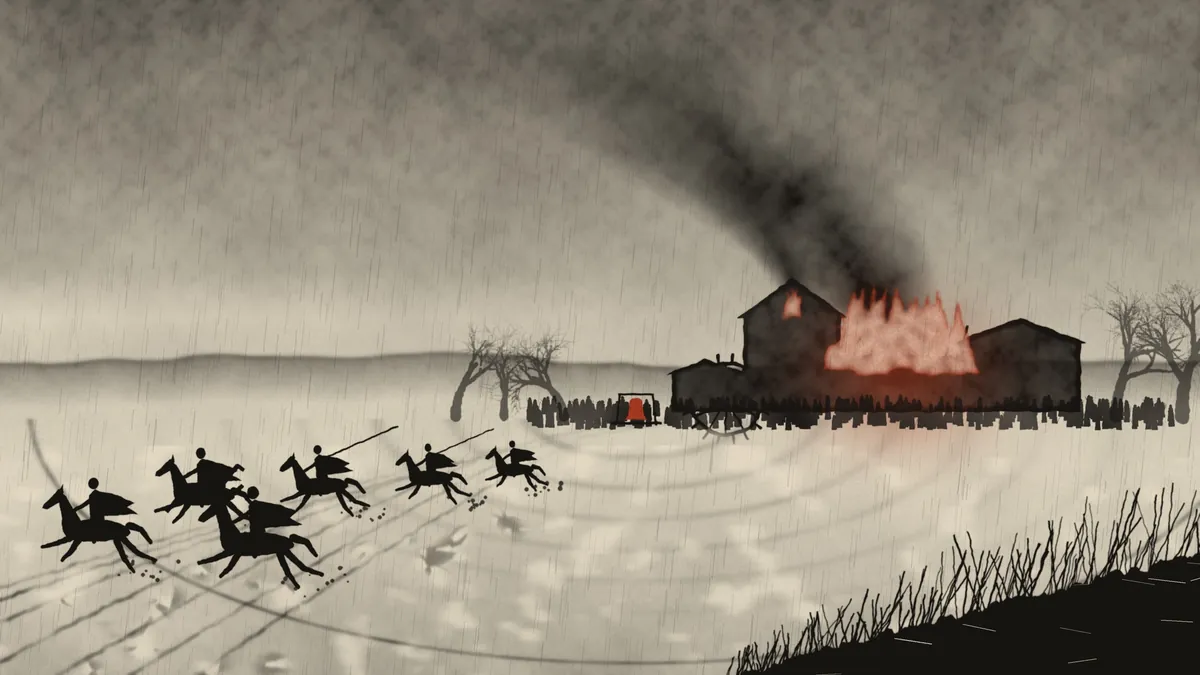
Edran Taken Alive
Rovan lay on his belly in the wet leaves at the edge of a beech hanger and watched Thornwick come up out of the dark. The thaw had come to the March a week before, and brought the mud with it, and he had been lying in the mud an hour. The cold had got into his knees and the shoulder Brackwater had cut, and he no longer noticed either. Below him the ground fell away in a long slope of rough pasture to a dozen roofs, a road, and a river. The Kell ran from his left hand to his right, high and brown with snowmelt, going south toward Dunmere, twelve miles downstream. The Hallam road came down its near bank from the north, from the keep ten miles away, and passed through the hamlet. On his right hand the Thorn brook ran down out of the hills under a timber road-bridge and into the Kell.
The mill stood on the river's edge with its leat and its pond. It was a big old fulling mill of gray stone, three stories under a slate roof, built by somebody's grandfather when the March was rich in wool. North of it was a tithe barn as long as a church, and between the barn and the road lay a wagon yard. Serath's people had walled the yard with a palisade of split logs and roofed half of it with new sheds.
They had taken the place in January, when Tierney's army had gone into Dunmere and not come out again. Rovan had learned why from a carter at Ivel. Maelin had dropped forty yards of causeway at Hallam in December, and the keep's gate was a ditch and a plank bridge. Nothing heavy could get up to it. So the bells had stayed down here, by the river, with the wheelwrights and the smiths, where the road was good.
There was one in the barn, and they could hear it. It rang through the night every eight minutes, a long, low note that came up the hill through the wet ground and set Rovan's teeth on edge. The carter had sworn there was a second in the yard, on its wagon, under canvas, unrung.
"Two hundred gray," Maelin said beside him, in a whisper. "Perhaps three. And all those poor bastards in blue."
"Five hundred," Rovan said. "Hallam men, and some of the River regiments."
"Who's holding them?"
"The barn bell." Rovan watched a lantern move along the palisade.
"Eight minutes between strokes," Maelin said. "They're not trusting the ten."
She grunted. She had the right glove off and her hand pressed flat into the leaf-mold, as far down as her wrist. He had stopped asking her what she felt through mud. She said thawing ground was a bowl of porridge with stones in it, and she could read the stones if she was quick.
The plan had been made in Dunmere two nights before, round a table in the Cornmarket inn, and every voice on the council had had its say in it. Rovan had asked Hessa first and Garrick second, and he had taken something from each of them. Hessa's company and Rovan's three hundred veterans would come down the slope at first light, straight for the barn and the yard. Garrick held the Thorn bridge to the south with four hundred horse. Baran had taken his squadron of two hundred across the Kell in the night by the ford at Lathe. He would cross back above Thornwick and sit astride the Hallam road, so that nothing with wheels went north. Maelin would go in with the pikes and put her hands on the bells.
"Break both," Rovan had said. "Burn the wagons and the frames and the bronze. If we leave her one, she has a field to stand her men in. If we leave her none, she has nothing south of the pass till the snow goes."
Every captain had agreed it, and it was a good plan, and he had been pleased with it.
The light came gray and wet over the hills beyond the river. He could see the barn's great doors now, half open, and the glow of a brazier inside. He could see men in the yard. Some of them were moving about the sheds in the stiff, careful way of men who have been told what to do and are doing it. Their coats were royal blue.
The bell rang, and Rovan felt it in his breastbone.
"Now," he said, and Hessa's trumpeter put his horn to his lips.
They went down the slope at a run, six hundred pikes and three hundred swords, with the wet grass to their shins and the mud sucking at every stride. They went in silence, because Hessa had told them she would fine any man who shouted before he could see the whites of an enemy's eyes, and her people believed her.
A Kharadi sentry on the palisade saw them at two hundred yards and yelled. A horn answered him from the mill. Men spilled out of the barn doors and the long sheds, gray cloaks and blue coats together, pulling on helmets, snatching up spears. Two Kharadi ran for the barn.
"The crew!" he said. "Hessa, the crew!"
"I see them, damn your eyes, I've got eyes!"
Her front rank hit the palisade where it ran down to the barn's north wall. The split logs were new and set in thawing ground, and three pikemen leaned on them together and they went over. The pikes went through the gap and spread out into the yard. Rovan went with the veterans along the outside of the barn to its great doors.
The bell hung in the middle of the barn floor from a beam of black oak set across two stone piers. It was smaller than the Karthen bell, and greener, and it hung so low that its lip was a foot from the flags. Four Kharadi were hauling on the striking beam. A fifth stood by them in a black coat with a hammer in his belt and a sand-glass on a chain round his neck.
Rovan killed him in two strides and one cut, before the man had his hammer out, and the sand-glass smashed on the flags. A veteran named Spry put a spear through the nearest of the crew. The other three let go of the beam and fought. They were big men with short axes, and they fought well, and it took a dozen of Rovan's people to get them down.
"Hold the beam!" Rovan said. "Keep their hands off it! Ten minutes!"
Two veterans threw themselves on the striking beam and held it. The bell hung silent, though its last note was going round the barn roof among the pigeons.
Outside, the noise of the fight rose. Rovan went back to the doors.
In the yard, Hessa's pikes were in a hedge across the middle, and the gray cloaks were falling back before them into the sheds. But the blue coats had come out of the mill. There were three or four hundred of them, Hallam men in gray-blue and River men in green, and they came round the mill-pond in good order with their pikes leveled. They came on without a sound. Their faces were the faces Rovan had seen at Brackwater, in the brook: grim, and horrified.
They were inside the barn bell's field, and they would be for ten minutes yet.
"Hessa!" he shouted. "Hold them! Hold them off and wait!"
She heard him, and her rear ranks turned, and the hedge of pikes became a box, and the blue companies hit its southern face with a crash Rovan felt through the doorpost. Men screamed, and a pike-shaft broke with a crack. Hessa's people gave a yard, and another, and held.
Maelin came past him through the barn doors at a stumbling trot, with her coat open and both gloves off and her face set. She went straight to the bell. The veterans on the beam drew their legs back from her as if from a fire.
"You'll hold it ten minutes," she said, "and it'll ring again the minute your backs are turned. No. Hold steady, my lovely. Steady now."
She put both bare hands on its crown, where the iron loops went into the bronze.
Rovan felt it through his boots. The flags of the barn floor hummed. The bell gave out a sound he had never heard a bell make, a long, rising groan, and the dust came down out of the rafters in a sheet. Maelin's shoulders hunched under the coat. The crown broke with a report that hurt the ears, and the bell split from crown to lip and fell apart on the flags in two great curved halves. One of them rocked, and settled.
Maelin sat down on the floor beside it, swaying, and looked at her bare hands, and put them under her arms, because they would not be still.
"There," she said thickly. "That's one."
Outside, through the din, another bell rang.
The sound came from the yard, beyond Hessa's box, from the far end of the long sheds. It was higher than the barn bell, and newer, and it went through Rovan to the bone. He ran out of the doors and along the palisade to where he could see.
They had the canvas off the second bell. It stood on its wagon at the north end of the yard, by the gate onto the Hallam road. The Kharadi had a team of ten horses in the traces already, and a crew of four on the beam. As Rovan watched, they struck it again. Then the gate was dragged open and the wagon lurched forward through it onto the road. It turned north, toward Hallam, with forty gray riders around it.
The blue companies in the yard had not stopped fighting. The bell was leaving, and its field with it, and they would have to go with it or come free. Somebody among them saw that as quickly as Rovan did.
A horseman rode out of the press round the mill-pond. He was bareheaded and he rode a tall brown horse, and he wore a royal captain's coat with silver buttons on the cuffs. He stood in his stirrups and shouted. The blue companies broke off from Hessa's box, all at once, and ran north across the yard, through the sheds, out of the gate after the wagon. They went at the double and formed as they went. Within a hundred yards of the gate they were a marching line with a rearguard of pikes, and the rearguard turned to face the yard and walked backward behind the wagon, step for step, with the bareheaded captain riding up and down behind them.
Rovan had taught that in the outer ward at Karthen, to every captain he had ever made. He had not taught anyone to do it under fire, alone, in somebody else's war.
He knew the horse before he knew the man. He knew the seat, long in the leg, as if the horse had been a gift that morning. He knew the way the captain turned his head, quick and sharp, at every sound.
"Plague take it," Rovan said aloud. "Oh, Edran."
His nephew rode behind the retreating column with his sword out and his face to the yard, set like a stranger's.
The wagon was on the road. In a mile it would come to Baran's two hundred, sitting across the road above the hamlet, and Baran would fall on it. The blue companies inside its field would fight for it with everything they had, and the Teshar would ride them down, and kill the officers first, because that was what cavalry did. They would kill the bareheaded man on the brown horse who was holding them together.
If Baran let the wagon pass, the bell would reach Hallam. It would hold the depot's compelled men until the snow went, and stand in a field at Serath's next battle.
He turned for Benno, the Teshar-born groom who had carried his letter south in December. The boy was at his elbow, as he always was, holding his horse.
"Ride to Baran," Rovan said. "Ride hard. Tell him to leave the road. Let the wagon go. Tell him I want the officer in the blue coat on the brown horse, alive. I'll meet him on the slope above the road. Go."
Benno stared.
"Go," said Rovan, and Benno went.
Behind him somebody said, "Commander." It was Hessa's runner, a Lissen girl with a cut cheek, and behind her came Hessa herself, out of the yard with her helmet pushed back. She had heard.
"What are you doing?" Hessa said.
"Taking my nephew."
"With my flank hanging?" She caught his arm. "Rovan. That bell is the job. That's the whole bloody job. If it gets to Hallam we fight it again."
"I know."
"Then let it be," Hessa said.
"I know," said Rovan, and pulled his arm free, and went for Benno's spare horse.
He came over the shoulder of the pasture a quarter-mile above the hamlet with a dozen of his veterans running behind him. The Hallam road lay below, and the wagon was on it, rolling north between the hedges at a fast walk, with its gray riders around it and its bell swinging on the frame. Every few minutes a man on the beam struck it, and the note came rolling up the slope. Behind it marched the blue companies, three hundred strong, and behind them, alone, rode Edran.
Baran's squadron came down off the higher ground to the north-west at a canter. Rovan saw the red cloaks and the horsehair plumes and the red-and-gold pennons, two hundred lances in a long line. They did not go for the wagon. They swung wide of it and let it go up the road. The gray riders round it drew together and spurred their team, and the bell went away north into the morning with the blue ranks toiling after it. The Teshar horse came down on the rearguard.
Edran saw them coming, and turned the rearguard to face them in the road, sixty pikes in a double rank, with the hedges on either side. He did it in the time it took the Teshar to cover a hundred yards. The first Teshar riders met a row of pike-heads and swerved off them, and one horse went down screaming with a pike in its chest.
"Round!" Rovan shouted, riding down the slope. "Round them, Baran! Over the hedge! Through the field!"
Baran heard him, or saw it himself. Half the squadron jumped the eastern hedge and came at the rearguard from behind. The pikes could face one way or the other. For a moment they tried to face both. They broke, and the Teshar were among them.
Rovan put his horse at the hedge and went over it into the road.
It was a melee now, horse and foot in a lane of mud between two hedges, with the dead underfoot. A pikeman in Hallam gray-blue thrust at Rovan's horse and Rovan beat the head aside and rode past him. He would not strike any of them if he could help it. A Teshar lancer did it for him. Ahead of him, ten yards off, Edran was fighting.
He was fighting two of Baran's men at once. He had his brown horse turning on its hocks in the mud and his sword going in long, hard cuts. Edran beat one lancer's point aside and cut the man across the face. The Teshar rider reeled and fell. The second came at Edran from the left. Edran leaned out of the saddle under his lance and cut his horse's hamstring, and the horse went down behind and threw its rider into the hedge. Edran wheeled, and a third came, and Edran killed him. He did it cleanly, with a thrust under the arm, the way Rovan had taught him at fifteen in the outer ward at Karthen.
He was crying, and Rovan could see it from ten yards. His mouth was open, and he was killing Teshar riders as fast as they came to him.
"Edran!" Rovan said.
His nephew heard him, and his head came round. His eyes found Rovan's and knew him; Rovan saw them know him. Then Edran put his heels into the brown horse and came straight at him with his sword up.
Rovan met him in the middle of the lane.
The first cut came down with the brown horse's weight behind it, and Rovan's bad shoulder took the jolt and made him grunt. Edran cut again at once, backhand, at his neck. Rovan leaned away from it and felt the wind of it. The horses shoved and bit at each other. Edran's brown was the younger and fresher horse, and it pushed Benno's gray back a step into the hedge.
"Get away," Edran said through his teeth. "Get away from me, Uncle. Get away from me."
He cut a third time, high, with all his weight. It was a killing stroke, and Rovan knew it was coming, because he had taught it. Rovan let the parry go. He dropped his sword and threw himself out of the saddle across the gap, under the blade, and took his nephew round the body with both arms.
They went down together between the horses into the mud.
Rovan landed on top, and the fall knocked the wind out of both of them. Edran's sword was gone somewhere under the hooves. The brown horse reared over them and came down a yard from Rovan's head. Then Edran had a knife out of his boot, and Rovan caught his wrist, and they rolled.
He was stronger than Rovan remembered. He had last wrestled with him when the boy was sixteen, and won. Now Edran was twenty-six and fighting for his life with somebody else's will, and he got on top and bore down with the knife. Rovan held the wrist with both hands. The point came down an inch at a time toward his eye. He could see his nephew's face above it, close, with his teeth bared and mud on his jaw.
"Please," Edran said. "Please, Uncle, I can't stop it."
Rovan let go with one hand and hit him in the throat.
It was a short blow, without much room to swing, and it was enough. Edran choked and the knife-point wavered, and Rovan heaved him off sideways and came up on his knees. He took the knife hand and turned it back on itself till the knife fell. Edran clawed at his face with the other hand and opened his cheek along the bone. Rovan got a knee in the small of his back and drove him face down into the road.
"Rope!" he said. "Somebody! Rope!"
Two of Baran's men were off their horses and kneeling on Edran's legs. A third had a halter, and they looped it round his wrists behind his back while he fought them, and fought them, and cursed them in the northern tongue. Rovan had never heard him speak it. He spoke it like a man born in the iron valleys.
"Across a saddle," Rovan said. "My saddle. West. Up the hill and over. Away from that bell."
"How far, Commander?" Baran asked.
"Till he stops."
They threw Edran across the gray's withers face down, and Rovan swung up behind him with both hands in his collar. Baran took the bridle himself, and they went up the slope out of the lane at a gallop, west, away from the road, away from the rolling note of the bell going north. Three Teshar riders came after them. Under Rovan's hands his nephew bucked and twisted and tried to throw himself off the horse's shoulder into the grass, and Rovan held him, and the horse labored up the wet hill.
The bell rang again behind them, fainter now. Rovan felt Edran's whole body heave at the sound.
They went over the brow of the hill into the beech hanger. The trees closed round them, gray trunks and last year's leaves. Somewhere in the first hundred yards of the wood, between one stride and the next, Edran stopped fighting.
He went slack, and Rovan felt it through his hands. The bucking body lay still across the saddle-bow, and then began to shake.
"Hold," Rovan said, and Baran pulled up.
Edran lifted his head. His face was smeared with mud and blood, some of it Rovan's. He stared round at the beech trees, and at the Teshar riders, and up at his uncle, and his eyes were his again.
"Uncle?" he said.
"Yes."
"Uncle. It's gone." His voice cracked across. "It's gone. It's gone, it's gone out of me."
Rovan got down off the horse and lifted him down, and held him on his feet with his hands tied behind his back, in the wet wood, while he shook.
They counted the cost in the tithe barn that afternoon, with the rain coming through the roof.
It was half a victory at best. The barn bell lay on the flags in two pieces, and Maelin had broken its frame and its iron fittings into scrap with what she had left. The sheds were burned, and the wagons in them, and the stacks of seasoned oak the wrights had been cutting for new frames. The mill had come through untouched. Eighty of the blue companies had been caught inside the yard when the wagon left, and had come free, and sat now in the mill under guard with their heads in their hands.
But the second bell had gone north. It had gone up the Hallam road with forty Kharadi horse round it and two hundred and twenty compelled men marching behind it, and not a lance had been raised to stop it. Garrick's scouts had followed it to within sight of Hallam. It was there now, in the village under the broken causeway, and the men with it.
Hessa had lost eleven killed and thirty wounded, holding the yard. Rovan's veterans had lost six, and Baran's squadron had lost four men in the lane, and seven horses, and two of the four were Edran's.
The officers stood round the brazier in the barn because it was the only fire with a roof over it. Garrick was there with his hands in his sleeves, and Baran, and Lucan. Maelin sat on a sack with her raw hands in her lap. Dace sat on the stone pier the bell had hung from, with his bad knee out in front of him. The Lissen captains were there, and the Saltmere captain.
Hessa came in last, when the rest had gathered. She had washed her face but not her hands. She walked round the brazier and stood in front of Rovan.
"Eleven," she said. "I want it said here, so I don't have to say it twice. Eleven of mine. Nan Pardoe, Mark Weller, the two Arkwright boys, Hal Dunning, who was to be married."
"Hessa," said Maelin.
"No. He'll hear it." Hessa did not look away from Rovan. "We came here for two bells. We had a plan for it. You made it. You asked every one of us, and we agreed it, and it was a good plan. The squadron on the road was the plan. You took the squadron off the road in the middle of the fight to catch one man. The bell walked through the hole. My people held that yard for a quarter of an hour longer than they should have, against men who'd have been free if that bell had stopped. And now it's in Hallam, and we'll have to fight it again." She drew breath. "You spent my company on your nephew. You never asked me. You never asked anyone."
The barn was quiet. The rain dripped through the roof into a puddle by the pier.
"You're right," Rovan said.
Hessa waited, and he let her wait.
"That's all?" she said.
"It's all I have," Rovan said. "You're right, and I'd do it again, and you're still right. Your people's names will be on my list as well as yours. I'll pay the death money from my purse if Lissen won't."
"I don't want your purse," Hessa said. "I want to know that the next time you see someone you love on the wrong side, my company won't pay for it."
"I can't promise you that," said Rovan. "I'd be lying."
Hessa turned away to the brazier and held her filthy hands to it.
"Well," she said, to the coals. "Then I'll have it in the compact. Before the next fight. That the war council can take the field command off you, in the field, on the day, by a vote of three. Not afterward. Not at Lissen with the clerks. In the field." She did not wait for his answer. "You'll put your name to that tomorrow, or my company goes home down the river, and takes its pikes."
Garrick cleared his throat. "If I may. My squadron was moved, not hers. I was asked whether my riders could take a man alive out of a fight. I said they could. I shall be glad to share the blame, Captain, if it lightens the load."
"It doesn't," said Hessa. "But thank you, my lord." She looked at Rovan once more across the coals, and he gave her nothing, because he had nothing yet to give, and she went out into the rain.
They made camp that night on the hill above Thornwick, in the beech hanger, where the ground was driest. Rovan sent a note to Dunmere by a Teshar rider, for his sister. It said that Edran was alive and whole and himself, and that she was not to come.
That last part was Edran's wish.
He sat by the fire with a blanket round his shoulders and his hands in his lap, and he studied his hands a great deal. Somebody had washed the mud off his face. He had a bruise coming on his throat where Rovan had hit him, and he spoke hoarsely.
"Not Mother," he said. "Not yet. Not till we know what I am."
"You're yourself," said Rovan.
"Here. Now." Edran turned his hands over. "Uncle. When you sleep tonight, I want a chain on me."
Rovan waited.
"I mean it," Edran said. "A chain, on my ankle or my wrist, to something that won't move. A tree. A wagon wheel. And a man awake beside me who can't be taken." He did not raise his voice. He had always been the loud one; now he was very careful. "They have bells at Hallam, now. One, anyway. It's ten miles. If they bring it down the road in the night, I won't hear it come. I'll hear it ring. And then I'll get up, and pick up the nearest sword, and walk to wherever you're sleeping."
"Edran," Rovan said. "Listen to me."
"If a bell comes, I'll cut your throat, Uncle," Edran said. "And I'll be crying while I do it."
Maelin, on the far side of the fire, put down her cup.
"Dace," Rovan said. "Have we a chain?"
"There's the trace-chain off that wagon the lady didn't burn." Dace was already getting up, grunting, with a hand on his knee. "I'll find a lock. There'll be a lock in the smithy." He paused by Edran and looked down at him. "You're a fool, boy. But you're the right sort."
He limped off into the dark, and Edran watched him go.
"He hit me with a hammer," Edran said. "In the passage. In December. I remember it."
"He turned it to the flat," Rovan said.
"Yes. I felt that too."
Maelin leaned forward into the firelight. "Tell us what it's like. Inside."
Edran was a while finding the words. When they came, they came in the order he had seen things, like a report.
"You're awake. That's first. You don't sleep, and you don't dream, and you don't forget. You see your hands do it." He held them up. "And you obey. Not everyone. A Kharadi cook told me once to fetch his water, and I told him to fetch it himself, and he laughed. But Captain Thrane, at Thornwick, and the Marshal, and the Bellmaster, and her captains. When they speak, it's done. They've been named. The Seat names them."
"How do you know?" said Rovan.
"Thrane told us, the first week. He was proud of it. And you feel the difference." Edran swallowed against the bruise. "The bell's only a sound. The sound goes, and the order stays. I've stood in the yard at Thornwick between strokes and tried to put my sword down, and my hand wouldn't open. Then they'd stop ringing for a while, and some time after, I could. Ten minutes, I think."
"Yes," said Maelin. "We learned it at Brackwater."
"And when you carry a man outside it, as you carried me, he's himself again," Edran said. "But it's still there." He touched his chest, over the breastbone. "Here. A hook left in a fish. The next bell that comes near reels it in. Being carried out doesn't cure you. Running away doesn't. Thrane said you could swear a hundred new oaths to a hundred kings and it would make no odds. The words went to the Seat. Only the Seat can let go of them, and it won't."
The fire hissed in the wet, and for a time the only talk was the rain's.
"Then what breaks it?" said Rovan. "For good."
"Breaking the Seat." Edran almost smiled. "Thrane said that too. As a joke. He said you might as well talk of breaking the mountain."
Dace came back with the trace-chain over his shoulder and a padlock the size of a fist. He locked one end round the trunk of a beech and the other round Edran's left ankle, and tested both, and gave the key to Rovan. Edran watched the lock close, and his shoulders came down an inch.
"There's one more thing," he said. "You'll want it tonight, not tomorrow."
"Go on."
"I kept the depot's orders all winter. I wrote them. Thrane couldn't read our letters, so he gave it all to me." He gave it like the rest, in order. "The foundry at Ashgate has cast three new bells since autumn. The Bellmaster himself is bringing them south as soon as the pass opens, with the first carts of spring. Orrin Voss. He'll have three or four hundred with him, and laborers to dig the wagons out of the snow. They'll come down through Karthen, and on to Hallam, and on wherever the Marshal wants them."
"When?"
"The first week of April, if the thaw holds." He raised his eyes to his uncle. "Three bells, Uncle. One for every town in the March."
Rovan sat with the key in his hand. Across the fire Maelin was silent, and he could see her measuring the thing already, the weight and the iron.
"Which road?" he said.
"There's only one road," Edran said.
"They'll have to cross the Sorrel," Rovan said.
"Yes." Edran pulled the blanket tighter round his shoulders. His eyes went to the fire, and to the chain on his ankle, and back to Rovan. "They'll come over the Sorrel Bridge. I know, because I'm the one who told them the parapet could be cleared."