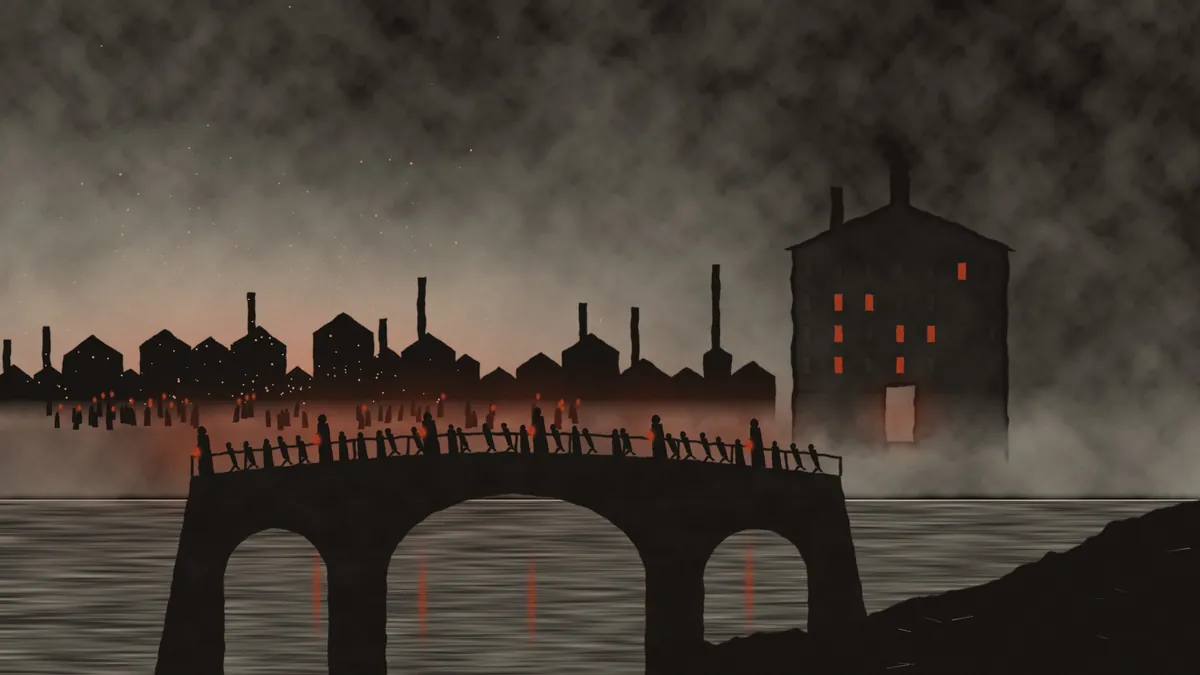
The Foundry Revolt
The foundry master's daughter would not sit down.
Rovan sat at the end of Jorund Falk's table the morning after the terraces fell, with Maelin on one side of him and Callum Breck on the other. The kitchen smelled of iron and onions. Edran stood by the door, where he could leave at once if a bell spoke. Dace Tolliver, the old Karthen armorer, sat on the stool by the stove, turning over in his hands a bolt from the great bracket as long as his forearm, with the expression of a man in love. The house stood on the lower town's main street, a thousand yards from the Weighhouse. Through the open window Rovan could hear the bell in the upper town strike its note, every ten minutes, as it had all night.
Jorund sat across the table from him. He had washed, and found a shirt, and he looked older with the soot off him. His burned forearms lay on the table like two lengths of cable.
Anke Falk stood behind her father with her arms crossed.
"Tell him," Jorund said to her.
"I'll tell him what I like." She looked at Rovan. She had her father's height and none of his bulk, and eyes so pale they were nearly white in her sooty face. She had not washed. Rovan suspected she had decided not to. "You've seen the bracket. Your mage has had her hands all over it. Four went north in June. That one's the spare."
"North to Dhor Kharad," Rovan said.
"To the bell-chamber. In the cliff, above the lower city. They cast the bell there, in a pit in the floor, because there's no road in the world that could carry it." Anke uncrossed her arms and put her hands on the back of her father's chair. "I took the brackets up myself, with forty men and a sledge-road. I saw it. They were finishing the bronze. It's as tall as this house, and it's heavier than this house, and when they're done it'll hang from my iron over a cistern you could sail a barge in." She stopped, and her pale eyes went somewhere else. "And they brought him up to see it. In a chair, under a cloth, with four men to carry him and the Seat-guard round them. I saw his hand come out from under the cloth and lie on the bell. The bronze went dark where it touched, like breath on a blade, and the bellwrights went down on their faces." She looked at Maelin's hand, which lay on the table beside her cup. "You do that too. I saw you, in the pit, with my bracket. You touch it and it listens."
"What will it do?" said Maelin.
"What do your little ones do?" Anke asked.
"Half a mile," Maelin said. "Ten minutes a stroke."
"The great one does the basin." Anke frowned, hunting for the southern words. "All the basin of Dhor Kharad, wall to wall. Three miles every way from the cliff. The bellwrights told me, at supper, when they were drunk. They were proud of it."
Rovan waited, because he had learned from Hessa that the second thing people told you was usually the one that mattered.
"And then there's the ceremony," said Jorund.
He said it heavily, to the table. Anke's hands tightened on his chair.
"On Harvest Eve," Jorund said. "The sixteenth of August, at midnight. The bell will be rung in the presence of the Seat, with the proper words, and the people will be brought to hear it. After that, its reach is fixed. Twenty miles." He looked up. "Twenty miles from the cliff, every way, for as long as it hangs. Rung or not rung. Any man who ever swore the words, inside that, belongs to the Seat."
Maelin swore, quietly and at length.
"And your king," said Anke. "They're bringing him up the Eastway. He's to stand in front of the people at the ceremony and swear them in himself, in person, so they know it's lawful. That's the part the bellwrights liked best."
For a while the kitchen was silent, until the bell in the upper town struck again and the window glass hummed in its frame.
Rovan saw it whole. Twenty miles would take in the capital basin, and the Gullet, and the valley road for a long way south of it. Every bound man in his army could be held, inside that ring, by a bell that need never be struck again. Every one of the decree's new swearers who was ever brought north would be held there too. Beyond the ring there would be wagon bells, going south along the roads. Inside it there would be a country where no one who had ever spoken the old words could stand up.
And the sixteenth of August was twenty days off.
"Why are you telling us this?" he said.
Jorund looked up at him with red-rimmed, exhausted eyes.
"Because my son is in the Weighhouse," he said. "With three hundred other children. And you are going to get him out."
They went in through the water, and the idea was Jorund's. He could not come himself: he was bound, and the upper town was inside the bell's field, and the moment he set foot in it he would be the overseers' man again. But he drew it for them, on his kitchen table, with a burned forefinger dipped in beer.
The hot springs came out of the rock under the upper town. The old builders had walled them into a spring-house beside the Weighhouse yard, with a grating in its floor, and from there the main culvert ran down through the hillside under the terraces. It was big enough for a man to crawl, Jorund said. He had crawled it as a boy, on a dare. The water ran ankle-deep in its bottom, and hot, and the air in it was thick enough to drown in.
"How hot?" said Rovan.
"You'll live," said Jorund. "You'll wish you hadn't."
Rovan took forty of Callum's clansmen, and Callum, and Maelin, and Anke Falk, who was unbound and knew the upper town, and he went himself. He had argued it with Maelin for an hour, and with himself for longer. He would not send men into a hole he would not crawl into. He went also because he wanted to be in the yard when the bell went quiet.
Before he went, he gave his orders at the bridge. Mabry's company and Ned Ferris's pikes stood ready below the upper gate, outside the half-mile, with Jorund and two hundred of his foundry men who had been carried out of the field the day before. Dace was with them, with his hammer.
"When it goes quiet," Rovan said to Mabry, "wait for the gate. Don't go near it until it opens. If it opens and the bell strikes again before you're through, you turn round and you run."
"And if it opens and the bell doesn't strike, sir?" Mabry asked.
"Then you come in like the wrath of the Teeth, and you bring the foundry men with you."
Mabry grinned, for the first time that Rovan had seen since Karthen.
The culvert entrance was in the side of the third terrace, behind a furnace. They went into it an hour after midnight, one by one, on their hands and knees.
It was worse than Jorund had said. The water was hot enough to make Rovan gasp when he put his hands into it, and it soaked through his breeches at once and scalded his knees. The air was wet and black and so thick it seemed to stick in his throat. He crawled with his sword across his back and Anke Falk's boots in front of his face and Maelin breathing hard behind him. The culvert climbed steeply, and the water came down against them, and the stone over their heads was so low that he scraped his back on it every few yards.
Every ten minutes the bell spoke above them, and the whole culvert shook with it. Maelin, behind him, made a small sound each time, as if something had touched the broken tooth.
It took them most of an hour. At the end of it there was a faint gray light ahead, and Anke stopped, and Rovan heard her whisper.
"The grating. It's not locked. It's never locked."
He crawled up beside her and looked. Above them, through a square iron grid, he could see the beams of the spring-house roof, and a lantern hanging from one of them, and steam. Beyond the open door of the spring-house was the Weighhouse yard.
Rovan lifted his head to the grating and looked.
The yard was small, perhaps forty yards square, paved and walled. On the far side rose the Weighhouse itself, a tall square tower of black stone with lit windows high up. On the left a long stone stair climbed the outside of the tower to a door on the second floor. In the middle of the yard stood the bell on its wagon, with a lantern on a pole beside it and six men round it. Two of them were at the beam, drawing it back.
He had one sentence of map for the men behind him, and he whispered it down the culvert. "Bell in the middle, six men, stair on the left to the school, gate to the barracks on the right."
The bell spoke. It was close now, twenty yards away, and the note went through Rovan's body and set the grating buzzing under his fingers. Dust and water fell from the spring-house beams. Behind him in the culvert he heard Maelin let out her breath. He waited until the sound began to fade. Then he put his shoulder to the grating and pushed it up and over, and came out into the steam.
He took the sand-glass from inside his shirt and turned it over and set it on the spring-house sill.
Edran had made it for him in May, at Karthen: a little glass of the kind ships use, in a frame of oak, that ran out in ten minutes. Every officer in the army carried one now, and the sand began to run.
They took the crew in silence. Rovan went out of the spring-house door with twelve clansmen behind him, low and fast across the wet paving. The bell crew were standing around the wagon. One was hanging the beam back on its hook, and another was yawning. They were tired men at the end of a long watch, and they had been striking a bell every ten minutes for three nights. None of them looked toward the spring-house.
Rovan reached the man at the beam first. The man turned at the last moment, and his mouth opened, and Rovan killed him before the shout came out of it. He caught him as he fell and laid him down against the wheel.
The clansmen took the others, quick and close and nearly quiet. One crewman got a hand to the beam and began to haul it back. Callum Breck hit him with the flat of his axe across the back of the head, and he went down over the wagon tongue without a sound. Another ran for the barracks gate and a clansman brought him down with a thrown knife and dragged him back by the heels.
Six men were dead or down, and the bell hung on its wagon in the lantern-light, quiet, with its beam hooked up beside it.
Rovan looked back at the spring-house sill. The glass had run for less than a minute.
"Callum," he whispered. "The stair. Take twenty. Get to the door and stop there. Don't go in until I come."
Callum's men went up the outside stair of the Weighhouse like shadows, keeping to the wall.
Anke was already gone, through the gate on the right, toward the long sheds where the bound foundry men slept. She had a message from her father to the men in those sheds, and she had refused to tell Rovan what it was. "They'll hear it from me," she had said, "or they won't hear it."
Maelin knelt by the wagon and put her bare palm on the paving.
"It's there," she said. "Strong. Ten minutes, Rovan."
"Nine," Rovan said. "And we let it die quiet. Break it now and it screams loud enough to wake the barracks, and they're in this yard before Anke's said her piece in the sheds."
They waited. Rovan stood by the bell with eighteen clansmen round him in the shadows of the yard and watched the yard gate, and the sand ran in a thin, bright thread on the sill.
The gate opened before the glass was half run. A Kharadi officer came in, a young lieutenant with a lantern, talking over his shoulder to someone behind him. He was halfway across the yard before he saw the dead men by the wagon. He was quick, and he wasted no breath on a shout. He dropped the lantern and ran for the bell.
Rovan met him at the wagon's tail. The lieutenant had his sword out, and he was good, and he came in hard. Rovan took the first cut on his blade and the second on his crossguard, and felt the shock in his wrists. The lieutenant feinted high and cut low at his knee, and Rovan stepped back, and the young man went past him for the beam with his hand out.
Rovan cut him down across the back. The lieutenant fell with his outstretched hand a foot short of the beam, and lay against the wagon wheel.
But the man behind the lieutenant had seen it all from the gate, a big Kharadi sergeant with a halberd, and he turned and ran back into the street bellowing, and the upper town woke. Doors banged. Lights came up in windows. High in the Weighhouse a window was flung open and a man shouted down into the yard in the northern tongue. A clansman with a little of the speech said it was Captain Hagen, asking who was in his yard.
"Don't answer him," Rovan said.
The first of the Kharadi came through the yard gate at a run, a dozen with spears, and the clansmen met them in the gateway. Callum's men came pouring back down the outside stair into the fight. The Kharadi were trying to get past the clansmen to the bell, because they understood quite well what the silence meant. A spearman broke through and ran at the wagon. Rovan stepped into him and took his spear-thrust on the flat of his blade and slid down the shaft and killed him.
"Rovan." Maelin's voice had gone thin. She was kneeling by the wagon with her head bowed. "It's going. It's gone."
He looked at the glass on the sill. The last grains were running out of the top of it.
From the long sheds beyond the barracks gate came a roar.
Rovan heard it with his body before he understood it. It was the sound of six hundred men shouting at once, in the northern tongue, all together. Then came the crash of doors going down, and the clang of iron bars on shields, and screaming. The bound foundry men of Ashgate had been held in their sheds by the bell for three months. They had been free for a breath, and they had heard whatever Anke Falk had told them, and they had come out.
"Maelin," said Rovan. "The bell. Now."
Maelin got up off her knees and went to the wagon and pulled herself up onto its bed, and put both bare hands on the crown of the bell, where the canons joined it.
She spoke to it under her breath, too low for Rovan to hear. He saw her shoulders set, and her head go down. Her left hand came off the crown and clapped flat against her left ear, as if something had gone into it, and went back to the bronze. The bell began to sing. It was a thin, high note, rising, the sound of a wet finger round the rim of a glass, but enormous. The clansmen in the yard stopped fighting and stared. The Kharadi in the gateway stopped and stared.
The crown of the bell broke with a crack like a lightning stroke. A piece of bronze as big as a shield fell off the wagon and rang on the paving, and lay there, humming, and went quiet.
Maelin sat down on the wagon bed with her hands in her lap and her head tilted, like a woman with river water in her ear.
"Go on," she said, too loudly. "Go and get the children. I'll sit here a moment. Say it twice if I don't answer. I can't hear a thing on this side."
Rovan took the outside stair of the Weighhouse three steps at a time.
The door at the top was open and Callum's men had held the landing inside it. There were dead men on the landing, Kharadi and two clansmen. Beyond the landing a corridor ran into the tower, and off it opened schoolrooms, long rooms with benches and slates, and in the schoolrooms were the children.
They were sitting on the floors in rows, in their nightshirts, with their knees drawn up and their arms round them, hundreds of them. They had been told to sit, and they sat. Some of them were crying, silently, with their mouths shut. Nearly all of them were watching the door.
"Where's Hagen?" Rovan said.
Callum pointed up a narrow stair at the end of the corridor. "Top. He has a boy."
The top of the tower was a single room under the roof, the old weighing-room, with a great iron beam-scale still hanging from the rafters. Captain Sorl Hagen stood under it, a lean man of fifty in a gray coat, with a narrow, clever face and a short sword in his right hand. His left arm was round the chest of a boy of nine or ten. The boy was big for his age, fair, with his father's shoulders. The point of the short sword rested on the boy's collarbone, under his chin.
Two Kharadi soldiers stood in front of Hagen with spears. Callum's men stood in the doorway with their axes, and did not come in.
"Commander Tal," said Hagen, in good common speech. "I know your face. You have been described to me. Stand back from the door, please, or I will kill this one and take another."
"His name is Piet," Rovan said.
"I know what he is called," Hagen said.
"His father's in the lower town. The bell's broken. Your men in the sheds are free, and they're killing your soldiers in the street. In a quarter of an hour this tower will be full of foundry men." Rovan kept his voice level. He kept his sword low, point down, by his right foot. "You have no way out. Put the boy down and I'll give you terms. You and these two. You can walk out of the valley, under my guard, and go north."
Hagen smiled, thinly, almost with regret.
"North," he said. "To tell the Seat I lost its valley and kept my life. No, Commander. I think not." He tightened his arm round the boy. "I think the foundry men will be very careful how they come up these stairs, while I have their children up here with me. And I think you will be careful too."
"Will you put him down?" Rovan asked.
"I will not," Hagen said.
Rovan nodded, and looked at Piet. The boy was looking back at him with wide pale eyes, his father's eyes, and his mouth pressed tight.
"Piet," said Rovan. "Your sister's in the yard."
The boy's head jerked toward the window. Just a little, just for an instant, toward the yard, and the sword's point slid off his collarbone into the air.
Rovan went between the two spearmen. He wasted no stroke on them. He went through them with his shoulder. One spear went past his ribs and the other scraped across his back, and he was inside them and in front of Hagen before Hagen had brought the sword back. Rovan's left hand closed on Hagen's sword-wrist and forced it out and up. His right hand brought his own sword up from below, short, between them.
Hagen made a small sound, and his arm loosened round the boy. Piet fell out of it, sideways, onto the floor, and rolled away under the great scale.
Rovan held Hagen up for a moment by the wrist. Then he let go, and Hagen went down, and lay under the scale where he had been standing.
Behind him the clansmen had the two spearmen down on the floor with axes at their throats. Callum came in, and looked at Hagen, and at Rovan.
"You lied to the boy," Callum said.
"No." Rovan wiped his blade on Hagen's coat. "She's in the yard. She came in with me."
By dawn the upper town was theirs.
The Kharadi garrison had fought in the streets for an hour, and then broken. Some of them fled north up the valley road. Most of them surrendered to the foundry men, who were not gentle about it, until Jorund Falk came up through the open gate with Mabry's company behind him and roared at them to stop. Mabry's men had come in like the wrath of the Teeth, as ordered. Ned Ferris's pikes had come in behind them, and Dace Tolliver had come in among the pikes with his forge hammer, swearing in the Teshar tongue. Four hundred Kharadi prisoners sat in the Weighhouse yard by sunrise, round the broken bell.
The children came down the outside stair in the gray light, one at a time, with clansmen at the top and bottom. Their mothers and fathers were waiting in the yard. Rovan stood by the spring-house and watched Jorund Falk go across the paving and pick up his son and hold him, and Anke stand beside them with her hand on her brother's head and her face turned away.
The valley did not turn all at once. On the second morning a man came down the north road alone, on foot, with a white cloth tied to a spear-shaft and his helmet under his arm. He walked across the bridge to where Rovan stood with Mabry, and laid his sword on the parapet, and stood with his hands at his sides. Rovan watched him choose his words.
"Eirik Sand," he said. "Captain of the Ashgate Watch. Four hundred, in the forts on the valley road." His southern was slow and careful, learned from a book. "My wife is in the upper town. It is required that I ask whether she is well."
"Nothing is required in this valley now," said Rovan. "Ask because you want to know."
Sand looked at him for a moment. "Then I ask it."
"She's well. They're all well. Go and see." Rovan picked up the sword from the parapet and held it out to him hilt first. "And then bring me your four hundred, Captain, if they'll come."
Two more companies came down to the bridge before dark.
And there were the people. There were ten thousand in Ashgate and perhaps twenty thousand more in the valley. They had no overseers now and no orders, and no one to buy their iron. They needed bread, and the bread had come down the north road by wagon from the capital's granaries. Those wagons would come no more. Rovan stood at the window of Jorund Falk's kitchen on the fourth night, with the lamp behind him, and looked at the lights of the lower town. He knew it was his now, whether he wanted it or not.
"You can't leave them," said Maelin, behind him. She was eating bread and honey, steadily, as she had been for two days. "The Kharadi will come back down that road the moment we march, and they'll hang every man who opened a gate."
"I know."
"And you can't take the bound men any closer to that bell," Maelin said.
"I know that too." Rovan turned from the window. "The bound men stay, all of them but Mabry's company. Ned's pikes with them, and the Watch. Ned commands. They hold the valley and the road, and they keep the people fed if they have to eat their boots to do it."
"That leaves you forty-five hundred."
"Against a city," Rovan agreed.
Mabry had come to him that afternoon, and stood in front of him with his cap in his hands, and asked to go north. "We were taken once, sir," he had said, "at Karthen, and we stood by while it happened. Every man of my company was there. We'll not be left at the back twice." Rovan had told him about the great bell, and the three miles, and the twenty. Mabry had listened carefully. Then he had said, "It's not hung yet, sir. Until it's hung, it's wagon bells, and we know about wagon bells." Rovan had given way.
He kept that from Maelin for now, knowing she would find out.
They marched north nine days after the terraces fell.
The road ran up the valley from Ashgate between the cut-over slopes, through the smoke of the last charcoal clamps, toward the high ground where the iron valleys ended and the mountains closed in again. Forty-five hundred men went up it, and behind them the people of Ashgate lined the road for a mile, and a great many of them cheered, and some of them wept.
On the evening of the first day, Edran came to Rovan's fire.
He came as far as the edge of the light, and stopped there, as he always did. He had a cord with knots in it in one hand and his map in the other.
"Uncle," he said. "I want to talk to you about the Gullet."
"Sit down."
Edran stayed standing. "Ulric commands the Gullet fort, and his family is in Ashgate. He may let us through. He may not. Either way, at the far end of it there's the outer wall and the Furnace Gate, and the city behind it, and we have forty-five hundred men and twelve days." He held up the map. "Someone has to go in first. Someone who knows the Kharadi forms, and the passwords, and how an officer talks to a sergeant at a gate. Someone who can find where they're keeping the king, and open the gate from inside when you come."
Rovan looked at him across the fire.
"No," he said.
"You haven't heard it yet," Edran said.
"I've heard enough. You're bound, Edran. Every bell in that city is a bell that can take you. One stroke within half a mile, and you're theirs, and you'll tell them everything you know, and you'll open the gate for them instead of me." Rovan's voice did not rise. "I shut one gate on you. I won't send you through another."
Edran stood at the edge of the firelight with the map in his hand. He made no argument. He folded the map, and put it inside his coat, and went away into the dark.
Rovan sat and watched the fire burn down.