The Return
The families from Grimsel were a day late, and the snow was coming.
Rovan Tal stood on the outer gate of Karthen in the gray of the afternoon and watched the sky in the north. It had been high and hard and blue all week, as it had been a year ago. Today it had come down, and lay on the peaks above the pass like a lid, heavy and yellowish, and the wind had gone round to the north-east and smelled of iron. By morning, or by midnight, the upper pass would be shut.
"You're frowning at the weather," said Ivo Brand, beside him.
"Someone has to."
"I'm the commander of this fortress. It's my weather now." Brand leaned on the parapet. He stood with his weight on his right leg, as he always would. The thigh Rovan had opened to the bone on the inner stair had healed crooked, and in the cold it pulled. "They'll come. Hild sent word from the Kell ford this morning by a boy on a mule. Eleven carts, forty-odd people, and the old woman riding in front. They'll be here by dark."
"If the snow holds off," Rovan said.
"It'll hold," Brand said. "Go and get warm, Rovan. You're not on the duty roster. I struck you off it in October, if you remember. With some ceremony."
Rovan remembered.
They had dedicated the stone in October, on a bright cold morning with the larches gone gold on the slopes across the river.
It stood in the inner ward, against the wall below the chapel terrace, where the old kitchen gardens had been. The masons of Karthen town had cut it from the gray rock of the shoulder itself, a slab twice the height of a man. They had cut the names into it all summer from Edran's lists, and they were still cutting when the day came.
Edran had been at Karthen since September, in a room off the old keep with a table and a lamp and a great heap of papers. They were muster rolls and prison lists, letters from Dunmere and Hallam and Merrow and the river towns, and the Kharadi garrison's own records. They had come down from Dhor Kharad on a mule with Anke Falk, who had sat with him for a week translating them. Every day, people came to Edran's door. Mothers came, and wives, and brothers, and old comrades. Some came from the south, and lately some from the north, over the pass. They wanted to know whether a man was alive, or where he had died, or who had seen him last. Edran wrote down what they told him. He wrote with his left hand now, slowly, in a cramped, careful script. The fingers of his right hand would close halfway, and no further.
On the morning of the dedication, the king came.
He came up the road from the south with a dozen horse, and no banners. Rovan had not seen him since the Gullet fort in August. He was thinner, and he walked with a stick, and he wore a plain dark coat, and the gold seal hung on its chain round his neck under the coat, where nobody could see it. He had signed the Settlement at Merrow Ford a month before, with the council of the cities and the clans' moot and the new council of the north. It left him his crown, his court and his name on the coins. It took away his army, which would be raised from now on by the council, and his oath, which was gone from every article in Auren. He had put his hand to it without a word.
He stood at the back of the crowd in the inner ward while the names were spoken.
The list was long. It held the men who had died in the inner ward the night the bell came, and on the Long Passage, and at the Sorrel Bridge. It held the men who had died in May retaking the fortress, and the men of Karthen who had died in Serath's regiments with their hands not their own. Edran read them, standing beside the stone with a paper, in a clear, carrying voice. Halfway through the list he came to Gant.
"Corporal Jem Gant," Edran said. "Of Karthen. Killed at the Sorrel Bridge, the fourth of December."
He stopped, because Gant's widow was standing in the front of the crowd, a small, square woman in a brown shawl, with her hands folded. She had stayed in Karthen all through the occupation. Edran looked at her, and she looked back at him. She nodded, once, very slightly, and Edran went on.
"Sergeant Harl Mabry. Of Karthen. Killed at the breach of Dhor Kharad, the fifteenth of August."
Mabry's wife stood with her three daughters. The youngest had her face in her mother's skirts. The eldest, who was fourteen and had opinions, stood with her chin up and stared at the stone.
"Dace Tolliver. Armorer of Karthen, born in Teshar. Killed at the great bell, the seventeenth of August."
Then Edran turned the paper over. "These are the northern dead," he said, "of Karthen."
A stir went through the crowd, as Rovan had expected. Edran had told him, a week before, what he meant to do, and Rovan had told him to do it. He read the names in the northern tongue, carefully. They were the gray riders who had died at the Kell ford, the day before the bell. They were the Kharadi who had died in the inner gate, and in May on the walls. Old Hild had come down from Grimsel in the summer to help him find the names, and she had found most of them.
A woman in the crowd spoke up. Rovan knew her: Wylie's mother, from the town. Wylie was the big fair recruit who had sworn at the supper and shaken as he knelt. He had died in August in the breach at Dhor Kharad, with Mabry's company.
"Why are their names on our stone?" she said. "Why are they here? They came over the pass and did this to us."
The ward went quiet, and Rovan saw Edran's face go tight, and saw him look down at the paper in his left hand.
Rovan walked across to stand beside his nephew. He stood there in front of the stone and looked at Wylie's mother, and he asked her a question.
"Mistress Garvey. Do you know what Wylie's last words to me were?"
She stared at him, and he answered for her. "They were on the slope of the outer ward, with a sword in his hand, on the morning they came. He'd been running at Kit with it. When he came out of the field, he dropped it and fell on his knees and said, 'I'd have, sir.' That's all he said. I'd have. And I knew what he meant, and I've thought about it every day since." Rovan looked at the stone. "Some of these northern men would have said the same, if they'd lived. Some of them were bound to the Seat, as Wylie was. Some weren't. Edran knows which, as far as anyone can, and it's written in his book. But they all died here. If you want your son's name and theirs on different stones, I'll see it's done, and I'll pay for it. I'm only asking you to wait and look at it first, all of it, before you choose."
Mistress Garvey looked from him to the stone for a while, and at last she turned and went away through the crowd. Rovan could not tell if he had done right.
She came back in the evening, alone, and stood in front of the stone until it was dark.
At noon Rovan gave up his command.
He did it in the great hall of the old keep, in front of the garrison, with the king standing at the side of the dais and leaning on his stick. He took off the commander's chain that he had worn for fourteen years and put it round Brand's neck. He gave Brand the keys of the outer gate, and the inner gate, and the supply gate at the end of the Long Passage. Brand took them in his long farmer's hands and looked at them.
"I'll lose these by the spring fairs," he said.
"Wenna has spares," said Rovan. "She always has."
There was a gust of laughter, a little too loud, and the hall came back to itself.
Afterward, when the hall had emptied, the king came to him in the passage outside.
"The council asked me to make you an offer, Commander," said King Osric. "Marshal of the North. The pass, the iron valleys, the Gullet, the frontier with the clans. Whatever force you think fit, under the council. They think you're the only man in Auren every side would trust with it." The king smiled, a little crookedly. "I think so too, for what my thinking is worth these days."
"Thank you, Majesty. No."
"I told them you would say so." The king looked down the passage, at the old stones, at the light from the narrow window. "May I ask why?"
Rovan thought about it while the king waited.
"I've given orders for thirty-five years, Majesty," Rovan said. "Some of them were good. Most of them were the best I could do. I gave one at the supply gate of this fortress last December that I'll carry to my grave. I'd like to stop now, while I can still tell the difference."
King Osric nodded slowly and put out his hand, and Rovan took it. It was warm this time.
"I gave one in July," the king said, "with a seal. I know what you mean." He let go. "Look after your nephew, Commander. And tell the Lissen woman I've paid her bill. All of it. She'll want to know."
Maelin rode in through the snow at a quarter to five.
Rovan had gone back up onto the outer gate, against Brand's orders, and he saw her come. She came up the road from the south through the town at a walk, a tall figure on a big gray horse. Her leather coat was buttoned to the throat, and snow lay white on her shoulders and her hat. The snow had begun in the middle of the afternoon. It came down slow and soft and dry, out of a sky the color of pewter, and it was settling on everything.
She rode up the last of the road onto the shoulder and stopped below the gate, and looked up at him.
"You're frowning at the weather," she said.
"So I'm told."
"It's snow, Rovan. It falls down. It's been doing it for years." She swung down from the saddle and stood stamping her feet in the road. "Are you going to let me in, or do I have to take the gate off its hinges? I'll do it. I'm in the mood."
"Brand has the keys."
"Then I'll take Brand off his hinges." She handed her reins to a gate guard. "Hello, Kit. Look at you, you've grown. Don't touch the saddlebags, there's a cheese in them that'll take your hand off."
She came up the gate stair and stood beside him on the wall. Her face was red with cold and her eyes were bright, and there were new lines at their corners that had not been there a year ago.
"I came by Dunmere," she said. "I saw your sister. She sends you her love and a pair of stockings, and she says if Edran doesn't write to her more than once a month she'll come up here herself and you'll both be sorry."
"He writes left-handed. It takes him an hour a page."
"I told her that. She said he's had since August to practice." Maelin looked north, up the pass, at the white sky. "They're late, aren't they? The Grimsel people."
"A day."
"Then we'll stand here and frown at it together," said Maelin, "as soon as I've had something to eat."
The winter supper was a shambles.
It was held in the great hall of the old keep, on the first Sunday of December, as it had been every year since before anyone could remember. This year half the kitchen staff had taken the evening off. A girl from the bakehouse had married a carter's son in the town that afternoon, in the chapel. The chapel had had no bell since the summer, when Brand took it down because the old soldiers of the garrison could not bear to hear it. The wedding had been rung in with pans and spoons instead. Afterward all the bakehouse and half of the kitchens had gone down to the inn to dance, and they had not come back.
So the hall was full and the kitchens were empty. Wenna Cole stood at the hatch between them with her great arms folded and her face like thunder.
"Commander," she said, as Rovan came in. "Commander Brand. Not you. You're nobody now. Commander, I've four girls and a boy and a pot-scrubber with one eye for three hundred people. The bread's late. The geese are late. If anybody in this hall wants their supper before midnight, they'll come and carry it."
"Mistress Cole," Brand began.
"Don't you Mistress Cole me," Wenna said. "Take a platter."
Brand took a platter, and so did Edran, and Kit, and Mabry's three daughters. So did Peck the merchant. He had come up to the supper for the first time in his life, because Wenna had told him that otherwise she would tell the whole town what he had charged the Kharadi for flour in the spring. He went up and down the benches in his fur collar with a jug of beer in each hand, looking as if he would rather be hanged.
"Three silver the jug," Maelin said to him, holding out her cup.
"It's free, mistress," Peck said. "It's the supper."
"I know. I wanted to see your face."
Rovan sat where they put him, halfway down the long hall among the old veterans. Maelin sat on one side of him and Edran on the other, and across from him a highland boy he had never met was eating like a wolf. The high table was Brand's now, and he sat at it with his stiff leg out under the board, and Gant's widow on his right, and on his left an empty chair.
The chair had a hammer laid across its seat. On the wall above it, in a row, hung five northern swords.
"He told me he'd put them up," Rovan said, "and tell lies about how I won them."
"Then I'll tell the lies," said Maelin. "I'm better at it." She raised her cup to the empty chair. "Dace Tolliver. The worst-tempered old goat that ever came out of Teshar. Better iron than his, the bastards had. He never forgave them."
"Dace," said Edran, and the old veterans round them said it too, and drank.
Maelin had a letter for him, and she took it out of her coat and put it down by his cup. It was in Garrick's hand, and it had come to Dunmere by way of three riders and a fish-cart.
"My prince dismissed me on a Tuesday," Garrick had written, "and restored me on the Monday following, three hundred of my riders having declined, with great courtesy, to be commanded by anyone else. He has given me land for it. I have given him the names. I walk with a stick, which I am told is distinguished. I have a new mare. She is not Merivel. I have told her so, and she bears it. Your servant, G.A."
"And Hessa?" Rovan said.
"Elected again. Four hundred and twelve votes to nine. She wants to know who the nine were, and she's charging the king interest." Maelin tore a piece off a loaf. "Serath's in the tower at Kingsholm, waiting on a court that can't agree what to do with her. She asked for books. And Callum went home with his arm in a sling and a song about a goat, and I'm told the goat has a verse of its own now."
The argument began over the geese, at the far end of the hall: apples in the stuffing, as in Dunmere, or nothing at all, as in the highlands. By the time Kit and the eldest Mabry girl carried the geese in, twenty people were on their feet about it. Mabry's eldest settled it by putting a goose down in front of the loudest and telling him he could go and catch his own.
Rovan let it run over him like warm water.
At the end of supper came the swearing.
Nine recruits had come in this year. They came up the hall in their new coats, red-faced, in a ragged line, and knelt on the flags. Brand stood behind them with the book. He looked down the hall at Rovan.
"Will you do it?" Brand said. "For old times."
Rovan shook his head. "It's yours, Ivo."
Brand nodded and opened the book. The words in it were new. They had been written at Merrow Ford in September, by a committee of the council, and argued over for a week, and Hessa Dorn had struck out half of them as a waste of ink.
"Say after me," Brand said. "I give my service to the people of Auren, and to those they set over me."
"I give my service," said the nine recruits, raggedly, "to the people of Auren, and to those they set over me."
"To keep this pass, and to obey the lawful orders of my officers, in Karthen and wherever I am sent, for the term of my enlistment, and no longer."
They said it, and their voices were stronger now.
"And to answer for what I do."
"And to answer," said the nine, "for what I do."
Nothing happened.
Nothing fell, and nobody dropped a cup. At the far end of the hall, by the hearth, the Grimsel women's stools stood empty, waiting for them. The recruits got up off their knees and went to be clapped on the back, and the hall roared, and Kit went round with the last of the beer.
Maelin leaned over. "Is that it?" she said. "No thrones? No undying anything?"
"No," said Rovan.
"Mother of mountains. It sounds like a contract."
"Hessa wrote most of it," Rovan said.
"I can tell," said Maelin. "It's got a term of enlistment."
They went up onto the north tower a little before ten. It was Maelin's idea; she said the hall was too hot and Peck was looking at her.
The snow had thickened, and it came down out of the dark in great soft flakes, steadily, without wind. It lay a hand deep on the parapet and on the roof of the tower and on the walls below, and the whole fortress was white and quiet under it. The town below was a scatter of yellow windows. Beyond it, the road ran south into the dark, and north up the pass toward Grimsel, and there were no lights on it anywhere.
They stood at the parapet with their shoulders almost touching. Rovan brushed the snow off the stone and put his hands on it.
"They should be here," he said.
"They'll come." Maelin put her bare hand down on the parapet beside his, in the snow. He saw her fingers spread on the stone. "I can feel the road, you know. All the way up to the ford. It's cold and it's quiet, and there's nothing in it. No hum. Nothing at all." She was silent. "I keep doing that. Putting my hand on things, to listen. I did it all the way here from Dunmere. Every bridge and every milestone. I think I'll be doing it for the rest of my life."
"Is it bad?"
She tipped her head, as she did now, to catch it with the ear that still had something in it.
"It's quiet," said Maelin. "I'm not used to quiet."
They stood there, and the snow came down on their hands.
"Callum asked me something at Carrow Hall," Rovan said. "In the spring. He asked why a battle-mage with a warm house in Dunmere would ride all night through the snow because an outlaw wrote her a letter. I said I had no idea. He laughed for an hour."
"I remember the letter," said Maelin. "'If you ever trusted me, come now and come armed.' It was the most romantic thing anyone ever wrote me. I've still got it."
"Twenty years ago," Rovan said, "on the Teshar border. After Ferren. I was going to ask you something."
"I know you were."
"You knew?" Rovan asked.
"Everyone knew, Rovan. The horses knew." She turned her head and looked at him. Her face was very close, and the snow was in her hair. "Then you went home to Dunmere and married Kesta, and she was a good woman, and you were happy. And I went off and broke things for twenty years, and I was happy too, most days. And that's what happened."
"Would you have said yes?"
Maelin took her time answering, and the snow came down between them.
"I'd have said ask me again in the spring," she said at last. "And you'd have been too proud to. And I'd have been too proud to remind you." She laughed under her breath. "We'd have been miserable, my dear. Both of us. We'd have killed each other inside a year. Look at us. Two old soldiers on a wall in the snow."
"Ask me again in the spring," Rovan said.
She met his eyes, and put her cold hand over his on the parapet, and left it there.
Neither of them spoke, and Rovan stood with her hand on his, and the snow falling on both, and watched the dark of the pass. He did not want to say anything that would spoil it.
Far up the road, where it came round the shoulder of the hill above the ford, there was a light.
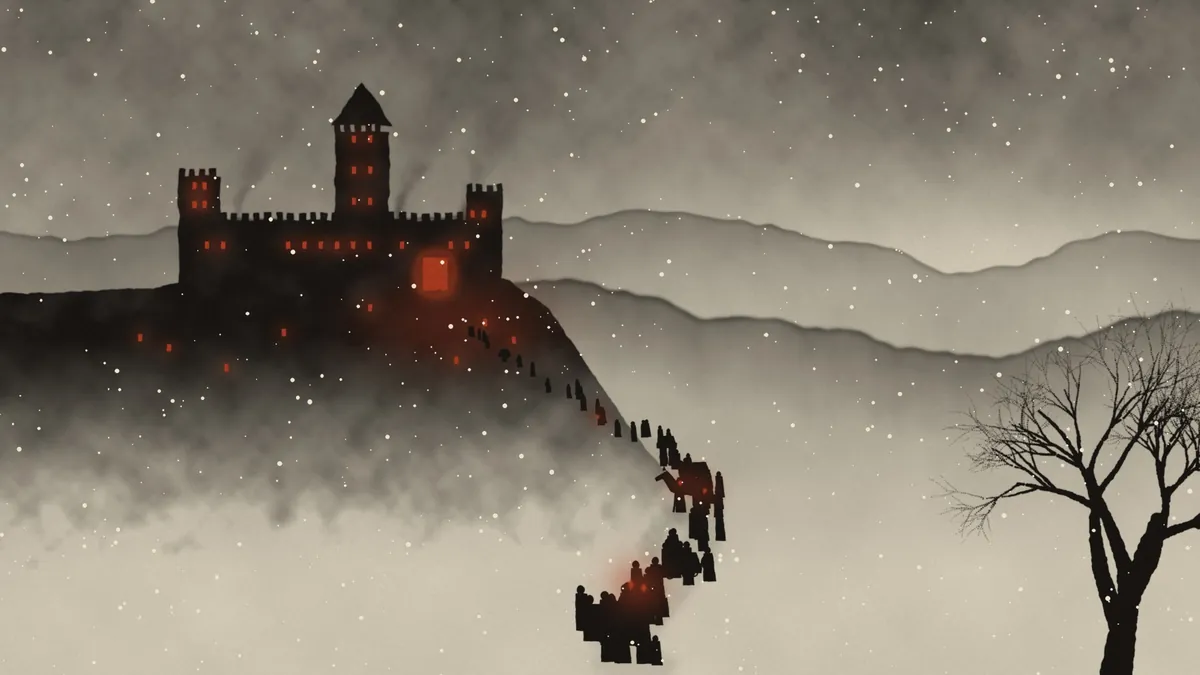
It was a lantern, and soon there were more of them, a slow string of small lights, winding down the last bends of the road toward the fortress through the falling snow. Rovan could see them clearly as they swung and steadied and came on. Between them, as his eyes grew used to the dark, he could make out shapes. Carts and mules, and people on foot, bent under bundles, walking beside the wheels.
"There," said Maelin softly. "There they are."
He was already moving.
He went down the north tower stair two at a time, as he had a year ago, and out across the outer ward through the snow, and Maelin came after him. Brand was in the gatehouse with the duty sergeant, and Edran with him, and when Rovan came in, Brand already had the keys out.
"I saw them," Brand said. "Open it."
They opened the outer gate. Its great leaves swung out into the snow, and the cold came in through the gap, and the lanterns came up the road out of the dark.
The first cart came up onto the shoulder and in through the gate. Old Hild was riding on the front of it beside the driver, so wrapped in shawls and snow that she had no shape at all. She looked down at Rovan as the cart went past him, with her black eyes, and nodded to him as if he were a horse she had bought after all.
"Commander," she said.
"Not anymore, mother."
"Commander," said Old Hild firmly, and the cart went on into the outer ward. In its bed, among the bundles and the sleeping children, Rovan saw a sack of horseshoes, new and dark, of good northern iron. They were for the forge, Hild had written in her message. A gift, for the old man's chair.
The others came after it: women and children and old men, and the men of Grimsel's mine, who had come home from the iron valleys in the summer. A girl of nine or so in a red hood was walking beside a mule, and she saw Edran in the gateway and shrieked his name and ran to him. He caught her with his good arm and swung her up, and she began to talk to him at once in the northern tongue. He answered her in it, haltingly, because he had been learning.
The last cart stuck in the gateway. Its near wheel had gone into a rut under the snow, and the mule could not shift it. The driver swore at it in the northern tongue, and Brand swore at it in the southern, and three of the garrison put their shoulders to the tailboard and could not move it.
"Oh, for pity's sake," said Maelin.
She knelt down in the snow by the wheel and put her bare hand on the iron tire. She did not seem to do anything. The wheel came up out of the rut as if somebody had lifted it, and the mule lurched forward, and the cart rolled in through the gate. The driver turned round on his seat and stared at her.
"Go on," Maelin said. "Go and get warm. There's goose."
Rovan stood in the gateway and looked back down the road.
It was empty now, with the lanterns all inside. The snow was coming down thick and fast on the place where they had been, filling the ruts, smoothing the road, closing the pass behind them. In the morning it would be shut from wall to wall, white and silent, and nothing would move on the road until April but wolves and the wind.
He stood there a moment longer, with the snow on his shoulders. Then Brand called to him, and he went in, and they shut the gate.
The end