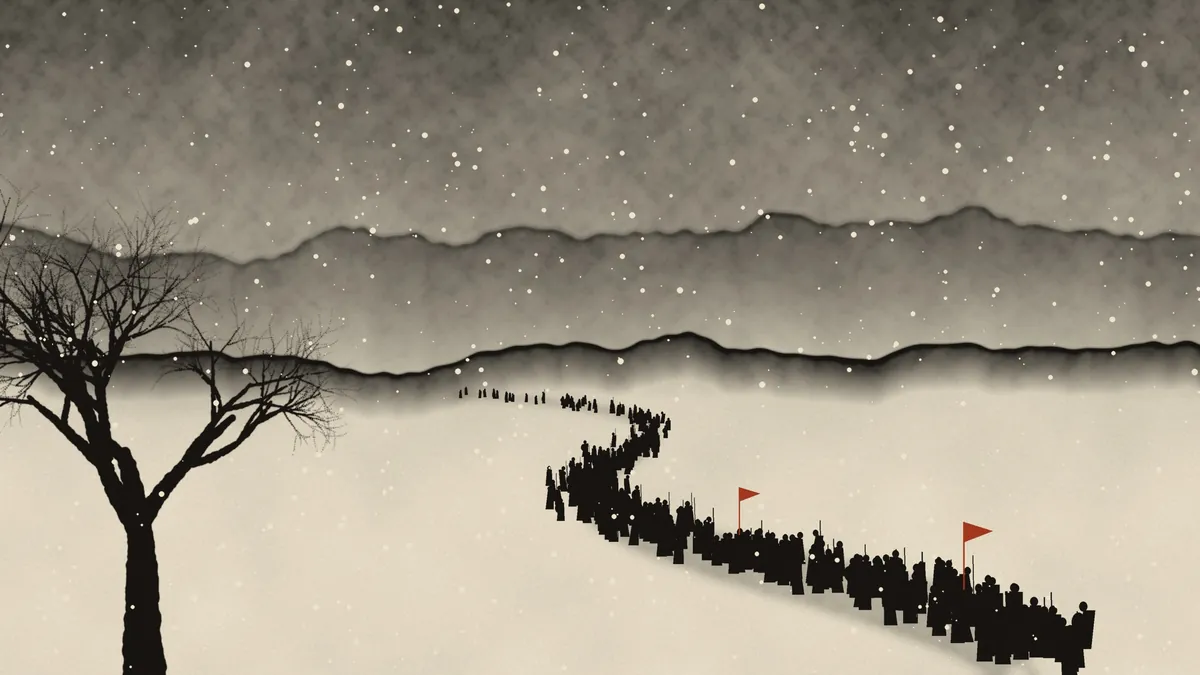
The Retreat from the Pass
The snow came an hour after they left Karthen, as if it had been waiting for them to go.
It came down the pass on a north wind, fine and dry at first, then thick and wet and blinding. By the time the last of the people from the fortress had straggled past the town, the road was white and the river Kell had gone the color of slate. Rovan walked at the back with Dace on his arm. Behind him the town was emptying too. Peck the merchant ran out of his warehouse yard in his fur collar, shouting about his flour. Wenna Cole had already taken two carts of it, mules and all. Peck stood in the road with his account book in his hand, and in the end he ran after them with the rest.
Rovan had about four hundred soldiers and five hundred others. Perhaps a third of the soldiers had weapons. Some had come out of the barracks without boots and had wrapped their feet in sacking. The families walked in the middle, in clumps, with the children carried or pulled. Old Hild rode on her mule among the women of Grimsel. The girl in the red hood walked beside Kit and held a fold of his coat.
Below the town the road crossed to the east bank of the Kell by a broad stony ford, and ran south down the floor of the pass with the river on its right hand, between walls of pine and rock. It was twenty-five miles to Hallam Keep and the governor there, and the nearest bridge that mattered was nine miles off. Rovan walked and thought about the nine miles.
"You're thinking about the boy," Dace said.
"I'm thinking about the bridge," Rovan said.
"You are. You've a face like a burnt pot." Dace limped on a while. His knee was swelling, and he would not let anyone put him on a cart. "That big lad, Wylie. You saw what I saw, on the slope. He was a yard off Kit with the sword up, and he stopped dead halfway up the hill, as if somebody had cut a string."
"I saw," Rovan said.
"And then Mabry came up the same slope and wobbled at the same place." Dace spat into the snow. "There's a line on that hill, Commander. No mason drew it, and it was there."
"Yes. And when they brought the bell up the hill, the line came with it." Rovan looked back over his shoulder. The snow had swallowed Karthen. "It reaches so far and no further. I don't know why."
"Then I'll tell you what I know," Dace said. "If that thing comes after us, I want to be in the next county when it rings."
Gant found them at noon. He came down the road behind them on a horse he had taken from somewhere, with his left arm still in its sling from the ford and snow in his ginger whiskers. Rovan had sent him back with two riders at first light to watch the road. The other two were not with him.
"They're coming, sir," he said. He leaned down from the saddle and kept his voice low, because people near them were turning to listen. "Gray riders first, forty or so, two miles back and coming easy. And behind them there's another of those things."
"Another bell," Rovan said.
"Smaller than the one at the fort. Not by much. It's on a wagon with twelve horses on it, sir, and they're bringing it at the gallop." Gant wiped snow out of his eyes. "There's riders all round it. Our riders. The Karthen horse, out of our stables, in our coats. I saw Sergeant Abney. I saw the captain."
Rovan said, "Edran."
"Riding by a gray officer with a white horsetail on his helmet. Close by him, sir, knee to knee, like an aide with his colonel." Gant's face worked. "I shouted to him. I was up on the bank above the road in the trees, and I shouted his name. He looked straight up at me. The officer said something to him, and he put his horse up the bank after me, and Durrow and Tam Benning went down between us." Gant stared at the reins in his hand. "I didn't wait to see more, sir."
So there were two bells, at least. Rovan stood in the falling snow and let that settle in him.
"How long?"
"An hour," Gant said. "Less, if the snow eases. They're not stopping for anything."
Rovan looked down the road ahead. Through the snow he could just make out where it bent left round a shoulder of rock, and beyond the bend the roar of white water came up to them out of the ground. That was the Sorrel gorge. The bridge over it was a single stone arch, and there was no other way across for a wagon this side of the snowfields.
He thought about the line on the slope. The compelled men had fought hard inside it, and outside it they had stopped. They could only fight where the bell was.
And the bell could only go where its wagon went.
"Dace," he said. "How long would it take you to bring down the parapet of the Sorrel Bridge? Onto the road, across the arch."
Dace looked at him, and down the road at the bend, and Rovan saw the old man's mind go over the bridge stone by stone. Dace had mended its coping once, years ago, for the road wardens.
"With crowbars and two good men? Half an hour. The mortar's old." He scratched his beard. "It won't stop horsemen for long. They'll lead their horses over the rubble on foot."
"I don't care about the horsemen," Rovan said. "I care about the wagon."
Dace's eyes narrowed, and he nodded. "Then I'll want Wenna's carts as well. The crowbars are in the bottom of the flour."
The Sorrel Bridge stood where the gorge broke out of the mountains to the east and fell into the Kell.
Rovan stood at the south end of it and looked north, and fixed the ground in his head. The torrent came down out of the east on his right, white and roaring in its slot of rock. It went under the arch a hundred feet below him and out on his left into the Kell, which ran south past him toward Hallam. The road came down from the north along the riverbank, swung onto the bridge, crossed thirty yards of stone, and came off at his feet. The arch was wide enough for four men abreast or one wagon. On the far side, north of the gorge, the road ran straight and open for a quarter of a mile between the river and a steep bank of pines. That was where the pursuit would come from, and where the bell would stop.
The people from Karthen were crossing. They came over the arch in a slow, shoving stream, with the snow driving across them and the gorge booming underneath. Wenna was on the bridge with her sleeves pushed up, sending them across by families and shouting at anyone who stopped to look down. Kit was ahead of her, going back and forth with the smallest children on his shoulders.
Rovan had asked for forty volunteers to hold the bridge, and he had got sixty. He took forty. Forty was all the arch would hold, he told the rest, and Hallam would need the others, and he sent them after the carts before anyone could argue. Gant was among them, with his arm in its sling and a borrowed sword in his good hand. So was young Lieutenant Quin, who had come up from Kingsholm in the autumn with a new commission and a borrowed horse. Quin had a spear and no coat, and his lips were blue with cold, and he grinned when Rovan looked at him.
"Sir. I was hoping you'd pick me. I've a bone to pick with those gray bastards."
"Pick it from behind the front rank," Rovan said. "Lieutenant. I want you alive tomorrow."
The last two carts came onto the bridge with Peck's flour on them. Rovan stopped them at the north end. He had the mules cut out of the traces and taken across. Then his men overturned both carts across the north end of the arch, wheels to the sky, and Dace's two men dug the crowbars out of the spilled flour.
Wenna came back across the bridge and stood looking at the sacks in the snow. Some had split. The wind was taking the flour off them in white smoke.
"That's three days' bread for five hundred people," she said.
"I know. It's three minutes for us, when they come." Rovan met her eyes. "Go with them, Wenna. Keep them moving until you can't hear the river."
"And what will you do?" Wenna asked.
"Stop them here, and come after you."
She looked at him the way she looked at a loaf she suspected of being underdone. At last she went back across the bridge with her skirts gathered in both fists, and he heard her voice go away down the road, scolding and steady.
Dace was on the arch already. He and two men had the crowbars into the joints of the western parapet, just north of the crown, and were heaving. The parapet was waist high, of big squared blocks capped with heavy coping stones. The first coping stone came loose with a grinding crack and went over the edge into the gorge. It fell for a long time before they heard it hit.
"Wrong way," Dace said, breathing hard. "We want them falling inward. Get round the other side of it, Spry. Lever them toward the road."
The gray riders came out of the snow an hour after noon.
Rovan heard the jingle of harness first, then the beat of hooves on the packed snow. They came down the straight road at a canter, forty gray shapes in the driving white, and saw the overturned carts across the bridge-end. They reined in a hundred yards short.
Rovan stood at the south end of the arch with his old sword drawn. His forty stood behind him on the arch and the south bank. The spears were in front and the swords behind, and his five bows were on the bank above the road.
The gray riders sat their horses and looked at the barricade. Their leader shouted, and half of them swung down and came forward on foot with their curved swords out and their round shields up.
They came over the carts. Rovan's bowmen shot two of them as they climbed. The others jumped down onto the arch and came on, and his spears met them at the crown.
It was a short, ugly fight in a narrow place. The arch was slick with snow and spilled flour, and men slipped and fell, and the roar of the torrent under them drowned every shout. The Kharadi were good. They fought shield to shield, four abreast, and they pushed. Rovan's spearmen held them at the crown for the space of thirty breaths, gave a yard, and held again. A spearman went down with his face opened. Another slipped and was stabbed where he lay. Rovan went up into the gap with his sword in both hands and cut down at a shield-rim and felt it split, and the man behind it fell back against the next. He cut again. The Kharadi line shuddered, and Gant was beside him, one-armed, stabbing low under the shields at knees and feet and swearing at the top of his lungs.
The gray riders gave back over the carts, carrying their wounded. They left four of their dead on the arch.
Behind Rovan the last of the crowd had gone round the bend, and the road south was empty except for footprints filling with snow.
"Dace?"
"Two more stones," said Dace from the parapet. "Give me two more."
Then the ground began to shake.
The bell came down the road at the gallop.
Rovan saw the horses first: twelve of them in six pairs, great heavy beasts lathered white and steaming, their heads down, their drivers flogging them on. Behind them came the wagon, swaying and bounding on the frozen ruts, and on it the bell. It was dark bronze, not much smaller than the one at Karthen and twice the height of a man, slung in a timber frame under a hood of canvas that the wind was tearing loose. Round it, before it and behind it, rode the Karthen horse.
He knew them, and he knew the horses as well as the men. He saw Abney on his bay with the white socks, and the Morgan brothers, and young Lowrie who had come up from Dunmere in the spring. Sixty or seventy of them rode there in their blue coats, riding close in about the wagon as a guard rides about a prince. And at the head of them, beside a gray-cloaked officer with a white horsehair plume streaming from his helm, rode Edran.
The wagon came on to within two hundred yards of the bridge. Then the drivers hauled the team round broadside across the road, and the wagon slewed to a halt, and men leapt down to the bell.
"Down!" Rovan shouted. "Get down! Cover your ears!"
It made no difference what they covered. The bell spoke.
It came across the snow and the gorge and the arch, and it came up through the stones of the bridge into Rovan's feet and his knees and his chest. The parapet thrummed under his hand. Snow slid off the coping in a sheet. Down in the gorge the torrent seemed to pause in its roaring before it roared again.
On the arch beside him, Lieutenant Quin stopped.
Rovan saw it happen to him. The boy's face went blank, then filled with horror. His eyes found Rovan's. Quin said, "Sir," quite clearly. And then he turned his spear around in his hands, as a man turns a tool to its proper end, and drove at Rovan's chest.
Gant knocked the spear up with his sword. The point went past Rovan's ear. Then two of the old men behind them had Quin by the arms, and he was fighting them, in silence, with his teeth bared. Further down the bridge another man had turned, and a third, a pair of young troopers who had come in last spring. One of them stabbed the man beside him in the thigh before he was beaten down.
"Hold them!" Rovan said. "Don't kill them. Sit on them. Take their weapons and hold them."
Across the road beyond the carts, the officer with the white plume raised his sword and called out in the northern tongue.
The Karthen horse charged the bridge.
They came at a canter, then a gallop, sixty riders on a road built for a wagon, and they came straight at the carts. The leading horses gathered themselves and jumped. The first went over clean. The second caught its hind legs on a wheel and fell, screaming, and its rider was thrown onto the arch. The third came over the second, and they were on the bridge, a mass of horses and men and swords, crowding the narrow arch from parapet to parapet.
"Spears!" Rovan roared. "Hold the crown! Hold it!"
Perhaps twenty of his spearmen were left on their feet. They knelt across the crown of the arch and set their spears, and the Karthen horse came onto the points.
Afterward it came back to him in pieces. A gray horse rearing above him with a spear in its chest, its rider clinging on, open-mouthed: Lowrie, from Dunmere. Abney's bay coming down sideways on the parapet and Abney going over it into the gorge without a sound. The jolt of his sword in a man's side, through a blue coat with Karthen's silver button on the cuff. A hoof that took him on the shoulder and spun him round. The noise, the gorge roaring under it all.
And Edran.
His nephew came onto the bridge on foot. His horse was down behind him at the carts. He came over the barricade with a sword in his hand and his face wet and set, and the men on the arch fell back from him because they knew him. Gant did not fall back. Gant was standing at the crown with his arm in its sling and his sword up, and as Edran came at him he lowered it.
"Captain," Gant said. "Captain, it's me. It's Gant. You still owe me for the beer."
Edran cut him down.
It was a clean cut, fast and hard, across the neck and shoulder, and Gant went down at once onto the flour and the snow. Edran stood over him. His nephew looked down at what he had done. His mouth opened. Then the gray officer shouted behind him, and Edran's head came up and his sword came up with it, and he came on toward Rovan along the arch.
"Now, Dace!" Rovan shouted. "Now! Bring it down!"
He heard Dace bellow somewhere behind him, and the scream of iron on stone. He stepped back. He stepped back again, with his sword up and his nephew coming at him through the snow, and he felt the men behind him give way.
The parapet came down.
It came down in one long piece, eight or nine yards of it, block after block toppling inward off the west side of the arch with a roar that drowned even the gorge. Two of the blocks went over the edge. The rest fell across the roadway, waist high and chest high, a jumbled wall of squared stone from one side of the bridge to the other. Edran's horse had followed him onto the arch, riderless. The falling stones struck it, and it screamed and fell back. A Karthen trooper on the far side of the line went down with his horse under the coping. The others pulled up, rearing, their horses slipping and crashing into the fallen blocks.
Edran stood on the far side of the rubble. Rovan stood on the near side. Between them was a wall of stone that no wagon in the world would cross.
For a heartbeat they looked at each other across it. Edran's chest was heaving. He had snow in his hair, and Gant's blood on his sword.
Then the gray officer called again, and Edran turned away and went back along the arch toward the bell.
Three of the Karthen horse had been on the near side of the rubble when it fell. One was dead under his horse. The other two came at Rovan's men on foot, and were beaten down and disarmed and held, struggling and silent, beside Quin and the two troopers who had turned.
Over the rubble, the gray riders tried once more. They came across it on foot, scrambling over the blocks with their shields on their backs. But a man climbing a wall of stone cannot fight, and the five bows on the bank shot them as they climbed. After the third went down, the rest went back.
Across the gorge, the Karthen horse had drawn back about the wagon. Rovan could see them through the snow, sitting their horses in a ring, unmoving, while the drivers fought to turn the team. The officer with the white plume rode back and forth before the rubble, looking at it, and at the gorge, and across at Rovan. At last he rode back to the wagon and gave an order, and none of them came.
"Spry," Rovan said. "Get the wounded on their feet. We're going."
They went down the road south in the driving snow. They carried their wounded, and they dragged the five who had turned. Quin fought the whole way. It took three men to hold him, and he kicked and twisted and bit, with no sound but his breathing. Half a mile down the road, past the first bend, where the noise of the gorge began to fall behind them, he stopped fighting. He went limp in their hands, and his head came up. His eyes went to the snow and the men who held him.
"Sir?" he said. "Commander? What happened?"
He saw Rovan's face, and turned his head back up the road toward the bridge, and Rovan watched him remember.
"I tried to kill you," Quin said.
"You did. Gant stopped you."
"Where is Gant?" Quin asked.
Rovan said, "Walk, Lieutenant."
The other four came back to themselves at the same bend, one after another, within a few yards of each other.
They had left eleven dead on the bridge. Another died on the road, of the spear-cut in his thigh, before they caught up with the crowd at dusk. Gant was among the eleven. There had been no way to bring him.
They walked all night, because Rovan would not let them stop. After the bridge, not a soul argued.
He walked at the back. The snow eased toward midnight, and the road dropped out of the mountains into the foothills. Somewhere behind him, at the edge of a gorge, the men he had trained sat their horses round a bell. Gant lay in the snow on the bridge.
He set himself to think. Who had turned, and who had not?
Brand had turned, at thirty-eight. Mabry had turned at forty-five, and Edran at twenty-six. Quin had turned, and the young troopers on the bridge, and Ellery on the stair, and Wylie, who had been sworn only the night before. The Karthen horse had turned to a man.
Rovan had not. Dace had not, and Dace was Teshar-born and had sworn to the Crown and nothing else. Gant had been an old Dunmere man, enlisted under the provincial articles before the reform, and Gant had stood. So had the gray-headed veterans who had taken their swords down off the walls of the families' houses.
It looked like age. Rovan did not think it was age. Mabry was older than half the men who had stood free. But Mabry had come to Karthen from the Kingsholm regiments eight years ago, and a man who changed regiments was sworn again, in the new form.
He thought of the six boys kneeling on the flags in the hall, and Wylie shaking, and the old woman from Grimsel dropping her cup. You have just given him six more, she had said.
He kept it to himself. He could not prove it, and a commander who said such a thing without proof would be called mad, and might be.
But at the first gray of dawn he called the officers he had left, and the sergeants, to walk with him.
"Every man in this company under forty," he said, "will march beside a man over forty, from now on. Pair them. Every man who came here from another regiment marches beside one of ours. If that bell catches us again, I want every man who might turn to have someone beside him who won't." His eyes went along their faces in the half-light. "I don't know why some turn and some don't. Until I do, we'll do this. If a man turns, take his weapon and get him down, and drag him away from the bell. You saw Quin. He came back once we were round the bend."
"And the ones who are paired with us, sir?" said one of the sergeants, a quiet man named Orley, who was thirty-one. "If it's us that turn?"
"Then you'll be sat on," Rovan said. "And I'll apologize afterward."
Orley laughed, a short bark in the cold. The others did not. But they went off down the line and did as he had said.
They came to Hallam Keep in the middle of the second afternoon after the bell.
It stood on a low hill above the Kell, where the foothills opened toward the farmland of the March. It was a square royal keep with round corner towers, a ditch, and a village of slate roofs below it. The royal flag hung sodden from the gate tower. Rovan had dined there a dozen times, and liked its governor, Arden Sayle, less each time.
The gate was shut. As the first of the Karthen people reached the ditch, someone rang the brass alarm bell on the wall, and they flinched from it and huddled together. Archers stood on the gate tower.
Rovan walked up to the edge of the ditch alone.
Sayle came out onto the gate tower. He was a big, soft, handsome man of fifty, in a fur-lined cloak, with a gold chain of office on his chest. His gaze went over Rovan to the people behind him: the soldiers in their shirts and their sacking boots, the women and children and old men shivering on the frozen road.
"Commander Tal," Sayle said. "I had your letter."
"Then you know what came down the pass."
"I know what you wrote. Wagons, at night, in December. I sat up half the night for your wagons, and this morning a carter came in and told me Karthen had fallen without a fight." Sayle's voice carried well, and he meant it to. "He said the garrison had gone over, and the commander had run out of the back gate with the women."
"The garrison didn't go over," Rovan said. "Something was done to them."
"Yes," Sayle said. "That's what I'd say, if I'd lost the strongest fortress in the north in a morning. I'd say a spell was put on them."
"Governor," Rovan said. "Five hundred of these people are not soldiers. They've walked twenty-five miles through the snow since yesterday's dawn. Take them in, and do what you like with me afterward."
"And open a royal keep to a mutineer's rabble, with an enemy behind it?" Sayle shook his head. "No, Commander. You'll camp under my walls, where I can see you. I've sent to Dunmere for orders. I expect they'll tell me to hang you, and I expect I'll be glad to."
"If that bell comes here," Rovan said, "it'll be your men who open your gate. And they'll weep while they do it."
"Then I'll stand at my gate and watch for weeping," Sayle said. "Good day, Commander. Keep your coward's company off my road." He turned and went in.
They camped without tents in a field by the river, in the lee of the keep's hill, behind a line of willows. They burned the willows and the village fences, and the village people came out and shouted at them for it. Rovan had the sergeants pay for the fences out of what silver the column had, and he did it before anyone asked him why. He had been twenty-one once, a trooper in the Dunmere horse, holding four horses at the door of a burning steading on the Lowe while a woman cursed him in the clan speech. He had not understood a word of it. The meaning had come through anyway. After dark, some of the same village people came back with bread and cheese and blankets, and went away without giving their names.
Wenna rationed the flour that was left: one meal for everyone, or two for the children. She chose the children. She divided her own portion between Kit and the girl in the red hood, and when he said something to her she told him to mind his soldiers.
He sat by one of the fires with a board on his knees and a candle stuck in the snow, and wrote a letter.
One person within a day's ride would believe him. She was wintering at Dunmere, in a house on the Cornmarket with a cellar full of wine and no patience for anyone. He had not fought beside her in twenty years, and had not written to her in ten. He wrote it short, because she hated long letters.
Maelin. Karthen is gone. They brought a great bronze bell down the pass on a wagon, and when it rang half my garrison turned on the rest of us. They knew what they were doing and could not stop. Brand is theirs. Edran is theirs. A second bell is behind us. I am under Hallam's walls with nine hundred people, and Sayle will not open his gate. If you ever trusted me, come now, and come armed. Rovan.
Below it he added a line: Do not tell Marta. I will tell her myself.
He sealed it with candle wax and his thumb, and gave it to a Teshar-born groom named Benno, who rode well and had not turned on the bridge. Benno took the best horse they had and went south in the dark along the Dunmere road.
Old Hild came to the fire before Dace did. She came on a Grimsel woman's arm, and would not sit, and stood looking down at him with the firelight in the creases of her face.
"The word," she said. "From your walls, this morning. Your men shouted it three times. You will want to know what it was."
"Tell me."
"A name. Kharad. Avar Kharad." She said it as the walls had said it, with the weight on the first part. "The one under the mountain. They were hailing him, Commander. As your men hail your king on his day." She looked north, where the cloud was coming down on the pass. "He has your fortress now. He will want the rest."
She went back to the women, and Rovan sat with the name.
Dace came and lowered himself down beside the fire with a grunt, and stretched out his bad knee toward the warmth.
"You've written to the mage," he said.
"I have."
"Good." Dace held his hands to the flames. "I never liked her. She drank all my brandy at Teshar and told me my rivets were crooked. But I'd have her at my back over any five regiments."
"So would I," Rovan said.
They sat. The fires burned down. Out beyond the willows the snow had stopped, and the sky was clearing from the south, and stars were coming out over the foothills.
Toward midnight, Rovan heard horses. He was on his feet, sword drawn, before he knew why. He saw torches: a long line of them coming out of the keep's gate and down the hill, two by two, and spreading out round the camp in the field. A hundred riders came, perhaps more, in royal blue, with lances. They ringed the fires at a walk, halted, and faced inward. People sat up in their blankets and stared at them.
An officer rode forward into the firelight. He was young and stiff, and he did not meet Rovan's eye.
"By order of the Governor," he said. "You and your people are to be escorted. For your own protection, Commander. No one is to leave the camp tonight. In the morning the Governor will receive your arms."
"My arms," Rovan said.
"All arms, Commander. Every blade in this camp." The young officer swallowed. "Those are my orders."
Rovan looked round the ring of lances, at the faces under the helmets. They were young faces, most of them. Every one of them had knelt somewhere on a stone floor and said the words.
Behind them, far off in the north, above the dark foothills, the mountains had vanished. Where the Ironbacks should have stood against the stars there was only a long, dense wall of cloud, low and white and solid, lit faintly from within. The snow had come down at last on the upper pass. Nothing would go north through it now until April.
Nothing would come south through it either. Whatever the bells had brought down out of the north was shut in with them for the winter, and would have to take what it needed from the country.
"Escort," said Dace, at his elbow, very low. "Is that what they call it in Hallam."
Rovan put his sword back in its scabbard, slowly, and sat down again by the fire.