The Mountain Capital
Edran Tal lay on his belly on a shelf of cold rock above the Gullet and looked at the city that had owned him.
It was the first time he had seen it. All through the winter he had served it without once setting eyes on it. He had marched for it and given orders for it and killed for it, and it had been only a weight at the back of his mind, a direction, north. Now it lay below him in the dark, and he could not stop looking.
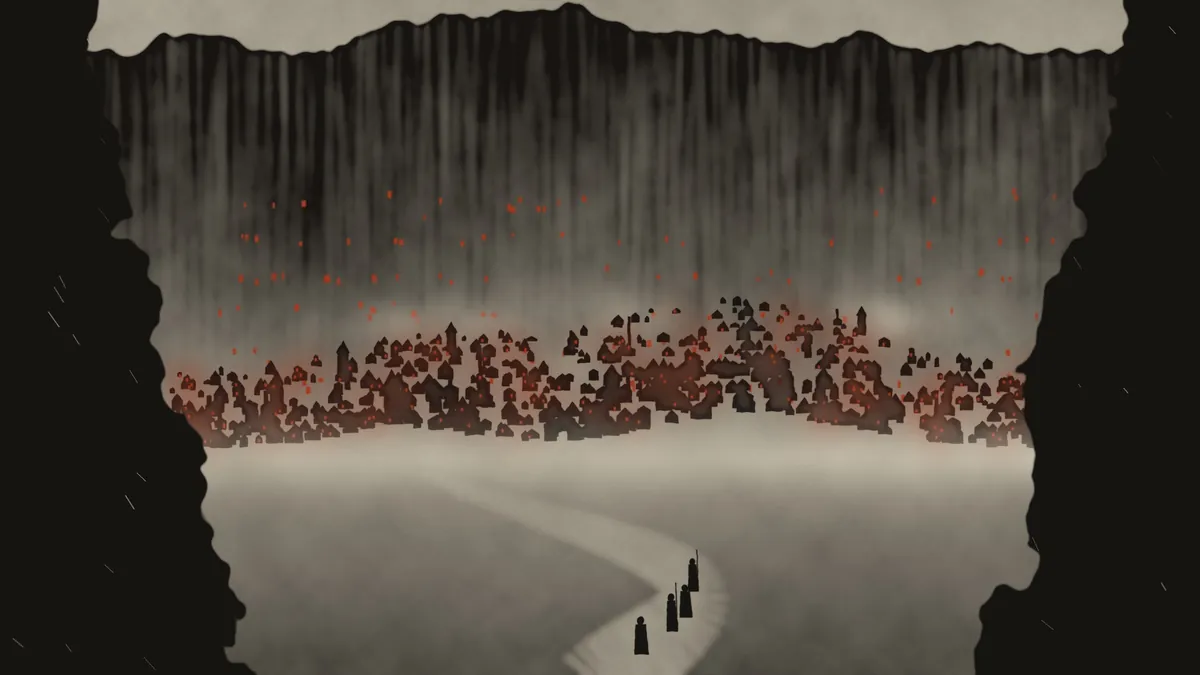
The Gullet came out under his shelf into the open basin. From where he lay, Edran could see the whole approach. A mile ahead of the Gullet's mouth, beyond a bare stretch of stubble and slag, the outer wall ran right across the south side of the basin from cliff to cliff, black against the lights behind it. The Furnace Gate stood in the middle of the wall, where the road went in, with a fire burning in an iron basket on each of its towers. Beyond the wall the lower city filled the basin floor, mile on mile of roofs and lamps and chimney smoke, climbing toward the north. And at the north, closing it all, stood the Kharad Wall.
It rose out of the city as a single sheer face of rock, so high and so black that it seemed to have no top. There were lights in the rock. They were windows, Edran realized slowly, and doors, and galleries, cut into the face of the cliff in rows and tiers, hundreds of feet up. A long, pale zigzag climbed the cliff from the city floor toward the highest of them. That would be the Stair of Kings. Somewhere inside that rock, above the lower city, the great bell waited, silent and not yet hung. Somewhere deeper in sat the thing that had taken him.
He remembered everything it had made him do. That was the worst of it, and he had told it only to his uncle. He remembered the Sorrel Bridge, and the weight of the sword going down, and Gant's face. He remembered the orders he had written in a clear hand at Thornwick, with the route of every convoy and the depth of every ford. He remembered being pleased that they were good orders. All winter he had been the best officer he had ever been, and he had been it for the Seat. Now he lay above its city with Callum's elbow in his ribs, and he thought that if he could undo one hour of that winter he would give his right hand for it, and probably his left.
"Bonny," said Callum Breck, beside him, in a whisper. "If you like that sort of thing."
"I don't," Edran said.
"No. Nor me." Callum pointed with his chin. "Watch the east tower. They strike it about now."
Edran watched the tower. On the far right, at the eastern end of the outer wall, a light moved on the top of a tower. Then the sound came across the basin, a long, deep note, faint at that distance. He felt it in the rock under his chest, and his whole body went tight, and he made himself breathe.
It was nearly a mile and a half away. He was outside it, and he knew he was outside it, and his hands were cold on the rock all the same, and he could not make them warm.
They held the council in the morning, in the hall of the Gullet fort, with Captain Ulric's map of the basin on the table.
Ulric was a big gray Kharadi of fifty with a face like a split log. His wife and three sons lived in Ashgate, and he had opened his gates to the coalition two days before without a blow struck. His men still wore the Seat's gray and still stood on his walls. Every morning a rider still went up the Gullet from the fort to the Furnace Gate with his dispatches, as one had every morning for twenty years. As far as the city knew, the Gullet fort was holding, and the southern army was still somewhere in the iron valleys.
"They will not believe it long," Ulric said. "A week. Perhaps less. Somebody will run."
"Then we have a week," said Rovan.
"Less, for your king." Ulric put a thick finger on the map, high under the cliff. "He came in last week by the Eastway, with two hundred of the Marshal's horse round him. They have lodged him in the reception wing at the head of the Stair of Kings. That is where they keep the great folk who are to be shown to the people."
Edran stood at the end of the table, where he always stood, with his back to the door. He waited until the others had finished. Then he unrolled the map he had made on top of Ulric's.
He had drawn it from the shelf above the Gullet, and from what Ulric's men told him of three nights' watching, and from what Anke Falk remembered of the city. Every distance on it was paced or reckoned. The scale was marked in the corner. On it, in charcoal, he had drawn circles with a cord and a pin. Each one was half a mile across the radius, true to the scale, centered wherever the scouts had seen a bell struck.
"The east tower," he said, and touched it. "The west tower. Each has a wagon bell on its roof, and they strike them every ten minutes all night, because half the wall garrison is bound and the officers don't trust them since Ashgate. The fields cover the two ends of the wall." He moved his finger. "They don't reach the Furnace Gate. The gate is a mile and a quarter from either tower. The gate guard is unbound, all volunteers, so they don't need a bell there."
"And inside?" said Maelin.
"Two wagon bells in the lower city," Edran said. "They move. Ulric's riders have seen them in the streets by day. But at night, from midnight till the dawn watch, they're both up here." He touched the north of the map, under the cliff. "In the barracks quarter, at the foot of the Stair. That's two miles from the gate. Every night for three nights, they've kept there."
Rovan studied the map, and Edran watched him do it with his hands pressed hard against the table edge to keep them quiet.
"And the great bell?" Rovan said.
"Silent. It isn't hung. Anke says it can't be rung until the ceremony." Edran made himself go on. "So between midnight and the dawn watch there's a road from the Gullet's mouth to the Furnace Gate, and from the gate into the lower city as far as the tanneries, with no field on any part of it. A man who knows the forms could walk it. Ulric's dispatch rider walks it every morning."
"A man who is bound," said Rovan.
"A man who knows the forms. I know the forms, Uncle. I spent three months learning them." Edran heard his voice tighten and steadied it. "I know how a Kharadi captain speaks to a sergeant, and what he calls the Marshal, and how he holds his cup. Callum's men don't. Maelin doesn't. Anke knows the city but she's nineteen and a foundry girl, and they'd stop her at the first door. I can get her through. She can show me where they're keeping the king. And on the morning you come, I can be at the Furnace Gate from the inside."
"And if a bell is struck while you're in there?" Rovan asked.
"Then I'm theirs," said Edran. "And Niall and Murdo knock me on the head and carry me out, or cut my throat, whichever's quicker. I've told them so."
The hall was silent. Ulric studied the table, and Maelin watched Rovan, and Rovan kept his eyes on the map and gave nobody a glance.
"Callum," he said at last.
"Commander."
"Take your scouts out tonight. Don't look at this map. Don't talk to Edran. Go and watch the wall and the city for two nights, and come back and tell me what you see." Rovan rolled up Edran's map and handed it back to him, without unkindness. "If Callum tells me the same thing you've told me, I'll think about it. Until then, I've thought about it, and the answer's no."
Callum came back two mornings later with his plaid black with mud and his eyes red from watching.
He stood in front of Rovan in the hall of the fort with a scrap of hide in his fist, cut all over with knife-point marks.
"It's what the lad said," Callum said. "All of it. Five nights running, with Ulric's three. There's a road there, Commander. It's narrow, but it's a road." He glanced at Edran across the hall, briefly. "I don't like it. But it's sound."
Rovan was silent while the fire settled in the hearth, and Edran heard his heart knock against his ribs. Then his uncle said, "Tomorrow night. You go in at midnight, and you're behind a door in the lower city before the dawn watch. The day after, we come at first light." He turned to Edran. "Find the king if you can. Don't take him. Find where he is, and be at the Furnace Gate when Maelin breaks the wall. If you can open it, open it. If you can't, stay alive."
"Yes, sir."
"That's an order, Edran," Rovan said. "The last part."
Edran nodded, and found that his hands were shaking, and put them behind his back.
Maelin found him that night on the wall of the fort, with the map spread on the parapet and a lantern weighing down one corner. He was going over his circles again with the cord and the pin. He had been over them so many times that the charcoal had worn gray.
"They're right," she said. "Leave them alone."
"I know they are," said Edran.
"Then stop rubbing them out with your thumb." Maelin leaned on the parapet beside him. "Do you remember the Sorrel Bridge? In April? When we walked you up the road to that bell with a rope round your middle?"
"I remember," Edran said.
"You said you felt it a step before it had you. A hand on the back of your neck, you said. Then one more step, and you were gone, and we hauled you back like a sack of meal." She tapped the map. "That step is yours. Nobody else in that city will have it. If you feel the hand, you don't stop to think about it, and you don't wait to be sure. You turn round and you go the other way as fast as your legs will carry you."
Edran rolled up the map. "And if it's in front of me and behind me both?"
"Then Niall knocks you on the head, as arranged," said Maelin. "He's looking forward to it. I asked."
They dressed him in the Seat's gray in Ulric's chamber the next evening.
Ulric gave him a captain's coat with the Gullet badge on the collar, and an iron tag on a thong to wear round his neck, stamped with the fort's mark. He gave him the night's words for the Lantern Post and the Furnace Gate. He gave him a letter, too, written and sealed by Ulric himself. It said that Captain Tal of the Gullet garrison was bringing in the founder Anke Falk, as requested by the Bellmaster's office in June, for the fitting of the great bell.
"It is a true letter," Ulric said. "They did ask for her, in June. I did not send her. Now I send her." Ulric studied Edran under his heavy brows. "If they question you hard, tell them the truth about the girl. A lie that is half true keeps longer."
Niall Nairn and Murdo Breck were dressed as Gullet troopers, in gray cloaks and round helmets. Niall was a lean, quiet man of forty, Elspeth Nairn's nephew, with a long jaw and a habit of saying nothing for hours. Murdo was Callum's cousin, twenty, freckled, and could not stop grinning at himself in his helmet. Neither of them had a word of the northern tongue.
"So you'll keep your mouths shut," Edran told them. "Both of you. All the way. If anybody speaks to you, you look at me."
"I can look stupid," said Murdo. "I've a great gift for it."
"You have," said Niall.
Anke came in last. She had washed at last, for the first time since Ashgate, and put on a plain brown dress and a founder's leather apron over it. She had a bag of tools on her shoulder. She studied Edran in his gray coat without any expression at all.
"It suits you," she said.
"It shouldn't."
"No. That's why it does." She shifted the bag. "I'll take you to my mother's cousin in Tanners' Row. Inga Moller. She'll hide us. She hates the Bellward, the bell-officers' corps, more than I do."
Rovan was waiting in the yard of the fort when they came out. He stood by the gate in the torchlight with his old sword at his hip and his hands at his sides. Edran stopped in front of him.
He had not stood this close to his uncle since March. He could see the gray in Rovan's beard and the scar on his cheekbone from Thornwick, and the lines round his eyes.
"I'm sorry," Edran said. "For the bridge. For Gant. For all of it. I never said it properly."
"You said it at Karthen. To his widow. I heard you." Rovan's voice was very low. "Come back, and say it to your mother."
He held out his hand, and Edran looked at it, and then took it, and his uncle's grip was hard and warm, and it was over.
They went up the Gullet at midnight, on foot, with Anke's bag of tools between them.
The Gullet was two miles of black rock and loose stone, with the road at the bottom of it and the stream running beside the road. The walls rose on either side to the stars. Their boots were loud on the stones. Edran walked in front, with his hands at his sides, and made himself walk as a Kharadi captain walks, not hurrying, with his chin up.
Ahead of him, beyond the Gullet's mouth, the east tower bell spoke. He felt it in the road. It was more than a mile and a half away and could not touch him, and every muscle in his body tried to stop.
The Lantern Post stood at the Gullet's mouth, a stone guardhouse at the foot of the western height, with a lamp over the door. Two Kharadi spearmen stood under it, and one of them stepped out into the road as they came.
"Who goes?"
"Tal, captain, Gullet fort, with escort and one civilian for the city." Edran said it in the northern tongue, as he had heard it said a hundred times in the winter. He said it bored. "Iron and stair."
"Iron and stair." The spearman turned to Anke. "What's she?"
"Founder, for the Bellmaster's office. They asked for her in June. The Gullet's been sitting on her." Edran shrugged. "Not my business why."
The spearman held up his lantern to Anke's face. She looked back at him with her pale eyes and said something short in the northern tongue about his mother, and the other spearman laughed. The first one stepped back. "Go on, then."
They went on, and the road ran out of the Gullet across a mile of open ground, cut stumps and old slag heaps, toward the Furnace Gate and its two fires. The road was empty. Edran could hear the wind moving over the basin, and Murdo breathing hard behind him, and the thud of his heart.
The gate towers grew as they came on, and the fires on them roared in their iron baskets, and he could see the shapes of the guard moving on the walk above. The great leaves of the gate were shut. A postern stood open in one of them, a small door with a lamp, and an officer's table inside it under an arch, with a ledger and a sergeant sitting behind it.
Edran walked up to the table and put down Ulric's letter.
The sergeant picked it up and read it, slowly, moving his lips. He was a short, thick man with a gray moustache, in the Seat's gray with a sergeant's knot on the shoulder. When he had read it, he looked up at Edran.
He took his time about it, and Edran saw, in his face, that the man knew him.
"Captain Tal," said the sergeant, in common speech. "Captain Edran Tal."
"Sergeant."
"Tormod Lund. I was at Karthen with you, in the winter, with the occupying regiment. I drilled your company in the outer ward. You won't remember me. You weren't remembering much, then." He laid the letter on the table. "They told us you were taken at the mill. At Thornwick, in March. Taken by the rebels, and carried off out of the field."
Edran stood with his hands at his sides.
There were three ways to go. He could lie, and the man would know it. He could run, and the guards on the walk above would have him before he reached the Gullet. Or he could tell a half-truth, as Ulric had told him to, and pray that it kept.
"I was taken," he said. "Carried off south, over the river. They kept me in chains for a month. Then the Marshal's people found the place, in April, and brought a bell up close." He made himself smile.
"And here you are," said Tormod Lund. He looked at Edran's gray coat, and the iron tag at his throat, and the Gullet badge. "At the Gullet."
"Ulric had need of an officer who knew the southern forms," Edran said. "Since Ashgate."
The sergeant's eyes narrowed at the name of Ashgate. Edran saw it, and could not tell what it meant.
"You know the order, Captain," Tormod said at last. "Every bound officer who comes into the city reports to the Bellward on the night he arrives. To be put under a bell, and confirmed. That's been the order since Ashgate." He reached behind him and rang a small hand-bell on a hook, an ordinary brass bell for calling a runner, and Edran nearly flinched out of his skin at the sound of it. "Lieutenant Odvar will take you up."
Lieutenant Odvar was young and tired and had been asleep in the guardroom. He came out buttoning his coat, with two spearmen behind him and a lantern, and took Edran's party into the city without asking any questions at all.
"The Bellward's up under the Stair," he said, yawning. "In the barracks quarter. It's a long walk. Two miles. You'll want to see the founder lodged first, I suppose. There's a hostel for the bell-crafts by the Copper Market."
"That'll do," said Edran.
The lower city closed round them. It was bigger than Kingsholm and older, and it smelled of coal smoke and hot iron and sewage and bread. The streets were narrow and steep, paved with black stone, and the houses leaned over them. Warm air came up through iron gratings in the paving, where the water ran under. There were lamps at the corners, and late taverns, and a woman singing behind a shutter. A cat sat on a step and watched them go by. It was a city full of people who had to get up in the morning, and Edran had not expected that, and it made his chest hurt.
At the top of the Founders' Steps a chain hung across the street between two posts, with a watchman beside it in a sentry box. He came out with a slate in his hand and held up his lamp, and Odvar gave him the night's word. The watchman wanted the names. He wrote each one on his slate, slowly, with his tongue between his teeth: Odvar, two spearmen, Captain Tal of the Gullet, two troopers, the founder Falk.
"Tal," he said, and frowned at the slate. "That's a southern name."
"Half the Marshal's officers have southern names," said Edran in the northern tongue, before Odvar could answer. "She's a southerner herself. You might write that down too."
Odvar laughed, and the watchman reddened and let the chain down, and they stepped over it. Edran felt the slate behind him all the way up the next street. His name was on it now, in chalk, in the middle of Dhor Kharad, where any officer of the Bellward could read it in the morning.
He walked beside Odvar and talked about the weather on the Gullet road, and the price of beer in the fort, and the Marshal. He did not know how long he talked. Every street they climbed brought them closer to the north quarter and the bells. Somewhere ahead of them, two miles up under the cliff, the wagon bells were laid up for the night. Every step closed the gap. Half a mile from them, Edran would feel the edge of the field. Inside it, Odvar would hand him to a bell-officer, and the bell-officer would say, Captain Tal, tell me who sent you, and Edran would tell him.
Anke caught his eye. She turned her head a little, to the left, toward a lane that opened off the street between two tanneries. The stink of the tan-pits came out of it like a wall.
"Tanners' Row," she said, in the northern tongue, to nobody. "We used to cut through here, when I was a girl. It's quicker to the Copper Market."
"Is it?" said Odvar. "I never come down here. It stinks."
"It's quicker," said Anke, and went into the lane.
Odvar followed her, and his two spearmen followed him, and Edran and Niall and Murdo followed them.
The lane was dark and narrow, and walled with tan-pits on either side behind low walls. Halfway down it, out of sight of the street, Anke stopped and turned round.
Niall Nairn killed the first spearman. He did it from behind, quickly, with a long knife under the helmet. Murdo took the second, and it was not so quick, and the man got out half a shout before Murdo's hand closed over his mouth and they went down together on the stones.
Odvar turned with the lantern in his hand and his mouth open, and saw Edran.
Edran had his knife out, drawn without deciding to draw it. He saw Odvar's face in the lantern-light, young and puzzled and sleepy, and he saw Gant's face at the Sorrel Bridge in December, turning toward him on the arch with the same puzzled look. Edran had cut him down. He had not been able to stop himself. His arm had come up and down, and Gant had fallen.
Odvar dropped the lantern and went for his sword.
Edran drove into him with his shoulder and carried him back against the wall of the tan-pit, and they fought there in the dark. Odvar was strong, and got his sword half out, and Edran caught his wrist and slammed it against the wall, and slammed it again, and the sword fell. Odvar's free hand found Edran's throat. Edran drove the knife in under his ribs.
The lieutenant made a sound, and his hand loosened on Edran's throat. He slid down the wall and sat in the mud at the bottom of it, and looked up at Edran with that puzzled look, and died.
Edran stood over him with the knife in his hand.
What frightened him was that his hand was steady. It was perfectly steady, and he had chosen to do it, and nobody had made him.
"Captain." Niall's voice, close and very low. "We've to go."
They put the three bodies in the nearest tan-pit, under the slime, and Murdo put the lantern out with his foot. Anke was already moving down the lane in the dark.
They were three streets from Inga Moller's door when the bell spoke.
It came from the north and above them, from up the hill. Edran felt it before he heard it. It came down through the paving under his feet and up through his boots into the bones of his legs. Then the sound came after it, deep and close and terrible, a wagon bell struck hard, rolling down the steep streets and breaking against the walls of the houses. Shutters rattled in their frames, and somewhere a dog began to bark.
"The Copper Market," Anke whispered. "That's from the Copper Market. They've brought one down."
"Someone found them," said Murdo. "Or the sergeant sent a runner after us."
Edran could not answer them. He stood in the dark street with his back against a wall and his hands spread on the stones behind him.
He felt it at the edge of him. It had not taken him yet; it lay lightly on the back of his neck, a hand he knew, a hand he had worn all winter. It made no sound and gave no order. It waited with perfect patience for him to come inside it. Inside it, he would stop and stand where he was, and wait with his hands at his sides, for an officer to come down the street with a lantern and say his name.
The Copper Market was half a mile up the hill. He was on the very rim of the field. He could feel the line of it across his body like a draught from a door.
And the line was moving. Up the hill, over the sound of the dog and the shutters and the shouting beginning in the streets, came the grinding of iron tires on stone, and the crack of a whip. The bell had been struck, and now they were bringing it down. Its field was coming down the hill with it, street by street. In a minute it would be over him.
"Edran," said Anke. She had him by the sleeve. "Edran. Which way?"
The hand on the back of his neck tightened, very gently, and he felt his feet begin to want to stop.
He tore himself off the wall and ran.