The King Freed
The dead man's coat still smelled of his pipe. Edran Tal buttoned it to the throat on the roof of the captured bakery, and his fingers were steady on the brass, and that frightened him more than shaking would have.
It was a Kharadi captain's coat of the Seat's gray, with the Seat stamped on every button, and he had worn it two nights ago to come in through the Gullet. He stood in the last of the light and looked north across the city he was about to walk through.
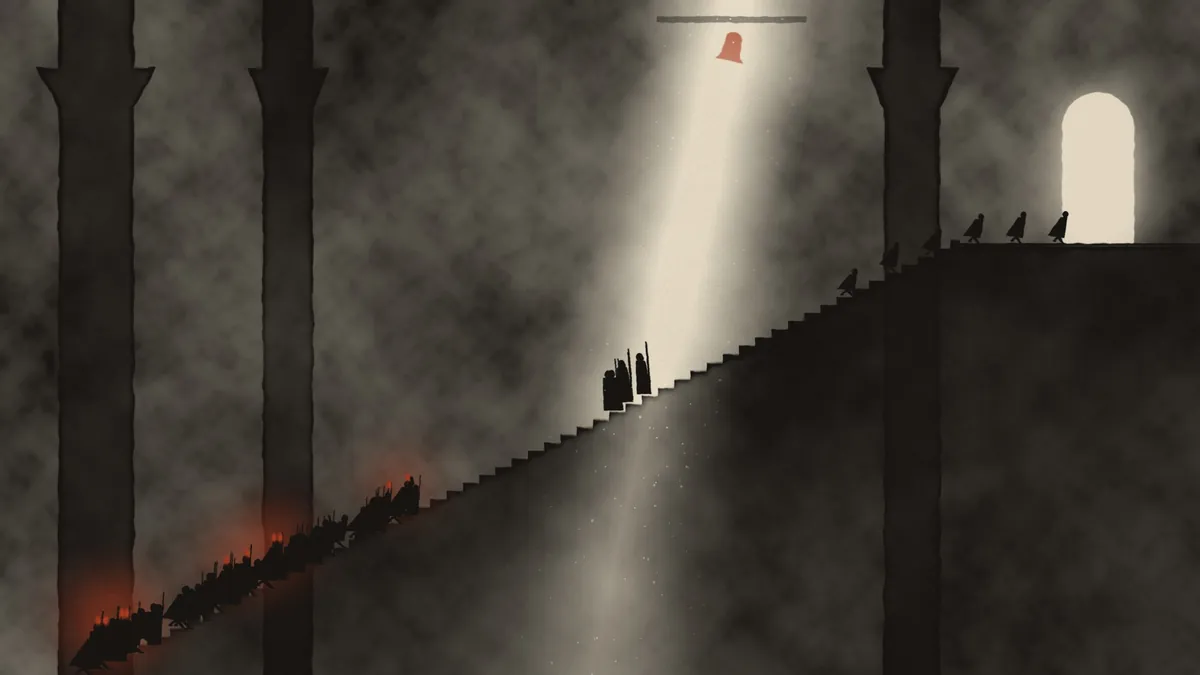
From here he could see all of it. The lower city filled the basin floor in front of him, roofs and chimneys and smoke, the better part of two miles of it running north to the foot of the Kharad Wall. The cliff stood up out of the houses, black and sheer, and its face was pricked with lights where the great shafts and windows let the air in. Up the middle of it, in a lit zigzag, climbed the Stair of Kings. At the top of the Stair, four hundred feet above the rooftops, a row of tall doors stood open and full of lamplight. That was the Hall of Oaths. Behind him, half a mile south, the Furnace Gate stood broken open in the outer wall, and his uncle's army held it and the streets up to the Salt Cross, and nothing more.
"You'll be wanting the time," said Kester Nairn, beside him.
"I know the time," Edran said.
"Tell me anyway. I like to hear you say it."
"The procession forms in the Hall at the ninth hour. It goes up to the bell chamber at the eleventh. The bell is struck at midnight." Edran looked at the sky over the western rim, where the light was going green. "It's half past seven."
Kester Nairn was Elspeth Nairn's grandson, a short, freckled, unhurried man of thirty with a highland axe through his belt and a wooden leg below his left knee. He said it was the reason he'd never sworn anything to anyone, since no king's recruiter would look at him twice. He could climb faster on it than most men on two.
"And when it's struck," Kester said, "you'll be the bell's man and not ours."
"Yes," said Edran.
"And so will the king."
"He will," Edran said. "That's the point of tonight."
Rovan came up the ladder onto the roof. He had not slept since the breach. Edran could see it in the way he held his shoulders, and in the bandage on his left wrist where it had been tied badly in the breach and never tied again. He came and stood at the parapet and looked north at the cliff for a while, as if he could learn it by heart.
"Kester," he said. "Will you give me a moment with my nephew?"
Kester went down the ladder. Rovan stayed facing north.
"You don't have to go."
"We've had this out, Uncle," Edran said. "Callum looked at the plan and called it sound. You agreed."
"I agreed you could go. I'm telling you that you don't have to." Rovan's voice was dry and level, the voice he used for forage returns. "You've done enough. You opened the gate. Mabry's dead in the breach because we were slow to it, and you weren't slow. Nobody would call you a coward for sitting tonight out."
"I would." Edran heard how young it sounded and did not care. "I know the forms. I know the Hall. Anke and Inga's man have drawn it for me door by door. Kester can't walk in there wearing this coat. Callum can't. I can, and not be stopped at the first door."
Rovan was silent.
"Then get him out," Rovan said at last. "Get him beyond the basin before midnight. If you can't, get yourself out. Don't hold anything. Do you hear me? Don't stand in a doorway for me this time."
"I hear you," Edran said.
His uncle turned then and looked at him. Edran thought he would say something more. Instead Rovan straightened Edran's collar, where the gray coat sat crooked, and stepped back.
"Plague take it," Rovan said, very quietly, and went back down the ladder.
They went into the city at full dark, twelve men and Edran.
The clansmen walked in front of him in a loose file, with their hands roped in front of them and their weapons hidden under their plaids. The ropes were tied with a slip-knot that Kester had shown them a dozen times. Edran walked behind with a drawn sword and the Kharadi coat and a sheaf of papers he had written himself that afternoon, in a hand he had learned from the people who owned him. Prisoners for the swearing. Highland rebels, taken at the Gullet, to be brought to the Hall of Oaths for the Seat's mercy. He had signed it with the name of a Gullet captain whom Ulric had sent north in the spring.
The lower city was full of people. That surprised him, though it should not have. There had been fighting in its southern streets all day, and the coalition held the Furnace Gate, and still the people of Dhor Kharad were out on Harvest Eve. Lanterns hung from the house-fronts, and garlands of barley were twisted round the doorposts. Children sat on the steps, eating something sticky from paper cones. Women stood in the doorways talking across the street to one another in the northern tongue, and they fell silent as the prisoners went past, and watched them with round, careful eyes.
"They don't look as if they're expecting the end of the world," Kester said, out of the side of his mouth.
"They're not. They're expecting a holiday. They've been told the southern rebels are beaten at the gate and the king of the south comes tonight to kneel." Edran kept his eyes ahead. "Keep your head down. You're beaten."
At the first checkpoint, at the bridge over the Cold Channel, the sergeant read his paper by lamplight and spat and let them through. At the second, by the Hall of Weights, a young officer wanted to know which company Edran served in. Edran told him, and told him the name of its colonel and the colonel's wife, and told him that if he wanted to keep the Seat's prisoners standing in the street on Harvest Eve he could explain it himself to the Warden of the Stair. The young officer let them through.
The bell spoke on their left, from somewhere in the Lamp Market.
It was a wagon bell, one of the small ones that the Kharadi had kept in the city's districts, half a mile of field around each. The note came through the cobbles and up through the soles of Edran's boots, and he felt it reach for him.
The touch came as a hand laid on the back of his neck, very lightly, from far off. It touched the edge of him and rested there. He knew precisely where it stopped. It was a line in the street a few yards ahead of him, where a drain cover lay in the gutter, and beyond that line was the bell's ground and the bell's men.
He stopped walking.
"Edran?" Kester had turned his head.
"Left," Edran said. His mouth was dry. "Turn left. Now. Down the alley by the dyers'. Don't go past that drain."
They turned left. He walked with his sword in his hand and the skin of his neck crawling, and the touch faded behind him and was gone. He made himself breathe. A field had a fixed edge, half a mile out from the bell, as fixed as a wall. He had told Maelin that in the spring with a rope round his waist, and she had measured it with a chain. He knew it in his mind. His body had never believed it.
"How far round?" Kester said.
"Half a mile round, and half a mile back. We'll come out at the Court of Fountains from the west. It'll cost us a quarter-hour."
"And if the bell moves?" said Kester.
"Then I'll feel it, and you'll knock me on the head."
"It'll be a pleasure," Kester said.
The Stair of Kings began in the Court of Fountains at the foot of the cliff, and it was guarded.
The court was a wide square of black stone with water running in channels across it, and the Stair went up out of its northern side into the rock. A gatehouse stood at its foot, with a portcullis raised and a dozen men of the Seat-guard in front of it in their tall bronze helmets. Above the gatehouse, the Stair climbed the cliff face in long flights, back and forth, with lamps on iron brackets at every turning.
"Sixteen turnings," he said. "The fifth is the narrowest. They call it the Kneeling Turn, because the old kings stopped there to pray. Then the Hall."
"You've walked it."
"Anke has, a hundred times. I've walked it in my head." He said no more, and Kester let it lie.
The officer at the gatehouse was a gray-bearded captain with a gorget of bronze at his throat. The gorget was stamped with the Seat, and it marked him as one of the officers the sovereign had named. Any bound man in a field had to obey him. Edran's eyes went to it before they went to the man's face, and he hated himself for that.
The captain read the paper. He read it again. He looked at the clansmen with their roped hands, and at Edran.
"Highlanders," he said. "For the Hall. I was told nothing."
"Nobody tells anybody anything tonight, Captain. The rebels are at the Furnace Gate."
"Who signed this?" the captain said.
"Captain Harro of the Gullet."
"Harro was hanged in the spring," said the gray-bearded captain. "I saw it."
He was reaching for his sword when Kester pulled the slip-knot.
The clansmen came out of their ropes together. Kester's axe came out from under his plaid and took the captain in the side of the neck as he drew, and the man went down against the gatehouse wall. The Seat-guard were slow. They had stood all evening at the foot of a stair in the safest city in the north, and they were looking at a dead officer. The clansmen were among them before their spears came down. It was quick and close and quiet, men grunting and the scrape of boots on wet stone. A guard ran at Edran with his spear leveled. Edran turned the point with his sword, stepped inside it and cut him across the face, and the man dropped the spear and fell to his knees with his hands to his eyes. Edran hit him with the pommel and he lay down.
Two guards ran for the court. One of the clansmen threw a short axe after them, and one of them fell. The other got away, shouting, round the corner of a fountain.
"That's done it," Kester said. He was breathing hard. One of his men, Fergus, was sitting against the wall with a spear-cut in his thigh, cursing in the highland tongue. "They'll know at the top before we're halfway."
"They'll know there's trouble at the bottom of the Stair. On Harvest Eve, with the rebels at the gate, they'll send men down to the gate, not up to the Hall." Edran dragged the gray-bearded captain's body into the gatehouse and pulled the bronze gorget off over his head. He looked at it in his palm for a breath. Then he put it in his coat. "Fergus stays here with two men and holds the gatehouse till we come down. The rest of us go up. Fast."
They went up fast.
The Hall of Oaths was cut straight into the rock of the cliff, two hundred feet long and sixty high, and it was full of names.
Anke had warned him of that, and it did not help. He came in through the side door from the guards' stair, with Kester and nine clansmen behind him, and the names hit him in the face. Long tables ran down both sides of the hall, and the tables were stacked with rolls. Hundreds of them lay there, thousands, in leather cases, in bundles tied with ribbon, in heaps. Clerks in gray sat at the ends of the tables with pens. Over the tables, from the high ceiling, hung banners on poles. They were the banners of towns. He saw the green tree of Hollin, where the bell had got away over the skyline in July with thirty people walking behind it, and the three fish of Saltmere's river wards, and the white bridge of Merrow Ford.
"Hells," Kester whispered. "What is all this?"
"Rolls. Every man and woman in Auren who has spoken the king's pledge since the decree, written down by the town clerk who heard them. They've been sending them north all summer by the Eastway." Edran heard his voice, quite calm. "Tonight they read them out at the bell."
The procession was forming at the far end of the hall, under the great doors that opened onto the top of the Stair. Readers in gray stood with rolls in their arms, and choristers, and a double file of the Seat-guard in bronze. And in the middle of them, a little apart, stood an old man in white.
King Osric of Auren had been a big man when Edran last saw him, at the hearing in the hall of the Lune. He was still tall, but the flesh had gone off him and left the frame behind, and the white robe hung on him as on a pole. His beard was cut short. He stood with his hands folded in front of him and his eyes on the floor. Beside him a page held a cushion, and on the cushion lay a heavy gold seal on a chain.
"Where are the prisoners?" Edran said.
"Under us." Kester had sent a man down the guards' stair already. "Here he comes."
The man came back up at a run. He was grinning.
"Two hundred of them," he said. "Southerners. In the undercroft, in chains, with six guards. Kingsmen, by their coats. Their sergeant says he knows you, Captain."
The sergeant's name was Ollan Pryce, and he had been born two streets from Edran's mother's house in Dunmere.
He was a lean, sallow, gray-haired man, with the fever-bright eyes of someone who had been eating prison bread since February. He had marched north with Lord Marshal Tierney in January with eight thousand others. He had felt the bell take him on the Dunmere road, and he had walked north in the snow behind it, singing a hymn he had never learned. Most of the eight thousand had been put into Serath's regiments. Two hundred had been kept back and brought to the capital in chains, to kneel behind the king tonight and show the north what the south's army had come to.
"Edran Tal," he said, when the clansmen had broken his chain and he stood rubbing his wrists. "Marta's boy. Your mother gave me a hiding once for stealing her plums."
"She told me. She said you came back the next day and stole more."
"They were good plums." Pryce looked at the Kharadi coat, and the gorget showing at the neck of it, and his eyes narrowed. "Are you theirs or ours, lad?"
"Ours, while no bell's ringing," Edran said. "Same as you."
"Then what do you want?"
"The king," Edran said. "Now, before the procession moves. And then I want him out of this basin before midnight."
Pryce looked at the iron door of the undercroft, and at his two hundred men standing up in the half-dark, thin and filthy, with their broken chains in their hands.
"We've no weapons."
"The guardroom's on the next landing," Edran said. "It holds the Seat-guard's spares."
"Then we've weapons," said Pryce.
They came into the Hall of Oaths from both ends at once.
Edran came through the side door with the clansmen, and Pryce came up the undercroft stair at the procession's back with two hundred starved men armed from the guardroom. The Seat-guard had perhaps forty in the hall. They were good soldiers, and they were facing the wrong way.
Edran went straight for the king. A guard turned to meet him, tall in his bronze helmet, and swung a long-hafted axe. Edran ducked under it and felt the wind of it on his scalp, and he drove his sword up under the man's arm where the mail stopped. The guard fell against a table and brought it down, and rolls went everywhere, sliding and bouncing across the floor. A second guard came over the spilled rolls at him. Kester's axe took that one behind the knee, and he fell.
The readers scattered, shrieking. The choristers ran for the great doors. Behind them the Seat-guard were trying to form across the hall, and Pryce's men hit them in the back. No drill-sergeant would have owned it. Two hundred men who had been chained in the dark for six months swung captured swords and spear-butts and lengths of chain at the men who had chained them. A guard went down under four of them and stayed down. Another threw down his axe and was killed anyway, and Pryce roared at his men to take prisoners, and was not obeyed.
Edran reached the king.
The old man had not moved. He stood in his white robe in the middle of the fighting with his hands still folded, staring at the floor, and the page beside him had dropped the cushion and run. Edran caught him by the arm.
"Majesty. Majesty, look at me."
King Osric raised his head. His eyes were gray and very tired, and for a moment they looked through Edran. Then they did.
"Captain Tal," the king said. "You were at Kingsholm. You testified."
"Yes, Majesty. I've come to take you out."
"Out." The king looked round the hall, at the dead guards, at the scattered rolls, at Pryce's men finishing the last of the Seat-guard against the far wall. "Is there a bell on me?"
"No bell is ringing on you now, Majesty," Edran said. "You're your own man."
"I'm nobody's man," said the king. "I'm a seal on a cushion." He bent, stiffly, and picked the gold seal up off the floor by its chain. He weighed it in his hand. "They had me use this. In July. With my own hand, Captain, and I knew every word I was writing."
A voice spoke from the dais at the end of the hall.
"Take him, then, by all means."
It was a reader, a stout bald man in gray with a roll still in his arms. He had not run. He stood on the steps of the dais where the procession had been forming, and he looked at Edran and the king with mild contempt.
"Take him back to the south," the reader said. "He was a banner. A very fine banner, and we are sorry to lose him. But the Seat does not need his mouth tonight. It needs these." He lifted the roll in his arms. "Fifty thousand names. Every one of them spoke the words aloud, in person, for the protection of the realm. At midnight the bell will be struck, and the rolls will be read, and at the last name the bell's reach will be fixed at twenty miles. Every one of these who lives within twenty miles will belong to the Seat forever, and the king of the south may watch it from wherever he likes."
Edran looked at the king. The old man's face had gone the color of the robe.
"Is that true?" Osric said. "Captain. Is it true?"
Edran remembered Maelin, at Kingsholm in June, explaining the rule to the king's council with her hands, and the king not wanting to hear it. A man's word bound only the man who spoke it. No king could swear for anyone but himself.
"Yes, Majesty," he said. "It's true. They don't need you. They never did. You were for show."
The reader smiled. Kester hit him in the mouth with the haft of his axe, and he sat down on the dais steps and stopped smiling.
"Then what am I for?" said the king.
He said it quietly. He was standing among the spilled rolls of his subjects, with the seal in his hand.
Edran had very little time. He knew it, and he made himself think in order, one thing and then the next, as his uncle did.
"You're for this, Majesty," he said. "No bell is ringing on you. For the next hour and a half you can write anything you like, and seal it, and no officer of theirs can make you unsay it until a field takes you again." He snatched a roll off the nearest table, broke its ribbon, and flipped it to the blank back. "Revoke the decree. Now. In your words, under your seal. Let it say that not another soul in Auren is to swear those words, on your authority, ever again. It won't free a single one of these. But it stops the next fifty thousand."
The king looked at the blank parchment. Then he looked at Edran, and something came back into the gray eyes that had not been there before.
"A pen," he said.
One of the clerks' pens lay on the floor by an overturned inkhorn. Edran gave it to him. The king knelt on the stone among the rolls, spread the parchment on the back of a fallen reader's case, and wrote. He wrote fast, in a big, sloped, old-fashioned hand. Edran stood over him with a bloody sword and watched the great doors and the inner door at the back of the dais. Kester stood at the king's other side.
"Inner door," Kester said. "Listen."
Edran listened. Beyond the inner door, deep in the rock, he heard boots. Many boots, coming down a stair at the run.
"Seat-guard," he said. "From the upper halls. Majesty, there's no more time."
"Done." The king pressed the seal into the wax from a guttered candle, hard, with both hands. He stood up. His knees cracked. He held out the parchment. "Who carries it?"
"Kester does. With you." Edran gave the parchment to Kester, who shoved it inside his shirt. "Kester, take the king and your men. Down the Stair, past Fergus at the gatehouse, and go west along the Court of Fountains to the Long Conduit. Anke showed you the grating."
"I know the grating," Kester said.
"The conduit runs under the city to the outer works. It comes out in the ditch two hundred yards west of the Furnace Gate. Get him through the gate and across the open ground and into the Gullet. The bell's field ends half a mile beyond the outer wall. Past that he's safe when it rings."
"And you?" said Kester.
"I'll hold the Stair."
Kester looked at him. "Your uncle said you weren't to hold anything."
"My uncle isn't here, and those men on the inner stair will be down on top of the king before he's at the second turning. Somebody has to stand at the Kneeling Turn." Edran looked at the king. "Majesty, can you walk two miles in a water channel?"
"I walked here from Callan Downs," said King Osric. "Walk in front of me, Highlander. I'll keep up."
They went out through the great doors and down. Edran watched the king's white robe go down the first flight between the clansmen, bent, quick, and then the turn of the stair took it out of sight.
The boots on the inner stair were very close now.
Edran turned to Pryce, who was standing by the dais with a captured sword in each hand and blood on his face.
"Sergeant. Take your men down the Stair after the king. Go now. Don't wait."
"No," said Pryce. "I'll not argue on a stair, sir. We're staying. Two hundred of us left eight thousand on the Dunmere road in January, and walked off singing. We're not leaving one more."
There was no time to make them go.
The Kneeling Turn was the fifth landing down from the top, where the Stair narrowed between the cliff and a carved parapet to the width of three men. A worn stone bench stood against the rock. Below the parapet, the face of the cliff fell away two hundred feet to the lamps of the lower city.
Edran held it with forty of Pryce's men. The rest Pryce had sent down after the king, cursing them, because they had asked to stay too.
The Seat-guard came down from the Hall in a column four wide. They had bronze helmets and long axes and round shields with the Seat painted on them in white, and they were fresh, and angry, and they came down the stair at a run. The first of them reached the turn and found the clansmen's dead and the overturned bench across the landing, and Edran and Pryce and three ranks of starved Aureners behind it.
They did not stop. They came over the bench.
Edran met the first of them with his sword two-handed and took the axe-blow on the forte. The shock went up both arms into his teeth. He let it carry the axe past him and hacked at the man's leg below the shield. The guard went down on one knee. Pryce killed him with a thrust over Edran's shoulder. The next came over the body. Edran caught a shield-rim in the chest and went back a step and set his feet against the rock.
On the narrow stair, numbers mattered little. Three men could fight abreast and no more. The guards were better armed and better fed, but they had to come down a slope at men who were waiting for them, and the dead made the footing worse at every blow. A guard on the parapet side swung too wide, and his axe struck the stone and threw sparks, and an Aurener with a spear pushed him over the parapet. He fell without a sound, a long way, onto the roofs.
They fought for a quarter of an hour. Edran lost the time. It was all one blow and then the next. He took a cut across the forehead that filled his left eye with blood, and he fought with the eye shut. An axe came down at his sword-hand and he pulled it back too late, and the blade laid open the back of his hand from the knuckles to the wrist. He felt it as cold, and then as heat. When he tried to close the hand on the hilt, the fingers would not close.
That was his worst moment, and the pain was the least of it. He had feared his hands for nine months. He had lain awake chained to a post in his uncle's camp and watched them in the firelight, the hands that had cut down Corporal Gant on the Sorrel Bridge. Now one of them would not do what he told it, and the stupid thought came to him that it served it right.
He changed the sword to his left hand and kept fighting.
A guard got past him. Edran saw the man's axe go up over Pryce's head, and he could not reach him. Three Aureners did. They went at the guard with bare hands and a broken spear, and dragged him down on the stair, and one of them took the axe-blow in the shoulder meant for the sergeant. Then a guard's axe came at Edran's face from the left, the blind side, and he saw it only as a darkness moving. Someone shoved him hard from behind, down onto the step. The axe went over him and struck the rock. When he looked up, a thin young Aurener with no front teeth was standing over him with a sword. He had killed the guard, and was grinning down at him.
"Down you stay, Captain," said the young man. "You're the only one of us who knows the way out."
The Seat-guard broke off at last, and gave no reason. Perhaps their officer had been killed. Perhaps they were called back above, for something that mattered more to them than a stair. They went back up the Stair of Kings in good order, shields up, and left their dead on the Kneeling Turn among the Aureners'.
Edran sat on the step with his back against the cliff. Pryce sat down beside him. The sergeant had a cut on his scalp and another on his forearm, and he was wheezing.
"How many?" Edran said.
"Eleven of ours dead. More hurt. They've lost more." Pryce looked at Edran's hand. "Let me see that."
"It'll do."
"It won't. Give it here." Pryce tore a strip off the hem of a dead guard's cloak and bound the hand up tight, with the fingers curled over a wad of cloth. "There. You'll not close it tonight, lad, and maybe not this year. Your mother will kill me."
Edran leaned his head back against the rock. Below, far down, he could see the lamps of the Court of Fountains, and the dark mouth of the gatehouse where Fergus had held. There was no sign of a white robe. The king was in the conduit by now, or dead, or taken. He could not know which. They bound their wounds and waited while the lamps burned down, and it was past the eleventh hour.
He thought of midnight, and the field reaching out from the cliff over all of them on the Stair. He thought of what came after, the moment when a man with a bronze gorget would tell him what to do with his left hand.
He reached into his coat and took out the gorget he had pulled off the dead captain at the gatehouse. He held it up in the lamplight so the men on the landing could see.
"Listen to me," he said. "All of you. When the bell sounds, we'll be inside its field. There's no help for that. You'll feel it take you. The first thing it says to everyone in the basin is kneel. That's the rite. It holds you on your knees until an officer tells you something else. Only these can do that." He turned the gorget so that the bronze caught the light. "Officers in these. If a man in one of these comes down that stair after midnight, he can turn you on each other. So if you see one, kill him now, while your hands are yours. And if you're on your knees and one comes, shout. Shout as loud as you can. The rest of us will know."
The men on the landing were silent. Pryce took the gorget from him and turned it over and handed it back.
"We'll kill them," the sergeant said. "Don't you fret."
Above them, high in the cliff, something groaned. It was a long, deep sound of iron and timber under strain, coming through the stone at their backs. Edran felt it in his spine before he heard it. He knew the sound from the foundry at Ashgate, where Anke had shown him the great beam on its chains, and the cradle for the ram.
Far above them, in the rock, the ringers had begun to draw back the ram.