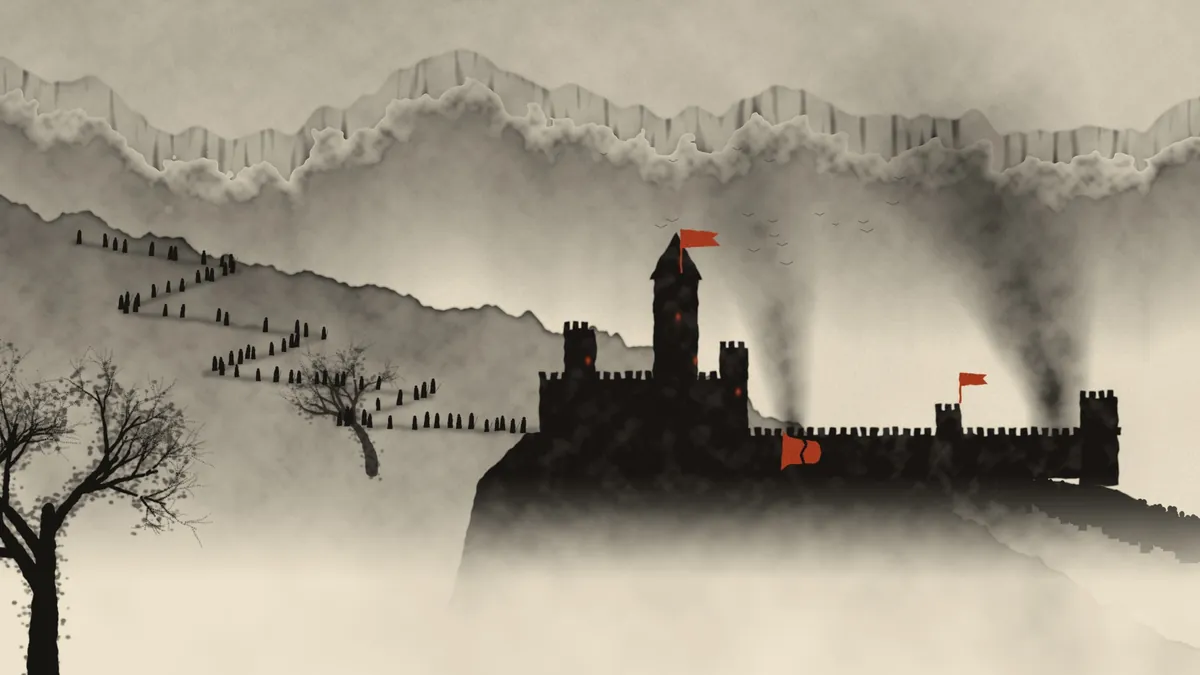
The Liberation of Karthen
Rovan lay in the wet grass by the road at a quarter to four in the morning and listened to the bell.
He lay a little north of where the wagon had stood in December. That had been the first thing he looked for when they came down to the road in the dark, and he had found the place by the ruts, sunk deep in the verge where the great wheels had stood all night. From here the road ran south along the shoulder for nine hundred yards and climbed to the outer gate of Karthen. The gate was a black square in the gray wall with a torch burning over it. The river Kell ran loud in its gorge below on his left hand. Beyond the outer wall, out of sight, lay the outer ward and the bell in its stone house. Beyond that were the inner gate, the inner ward, the keep, and the mountain rising sheer behind them all to the west.
The note came up the road and through the ground into his chest, the note he had heard in his sleep for five months, and he felt it in his teeth. Around him in the grass and among the rocks, nine hundred men and women felt it too, and none of them moved.
None of them had sworn; he had made sure of that, man by man, over three days.
"That's the one," Hessa said beside him, very low. She was lying on her elbows with her helmet in front of her on the turf. "Eight minutes from now, the next."
Rovan nodded.
"And the field's half a mile round it," Hessa said. "Your sergeant says the bell sits forty yards inside the gate, so we're lying just beyond its edge. Fifty yards up the road, and we're in." She sniffed. "Not that I'd feel it. I always expect to feel something."
"Maelin feels it."
"Maelin feels everything. It's why she's so bad-tempered." Hessa pulled her helmet on and tied the strap. "Your nephew's going to hate you for this, you know."
"He hates me already," Rovan said. "He hates himself more. It keeps him honest."
Edran was four miles off at Kell Tower, with every bound man in the army, and Rovan had set two of Callum's clansmen to sit with him. They were to stop him if he tried to come. Edran had asked for that himself. He had asked to lead the assault first, standing in the Kell Tower yard in the evening with his face set, and Rovan had told him why not. A bound man inside that field would hear the next strike and turn, and the Kharadi would have a captain who knew every stair in Karthen. Edran had heard him out, and at the end he had asked for the guards.
Rovan looked up at the mountain behind the fortress, where the dark rock went up and up into the clouds. Somewhere on it, in a cleft he could not see, Callum Breck and four hundred clansmen had been lying since midnight on a goat-path above the inner ward. They had come over the top from Kell Tower in the dark, by a way the highland herdsmen had used for three hundred years to steal the garrison's goats.
The sky was going from black to iron over the eastern wall of the pass. It was the same color, he thought, as the morning they had run.
"Maelin," he said.
She was lying a yard off with her gloves already on. She turned her head. "I know. The gate. I'm going."
The bell rang again as they went up the road. Rovan was walking beside Maelin at the head of the pikes, in the half-dark, and he felt it come through the soles of his boots. Maelin swore under her breath. The ground under them was rock, the long rock of the shoulder, and to her the field was a hum in every stone of it.
"Strong," she said. "Close. It's in the ward, just where your sergeant said. Against the east wall." She spat. "I hate the taste of it."
They were three hundred yards from the gate when the sentries saw them. A horn blew on the wall, and lights went up along it. They were two hundred yards off when the first arrows came, and Hessa's front rank lifted their shields and kept walking.
Rovan looked up at the walls as he walked. Men were running along them, taking their places. Some wore the long gray cloaks of the north. Most wore old royal coats, faded and patched, and carried their bows and spears as Rovan had taught them to carry them. Over the gate, shouting orders, stood a tall man leaning on a stick. It was Brand.
He could not see the face at this distance, but he knew the shape of the man and the way he stood. The stick was new.
"Archers on the wall are ours," he said to Hessa. "The old garrison. Don't shoot at them unless you must."
"Then they'll shoot at us."
"They will," Rovan said.
"Your mercy will cost me pikemen, Tal, and pikemen cost money." But she passed it back down the ranks, and her sergeants shouted it on.
The arrows came thicker at a hundred yards. A pikeman two ranks behind Rovan grunted and sat down in the road with a shaft in his thigh. Another went down without a sound. The front rank closed up over them. At fifty yards the gate loomed over them, black oak and iron, with a ditch before it that the Kharadi had dug in the winter, and the torch hissing in its bracket above.
Maelin ran the last thirty yards. Rovan ran with her and six pikemen ran around them with their shields up. Arrows hammered on the shields. One came through and stood quivering in a pikeman's arm, and he swore and kept his shield where it was. Maelin went down into the ditch and up its far side and threw herself flat on the rock at the gate's foot. She laid both iron palms on the bare stone of the shoulder, where the gate-tower's footing went down into it.
"Shields over me," she said. "And don't talk."
They held their shields over her. Stones came down from the gatehouse, and boiling water, and one of the six went down with his helmet crushed. Rovan stood over Maelin with a shield he had taken from the dead man and felt every blow of it in his arm.
Under his feet, the rock began to hum.
It was a different hum from the bell's, coming up deep and rising, and the whole shoulder of the mountain seemed to tighten under him like a drawn rope. Maelin's back was arched. Her face was pressed against the stone and her eyes were shut. Grit began to trickle down the face of the gate-tower above them, then pebbles, then a stone the size of a man's head. A long crack opened in the masonry beside the gate. It climbed the tower from its footing to its parapet, and the tower leaned outward.
"Back!" Maelin shouted. "Back, back!"
They ran, and behind them the gate-tower came down. It sagged inward rather than outward, its footing gone, onto the gate itself, and the gate burst from its hinges under the weight. The gateway vanished in a roar of falling stone and dust. When the dust began to thin, the gate was a slope of rubble and broken timber. Beyond it lay the outer ward.
Hessa's pikes went up the rubble in a wedge, with Rovan among them.
He came over the top of the rubble and the outer ward of Karthen opened in front of him, and he took it in with one look.
The barracks were on his right and the stables on his left, just as they had been. The parade ground lay between, churned to mud. Against the stable wall, forty yards inside the gate, stood a squat stone house with a slate roof. It was open on its southern side, and in the shadow of that opening hung a great curve of red-gold bronze. Men were running toward it with spears, and men were running everywhere. Down the slope beyond, a hundred and sixty yards off, the inner gate stood shut, and there were men on its gatehouse.
The old garrison came at them across the parade ground.
They came in a line, as they had been trained to come, with their spears leveled. Rovan saw their faces and knew them. They were faces from the supper hall and the parade, from the ford and the kitchens and the long winter nights. Some of them were wet, and all of them were set and white. A Kharadi officer rode behind their line on a gray horse, shouting orders in the northern tongue, and each time he shouted, they flinched.
"Pikes!" Hessa roared. "Front rank, kneel! Hold! Hold, damn you!"
The two lines met in the mud.
It was pike against spear, and the pikes were longer. Hessa's front rank caught the charge and held it, and the old garrison came up hard against the pike-heads and stopped. They could not reach. They thrust and thrust, and men cried out on both sides. Rovan was in the second rank with his sword drawn, and a man in front of him got his spear past the pikes. He drove it into a Lissen pikeman's shoulder, and pulled it out, and drew it back to thrust again.
It was Ellery.
Ellery, who had come up the stair at him in December with eyes full of horror. Ellery had been with him at the Kell ford, and had put his spear into a gray rider for him that day. He was thinner now, hollow-cheeked and bearded, in a coat with no buttons. His mouth was open and he was saying something. Rovan could not hear it over the noise.
The pikeman beside the wounded man thrust, and his pike took Ellery in the chest. Ellery went backward into the mud and lay there. His hands opened, and the spear fell out of them.
Rovan stepped over him. There was nothing else to do.
"The bell!" he shouted to Hessa. "Get me to the bell!"
"Get yourself there! I'm busy!"
Maelin was beside him again, filthy with dust, with a cut over her eye. She grabbed his arm.
"Left," she said. "Along the stable wall. They've only a dozen there. Come on."
They went along the stable wall with twenty of Rovan's veterans, the free men of the old garrison, who had been at Merrow and Brackwater and the Sorrel Bridge and had sworn to be at this. The Kharadi had a dozen bell-crew and guards in front of the bell-house, as Maelin had said, in short mail, with axes and short swords. They had made a wall of shields across the open side of the house, and they stood behind it and waited.
The bell rang.
It rang from twenty yards off, inside its stone house, and the noise of it was beyond anything Rovan had known. It struck him in the chest and filled his skull. The stable wall shook beside him and slates slid off the bell-house roof and smashed. Rovan staggered, and beside him one of his veterans dropped to his knees with his hands over his ears. Behind them, across the parade ground, Rovan heard the old garrison give a great hoarse groan, all together.
They had been inside the field all along. But they had felt it come, every one of them, and they had heard what it meant. Eight minutes more. Ten minutes more. Another winter.
"Now," said Maelin. "Before they can haul the beam back."
They went in.
The Kharadi shield-wall was good, and it held them for the space of a dozen breaths. Rovan took an ax on his blade, and it nearly tore the sword out of his hand. He shoved the shield in front of him with his body and cut over the top of it, and missed, and cut again, and felt the old sword bite. A man went down. A veteran beside him named Thatcher, sixty years old and missing three fingers, put his spear through the gap. Another went down. Rovan was through.
Inside the house, under the bell, a tall man in a black coat stood with a hammer. He was the bell-captain, by the chain at his neck. He looked at Rovan without fear, and he said something in the northern tongue as he swung the hammer.
Rovan ducked, and the hammer took the wall behind him and splintered the stone. He came up inside the swing and drove the old sword into the man's body under his arm, where the coat opened, and the bell-captain folded and slid down the wall.
Maelin went past him to the bell.
It hung from a beam of black oak on iron straps, over a pit in the floor. Its lip was at the height of her shoulders. It was bigger than the bell at Merrow, and older, its bronze crusted green along the lip. Its crown was bolted to the beam through four great iron collars. A rope ran from the striking-beam along the wall to a windlass, and two of the crew were at the windlass, winding. Rovan killed one, and the other ran.
Maelin pulled off her right glove with her teeth. She put her bare hand flat on the bronze, and Rovan saw her flinch at the touch of it.
"Blood and iron," she said, between her teeth. "It's singing in the stone. Rovan, hold the door."
He held the door while the Kharadi came back across the ward, more of them now, with the officer on the gray horse. His veterans stood in a line across the open side of the bell-house with their spears out, and Rovan stood with them. Behind him he heard Maelin begin to talk to the bell. She spoke in a low, steady voice, too low to make out the words. She sounded like a woman talking a horse down in a burning stable.
The Kharadi charge hit the line, and Thatcher went down. Rovan fought in the opening of the bell-house with his back to the bell, and every time his sword struck iron, he felt the bronze behind him answer it with a faint bronze murmur.
Then the bronze cried out, a scream of metal, high and long, no ring at all, and Rovan felt it go through the soles of his feet. Behind him something cracked like a frozen lake breaking. He turned his head. Maelin was on her knees under the bell, with both hands pressed against its crown where it met the iron collars. A crack ran down from the crown through the bronze, across the green-crusted shoulder, down the body toward the lip. As he watched, it forked, and forked again. The bell lurched in its straps. An iron collar burst. The great bell tilted, and its body split along the crack from crown to lip, and half of it fell into the pit with a roar that shook the slates off the roof.
The hum in the ground stopped.
Rovan felt it stop. He had never guessed he could feel it until it was gone.
Out on the parade ground, the old garrison of Karthen came to themselves.
Rovan saw it happen. A man in the front of their line had his spear drawn back to thrust at a Lissen pikeman. He stopped with the spear drawn back, and stood there, and looked down at his hands. All along the line it went the same way, as if a wind had passed over a field of barley. Men stood where they were and dropped their spears, and some knelt where they stood. One threw back his head and howled, a long, wild, broken sound. Another turned on the Kharadi officer on the gray horse behind him and dragged him from the saddle, and four more fell on him.
Hessa's voice cut through it all. "Hold! Hold, they're ours now! Hold your pikes! Anyone who stabs a man in a royal coat answers to me!"
From the inner gate, down the slope, came a roar.
Rovan ran out of the bell-house and down the long slope of the outer ward toward the inner gate, where he had stood in December and watched Wylie stop running. The inner gate was shut, and on its gatehouse roof men were fighting. He could see gray cloaks and royal coats, struggling at the parapet. As he came closer, a gray cloak went over the parapet and fell into the archway.
He heard the bar go up behind the gate. The great leaves shuddered, and began to open. In the widening gap, braced with his shoulder against the oak, stood a big man with a cropped gray head and a sword in his hand.
"Commander!" Mabry bellowed. "Commander! In! Come in, sir, for the love of the Teeth, I can't hold it alone!"
Rovan went in with twenty men behind him, and Mabry was not alone. There were thirty of the old garrison in the archway, fighting the Kharadi who had held the gatehouse with them. And on the gatehouse stair, holding it alone with his back against the wall and his stick gone, stood Ivo Brand.
He had a sword. His bad leg was locked straight and he fought from the other. Three Kharadi were coming up at him from below. He killed one as Rovan watched, with a short, ugly cut that Rovan had taught him eleven years ago. The second got a spear past his guard and into his shoulder, and Brand cried out and sagged against the wall.
Rovan reached the foot of the stair. He took the second Kharadi from behind. The third turned, saw him, and threw down his weapon.
Brand slid down the wall and sat on the stair with the spear-head in his shoulder and his face slick with sweat. He looked down at Rovan. His eyes were clear.
"You took your time," he said.
The inner ward fell inside the hour. Callum's clansmen had come down the goat-path at the first noise from the gate, four hundred of them, dropping onto the terraces of the kitchen gardens. The Kharadi reserve had broken at the sight of them, the first gray cloaks Rovan had ever seen run, and had gone pelting across the ward into the old keep with the clansmen on their heels. The Kharadi commander held the keep for another half-hour, until he saw that the bell was broken and three hundred of his garrison had changed sides. At last he came out with a white cloth on a spear.
His name was Osgar. He was a gray-bearded man with a soldier's bearing, and he gave Rovan his sword hilt first.
"It is required that I ask terms," he said, in careful southern. "That is how the Seat speaks to us, and how we have learned to speak. Nothing is wanted. Everything is required."
"Your men will be prisoners. They won't be harmed. I want your word that they won't try the walls."
"You have it." Osgar looked past Rovan, at the bell-house and the broken bronze glinting in the sunrise. "You are Tal. The one who ran."
"Yes."
"Your sergeant told us you would come back. Every night, all winter, at the fire." Osgar almost smiled. "We had him flogged for it, twice. He kept saying it."
They counted the cost in the afternoon.
Rovan walked the fortress with Mabry beside him and a clerk behind, and took the names. Thirty-one of the coalition dead, most of them Lissen pikes. Eighty-odd Kharadi. Of the old garrison, forty-four dead, killed by their comrades in the morning or by the Kharadi when they turned, or before that, in the winter.
"Finn," Mabry said, outside the barracks. "Lieutenant Finn. He died in February, sir. The cold got in his chest. They put him in the pit behind the stables with the others. I said words. I don't know if I said the right ones."
"You said them. That's what matters."
"Ellery you saw." Mabry's big face was working. "Nash's brother. Young Tenby's brother. Old Varrin's son, the farrier. The cook, you remember the barracks cook, he tried to cut the bell-rope in January. They didn't need the bell to stop him. They just held him and hanged him from the stable beam, and we stood in the field and watched." He stopped. "We were made to watch. We couldn't turn our heads."
"I know."
"You don't, sir," Mabry said. "Begging your pardon. You don't."
Maelin he found in the bell-house, sitting on the edge of the pit with her back against the wall and her hands lying open on her knees, palms up. She could not close them. She had tried, she said, and they would not, and she thought they might by tomorrow. He sent a pikeman to her with bread and beer, and she ate the bread off her knees like a dog at a trough, and swore at the pikeman for watching.
Wylie was alive, the big fair recruit who had chased Kit up the slope in December. He came up to Rovan in the outer ward, thin as a rake, and saluted, and could think of nothing to say, and walked off.
Mabry's wife and daughters had been in the town all winter, under the walls, inside the field but untouched by it. They came up the road at noon, all four of them at a run, and Mabry went down the rubble of the outer gate to meet them. Rovan turned away. He had seen enough faces that day.
Wenna came up the road with the wagons from the Kell ford at three in the afternoon. Kit was on the first wagon beside her, standing up and shouting at the mules. She went straight to her kitchens, and Rovan followed her, because he knew what she would find.
The Kharadi had used the great kitchen as a forge. The ovens were cracked and black. The long tables were gone, burned for fuel in January. The copper pans were gone, melted down. The bread-trough was a horse trough, and there was dung on the floor. Wenna stood in the middle of it with her great arms folded and looked about her.
"Well," she said at last. "They'll not have cleaned the flues either."
She rolled up her sleeves and shouted for Kit and a broom.
Not everyone was glad to see him.
He had known it would be so. In the inner ward, where the families' houses stood, he found a dozen women waiting for him by the well. Their husbands had been in the outer ward in December, or on the walls, or at the inner gate when it fell. They had not gone down the Long Passage that morning. They had stayed, because their men were in the fortress and they would not leave them, and they had lived all winter among the Kharadi with their husbands turned into strangers.
"You shut the gate," said one of them. She was a thin, dark woman with a baby on her hip. Rovan knew her. Her name was Jenna Lowell, and her husband had been the corporal down on one knee in the archway, holding his belly. "You shut the supply gate and you ran. And you left us."
"I did."
"Lowell died on the third day. In the infirmary. They wouldn't let me go to him, because he was in the outer ward and I was in the inner, and they'd made a rule." Her voice did not rise. "If you'd stayed, if you'd fought, perhaps they'd never have made their rule."
"If I'd stayed, Mistress Lowell, I'd have died at the passage mouth, and so would every family in that tunnel." He kept his voice level. "I chose them. I'd choose them again. I'm sorry it was not you."
She looked at him, and spat on the cobbles at his feet, and walked away. Two of the others went with her. The rest stood there without a word, and he could not tell which was worse.
Brand had been put in the infirmary off the inner ward, in the room where Lowell had died. The surgeon from Lissen had taken the spear-head out of his shoulder and bound it up. He lay on the narrow cot with his bad leg stretched out stiff, and his face was the color of tallow. But his eyes followed Rovan in from the door.
"Sit down," Brand said. "You look worse than I do."
Rovan sat on the stool by the cot. Neither of them spoke for a time. Through the window came the sound of Wenna scolding somebody in the kitchens.
"I asked you to kill me," Brand said.
"You did," said Rovan.
"You opened my leg instead," Brand said. "I've had all winter to think about why." He shifted on the cot and winced. "You knew I drop my point after a high cut. You've known for eleven years. You had me cold."
"I did," Rovan agreed.
"Then why?"
Rovan looked at his hands. "Because I wanted a second at Karthen who knew the names of every man's children. I couldn't think where I'd find another."
Brand laughed, and it hurt him, and he stopped. He lay looking at the ceiling.
"I want to ask you something," he said. "And I want you to say yes, and not argue."
"Ask," Rovan said.
"Put me somewhere they can't reach. Somewhere no bell will come. The bottom of a mine, the far end of the highlands, I don't care. I've stood on that wall all winter shooting arrows at people because a man in a gray cloak told me to. I'll not do it again. I'd rather be dead." His good hand found Rovan's sleeve and gripped it. "I'm bound yet, aren't I? The words are still in me. The next bell that comes within half a mile of me, I'm theirs."
"Yes."
"Then put me where it can't," Brand said.
Rovan took a breath. "There's no such place, Ivo. Not yet. There won't be until somebody breaks the thing they swear to." He put his hand over Brand's. "But I'll keep you beyond the bells. I give you my word. And when we go north for the throne, I'll leave you here, at the far end of the Long Passage, with Wenna to feed you."
"She'll kill me first," Brand said.
"She might."
Brand shut his eyes. "Good," he said. "Good. That'll do."
Edran came down from Kell Tower at dusk, when the field had been gone for twelve hours and the riders had brought word that no other bell was anywhere within ten miles.
He came in through the broken outer gate on foot, with the two clansmen at his back, and he walked across the outer ward and looked at the bell-house. He stood looking at the broken bell in its pit, and went on to the inner gate. Rovan met him there.
"I need to see someone," Edran said. "Will you come?"
"Who?"
"Corporal Gant's wife," Edran said.
Rovan had never heard that Gant had a wife in the fortress. He went with his nephew down through the inner ward to the families' houses along the western wall. Edran knocked at the fourth door. It was opened by a woman of forty, with a broad, plain face and gray in her hair, in a patched apron. She looked at Edran, and her face went still.
"Mistress Gant," Edran said. "I'm Edran Tal."
"I know who you are. Everybody in Karthen knows who you are." Her voice was low. "The Kharadi told us. They were proud of it. They said the captain cut him down at the bridge, and he never even lifted his sword."
"He did lift it," Edran said. "He lifted it and then he put it down again. Because it was me." He stood very straight in the doorway. "I was in the field. I was told to clear the bridge, and I couldn't refuse it. But I knew him. I knew what I was doing. I could feel my arm do it. I want you to know that. I don't want you to think it was a stranger."
Nell Gant stood in her doorway and looked at him. Behind her in the little room a fire was burning and a kettle was on the hook. On the mantel above the fire stood a horseshoe, bright and new, and a tin cup with a crack in it.
"He told the lads he courted a miller's widow up at Grimsel," she said. "Did you ever hear that?"
"Yes," Edran said. "Every time he came back late."
"He never courted anybody. He told them because it made a better story than coming home to me. He came home to me every night he could." She pressed her lips together. "He liked you. He said you were mad. He said you were their madman."
Edran did not answer. His hands were shaking at his sides, and he did not hide them.
"I can't forgive you," Nell Gant said. "Don't ask me to. I don't know if I ever will." She stepped back from the door. "But you'll come in. You'll sit by my fire and you'll tell me what he said at the end, every word, because nobody else was there, and I've waited all winter to hear it."
Edran went in. The door shut. Rovan stood outside it in the dusk until the light was gone, and walked back up to the keep alone.
He slept in his own bed that night, in the old room in the keep, with his sword on the chair beside him.
Or he lay in it. The room had been some Kharadi officer's all winter. Someone had moved the table, and on the table, weighted with a candlestick, lay a single sheet of paper under a gray wax seal. He stood by the window and went through it while the light lasted.
"Commander. I leave you your fortress, because it is the one thing in Auren you will not sell. I am going where the money is. Your sergeant told my officers every night that you would come back. I believed him. S."
He went through it twice, and put it back under the candlestick, and lay down. The bed was the same, and the window, and the long crack in the ceiling plaster that he had looked at for thirteen years. The fortress was quiet around him. In the kitchens Wenna was still banging pans. In the town below, somebody was singing.
He lay and waited for the bell, and it did not come. He knew it would not come, because he had seen it broken in its pit. But every eight minutes, all night long, he found himself waiting for it. He felt his chest tighten for the weight of it. And every eight minutes the silence went on, and he lay there in the dark and breathed.