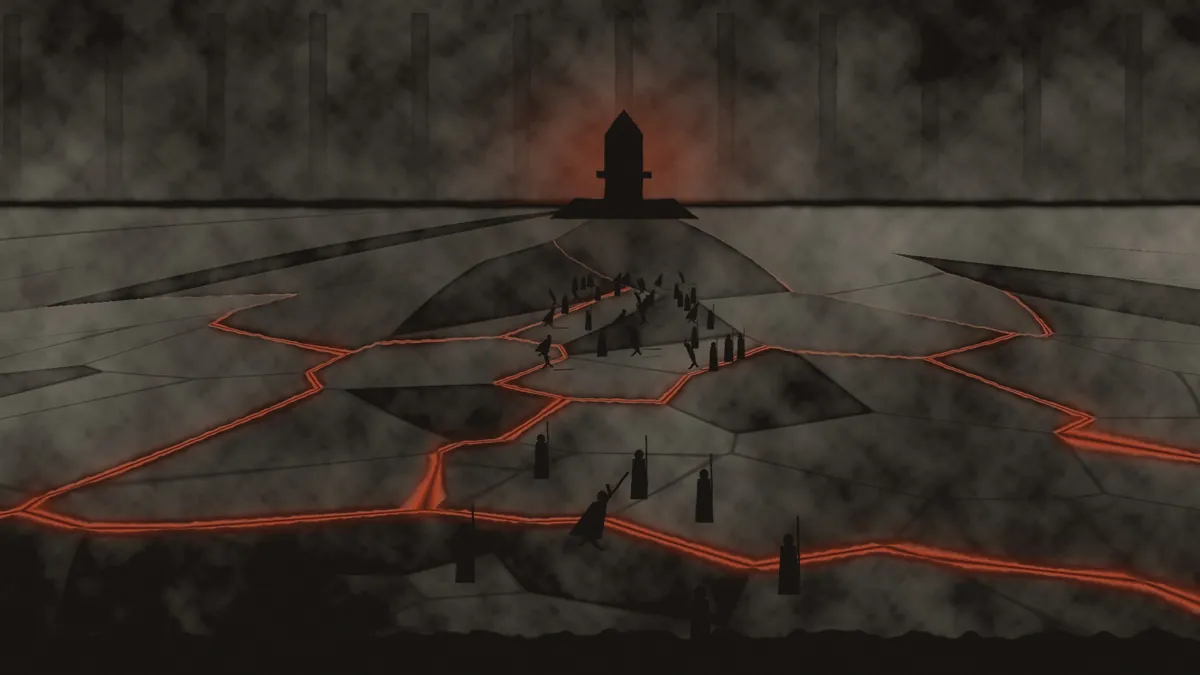
Avar Kharad
Nowhere in the mountain would serve to lay Dace but the bridge-arch, so they laid him there with his hammer on his chest. Rovan closed the old man's eyes with his thumb and stood up.
His knees ached, and his left wrist, under its bad bandage, had begun to bleed again. He noticed these things as he noticed the weather, at a distance, and set them aside. He had learned to do that at thirty-one, on the Teshar border, and he had never been grateful for the lesson until now.
"Commander." Callum was waiting at the north end of the arch. "When you're ready."
"I'm ready," Rovan said.
Maelin was sitting on the stone with her back against the rock and the heels of her hands pressed over her ears. When she took them away, they were shaking. Anke Falk crouched beside her with a water-bottle. The girl was gray with dust from head to foot.
"Can you walk?" Rovan said.
She turned her head and gave him the right ear, and he said it again.
"Far enough." Maelin took the bottle and drank, and gave it back. "Don't ask me to dance, that's all."
"Can you do more?" Rovan asked.
She looked up at him with red-rimmed eyes, very bright.
"There's a hum in the rock, Rovan," she said. "It's not a bell. Bells come and go, every ten minutes, and this doesn't. It's been there all night, under everything, and I never felt it till the great bell stopped. It's coming from the north. From wherever that old bastard sits." She held up her right hand and looked at it. "Ask me again when we're standing on top of it."
Footsteps came over the arch behind them, a lot of them, and Rovan turned with his hand on his sword.
It was Edran. His nephew came across the bridge-arch out of the bell chamber with forty thin, ragged men behind him in royal coats. He had a bloody rag tied round his forehead and his right hand bound up in a fist, and he was walking as if every step had to be argued with. When he saw Rovan he stopped short, and came on.
"Uncle."
"The king?" Rovan asked.
"Gone down the Stair with Kester Nairn, before eleven. Into the conduit." Edran's voice was hoarse. "I don't know if he's out. I don't know anything since. We held the Kneeling Turn. Then the bell struck and we were on our knees on the Stair, all of us, for an hour, waiting for a man in a gorget." He took a breath. "One came. Pryce's lads killed him before he could open his mouth. Then the bell fell, and we got up."
Rovan looked at the hand bound in its fist, and the rag, and the face under it.
"Dace is dead," he said.
Edran's eyes went past him to the arch, and to the shape lying on it with the hammer, and he stood there.
"How?"
"Holding this." Rovan put his hand on the stone. "He held it, and the bell came down."
His nephew nodded and walked out onto the arch and knelt down by the old armorer, clumsily, with his bound hand against his chest, and stayed there. Rovan let him stay, and went to Callum.
"Show me," he said.
The passages behind the bell chamber ran north and up into the rock, through doors of bronze that hung open, past guardrooms and stairs and long galleries lit by lamps. They were full of the Seat's men, and none of them fought. Rovan walked past them by the hundred. They sat against the walls with their weapons thrown down, Kharadi in bronze helmets and gray coats, and a few southerners in the old blue of Auren, and they looked up at him as he passed with dazed, empty faces. A young guard was being sick in a corner. An old one sat with his helmet in his lap, talking quietly to it.
Six hundred yards in, the passage turned, and at the turn Callum stopped him with a hand on his arm.
"There," said Callum. "Look."
Rovan looked. The last passage ran straight ahead of him into the rock, forty yards long and wide enough for six men abreast. Its walls were dressed stone, black and smooth, and its floor was laid in great black slabs with seams of bronze between them, gleaming in the lamplight. At its far end stood a pair of bronze doors, shut. And in front of the doors, filling the passage from wall to wall, stood the guards.
There were fifty of them, perhaps, in ranks. They stood with their axes raised to the ready and their faces turned toward him, and they did not move, though their eyes were open. Some of them were crying without a sound, and their beards were wet. One near the front, a young man with a scar through his eyebrow, was shaking so hard that Rovan could hear his mail.
Rovan walked on down the passage until he was ten yards from the front rank, and stopped. Maelin came up beside him and laid her bare right palm on the passage wall.
"Blood and iron," she said softly. "There it is."
"Where?" Rovan asked.
"Everywhere. In the floor and the walls and the roof and the bronze in the seams. It's coming up through all of it from behind those doors, the way water comes up through sand." She moved her hand along the wall, a foot, and back. "It ends. Here. Right about where you're standing. A hair this side, a hair that." She took her hand away. "From here to the Seat is thirty yards, if I'm any judge. Not one inch more."
"Edran," Rovan said.
His nephew had come up behind them, with Pryce at his shoulder. He came forward now, slowly, a step at a time, toward the guards. Two strides beyond Rovan, Edran stopped dead. His head went back a little, and his shoulders hunched.
"Yes," Edran said. His voice was quite steady. "It's here. On the back of my neck." He stepped back, and back again, and let out his breath. "Not a bell. I can't hear anything. But it's the same hand."
"Then you'll stay at this line," Rovan said, "and so will Pryce and every man who ever swore those words, because one step past it, you belong to whatever's behind that door. I'll not argue it. I'll go in with the never-sworn and no one else." He turned. "Callum. How many of yours can still fight?"
Callum looked back down the passage at his highlanders. They had come into the mountain sixty strong. Rovan could see perhaps thirty of them now, sitting and standing among the Seat's men, bandaged, bloody, most of them hurt.
"Six," Callum said. "Six I'd trust in a fight tonight. And me."
"That'll do."
"Seven men and a mage," said Callum. "Against fifty with axes. My grandmother would have called that fair."
"We'll not fight fifty," said Maelin. She was looking at the floor of the passage, at the bronze seams between the slabs. "Rovan. Give me the line you're standing on. Thirty yards from the Seat. Those fifty men are standing on stone that's joined to it, all the way back. If the stone stops being joined to it, they stop being his."
"Can you do that?"
"I can try." She knelt down at the edge of the field and put both hands on the floor. "Stand back. All of you. This is going to be rude."
She cut the passage in two. Rovan had seen her break walls and gates, and strip the iron heads off a rank of spears through a frozen road. He had never seen her do this. She knelt ten yards short of the front rank of the guards, and she pushed. He saw the cords stand out on her neck. A crack opened in the floor beyond the last rank of guards, at the sill of the bronze doors. It ran across the passage from wall to wall, straight as a rule, through stone and through the bronze of the seams. It went up both walls and across the roof. The whole passage groaned, and dust and grit came down in a hissing stream.
As the crack widened, Maelin made a sound in her throat like a woman lifting a horse. The crack opened to a finger's width, then a hand's, and the near section of floor, the length of the passage where the guards stood, dropped an inch on its bed and settled with a jolt.
The front rank of guards staggered. They staggered all together, and lowered their axes, and stood looking at them. The young man with the scar through his eyebrow dropped his axe on the floor with a clang and put his hands over his face. The men around him began to sit down, slowly, on the stone, and then all of them were doing it. Some were sobbing aloud. Rovan heard one of them say, in the old blue coat's accent, "Oh, gods. It's let go."
"Them," Maelin gasped. She was still on her knees. "Them, not you. They're on my side of it now. The near piece. It's not joined to him." She looked up at Rovan, and her face had no color in it. "Get them out. Get them out of the way. There'll be more in there."
Callum's men got the guards out, gently, passing them back down the passage to Edran and Pryce. Rovan helped Maelin up, and she stood leaning against him for a breath, with her eyes shut. At last she pushed herself off him.
"Every crack I make," she said, "I'm cutting my own road. That piece is dead to me now, for anything past it. Remember that."
"I'll remember," Rovan said.
They went down the passage to the bronze doors, eight of them and Maelin. They stepped across the crack in the floor. Rovan felt nothing as he crossed it, and the clansmen felt nothing. Callum pushed the doors, and they swung open without a sound.
The Seat's chamber was round, and smaller than he had expected, perhaps twenty yards across, under a low dome of black stone. Lamps burned in iron brackets round its walls. The floor was black slabs, like the passage, and through the floor, from the walls to the middle, ran thick bars of bronze set into the stone like the spokes of a wheel. They all ran inward, to a raised dais in the center of the chamber. On the dais stood a chair.
This was the Seat. It was cut from the same black stone as the floor, and its stone and the stone of the dais were one piece, with no seam between them. Veins of bronze ran up through its legs and arms and back. The spokes of the floor ran into the dais and on up into the Seat, so that it seemed to have grown there, rooted, out of the mountain.
Round the dais, facing outward, stood twenty guards in bronze. Their faces were like the faces in the passage.
And on the Seat sat Avar Kharad.
Rovan had thought about this moment, since the spring, more often than he liked. He had expected horror: a monster, or a giant, or a corpse. What sat on the Seat was a small old man. He was shrunken and dry, his skin dark and creased, stretched over his bones like old leather over a drum. He wore a robe of faded red. His hair was long and white and very fine, and it lay on his shoulders. His hands rested on the arms of the Seat, and from the backs of his wrists, and from the base of his neck behind, fine threads of bronze ran down out of his body into the stone. There were dozens of them, hundreds, catching the lamplight, fine as harp-strings.
His eyes were open, dark and clear, and they were looking at Rovan with great courtesy and interest.
"Commander Tal," said Avar Kharad. His voice was soft and dry and perfectly clear, and he spoke the southern tongue in an old, careful form, as if from a book. "Of Karthen. You held my gate for thirteen years."
"I held my own gate," Rovan said.
"Your gate. Yes. Forgive me." The old man smiled. His teeth were small and brown. "And Mistress Rennick. You have broken my bell. That was a great piece of work. I watched you do it, through the stone. I have not seen better hands in five hundred years."
"You can keep your compliments," said Maelin. "I've had a long night."
"I can see that you have," Avar said. "Sit, if you wish. I shall not harm you while we talk."
Nobody sat.
"I will tell you what I offer," Avar said, "and then you may refuse it, as I think you will. But I would be discourteous not to make the offer."
He turned his head to Rovan, and the bronze threads at his neck moved with it and caught the light.
"Your kingdom fights a war every ten years, Commander. Against Teshar, against the clans, against the free cities, against itself. You have fought in four of them. You know what they cost. You know the faces." The soft voice did not change. "Bind your service to the Undying Throne, and you will command the armies of the north and the south, one army, under one law. There will be no more border wars. There will be no more Karthens. There will be no more men like your Corporal Gant, cut down on a bridge by their friends."
Rovan stood with his sword in his hand.
"And when I'm dead?"
"Then another will command, under the same law," Avar said. "I am patient. I have outlived every king of Auren. I shall outlive all of you, and the peace will outlive me."
"No," said Rovan.
The dark eyes rested on him for a breath. Then they turned to Maelin.
"And you, Mistress. You have spent your life breaking things to end wars, and the wars do not end. I have spent mine holding things together. Stand here, at my side. Put your hands on the stone with mine. I will show you what you could do with that stone if you were not afraid of it. Between us, no army would march again anywhere under the sky. You could end war tonight."
Maelin looked at the old man on the Seat for a while. Rovan saw her lips move, and saw her bare left hand open at her side, the fingers spreading as they spread when she reached for stone, and shut again.
"Every man in this room is crying," she said. "Your guards. Standing there with their axes up and their beards wet. That's your peace. That's what it looks like up close." She pulled the glove off her left hand and dropped it on the floor. "No, thank you."
Avar sighed, a small, dry, rustling sound.
"Then it is required," he said, and his guards came down off the dais at them.
"On me!" Rovan said. "The doors at our backs! Callum, the left! Line in front of her!"
They made a line, eight men across the chamber's floor in front of the doors, and Maelin went down on her knees behind them with her hands on the slabs. The guards came at them in a rush, axes swinging. They were Kharadi, most of them, big men in bronze, and they were compelled, and they fought like men who knew it and could do nothing.
Rovan took the first axe on his blade near the hilt and let it slide. He hit the man in the face with the pommel and shoved him back into the next. A highlander beside him went down with an axe in his shoulder. Callum stepped across the fallen man and swung his axe in a flat arc that took a guard off his feet. The line bent, and held.
Then the floor moved. It moved under Rovan's feet like a deck in a swell. The slab he stood on tilted, rose, and threw him forward onto one knee. A guard's axe came down where his head had been and struck sparks from the stone. He rolled and came up, and all across the chamber the floor was heaving. Slabs rose and fell, grinding against each other. The bronze spokes between them flexed and rippled. One of them tore up out of the floor near the doors, a bar of metal as thick as a man's leg, and swung across at the line. It took a clansman across the chest and threw him against the wall.
"It's him!" Maelin shouted. "It's him, Rovan! He's in the floor! He's using my stone!"
On the dais, Avar Kharad had not moved. He sat on the Seat with his hands on its arms and his eyes half-closed, and the threads of bronze at his wrists were humming.
Maelin pushed back. Rovan felt it through his boots: two great pressures meeting in the floor beneath him. The stone shuddered, and a crack ran out from under Maelin's hands toward the dais, and as it ran, Rovan saw it seal again behind its head, the stone flowing together and sealing. Maelin cursed and pushed again, and the crack ran again, and again it closed.
"He mends it!" she shouted. "Hells and damnation, he mends it as fast as I break it!"
"Then break it wider!"
"I'm trying, you bloody fool." A slab reared up under her and she flung herself sideways off it. "Air. He can't mend air. Nor can I. If I open it wide enough he can't close it."
"Then do it!"
She did it, and Rovan saw her shift to the left of the doors and set her teeth. A crack opened, ran across the chamber's eastern side from the wall to the edge of the dais, and kept opening. It widened to a hand, a foot, two feet, and below it was darkness. The whole eastern third of the chamber floor, a great wedge of slabs and bronze, tore loose from the rest with a shriek of metal and dropped a yard into whatever lay beneath. It settled there at a tilt, grinding.
The six guards standing on it stopped.
They lowered their axes, and one sat down at once, hard, as if his legs had been cut. Another let go of his axe and turned, looking for a way out, and found the doors, and ran for them. Rovan let him go.
"One," Maelin said. Her voice was thick. "That's one."
It went on. Rovan lost the time of it, as a man does in a breach: there was the next axe, and the one after.
He fought in front of her with Callum and three clansmen on their feet, and the guards came at them across the heaving floor. He kept them off, killing only when he could not help it, and mostly he could not help it. He cut a man's legs from under him and kicked another into the crack. He took an axe-haft across the ribs and felt something give. Callum's arm was laid open from wrist to elbow, and Callum swore, and fought on left-handed.
Behind them, Maelin broke the chamber. She broke the western side next, and after it the north, behind the dais, where the bronze spokes ran into the wall. Each time it was the same: the crack running out, the old man on the Seat closing it, Maelin forcing it wider and wider until it opened onto air and he could not close it. Each time a section of the floor tore loose and dropped, and the guards standing on it stopped fighting and stood dazed and staring. And each time, Rovan saw, Maelin had less floor under her that joined the rest. The section she knelt on was cut off now on two sides.
"I'm running out of road!" she shouted. "Rovan! I'm running out of stone that touches him!"
The floor in front of the dais was the last. It was a ring of black slabs perhaps eight yards across, with the dais in the middle of it and the Seat on the dais. Every other part of the chamber had been cut loose and dropped, and lay around it at angles, tilted and broken, with dark gaps between. Five guards stood on the ring around the dais. They were compelled yet, and the old man's.
And the gap between Maelin's section and the ring was nine feet wide.
She knelt at the edge of it, swaying.
"I can't reach him," she said. "I've cut everything that joins me to him. There's no stone left between us that isn't broken." She laughed, a little wildly. "I've beaten myself, Rovan. Isn't that a fine thing."
On the dais, Avar Kharad opened his eyes.
"Yes," he said. "It is a very fine thing. You have freed all my servants but five, Mistress, and you have nothing left to free them with. And I have all the time in the world."
The ring of floor under the dais shifted. The slabs of Maelin's section groaned and began to tilt toward the gap.
Rovan looked at the gap: nine feet, and darkness under it. He was fifty-one years old, and his ribs were broken.
He sheathed his sword so his hands would be free, and he took three running strides across the tilting slab and jumped.
He landed on his knees on the ring of floor in front of the dais, and the pain in his ribs went white. He got up anyway, and a guard came at him with an axe. He drew and cut in one motion, under the swing, and the guard went down. Another came, and Rovan caught the axe-haft in his left hand, felt the bandaged wrist rip open, and drove his sword into the man's side. Three more stood between him and the Seat, and they came at him together. He killed one and was struck across the shoulder by the haft of another's axe and went down on one knee on the steps of the dais.
Callum Breck landed beside him. He had jumped the gap with his torn arm and his axe, and he came down howling and swinging. The last two guards turned to meet him, and Rovan let them.
He went up the steps of the dais.
The steps moved. The black stone of the lowest one rose under his boot and tipped him, and he went down on his broken side and heard himself cry out. The second step reared. He got his left hand on it, and the bandage tore, and the stone shifted under his palm like a horse's flank. The old man was not looking at him. He was looking at Maelin, across the gap, and the ring was tilting her slab again. Rovan went up the last three steps on his hands and knees, with the stone trying to shake him off at every one.
Avar Kharad turned his head to him then, slowly. He had not risen from the Seat in five hundred years, and he kept it now. The threads of bronze ran out of his wrists and his neck into the black stone, fine and gleaming, hundreds of them, and the stone hummed.
"You cannot kill me with that, Commander," Avar said. His voice was courteous still. "I am not in this body. I am in the stone."
"Then you'll not mind," said Rovan.
He swung the old sword down across the bronze threads at the old man's right wrist. They parted like the strings of a harp. He felt them go, a dozen small snaps through the blade. Avar made a sound, small and dry. Rovan cut again, at the left wrist, and the threads there parted. Then he stepped round the side of the Seat, set his feet, and cut down across the threads at the back of the sovereign's neck with all the strength he had left. The blade went through them and rang on the black stone of the Seat, and a notch the size of a fingernail came out of its edge.
The humming stopped.
Avar Kharad sat with his head fallen forward a little. He was looking at his hands, at the cut ends of the bronze threads hanging from his wrists.
"Ah," he said.
The floor of the ring had stopped shifting. Across the gap, Maelin's slab had stopped tilting. Rovan turned and held out his hand across the gap, and then, because that was useless, he called her name.
She jumped and landed short. Her hands caught the edge of the ring, and Rovan threw himself flat and took her by the collar. Callum caught her arm, and they hauled her up, and she lay gasping for a breath before she got up and went to the Seat.
She put both her bare hands on its black stone.
"Now," she said to it. "Nobody's holding you."
"You will find it very quiet, Mistress," said Avar Kharad, without raising his head. "I did."
Rovan felt it break through his boots, and through the dais, and in his chest. It was a single deep crack, no louder than a stick broken over a knee. The black stone of the Seat split from its crown to its root, straight down through the middle, and the two halves fell apart from each other and lay on the dais in the lamplight. The bronze veins in them were dull.
Avar Kharad lay between the halves, on his side, curled small, an old dry body in a faded robe. He was very light and very old, and he was dead.
The two guards fighting Callum put down their axes.
Rovan sat down on the steps of the dais. He found he could not do anything else.
Behind him, Maelin was sitting on the dais with her back against one half of the broken Seat and her bare hands in her lap. She was laughing, a little, under her breath, and the laugh kept turning into something else. Callum said something to her as he passed, and she gave no sign that she had heard it. He was binding his arm with his teeth. Across the broken floor, the freed guards stood on their tilted slabs, or sat, or lay, and looked about them at the chamber as if they had just woken in it.
From the doorway came a shout.
It was Edran. He stood at the doors of the chamber, past the line he had been forbidden to cross, with Pryce beside him and Anke behind. He had his bound hand pressed against his chest. As Rovan looked, he took a step into the chamber, and another, across the place where the field had been. Then he stopped and stood there in the doorway, with the tears running down his face, and he was laughing.
"Uncle," he called across the broken floor. "Uncle. It's gone."
"What's gone?" Rovan asked.
"All of it. It let go. Here." He struck his chest with his good hand. "It let go of me. I've carried it since the day I knelt in your hall at Karthen, Uncle. Eight years. And I never knew it was there until it went."