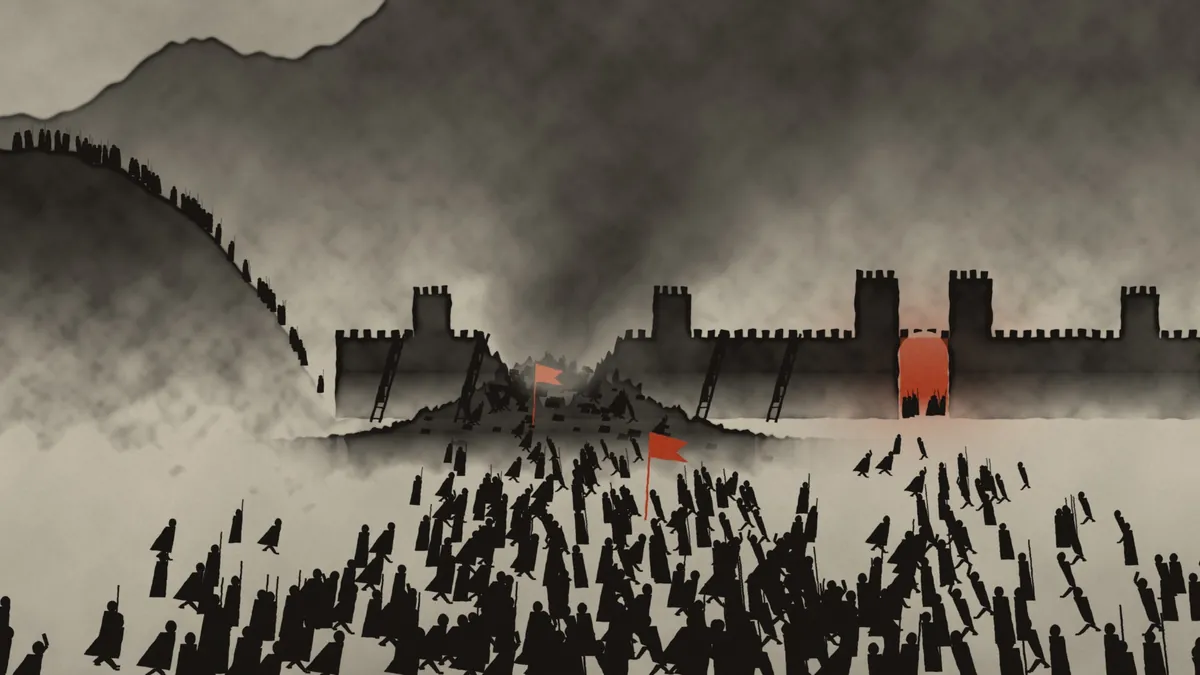
The Attack Begins
The clans went up the heights in the dark, and Rovan Tal stood at the mouth of the Gullet and listened for them to die.
He heard nothing for a long while but the stream beside the road and the east tower bell, far off across the basin, sounding its note every ten minutes as it had all night. Then, high on his left, a man screamed. There was a clash of iron, small and thin at that height, and a voice shouting in the northern tongue, and the voice stopped. A little later the same sounds came from the right. After that, for a time, there was nothing at all.
A horn blew on the western height: one long blast, falling at the end. It was Callum's horn, and one blast meant the height was taken.
On the eastern height, a minute after, another horn answered it.
"That's both," said Dace Tolliver, at his elbow. The old armorer had his forge hammer over his shoulder and a steel cap on his bald head that he had made himself at Ashgate. "Hells and dogs, I never thought they'd do it so quiet."
"They're highlanders," Rovan said. "They've been stealing each other's cattle in the dark for four hundred years."
It was an hour before dawn. Behind him, packed into the last half mile of the Gullet between its black walls, forty-five hundred men waited in silence. They were Callum's clansmen who had not gone up the heights, Rovan's Karthen veterans, seven hundred Lissen pikes under Ilse Brask, and, at the very back, three hundred men of Mabry's company. Somewhere ahead of them, beyond the wall, in a city of two hundred thousand people, was Edran. Rovan had not let himself think about Edran since midnight, and he kept from it now.
The sky over the eastern cliffs went from black to iron.
Rovan studied the field in the growing light. The Gullet opened in front of him onto a mile of bare ground, all stumps and slag heaps, rising gently to the outer wall. The wall ran right across the basin from his left hand to his right, thirty feet high, black, with towers along it. The Furnace Gate stood straight ahead on the road, its two fire-baskets still burning on its towers. Two hundred yards to the left of the gate, where the wall stood on a spur of bare rock, was the place Maelin had chosen. Far off at either end of the wall, more than a mile from the gate, stood the east and west towers with their bells. Behind the wall, the lower city climbed toward the cliff in the gray light, roof upon roof, and the cliff stood over everything.
"Their fields stop short of the gate by three-quarters of a mile," Rovan said, to the officers round him. He had said it last night too, and he said it again now, because men forget things in the dark. "Nothing reaches the ground in front of us. Nothing reaches the wall where Maelin's going. If that changes, Callum blows three blasts from the height, and Mabry's company goes back into the Gullet at the run."
"And the bells in the city?" said Ilse Brask. She was a tall, rawboned woman with a voice like a gull's.
"Laid up in the north quarter," Rovan said. "Two miles off. If they come out, Callum will see them come."
Maelin came up beside him. She had her gloves off and was working her hands open and shut.
"Well," she said. "I'll go and knock, then."
"Maelin."
"What?" Maelin asked.
He had nothing to say that she did not know. "Mind the stones," he said.
"Mind your own," said Maelin, and went.
The storming column went out of the Gullet at first light, and the wall woke up.
Rovan went with it. He would not watch this one from the back. He walked with the Karthen veterans in the second line behind the Lissen pikes, with his shield up and his old sword drawn. The mantlets went in front, great wicker screens on wheels, pushed by men bent double. Behind the mantlets came the ladder parties, and Maelin among them with twenty men round her holding their shields over her head.
The first stone came off the wall at three hundred yards. It was a round of black slag the size of a calf, flung from a throwing-engine on the gate towers. It came down in the middle of the Lissen pikes and went through them. Men fell. The pikes closed up over the gap and kept walking.
Then the crossbows began, and the bolts came down in sheets, hissing, and thumped into the mantlets and the shields and the ground. A man beside Rovan sat down suddenly with a bolt through his foot. Another went over backward without a sound. Rovan kept walking. The wall came up in front of him, black and huge, and he could see the faces now along its top, and the crossbows rising and falling.
From the heights on either side came the clansmen's answer. Callum's bowmen had the high ground now, and they shot down along the wall-walk from both flanks, so that the crossbowmen on it had arrows coming at them from the side. The bolts from the wall slackened, though they never stopped.
At a hundred yards, the column split. The pikes and the veterans went straight on toward the Furnace Gate, with the ladders, to draw the defenders there. Maelin and her twenty swung left along the foot of the wall toward the spur of rock.
Rovan went left with them, though he had not meant to, because his feet took him there. He found himself running at a crouch along the wall's foot with stones coming down past him and Maelin's back in front of him. The spur was a hump of bare gray rock that ran out from under the wall into the field, like the knuckle of a fist. Maelin threw herself down on it and pressed both her bare palms flat against the stone where the wall's lowest course was bedded into it.
"Shields!" Rovan shouted. "Over her! Over her!"
They knelt round her and held their shields over her and over themselves, a roof of wood and leather. Stones hammered on it. A bolt came through the shield beside Rovan's head and stopped with its point an inch from his eye. The man holding the shield swore and held it steady.
Under the roof of shields, Maelin talked to the wall.
Rovan could hear her. She was talking quietly and fast, in a voice he had heard her use to horses. She told the wall it was old, and tired, and heavy, and had stood long enough. She told it the rock under it had never liked it. She told it to let go. Her shoulders were shaking. Her hands on the rock had bent into claws, the fingers hooked and rigid, and she kept talking.
The rock under Rovan's knees moved. It was a small movement, a shrug, the kind of thing a horse does under a saddle it dislikes. Then it moved again, harder. A crack opened in the spur in front of Maelin's hands. It ran in under the wall with a noise like a tree going over, and up, through the courses of black stone, zigzagging.
"Back!" Maelin screamed. "Get back, get back!"
They ran. Rovan grabbed her by the collar of her coat and hauled her up off the rock and ran with her, stumbling, and behind him the wall came down.
He heard it more than saw it. It was a long, deep, grinding roar that went on and on. When he turned, the wall was falling outward over the spur in a great slow wave of black stone and dust. Thirty yards of it slid down and spread across the field, with the men who had stood on it and the engine on the nearest tower. When the dust cleared there was a gap in the outer wall of Dhor Kharad. It was wide enough for twenty men abreast, with a ramp of broken stone leading up into it, and the streets of the city showing through.
Maelin sat down on the ground at his feet. Her hands lay in her lap, curled half shut, and she looked at them the way she might have looked at a stranger's. Her face was the color of ash.
"There's your door," she said. "Somebody else can open the next one."
The enemy came through the breach before Rovan's men could reach it.
They came at a run, in a dense gray mass, down the ramp of broken stone. They were the Wall Guard, the city's own, unbound and willing: big men in long mail shirts with axes and round shields, eight hundred of them at least. They had been waiting behind the wall for exactly this. They came out of the dust and down the ramp and turned right along the foot of the wall, straight into the flank of the Lissen pikes at the gate.
Rovan saw the pikes stagger. Pikes are a wall to the front and nothing to the side. The Wall Guard went into them with their axes and the pike block folded up from the end like a shutter. Men screamed. Ilse Brask's gull voice rose over the din, shouting her people round. The block began to turn, too slowly, and the Wall Guard hewed at it as it turned.
"Veterans!" Rovan roared. "On me! On me!"
The Karthen men came. They came across the broken ground at a run and hit the Wall Guard in their flank in turn. Rovan was in the front of them. A big Kharadi turned to meet him with his axe up, and Rovan went in under the axe and drove his shoulder into the man's shield and cut at his leg below the mail. The man went down, and another came. Rovan took the axe on his shield and felt the shield split, and the blade came through and opened his left wrist. He cut the man across the face and he reeled away.
It was a dreadful fight, because the Wall Guard were good, and fresh, and there were a great many of them, and more were coming down the ramp from the breach all the time. They pushed Rovan's veterans back step by step along the foot of the wall. The Lissen pikes were wrecked by now, and Ilse Brask was down, and someone was dragging her by the arms. Maelin was somewhere behind him in the dust with a dozen men round her, sitting on the ground.
If the Wall Guard held the breach, the breach was theirs, not his. It would be a door that opened only outward. They would sit in it and kill everything that came near, and by tomorrow they would have it walled up again.
"Dace," Rovan said, through his teeth. The old man was beside him, swinging his hammer. "Is there a bell?"
"Not that I've heard, and I've been listening." Dace hit a Kharadi on the shield with his hammer, and the shield broke. "The towers are ringing, same as before. Nothing nearer."
Rovan looked up at the western height. No signal came from it. Callum would have blown if he had seen anything.
"Then fetch Mabry."
Mabry's company came out of the Gullet at the run.
Rovan saw them come, three hundred men of Karthen, in the blue coats of the old garrison with the Karthen mark on their shields. They had stood in the outer ward in December and turned when the bell spoke. They had fought him on the inner stair. They had spent the winter as the enemy's, every one of them, and they had been free for three months, and every man of them was still bound. They came across the mile of open ground in a long ragged line, roaring. At their head ran Harl Mabry with his sword up and his gray head bare.
They hit the Wall Guard where the ramp met the field, and the Wall Guard stopped.
It was like watching a river come against a dam. The gray mass checked and swayed and gave a yard. Mabry's men went into it with a fury Rovan had never seen in them, not in thirteen years at Karthen. They fought as if they had a winter to pay back, and perhaps they had. Rovan's veterans came in on their left. The Wall Guard broke back up the ramp, step by step, and Mabry's men went up the ramp after them, and Rovan went with them.
At the top of the ramp, in the breach itself, the Wall Guard turned and stood.
The breach was a jagged slot thirty yards wide, floored with broken stone, with the shattered ends of the wall rising on either side. Behind it a street ran away into the city. The Wall Guard filled the slot in a block twelve deep, and they would not go back another step, and Mabry's men could not push them.
So the two sides stood in the breach and killed each other.
Rovan was in the front rank, with Mabry on his right. He had never stood beside Mabry in a fight before. In December they had stood on either side of the inner gate. Mabry fought as he carved meat: with grave care. He took an axe on his shield and stabbed under it. He stepped back, and took another, and stabbed again. He was breathing in great hoarse gasps, and between the gasps he was talking to the men on either side of him, steadily, as if they were on the drill ground.
"Shields up, Corran. Up, I said. That's it. Well struck, lad. Again."
A Kharadi came over the man in front of him, swinging an axe two-handed. Rovan cut him out of the air. The man fell across the broken stones between them.
"Thank you, sir," said Mabry, without looking round.
Then, high on the western height, a horn blew three times.
Rovan looked up the street behind the Wall Guard, over their heads, through the dust.
The street went up from the breach into the lower city. Five hundred yards up, it met a wider street, the Furnace Street, which ran north from the gate toward the cliff. Along the Furnace Street, coming down it from the north at a gallop, came torches.
They were torches in daylight, carried by riders. Behind the riders came a wagon. It was a big wagon, drawn by a team of twelve, rocking and swaying on the cobbles, with a dark shape riding high on its bed. Men were running beside it, holding on to its sides.
"Bell," said Dace. He said it quite calmly. "There's your bell, Commander."
Rovan knew the Furnace Street. He had learned it off Edran's map until he could have walked it blind. Above that junction, where it crossed the Salt Street, was the Salt Cross, a stone market cross on a stepped base. The Salt Cross was a half mile from the breach, near enough. If that bell was struck at the Salt Cross, or anywhere south of it, its field would reach the breach. Every man of Mabry's company would turn in the instant the note sounded, and the Wall Guard would have three hundred more men, standing in the middle of Rovan's line.
The torches were a quarter mile beyond the Salt Cross, and coming fast.
"Mabry," said Rovan.
"I see it, sir."
"Take your men out," Rovan said. "Back down the ramp and back to the Gullet. Now, while there's time."
Mabry stabbed under a shield and stepped back. His face was gray with stone dust and running with sweat, and there was blood on his cheek that was not his.
"If we go, sir, the breach goes," he said. "You know that. You haven't the men to hold it without us."
"I know it," Rovan said.
"It's not struck yet." Mabry took another axe on his shield and grunted. "It's not past the Cross. Give us till it's past the Cross, sir. Please. We've not come all this way to walk off and leave you in it."
Rovan watched the torches. They were coming down the Furnace Street, past the shut shops and the gratings and the lamp-posts, and they were three hundred yards from the Salt Cross, and the wagon was rocking on its wheels.
December came back to him: the arch of the inner gate at Karthen, and Mabry's voice coming up out of the yard, telling him to get back and get the gate shut. He weighed the price of being wrong, and found he could not lift it.
"Till it's past the Cross," he said. "Not one step after. When it passes the Cross, you go, and you don't argue with me. Will you do that?"
"I will, sir," Mabry said.
"Then hold."
The Furnace Gate opened, and Rovan heard it before he saw it. A long grinding shriek came from his right along the wall: iron on iron, a winch turning, chains running. Every head in the breach turned toward it, Kharadi and Aurener alike. Two hundred yards along the wall, the great leaves of the Furnace Gate were swinging inward. As they swung, Rovan saw figures on the gate-tower above them, fighting. One was in a gray Kharadi captain's coat. He was hacking at someone in the doorway of the winch-room with a sword, and he had no helmet, and Rovan knew the shape of his head the way he knew his own hand.
"Edran," he said aloud.
The leaves came open, and the road ran in through the gate into the city, clear. Out on the field, the clansmen who had come down off the heights saw it. They gave a great yell, and ran for it.
Mabry laughed. It was a huge, cracked, delighted laugh, the laugh of a man at a wedding.
"The lad's done it, sir!" he shouted. "The lad's opened it! Look at him! Look at him go!"
He was still laughing when the axe took him.
It came over the shield of the man in front of him, a long Kharadi axe swung by a man who had seen the big gray sergeant turn his head. It struck Mabry where his neck met his shoulder. He went down on one knee among the broken stones. His sword fell out of his hand.
Rovan killed the axeman. He stepped over Mabry with his shield up and cut the man down through the collarbone before the axe was clear of its stroke. Then Corran and two others were in front of them both with their swords going, and Rovan was on his knees in the dust holding Mabry up.
Mabry looked up at him, smiling yet, with blood on his teeth.
"Free, sir," he said. "That's the thing. Wasn't it, sir? Free."
"Yes," said Rovan.
"Tell my girls," Mabry began, and frowned, as if he had forgotten what it was. Then he stopped frowning, and his eyes went past Rovan to the sky over the breach, and stayed there.
Rovan laid him down on the stones.
He stood up and picked up his sword, and looked down the street over the heads of the Wall Guard, and the torches were a hundred yards from the Salt Cross.
He went through the gate with everything he had left.
The clansmen were pouring in through the Furnace Gate, and the Karthen veterans who were not in the breach went with them, and Rovan went at their head. Dace Tolliver ran beside him with his hammer. Behind him came Maelin, on her feet now, with two clansmen holding her up under the arms, cursing them both for fools.
"Mabry's company, out!" Rovan shouted back over his shoulder as he went. "Corran! Get them out! Down the ramp, back to the Gullet! Now!"
He left Corran to it, and ran on.
The Furnace Street ran north from the gate, straight and steep, between tall black houses with shuttered windows. People were looking out of the upper windows. A woman screamed and slammed a shutter. The clansmen ran up the middle of the street in a howling mass, and the torches came down it toward them, and the two met fifty yards short of the Salt Cross.
The riders were Bellward horse, light men on shaggy northern ponies. They had come to clear the way for the wagon, and they were not ready for two thousand highlanders coming up the street at a run with axes. The clansmen went into them and through them. Ponies screamed and went down, and riders were dragged from the saddle.
The wagon stopped, and its team reared and plunged in the traces. On its bed, the bell crew were already at the beam, and they were hauling it back.
Rovan saw the beam go up on its chains, back and back. He saw the bell-captain on the wagon bed, a gray man with a white sash, with his hand raised for the stroke. He glanced at the Salt Cross. The wagon had stopped thirty yards north of it.
It might be thirty yards short of the half mile, or thirty yards over, and he had no way on earth to know which.
He ran at the wagon. A Bellward rider came at him from the side, on foot now, with a spear. Rovan beat the spear aside with his shield and cut the man down and kept running. The wagon came up in front of him, tall and dark, with the bell riding high above, a great green-gold curve of bronze. He got his foot on the wheel-hub and his hand on the side-rail and hauled himself up.
The bell-captain's hand came down, and the two men at the beam threw it. It swung forward on its chains, a baulk of iron-shod oak as thick as a man's body, toward the bell.
Rovan threw himself across the wagon bed and caught it.
He caught it with his shield and his shoulder and all his weight, and it drove him back against the bell's lip. It knocked the breath out of him and he felt a rib go. The beam stopped short of the bronze and touched nothing. It hung there against his shield, and he held it, with his feet braced on the boards and his back against the cold bronze. The bell-captain screamed at his men to pull it back and strike again.
Dace Tolliver came up over the side of the wagon with his hammer.
He hit the first man at the beam, and the man went off the wagon, and then he hit the second. The bell-captain drew a sword and turned on him, and Dace swung the hammer up under his arm, and the captain went down across the boards.
Then Maelin was there, hauled up onto the wagon bed by her clansmen. She fell to her knees beside Rovan and put both bare hands on the bronze.
"Not another one," she said faintly.
She had no words for this one, and Rovan doubted she had the breath. She bowed her head over her hands and shut her teeth, and the bell began to sing, high and thin. The crown cracked with a small crack, a dull, sick sound, nothing like the clap of thunder at Ashgate. But the bell's voice died in the middle of its singing, and Rovan, with his back against it, felt the life go out of the bronze.
Maelin fell sideways against him, and Rovan caught her with his good arm.
By nightfall they held the Furnace Gate, the breach, and every street of the lower city from the wall to the Salt Cross.
They had paid for it, and Rovan walked the line at dusk with his ribs strapped and his left wrist bound up, and made the officers tell him the names. The Lissen pikes had lost nearly three hundred men killed and wounded, and Ilse Brask would not walk again for a month. Ned Ferris had what was left of her pikes now, and had put them on the gate. The clans had lost two hundred, most of them on the heights and in the Furnace Street. The Karthen veterans had lost a hundred and sixty. Mabry's company had gone back to the Gullet when they were ordered, and Corran had brought them. They had left ninety-one men in the breach, Harl Mabry among them.
Edran was alive. He had a cut along his left forearm and a bruise the shape of a sword-hilt on his jaw, and he could not stop talking. He and Anke and the two clansmen had lain in Inga Moller's cellar through the night of the fourteenth while the bell went up and down the streets above them. At dawn, when the wall fell, the gate guard had gone running to the breach. Edran had walked up to the gatehouse door in his gray coat and told the four men left in the winch-room that the Marshal had sent him. Niall Nairn had killed one of them before they understood, and the other three had fought.
"Murdo's dead," Edran said. "On the winch-room stair. He held the door. He was making jokes."
Rovan put a hand on his shoulder, briefly, and took it away.
"And the king's in the reception wing, at the head of the Stair," Edran said. "Anke's cousin Inga's man carries bread up there. He's seen him at a window. They're keeping him for tomorrow night."
At dark, a rider came in through the Gullet, past Ulric's fort, on a horse so lathered it could hardly stand. It was a boy of nineteen with a Teshar accent, called Pirro. He had come round from the Eastway by goat-tracks over the mountains, two days and a night without sleep. He had a letter in Garrick's hand, sealed with a wafer of wax and a thumbprint, and he gave it to Rovan in the street by the Salt Cross and then sat down on the cross's steps and went to sleep.
Rovan read the letter by a torch.
"Serath is on the Eastway with the best part of her army," Garrick had written. "She is three days from your city as I write. I am a day behind her and closing, and Hessa comes up by the pass and Ashgate as fast as feet will carry her. We shall do what we can. Hold the door. Your servant, G.A."
It was dated the day before yesterday.
The captured bakery stood on the Furnace Street, two doors from the Salt Cross, and its ovens were still warm.
Rovan sat on a flour sack in the dark with his back against the oven wall, because the warmth eased his ribs. Maelin sat on the floor opposite him with her legs straight out in front of her and a whole round loaf in her lap. She was tearing it into pieces and eating them one after another, slowly, without enjoyment, as a mage eats after a great working. Outside in the street, men were building barricades out of furniture. Somewhere a clansman was singing a lament, very badly. The cliff above the city was full of lights.
Neither of them had said anything for a long while.
"Mabry," said Maelin at last.
"I know."
"He laughed," Maelin said. "Dace told me. He was laughing when it took him."
"He was." Rovan looked at the dark ceiling. "He laughed like that at the winter supper, the night Gant told the story about the goose. I hadn't heard it since. He had three girls in Karthen town. They fight Kit about horses."
Maelin put a piece of bread in her mouth and chewed it, and swallowed, and did not say anything comforting, for which he was grateful. Kesta would have. He had loved her for it, and he had never once wanted it from Maelin. Nor had he wanted it twenty years ago on the Teshar line, the night they buried Ferren, when she had sat down beside him in the mud and kept him company for an hour without a word of comfort. There was a thing he had meant to say to her then, and he had carried it since, and this was not the night for it either.
"Garrick's letter," she said. "Three days, written the day before yesterday."
"Serath will be at the Gullet tomorrow," Rovan said, "or at the east road into the basin. Somewhere by tomorrow night."
She turned her head to give him her right ear. "Say that again. The left's been no use since Ashgate, and the right's been ringing like a smithy since that wagon."
He said it again, louder.
"And the ceremony is tomorrow night," she said.
"At midnight."
Maelin tore off another piece of bread and looked at it, and put it down in her lap.
"Tomorrow, then," said Rovan.
She raised her eyes to him across the dark bakery, and for a moment he thought she might laugh.
"Tomorrow it is," Maelin said.
"Harvest Eve," Rovan said.
"Don't."