Northern Allies
The road to Carrow Hall was not a road at all, and the king's envoy had been complaining about it for three days.
Rovan rode at the head of the little column with Maelin beside him and twenty troopers strung out behind. The track climbed out of the March of Dunmere into the western highlands by way of a river gorge, then a bare moor, then another gorge. On the fourth morning it came over a saddle of wet heather, and the clans' country opened below them. It was a long green valley under a gray sky, with stone houses scattered along a stream, sheep on every slope, and smoke going straight up from a hundred chimneys. At the valley's head, built into the hillside under a roof of turf, stood a hall as long as a barracks.
"Carrow Hall," said their guide, a silent boy of fifteen who had met them at the edge of the moor. He said it with the pride of a man showing off his own sword.
"Thank the gods," said Lord Gervase Dalby. "Is there a bath?"
Dalby was a tall, handsome man of forty with a silver chain over his riding coat and a fine bay horse that had gone lame on the second day. The king had sent him north with a letter, a seal, and instructions. They came to this: the clans were to be thanked, flattered, promised gold, and given nothing that belonged to the Crown.
"You'll find a stream," Maelin said. "It comes off the snow. Very bracing."
"You are enjoying this, Mistress Rennick."
"I am," Maelin said. "I spent the winter in tents and on barges, and the spring in my own parlor at Dunmere arguing with quartermasters. A hall with a fire in it is the best thing that's happened to me since Brackwater."
Rovan said nothing to either of them. He was looking at the land below the valley's mouth, where the hills fell away eastward in long green steps toward the lowlands. He knew those steps. The last of them, broad and well-watered and fenced now with royal stone, was the Lowe. He had not seen it in thirty years. He had hoped not to see it again.
Behind them, the road south was theirs from Dunmere almost to the pass. Hallam Keep had opened its plank bridge in April without a blow. Its Kharadi had hauled their bell away north before the thaw, and the governor's garrison had come out hungry and asked for terms.
The moot met at noon the day after they rode in. Seven clans sent their heads and their speakers, and the hall filled behind them with anyone who cared to come.
A fire ran down the middle of the floor in a long stone trough, and the smoke found its way out through holes in the turf. Benches lined both walls. At the far end, on a wooden chair no grander than the others, sat the Speaker of the moot. Elspeth Nairn was over sixty, with white hair cut short as a man's, a weathered face, and hands that had lambed a great many ewes. She wore no jewels. When she lifted one finger, the hall went quiet.
"The southerners have come a long way," she said. "Let them speak first, and then let us tell them what we think of it."
The hall laughed, not unkindly. Dalby rose and spoke.
He spoke well; Rovan gave him that. He described the bells, the fall of Karthen, the lost army in the north, the victories at Merrow and Brackwater and the Sorrel Bridge. He named the king's gratitude in advance, and the gold the Crown would pay for every clansman under arms, and the honors that would follow. He sat down and waited for applause.
None came. A big man on the left-hand benches stood up instead.
Callum Breck was perhaps thirty-five, broad and red-bearded, in a plaid that had seen weather. He had a war-leader's ax thrust through his belt and a grin that seemed to live on his face whether he wanted it there or not. Rovan had heard of him already in the lowlands. He had heard that Breck's people had burned out three Kharadi raiding parties on the high tracks since the turn of the year. They had hanged none of their prisoners, which was more than the Crown had ever managed.
"I'm for war," Callum said. "Everyone here knows that. I've been for war since the gray riders came west out of the pass in January and burned the Anstey steadings. I'd go north tomorrow with every clan in this hall, and I'd take these southerners with me, if they'd keep up." The grin went wider. "But I'm not the moot. And the moot has a question for the lord envoy, and it's been waiting thirty years to ask it."
He sat down. Elspeth Nairn looked at Dalby.
"The Lowe," she said.
"Madam?" Dalby asked.
"The Lowe grazing. The best summer grass in the March, from the Carrow burn down to the Dunmere road. It was Nairn grazing and Breck grazing for longer than your Crown has had a name. Thirty years ago a royal governor said our herdsmen were harboring reivers, and sent soldiers, and took it. He gave it to the king's remount farms. We have asked for it back at every royal court since. We are asking again." She folded her hands. "You want our sons and daughters to fight for your king. Give us back the Lowe, and we will talk about it."
Dalby had been warned of this. Rovan watched him smile.
"Madam Speaker. The king is deeply sensible of your grievance, and will hear it once the present emergency has passed. But the Crown cannot bargain away its lands in a war. It would set a very bad precedent."
"I see that it would set a precedent," said Elspeth Nairn. "I don't see what's bad about it."
"With respect, madam, the Crown has never once admitted that."
"Thirty years," said a voice from the back of the hall. "My father's house was on the Lowe. I was eleven. I watched them burn it."
Others took it up. Rovan sat on his bench by the fire and let the noise go over him. He was remembering a morning in late summer, a sergeant shouting, a stone steading with a turf roof, and a woman in the doorway with a child on her hip. He had been twenty-one, and he had held the horses.
He stood up.
The hall quieted by degrees. They knew who he was; he saw it in their faces. He was the commander who had lost Karthen and run.
"I was there," he said. "When the Lowe was taken. I was a trooper in the Dunmere horse, under Captain Askew. We came up the burn at dawn and cleared four steadings. I held the horses at the third. There was a woman in the door, and she cursed us in your speech. I didn't understand her then. I think I understand her now."
The hall had gone quiet. Elspeth Nairn's eyes had narrowed.
"There were no reivers," Rovan said. "Askew knew it, and we knew it. The governor wanted the grass. That's all I have to say about the claim. It's just." He looked at Dalby. "My lord envoy speaks for the king, and I can't overrule him. But I command the northern army of the coalition, and I can say what that army will do. I'll tell you tomorrow."
He sat down. Dalby was staring at him.
"Commander Tal," Dalby said, "a word. Outside."
Outside, Dalby told him he had no authority, and that he was destroying himself at court for a few sheep. Rovan agreed with both. Dalby told him the king would hear of it.
"I'd think less of you if he didn't," Rovan said.
"Do you want to hang, Tal?"
"No. I want the clans." Rovan looked down the valley. Children were driving geese along the stream, and the geese were winning. "I want three thousand mountain infantry who have never sworn a word to any throne. Every one of them can stand in a bell's field and feel nothing. Do you know what that's worth, my lord? I've lost men all winter because I couldn't put them within half a mile of a wagon. These people I could put anywhere."
"Then pay them," Dalby said.
"They don't want pay. They want what's theirs." He turned back to the envoy. "And it is theirs. You heard her."
That night he wrote the clause himself, at a table in the guest house by the light of a rushlight, with Maelin reading over his shoulder and eating an apple. He wrote it into the coalition's articles, the same articles Hessa had wrung out of the free cities at Lissen in January. It went in under the clause he had signed for her at Thornwick in March, the one that let the council take his field command from him by a vote of three. Those articles had given him the northern command and the right to make terms for it, and they could take both away.
He wrote that so long as the clans served in the coalition, it would hold the Lowe grazing in trust for them, and yield it to no officer of the Crown.
"Hessa will want to know what it costs," Maelin said.
"Tell her it costs me," Rovan said.
"She'll like that better." Maelin put down the apple core and looked at him. "They'll call it treason at Kingsholm, you know. Not the envoy. The others. Tierney's friends, the ones who are left. They've been looking for a rope since Merrow."
"I know."
"Good. As long as you know." She sat on the edge of the table. "Askew. I remember Askew. He had a mustache like a yard broom and he couldn't ride."
"He rode well enough that day," Rovan said.
Maelin looked at him a while longer. At last she reached over and took the pen out of his hand and signed under his name as a witness. Her signature was large and untidy and sprawled across the margin.
Rovan looked at it, and at the hand that had made it: a big hand, scarred across the knuckles, with a burn on the heel of it from the bronze at the Sorrel Bridge. He had known that hand for twenty years. He had watched it open gates and fold spear-heads and hold a cup at his table at Karthen, and it came to him that he had been looking at it a good deal longer than a man looks at a witness's signature. He picked the pen up again, to give his eyes something else to do.
"There," she said. "Now we can hang together. I'd hate to miss it."
The moot heard the clause read the next morning. Elspeth Nairn listened to it twice through, once in the southern speech and once in the highland tongue. When it was done she sat back and studied Rovan for some time.
"It's a paper," she said at last. "Papers burn. I've seen royal papers burn before."
"Yes."
"But it's a better paper than I've had from any man in a silver chain." She did not look at Dalby, who sat very straight with his jaw set. "The moot thanks the commander. The moot does not yet go to war."
Callum's benches groaned. She lifted her finger, and it stopped.
"We fight for a purpose," she said to Rovan. "Not for a king, and not for a year at a time. We say what we're fighting for, and when it's done we go home, and any leader who keeps us longer finds himself walking home alone. You'll learn this about us, Commander, if you stay. So here is a purpose." She nodded toward Callum. "Callum Breck has wanted Kell Tower since January. The gray riders hold it. They watch our tracks from it, and they light a fire on it when we move, and their horsemen come out of Karthen and burn whoever they find. Take Kell Tower with him. Take it, and come back, and the moot will talk again."
Callum was on his feet before she had finished.
"Forty men," he said. "I'll pick them. A fortnight."
"Forty men and a fortnight," said the Speaker. "And the southerners go with you, Callum. Both of them. I want to know if they can climb."
Kell Tower stood on a crag above the last descent of the high track, where the highlands broke off in cliffs toward the pass. It had been a royal signal tower once, a square stone keep with a walled yard and a beacon on its roof. The Kharadi had taken it in December, two days after Karthen, without a fight. Its garrison of three old men had been asleep.
They came to it after six days on the hill tracks, sixty miles of bog and scree and wind. On the last evening Callum brought them to a hollow under a ridge and let them look. Rovan lay in the heather on his belly beside him and took the ground in.
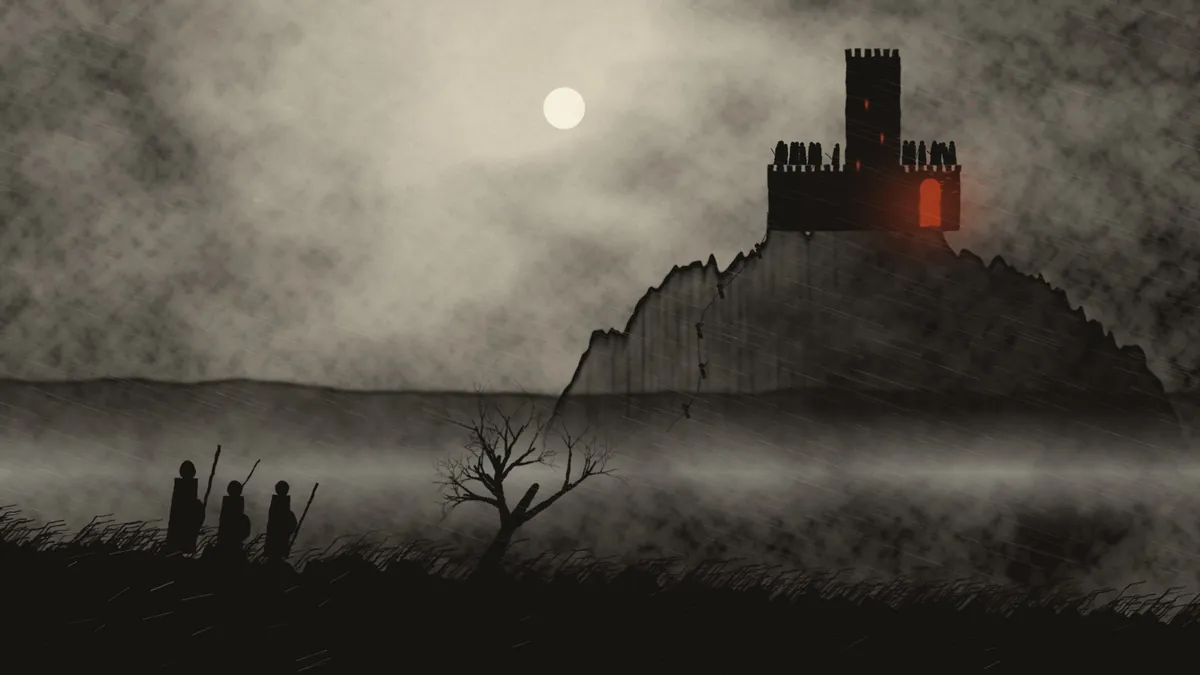
The crag stood a mile off across a boggy saddle, with the tower on its top against the evening sky. Its east face dropped sheer to the track. Its south face was a long slope of loose stone with a wall across the top and the gate in the wall. The north face was a cliff of broken rock, two hundred feet high, with stunted pines growing out of its cracks. Beyond the crag the ground fell away into a dark trough, and in that trough, three or four miles off and hidden behind a shoulder of the mountain, was the Kell. Karthen stood on the far side of that shoulder, under four miles from where he lay.
"Sixty of them," Callum said. "Kharadi, all willing, no bell. Gray riders mostly, some foot. They light a fire on the roof at midnight, every night, one fire for all's well. Karthen answers it. If they light two fires, Karthen sends horse."
"So we must take it before they can light a second fire," Rovan said.
"So we must take it quietly." Callum grinned. "The gate's on the south side. That's where they watch. Nobody watches the north face, because nobody's fool enough to climb it at night."
"Are we?" said Rovan.
"I am," Callum said. "My lads are. Are you?"
Rovan looked at the north face. It was broken rock, steep and wet, with the light going off it.
"How do I get down if I fall?"
"Quickly," said Callum.
Maelin was lying on Rovan's other side with her chin on her fists. "I'm not climbing that," she said. "I'm forty-seven and I've a stiff back and I've seen your lads' rope. I'll take the gate."
"With what?" said Callum.
"With my hands, highlander," Maelin said. "Give me ten men to get me there quietly, and stand back when I tell you to."
Callum studied her as though she had offered to fly. He laughed out loud, and a clansman behind him hissed at him to shut his mouth.
They went up the north face an hour before midnight, in the wind.
Twenty-four men climbed: Callum and twenty of his clansmen, two of Rovan's troopers who had been raised in the hills, and Rovan himself. Callum went first with the rope, and the rest followed on it, a man to every few yards. The wind came over the crag from the west in long gusts that pressed Rovan flat against the rock and then let go of him without warning. The cracks were full of old snow. His fingers went numb in the first fifty feet. After a hundred feet he stopped feeling them at all, and climbed by watching his hands.
Below him a clansman named Lachlan slipped, swore, and caught himself with his chin. Above him Callum's boots scraped and found holds and moved on. Rovan's mind held nothing but the next hold, and the old sword on his back pulling him outward from the rock.
Then, faint and far and bronze, from somewhere beyond the dark trough to the south-east, came the sound of a bell.
It was so faint that Rovan was not sure at first he had heard it. It came on the wind, a long, low note, softer than a sigh. Below him on the rope he heard the men stop moving. He hung on the face in the wind and listened, and he knew it.
"Karthen," Callum said above him, very low. "Every eight minutes, day and night, since December. My scouts on the ridges have heard it every night since the snow went. You can set a pot by it."
Rovan held the rock. The note faded into the wind. Somewhere four miles off, a crew was swinging a beam in the dark. Brand was in that field. Mabry was in that field. Every man he had promoted, the ones who had sworn the new words, had stood under that note all winter and heard it and obeyed.
"It can't touch us," he said. "It's four miles off, and there's no man on this rope who swore."
"I know that, southerner. I was telling you, not asking you." Callum's voice was hard and cheerful. "Climb."
They climbed.
The top of the north face came out under the tower's wall on its west side, where a ledge ran along the foot of the masonry. Callum went over the lip and lay flat, and the others came up one by one and lay beside him in the wind. Rovan came over last but two. He lay on the ledge with his cheek on cold stone, getting his breath, and flexing his hands until the feeling came back into them with a pain like hot needles.
The wall above them was fifteen feet high. A sentry walked along its top. They heard him come, heard him stop above them, heard him stamp his feet against the cold and walk away again.
Callum had a grapnel, padded with rags. When the sentry was at the far end of his walk, he stood up and threw, and the hook caught on the parapet with a muffled clink. He was up the rope before Rovan could count to ten. Two more went after him. Rovan heard the sentry turn, heard a challenge begin in the northern tongue and stop short, heard something heavy fall.
He went up the rope. At the top a clansman caught his wrist and hauled him over, and he was on the wall-walk, in the wind, with the yard of Kell Tower spread below him.
It was a small yard, cobbled, with a stable along one side and the tower in the middle. A lantern hung by the tower's door. Two men were crossing the yard toward the gate with a brazier between them on poles, and the wind was tearing sparks from it. On the tower's roof, black against the cloud, stood the beacon frame, and a man stood beside it with a torch.
"The roof," Rovan said. "Callum. The man on the roof."
"I see him."
Then the alarm went up. Someone on the south wall had looked back and seen them, black shapes along the parapet, and he shouted, a long, wordless yell that the wind snatched away and threw back. The two men with the brazier dropped it. Doors banged open in the stable. Men came running out into the yard, half-armed, and the man on the roof turned toward the beacon with his torch.
Callum's people went over the inside of the wall onto the stable roof and down into the yard like water over a weir. Rovan went with them.
He fought on the wall-walk first, because that was where the enemy came.
Three of them came along it from the south side, the sentries from the gate, with spears. The walk was a yard wide, with the yard fifteen feet below on one hand and the drop to the cliff on the other. The wind came across it in buffets that staggered a man in mid-stride. Rovan drew the old sword and stood his ground.
The first man thrust at his belly. Rovan turned the spear aside with the flat of his blade and stepped in along the shaft, and the wind shoved him the last half-yard so that he arrived harder than he had meant to. He drove his shoulder into the man's chest. The Kharadi went backward off the walk into the yard with a cry, and Rovan heard him hit the cobbles.
The second was more careful. He came on with short jabs at Rovan's face, keeping his distance, and the third came behind him with his spear over his comrade's shoulder. Rovan gave ground. A gust caught his cloak and dragged at him, and he felt his heel go over the edge of the stone. For a moment he hung there with his arms out. The spear came at his eyes. He swayed, felt the head go past his ear, and grabbed the shaft with his free hand and pulled.
The Kharadi came with it, off balance, and Rovan cut him across the neck under the helmet's rim. The man dropped. The third man stepped over him, set his feet, and thrust, and Rovan caught it on his sword, and steel slid on steel. He let the spear run past him and cut down at the man's leading hand, and felt the blade bite. The spear fell. The man fell after it, into the yard, clutching his hand.
Rovan stood on the wall-walk with his chest heaving and looked for the roof.
The man with the torch had reached the beacon. He was thrusting the flame into the frame, among the pitch and the kindling. As Rovan watched, the first tongue of fire caught and streamed out sideways in the wind, bright orange.
Then a clansman came up out of the tower's roof hatch behind the beacon-man. It was Lachlan, the one who had slipped on the climb, with blood all down his chin. He took the beacon-man round the waist and they went over the parapet together, both of them, without a sound that Rovan could hear. The torch went with them. The fire in the frame flickered, streamed, guttered in a gust, and caught again.
"The fire!" Rovan shouted. "Callum! The fire!"
Two more clansmen were up through the hatch. One of them tore off his plaid and beat at the flames with it. The other kicked the burning kindling out of the frame and over the edge, and it fell past the tower in a shower of sparks and was gone. Rovan watched the dark sky to the south-east for a long breath, for an answering light from beyond the shoulder. None came.
Below, in the yard, the fight was still going.
The Kharadi had got their backs to the tower door and their wits about them. Twenty of them, perhaps, stood in a half-ring with shields and swords, and the clansmen were throwing themselves at it and being thrown back. The rest of the garrison had shut themselves in the tower, and arrows were coming from its slit windows. A clansman went down in the middle of the yard with an arrow in his thigh, and lay there swearing.
And outside the walls, at the gate, a Kharadi officer was shouting from the gatehouse to men inside the stable to get to the horses and ride for Karthen.
The gate. Rovan had forgotten the gate. He went down the steps from the wall-walk two at a time, round the edge of the yard, toward it.
It was a heavy gate, two leaves of oak bound in iron, set in an arch of dressed stone. It was barred and chained from inside. Four Kharadi were at the bar, trying to lift it so that the riders could get out. Behind them, in the stable door, men were leading out horses.
Then the gate moved.
It moved before Rovan reached it, and before the men at the bar had lifted it an inch. The iron bands on its outer face screamed. The whole gate bowed inward in the middle as if a great hand had pressed on it from outside. The bar bent in its brackets. Then, with a crack like a tree going over, the stone arch around it split from top to bottom, and the right-hand leaf tore out of its hinges and fell into the yard.
The four men at the bar were thrown down under it. The horses reared and bolted. And through the gap, in the wind and the flying grit, came Maelin Rennick in her leather coat with her gloves smoking, and ten clansmen behind her with their swords out.
"Blood and iron," she shouted, to nobody, "I said stand back, didn't I?"
Rovan reached her as the stable men came at them. There were half a dozen, with swords, and they were angry and frightened and fought like both. Rovan killed one in the gap of the broken gate and took a cut across the back of his left hand from another. Maelin did not draw a weapon. She stooped and put her iron-shod palm on the threshold stone. The cobbles in front of the stable door bucked and heaved up in a ridge a yard high, and three men went down sprawling. The clansmen were on them before they could rise.
The ring of shields at the tower door broke a minute later, when Callum came over the stable roof with a dozen men and dropped on it from behind. Rovan heard him laughing as he came. It was a great, delighted roar of a laugh, as if somebody had told him the best joke of the year. He laughed as he swung his ax. A Kharadi sword opened his sleeve from wrist to elbow, and he laughed at that too. He was still laughing when the last of the shield-men threw down his sword and knelt on the cobbles with his hands up.
The tower held out for another quarter of an hour. Then Maelin went to its door, gripped its iron straps, and told the men inside, in a reasonable voice, what she was going to do to the stair. The door opened.
They had taken Kell Tower with four dead and nine wounded, and they held forty-one prisoners. Lachlan was one of the dead. They found him in the morning at the foot of the tower, on the rocks below the east face, still holding the beacon-man round the waist.
Callum stood over him a long time. He did not laugh.
At midnight, while the wounded were still being seen to, he had a single fire lit on the beacon. They watched the south-east until a single fire answered, far off and small, beyond the shoulder. Karthen had seen it. All was well at Kell Tower.
"They'll expect one every night," Rovan said.
"They'll get one every night." Callum's arm was bound up in a strip of his own plaid. "I'll leave ten men here to light it. Your fortress will think its tower's watching the hills, Commander, and the tower will be watching your fortress."
Rovan questioned the prisoners in the morning, in the stable, with Callum to put his questions into the northern tongue. Most of them would say nothing. One would. He was a gray-haired sergeant with a broken arm and an old soldier's eye for which way the wind was blowing, and he said that Karthen held five hundred Kharadi foot and riders. He said it also held three hundred of the old garrison, kept under the bell.
"The bell," Rovan said. "Where is it?"
"In the outer ward." The sergeant made a shape with his good hand. "They built a house around it. Stone, against the stable wall, open on one side so the beam can swing. A crew of twelve, four at a time, day and night. They are flogged if they're late on the stroke."
"The old garrison," Rovan said. "Do you know names?"
The sergeant shrugged. "A big gray sergeant. They call him Mabry. And a captain who walks with a stick, who commands them when they're on the walls. His leg is bad. They say the old commander gave him that before he ran."
Rovan thanked him. He went out of the stable and stood in the cold sunlight in the yard of Kell Tower and looked south-east at the shoulder of the mountain.
At noon, faint on the wind, he heard the bell again.
The moot met for the second time when they came back over the hills, in the long hall at Carrow, with the fire roaring in its trough. Callum told the story of Kell Tower. He told it at length and with gestures, and the hall shouted and stamped. When he came to Maelin and the gate, a hundred people turned to look at her, and she raised her cup to them and drank. When he came to Lachlan and the beacon, the hall went quiet, and an old woman by the door began to keen. Callum let her finish before he sat down.
Elspeth Nairn rose from her chair.
"The southerners can climb," she said. "Or one of them can. The other one opens gates." The hall laughed. "We have their paper. We have Kell Tower. I ask the moot for a purpose and a term." She turned to Rovan. "What purpose, Commander?"
He had thought about it all the way back across the hills. He stood up.
"Karthen," he said. "The fortress, and the men in it. And then the throne under the mountain, which is what rings their bells. I can't give you a term for the second. I can give you one for the first. Midsummer."
"Karthen by midsummer," said the Speaker. "And then we talk again about the throne. Who is for it?"
The hall rose. It rose bench by bench, and stamped, and the sound of it came up through the floor into Rovan's boots, warm and heavy, a great deal better than a bell. Dalby sat alone on his bench by the door with his letter on his knee, and he did not rise.
Afterward, outside in the long spring dusk, Callum found Rovan by the stream. He had a jug in one hand and two cups in the other, and his bandaged arm in a sling.
"Nine hundred," he said. "That's what the clans will send. Nine hundred now, and more if your Karthen comes off." He poured, and handed Rovan a cup. "But first I've a question, and I've been saving it since the moor. Your mage. She has a warm house in Dunmere, she says, and a parlor, and quartermasters to shout at. Why would a woman like that ride all night through the snow because an outlaw wrote her a letter?"
"I have no idea," Rovan said.
Callum looked at him over the cup. Then he laughed. It was the laugh from the yard at Kell Tower, the great delighted roar, and it sent the geese up off the stream in a clatter, and he was still laughing when Rovan had given up waiting for him to stop.
"No idea," Callum said, wiping his beard. "Mother of us all. You'll want to talk about how you take it, I suppose. Your fortress. Your walls, your gates, your bell in its little house."
"I'll want to talk about it for a week," Rovan said.
"I'll save you the week." Callum grinned his great grin at the dusk. "Now. Your fortress. We know the goat-path to the top of it."