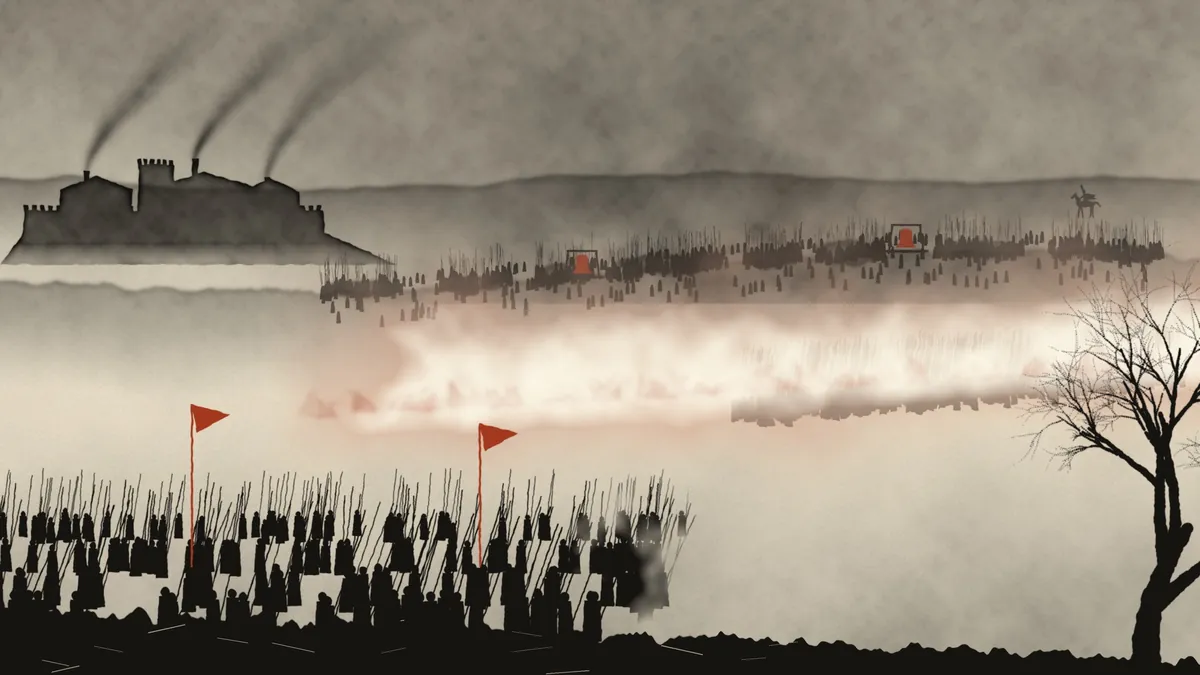
The Battle for the King's Arsenal
The commandant of the King's Arsenal at Brackwater did not want to leave it. He was an old major of horse called Wendell Fane, forty-one years in the king's coat.
"Eight years on this hill," he said. "Commander, I know every pike in those sheds. I know which roofs leak. I set that clock myself, every Sunday, by the sun." He pointed up at the gate-tower over their heads, where a great white clock-face with gilded hands looked out north over the valley. "And you want me to march my garrison out of the back gate in the dark and leave it all to you and a regiment of fishmongers."
"I'm asking you to," said Rovan.
"Asking," said Fane. "Not ordering."
"I can't order you. You're the king's officer."
"So are you, I hear," said Fane.
"Under a warrant. Not over you."
They stood in the arsenal yard in the last of a February dusk, among the long stone magazines with their slate roofs and iron-studded doors. The coalition had come in from the east along the Lissen road at dusk after three days' hard marching, five thousand of them, and lay now along the low ground south of the brook. Their fires were coming out in the dusk below the walls. Twelve miles north, Serath's fires had been seen at noon from the top of this tower.
"When did you swear, Major?" Rovan said.
Fane's face went stiff. He was a lean, bow-legged old man with a white mustache and the eyes of a hawk that had been kept too long indoors.
"When I took this command. You change regiments, you swear again. It's the form."
"The new words," Rovan said.
"Yes." Fane looked away up at his clock. "I've read the king's letter, Commander. I know what it says. I know what happened to Tierney. I'm not a fool."
"No," Rovan said. "And your garrison?"
"Four hundred. Three hundred and some of them sworn the same." He chewed his mustache. "You think she'll ring it at my gate."
"I think she'll ring it in the valley, and your men will open the gate for her from the inside," Rovan said. "They'll know what they're doing, and they won't be able to stop. Then they'll arm her compelled regiments out of your sheds. I've seen it happen. It happened to me." Rovan held his eyes. "Take them south, Major. Three miles down the Kingsholm road, further if you can. Leave me the keys and the free men. I'll give you back your arsenal tomorrow night with every pike in it I can save."
The old man stood there in the dusk under his clock until the first stars came out. At last he unhooked a great ring of keys from his belt and held it out.
"There's a man of yours in the sheds already," he said. "Teshar fellow. Bad knee. He's been going through my magazines since noon like a bailiff, and he's told my armorer his gauges are wrong. He's right, damn him."
"That's Dace," said Rovan. "He'll take care of them."
Fane's garrison went out by the south gate at midnight, with the major riding at their head and his back very straight. Rovan watched them go, and went round his lines in the dark, as he had always done, and spoke to every captain and as many men as he could find awake.
He asked every company the same thing. Was there any man in it who had sworn the royal oath in the new form? The captains had tested them all at Lissen, under Hessa's compact, but he asked again. He had learned to ask twice. In the Lissen river companies a boatman owned up that he had done six months in the river regiment when he was twenty, and forgotten. He went back to Lissen that night under escort, swearing at Rovan the whole way, and Rovan was glad to hear him do it.
At the bridge he found Maelin sitting on the parapet with her hands on the stone.
"Good bridge," she said. "Old. Three arches. They built it before your kings had a name, and somebody's been patching it ever since with bad lime." She patted it. "If you want it gone, tell me in good time. It's heavy."
"I may."
"You'll have to ask nicely." She looked north into the dark, toward the ridge where Serath's fires had been. "Two bells, the scouts say."
"So I hear."
"And nine thousand. And most of them Tierney's." She rubbed her gloves together. "Those poor bloody boys, Rovan. In the rain at Dunmere."
"They'll be in front tomorrow," said Rovan. "We'll have to kill some of them."
"I know." She swung her legs off the parapet. "I've been trying all the way from Lissen to think of a way not to. I haven't found one."
At first light he went up the gate-tower under Fane's clock and looked at the ground.
The Brack brook ran east below him across the whole front, in a shallow valley of wet meadows, from the arsenal's knoll on his left to a beech wood on a hill-shoulder a mile away on his right. A mile beyond the brook the long bare back of Cold Ridge filled the north. The Dunmere road came down off it, straight as a rod, to cross the brook at the stone bridge in the middle of his line.
Serath's army was coming over the ridge.
They came down the road in files and then deployed, unhurried, along the whole forward slope of the ridge, regiment after regiment. Most were in blue. The royal blue of Auren, with the facings of a dozen regiments Rovan knew. The Queen's Foot, buff. The River regiments, green. The Hallam garrison, gray-blue, under the Hallam tower. They formed their ranks on the slope in the cold dawn as neatly as on parade. Behind them, along the crest, stood the gray cloaks of the Kharadi, two thousand or more, with their horse on the flanks.
And there were the bells.
He saw both of them through the glass. One stood on the road at the top of the slope in the middle of the enemy line, half a mile above the bridge, on its six-wheeled wagon with its team still in the traces. The other was out on Serath's right, the west, on a spur of the ridge that ran down toward the arsenal's knoll. It stood well forward. It would be within a short half-mile of the arsenal wall.
On the crest above the center bell sat a small group of horsemen under a plain gray banner. In front of them, a little apart, a rider on a gray horse.
"That's her," said Maelin, beside him.
"Yes."
Below, along the brook, the coalition stood to arms. On the left, the Torrin men and a thousand of the Lissen wards held the knoll's slopes and the arsenal wall, with Dace in the gatehouse. In the center, his three hundred Karthen veterans and fifteen hundred of the river companies lined the south bank of the brook to either side of the bridge. On the right, toward the beech wood, stood Hessa's company and the thousand Saltmere foot. Not one man in five thousand had sworn the words. He had asked them all.
The center bell rang.
It came across the valley as a great deep note that he felt in his chest and in the stone of the tower under his feet. All along the brook, five thousand free men flinched together at the sound, and stood, and were nobody's but their own.
On the slope across the brook, Serath's blue regiments lowered their pikes and came down the hill.
They came at the center first. Rovan went down from the tower at a run and got to the bridge as they reached the brook.
It was the Queen's Foot. He knew their buff facings and their colors, a white swan on blue. They came down the last of the meadow in a dense block, eight hundred pikes, at a steady walk. Their officers marched in front with drawn swords, and their faces were set and blank, and some of them were shouting.
"Get back!" a captain was shouting. He was a young man with a fair mustache. "For the gods' sake, get back from the bridge! It isn't us!"
They came on. The front of the block came onto the bridge and down into the brook on either side of it, wading thigh-deep in the brown water with their pikes leveled. The river companies met them at the bank. Pike struck pike with a clatter like a falling woodpile, and the two masses ground together in the water and the mud.
On the bridge, there was no room for pikes. It was swords. Rovan stood in the middle of the roadway with the old heavy sword and forty veterans behind him, and the Queen's Foot came at him over the crown of the arch.
The first man was a sergeant, big and gray, bellowing as he came. He swung a short sword at Rovan's head. Rovan took it on his blade and turned it, and hit him in the face with the pommel, and the sergeant went down on the stones. The next one came over him. Rovan cut him across the forearm and the sword fell from his hand. A third thrust at him with a half-pike. Stannard, on his left, caught the shaft and hauled the man forward, and Rovan struck him down with the flat across the side of the head.
He was trying not to kill them. He knew he could not keep it up.
A boy of eighteen came at him with his mouth open in a soundless shout and a sword in both hands. Rovan parried it and parried again, and the boy kept coming, hacking, sobbing, and the third cut came through. It caught Rovan on the left shoulder and opened his coat to the mail. Behind the boy, more were coming over the crown of the arch, and to Rovan's right one of his veterans went down with a sword in his chest.
Rovan killed the boy. He did it with one straight thrust under the breastbone, because there was nothing else left to do, and he let him slide off the blade onto the stones.
Across the brook, at the top of the slope, he saw the center bell's wagon begin to move.
They were bringing it down the road. Its twelve-horse team leaned into the traces, and the great shape under its canvas swayed and came on down the hill toward the bridge, with a hundred Kharadi marching round it.
"Back!" Rovan shouted. "Off the bridge! Back to the bank!"
His veterans gave ground, fighting. The Queen's Foot came on after them over the arch. Rovan went back with his men, step by step, off the end of the bridge onto the south bank, and he looked for Maelin.
She was already there. She was kneeling on the bank at the bridge's end, with both hands on the great stone footing of the first arch, and her lips were moving.
"Now," Rovan said. "Maelin. Please."
"Since you ask," she said, through her teeth.
The bridge came down.
It came down from the middle outward. The keystone of the center arch dropped first, with a crack that rang over the valley louder than the bell. The arch sagged, and broke, and fell into the brook in a great roar of stone and water, with the men on it. The two outer arches followed it, slower, one after the other, toppling outward into the stream. A wave of brown water went up both banks and knocked men off their feet.
When the spray settled, there was no bridge. There was a dam of broken stone across the brook, with the water piling up behind it. The Queen's Foot were struggling out of the flood on either side, and the bell's wagon halted on the road a quarter-mile above it.
Maelin knelt on the bank with her hands held out in front of her, and they would not stop shaking. She looked at them as if they belonged to a stranger.
"That," she said, "was a good bridge."
They had broken the bridge. They had not broken the attack.
The Queen's Foot came on through the brook on either side of the wreck, wading where the water had spread out over the meadows, and the River regiments came down behind them on their left. For an hour the whole center of the line was a struggle in the water and the mud of the south bank. It was pike against pike and sword against sword, with men drowning in the flood and the bell ringing over it every few minutes from the road above. Rovan fought in it, for how long he never knew. He killed four more men in blue. He took a cut on the left arm and felt nothing until his hand would not close. He knew that Stannard went down beside him with a pike through his thigh, and that he and Maelin dragged him back up the bank between them while the bell rang.
At ten o'clock, by Fane's clock, the left began to go.
He saw it from the bank when he could look up. Out on the west, the second bell had come forward down its spur. It stood now on the lower slope opposite the arsenal knoll, ringing. Two blue regiments had crossed the brook below it and were climbing the knoll toward the arsenal wall, with a thousand Kharadi coming behind them. The Lissen wards on the knoll's slopes were falling back. Smoke was going up from the west end of the arsenal, where the outermost magazines stood outside the main wall.
"They're in the west sheds," said a runner, a girl of sixteen from the Lissen wards, gasping. "Dace sent me. He says they're carrying out pikes by the cartload, and he can hold the gate but not the sheds, and where in the name of the Teeth is the cavalry."
"We've no cavalry," said Rovan.
"He knows, sir. He says that's why he's asking."
Rovan looked at the knoll, and at the bell on its spur, and at the long open slope of meadow between. He had nothing left to send. Every free man he had was in the brook or on the knoll or holding the right with Hessa. He opened his mouth to tell the girl so.
Behind the arsenal, on the Kingsholm road, a trumpet blew.
They came round the south side of the knoll at a canter, out of the road behind the arsenal, more horsemen than Rovan had seen together since the border war. They rode in long open lines on tall fine-legged horses, and the riders wore short cloaks of dark red over mail and round steel caps with plumes of horsehair. At the head of each squadron rode a pennon of red and gold.
"Teshar," said Maelin. She had got up off the bank and was staring. "Blood and iron. That's the Prince of Teshar's horse."
They swept on past the knoll. The leading squadrons swung wide round its foot onto the open meadow and went across the brook at the gallop, in a great sheet of spray, straight at the spur where the western bell stood. The Kharadi horse on that flank came down to meet them. Rovan saw the two lines meet, and lost them in the smoke from the burning shed.
A smaller party broke away from the rest and came along behind his line toward the center, a hundred riders or so. At their head rode a lean dark man on a bay mare with a white sock, sitting his horse as if he had been born on it. On his saddle-bow, in a cradle of iron hoops, rode a brass pot with a pierced lid, and a thread of smoke came out of it.
He reined in on the bank above Rovan, swept off his steel cap, and bowed from the saddle. He had a narrow, clever face, a short black beard and laughing eyes.
"Commander Tal, I think," he said. "Garrick Aras, at your service, and at the service of my prince, who sends his compliments and regrets that he cannot be here in person. He is very fond of battles, at a distance." He replaced the cap. "We last met twenty years ago, at the river line. You held a burning ford against my father's horse for a day and a night. I was nineteen, and in the front rank, and I spent most of it in the river. I have wanted to meet you ever since."
"Lord Garrick." Rovan wiped his sword on his sleeve. "I never sent for you."
"No. That is what made it so pleasant to come." Garrick looked out over the valley, at the brook full of struggling men and the bell on the road above. The laughter went out of his face. "We heard at Kingsholm what the Marshal is doing with these things. My prince thought it a pity. Where would you like me?"
Rovan did not answer at once. A runner was coming along the bank from the right at a dead run, a pikeman from Hessa's company with his steel cap gone. He fell on one knee in front of Rovan.
"Captain Dorn's compliments, sir. She asks your leave to take the company and the Saltmere foot round by the beech wood and up the end of the ridge, and come down on that bell from the side." He pointed at the center bell on the road. "She says she can get to the wood unseen. But after the wood it's open slope, half a mile of it, under the Marshal's nose. She says if they see her coming, she'll lose half the company before she's halfway, and she'd sooner not, because they're owed money."
Rovan looked at the slope. It was what the man said. Open meadow ran from the beech wood up the eastern shoulder of the ridge, without a hedge or a tree. Serath sat on her gray horse at the top of it with her staff around her.
"Lord Garrick," he said. "Can you hide six hundred pikes on an open hill?"
Garrick studied the slope too, and then the little brass pot on his saddle-bow, and smiled.
"No. But I can make the Marshal wish she had not looked." He turned to the rider at his side. "Lucan, my compliments to Captain Dorn, and she may march when she sees my light. Commander, you will forgive me if I do not watch it myself. I learned at nine years old not to look at my work."
He rode out alone along the brook to the right, a hundred yards in front of the line, and stopped on a little rise of ground below the beech wood. He took the lid off the brass pot. Rovan saw him put his bare hand over it, as a man warms his fingers at a brazier.
Then he drew the fire out of it.
It came up out of the pot in a thread of light, thin and bright as wire, and Garrick lifted his hand, and the thread went with it. He flung his arm out toward the ridge. The thread ran away from him across the meadow and up the slope and along it, a line of red fire in the winter grass, three hundred yards long, then six hundred. Where it ran, the dry grass caught. Smoke came up from it, thick and white.
Then the fire stood up.
It rose out of the burning line on the hillside like a wall: a curtain of white glare as high as a house, so bright that Rovan flung up his arm across his eyes. Even through his sleeve he saw it, white and shaking. It stood across the face of the slope between the beech wood and Serath's crest, and nothing could be seen through it. On the crest, every face turned away.
Under it, out of the beech wood, Hessa's company came at the double, with the Saltmere foot behind them. They went up the slope under the wall of glare in a long dark file, with their pikes at the trail, and the smoke covered them.
Rovan did not wait to watch it. He took Lucan's horse, and the glass out of Lucan's saddle-holster, and went along the bank at a gallop toward the knoll, with Maelin running behind him and swearing at him the whole way.
The arsenal gate stood shut at the top of the knoll, with Dace in the gatehouse over it and the great white clock-face over Dace. Below the gate, on the slope, the fight had gone as the girl had said. Two blue regiments were at the wall, hundreds of men on ladders and shoulders and each other, and the Lissen wards on the parapet were beating at them with pike-butts and stones. Out on the spur across the brook the western bell stood on its wagon, and Garrick's red riders were in among it. Rovan put the glass on it. He saw the crew go down at the beam one after another under the sabers. He saw the gray horse come back at the riders and drive them off, and the wagon stand with no one on it.
He went up the gatehouse stair with the glass in his hand. Dace was at the arrow-slit with his bad knee on a stool, and a slate on his lap, and a piece of chalk.
"Ten past the hour," Dace said, without turning his head. "That's when the red ones killed the crew. I marked it. It's not rung since. Look at them."
Rovan looked. The blue regiments were still at the wall. They were fighting as hard as they had fought at the bridge, climbing on each other's backs with their faces gray and set. A Lissen boy came off the parapet with a pike in his chest while Rovan watched. Nothing had changed. The bell was silent, and the men it held were killing his people as if it rang yet.
"It's in the stone," Maelin said behind him. She had come up the stair with her hand flat on the wall. "The sound's gone and the hum's still there. Fainter. But there."
"Quarter past," said Dace.
They stood at the slit and watched. On the slope, a ladder went up against the wall and was thrown down, and went up again. In the gate-yard below, the Lissen wards were bringing up stones in baskets. The gilded hands of Fane's clock stood over them all, and moved as slowly as a clock moves when it is watched.
"Twenty past," said Dace. "Look at that one, Commander. The big fellow at the foot of the ladder. Look at him."
A broad man in the gray-blue of Hallam stood at the foot of the nearest ladder with his pike grounded, looking up at the wall. As Rovan watched, he lowered the pike. He held it out in front of him and looked at it, as a man looks at a thing someone has just put into his hands. He laid it down on the grass, and sat down beside it, and put his face up to the rain.
All along the wall it was happening. Men came down off the ladders. Men let go of each other. A whole regiment stood in the wet grass under the arsenal wall with its weapons hanging. The Lissen wards on the parapet stopped throwing stones, because there was no one left to throw them at. Somebody below the gate called up, quite clearly, for a drink of water.
"It's gone," Maelin said. "Out of the stone. It's gone."
Then, across the brook, the gray cloaks got new men up onto the wagon. Rovan saw them through the glass, four of them, hauling at the beam. The bell rang. The note came over the brook and up the knoll. Under the wall, three hundred men got up off the grass and picked up their pikes and went back to the ladders, and some of them were screaming as they went.
"Ten minutes," he said. "A stroke holds them ten minutes. Then it lets them go."
Maelin heard it, and took it in, and her face went hard.
"So you needn't break the thing," she said. "You only have to stop them ringing it."
"For ten minutes. With the beam in our hands." Rovan turned to the Lissen runner, who had followed them up the stair. "Go to Captain Dorn. Go round by the wood and catch her up. Tell her she's to kill the crew at that bell and take the beam, and hold it. Not break it. Hold it. Let no man of theirs near it. Ten minutes by the clock on the arsenal tower, and the regiments in the brook will be free."
He watched it from the gatehouse roof, under Fane's clock, through Garrick's glass, with the fight going on below him.
The glare-wall dropped at last, and Garrick swayed in his saddle on the rise with both hands under his arms. Hessa's people came out of the smoke at the top of the slope, a quarter-mile east of the bell, and turned, and leveled their pikes. The Kharadi round the bell turned to meet them, too late. Six hundred pikes went into the flank of the bell-guard at a run, with Hessa somewhere at the front of them.
He looked up at the clock over his head. The gilded hands stood at twenty-five minutes to eleven.
He put the glass back on the road. The pikes were round the bell now. They had made a ring of it, a hedgehog of steel round the wagon, facing out. Inside the ring he saw men at the beam: men in buff coats, the Lissen colors. The crew were gone. A Kharadi officer rode at the ring with forty horse behind him and broke on it. Outside, the Saltmere foot were holding the road against the Kharadi coming down from the crest.
"Hold," Rovan said aloud. "Hold, Hessa. Hold."
Below him, in the brook, the Queen's Foot were still fighting.
They fought on. That was the hard part. The bell was silent now, and the field it had made still held them. For ten minutes they went on attacking the river companies through the flood, as hard as ever, swearing and praying and killing. A Lissen boatman went down under a blue pikeman's thrust, ten yards from Rovan. The pikeman's face was the face of a man watching a stranger's hands do murder.
Rovan went down the stair and along the bank and into the brook. He could not stand on a tower and watch.
He fought for five minutes more, perhaps six. He knocked a pike aside and took a man of the Queen's Foot by the collar and threw him down in the water. He held him there, not drowning him, holding him, while the man thrashed and begged his pardon, over and over. Something hit Rovan on the helmet and he saw stars. Maelin was beside him with her iron hand round a pike-head, folding it. A blue sergeant came at her with a sword. She hit him with the folded pike-head, and he went down.
Then the fair young captain who had begged them to get back from the bridge, at the start of it all, stopped in the middle of the brook with his sword raised.
He stood there with the water to his thighs and the sword up, and looked at it. Along the whole front of the brook, the Queen's Foot stopped with him. Then the River regiments behind. Men stood in the flood with their pikes thrust out and looked at their hands. A pikeman in front of Rovan let go of his pike and it floated away down the brook. Somebody began to laugh, high and cracked, and went on laughing.
The fair captain turned round and looked up the hill at the Kharadi.
"Queen's Foot!" he shouted, and his voice broke on it. "Queen's! About face! About face, damn you, and at them!"
It was over in an hour after that, though the killing went on for most of it.
Some of the freed regiments turned on the Kharadi on the slope and went up the hill at them with whatever they had, and many of those died. More of them sat down in the mud and the flood and did nothing at all. Rovan let them sit. He took his veterans and the river companies across the brook over the dam of the broken bridge and up the road, and they met Hessa's people coming down. Maelin went past him at a stumbling run to the bell. She put her bare hands on its crown, where the hanging-loops met the shoulder, and pushed, and nothing happened. She pushed again, and her knees went, and Rovan caught her under the arms.
"It won't," she said. "Rovan, it won't hear me. I've nothing left to say to it." Her hands were shaking so hard that he took them in his and held them. She went slack against him, and he laid her down on the road. She did not wake when Hessa's people took the striking beam off its chains and carried it away down the hill on their shoulders, nor when they lifted her into a cart.
On the west, the other bell rang on.
Serath kept it. She drew it back up its spur at the gallop, with a ring of Kharadi horse around it, and the blue regiments of her right wing went back up the hill with it. They had to. They were inside its field, and it was going. The arsenal knoll emptied as the compelled men climbed away from it. Rovan saw them go over the ridge in good order, rank by rank, with the Kharadi foot behind them and their horse covering the rear. Garrick's squadrons followed them to the crest and no further, and came back.
Not a regiment broke. Not a wagon was left that could be got away.
At the very end, when the last gray ranks were going over the crest, the rider on the gray horse came back alone to the skyline. She sat there a moment, looking down across the valley, across the dead in the brook and the smoke of the burning shed and the broken bridge, toward the bank where Rovan stood.
She raised her hand to him. It was the salute one officer gives another across a field.
Rovan stood looking up at her. After a moment he raised his. She turned the gray horse and was gone.
They counted the cost at dusk, by the light of the burning west magazine, which no bucket could reach. Rovan had lost three hundred and eleven dead, and as many again wounded. Stannard would keep his leg. Hessa had lost forty-three, and had their names written down before Rovan had finished asking. Serath had carried off sixty cartloads of pikes and sword-blades from the west sheds, and burned one magazine. The rest of the arsenal stood. Dace was sitting on the gate step with his bad knee stuck out in front of him and a jug of the major's wine, telling anyone who passed his opinion of the major's gauges.
Two thousand men of Tierney's lost army had come free in the brook. Rovan had them marched three miles south under their officers to Major Fane's camp on the Kingsholm road, out of the reach of any bell he could imagine. They went quietly, most of them. The fair captain of the Queen's Foot shook Rovan's hand at the roadside, and said nothing, and went.
Garrick found him on the bank by the broken bridge. The Teshar lord had his hands wrapped in a horse-blanket, and he walked stiffly, like a man who had been out all night in snow. He bowed all the same, very low, with a flourish of the blanket.
"Commander," he said. "A most instructive morning. I hope you will allow me to stay a while. My prince instructs me to preserve my force." He smiled. "He did not say from what."
"Stay as long as you like," said Rovan. "I can't pay you."
"Nobody ever can. It is the curse of my family."
Behind him, a light rider in a red cloak came down the bank at a trot and saluted. He was a boy of eighteen or so, mud to the eyebrows, on a lathered horse.
"Lord Garrick. Commander." He was out of breath. "I've been up the Dunmere road behind them since noon, sir, as you ordered. I took a carter at the crossroads at Ivel. He'd been hauling for the Marshal for a month. He says this wasn't the first." He swallowed. "He says she emptied the armory at Hallam two weeks ago, sir. And the one at Dunmere before that. Every pike and blade and helmet in both of them, gone north in wagons. He says she didn't come here because she needed the weapons."
Rovan looked up at Cold Ridge, black now against the last of the light, where the gray horse had stood.
"Then what did she come for?" said Garrick.
"For this." Rovan turned and looked at the long dark sheds behind him. "Not to fill her wagons. To empty ours. Five thousand free men and the biggest arsenal in the south, within a day's march of each other. She meant to burn it or carry it off before we could put the one into the other." He raised his voice. "Dace. How many pikes in the sheds that are standing?"
"Eleven thousand," said Dace, over the jug. "And the gauges wrong on half."
"Then every man in the river companies carries two by morning, and the wrong gauge goes to Torrin," Rovan said. He looked at Garrick. "And the two thousand don't stop at Fane's camp. They go on tonight, to Kingsholm, under their officers, with your riders round them, and they don't stop till there's a river between them and her. She knows where they are. She has a bell left, and she'll want them back."
Garrick bowed, blanket and all, and went to find his horses.
Rovan stayed by the broken bridge while the magazine burned. Up the road, on the dark slope where the center bell sat on its wagon with its crown whole, a lantern went up out of the valley on a creaking cart. Presently, over the noise of the fire and the wounded, a sledge began to ring on bronze. Dace had found a cold chisel in the major's sheds. The sound went on all night, slow and steady, a stroke every few breaths, and not a man on the field turned toward it.