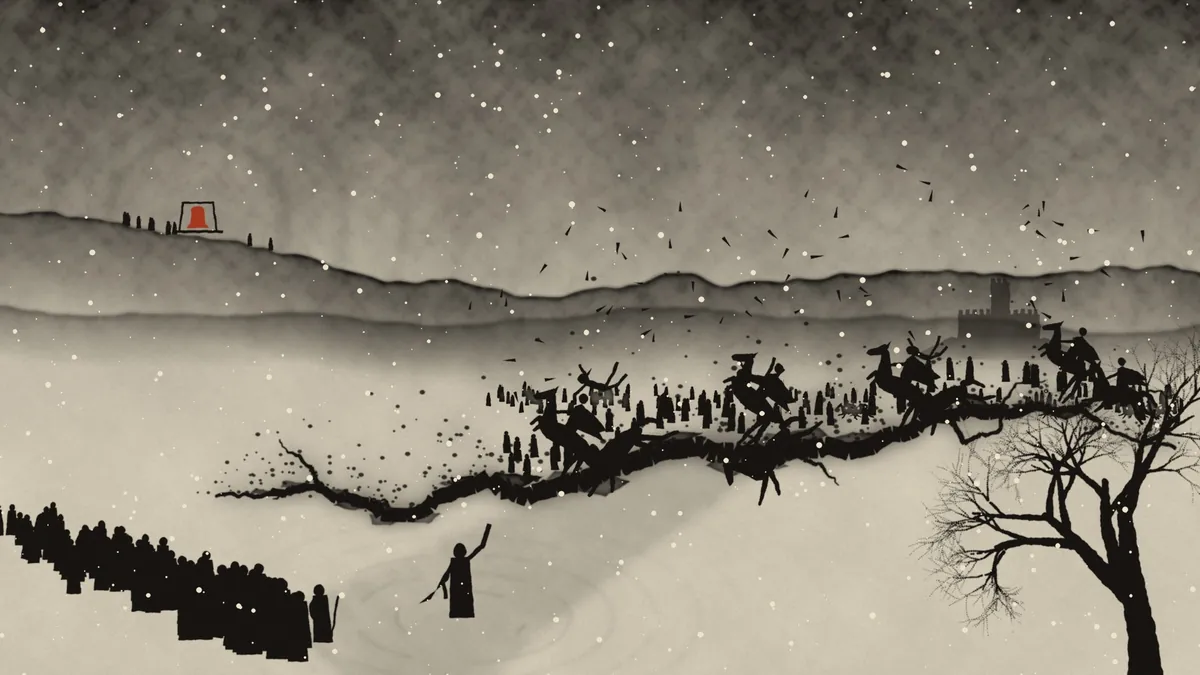
Maelin Intervenes
"A gate," said Maelin Rennick, "is a wall that has been taught to move. Never forget that it would rather not."
She stood in the arch of Dunmere's old west gate with her hands in her coat, and looked at her class. They were thirty militia of the March, bakers and coopers and clerks in mismatched helmets, standing in the slush of the gate-yard. Half of them were listening. The other half were watching her hands, because they had heard what her hands could do and were hoping she would do it.
"So when you break a gate," she went on, "you don't fight the wall. You fight the teaching. Hinges. Bars. Pins. Bolts. The iron that holds it in its frame. A gate is only as strong as the cheapest smith who ever worked on it." She pulled her right hand out of her pocket. The glove was heavy brown leather, shod across the knuckles and the palm with plates of dark iron, and the militia leaned forward as one man. "Sergeant Marsh. Who forged the pins of this gate?"
Cuthbert Marsh, who commanded the Dunmere militia and had been her pupil for three weeks and her drinking companion for two, considered the question gravely.
"Couldn't say, Mistress. It's two hundred years old."
"It's a disgrace, is what it is." She laid her iron palm against the great strap hinge at shoulder height, where the black iron ran into the stone of the arch. She felt it at once: the long cold of the strap, the pin in its socket, the old mortar round the pintle, the whole lazy weight of the gate hanging there. It had been hanging for two hundred years and wanted nothing more than to go on doing it. "Listen to that. Bubbled iron. Slag in it like currants in a cake. Somebody's great-great-grandfather was paid good March silver for that and spent it on beer."
She pushed.
No flash came, and no sound but the iron's. The pin groaned in its socket and the strap bent away from the stone. The upper corner of the gate dropped a foot and hung there, cocked and sagging, and a shower of old rust and pigeon droppings came down on the front rank. The militia jumped back, swearing, and then began to laugh, and somebody at the back cheered.
"That," said Maelin, "is what I'll be sending the Council a bill for. Don't cheer. Any fool can wreck a gate. The trick is to wreck the one you meant, at the time you meant, without dropping the tower on your friends." She took her hand away. The glove was warm, and her palm under it tingled, warm and buzzing. "Spectacle is for children and kings. Tomorrow, the same hinge, and you'll tell me which pin goes first and why. Dismissed."
They went off in knots through the slush, arguing about pins. Maelin stood looking at the sagging gate with her hands back in her pockets. She was forty-seven, taller than most of the men she had just been teaching, with gray running through her black hair in two broad streaks that she refused to dye. She had been wintering in Dunmere because Dunmere had a good cellar under the house she rented and nobody in it had wanted anything from her in eight months.
She was so bored she could have chewed the gate.
"Hells, Marsh," she said. "Is there anything to do in this town in December besides drink?"
"There's the Midwinter dancing, Mistress."
"Then there's nothing," said Maelin, and went home.
The letter came at two in the morning.
She was awake, because she never slept well in winter. She sat by the embers in a blanket, with a glass of Teshar red and a book about the forging of river chains, and she heard the horse in the street before the knocking began. She knew a foundered horse when she heard one. It had stopped outside her door and stood blowing and groaning in the snow.
The rider on her step was a Teshar boy with an iced-up face, who said his name was Benno and that he came from the Commander. He fell over when he tried to come in. She sat him by the fire with the rest of the wine and read the letter standing up.
She read it again, and stood with it in her hand while the boy shivered on her hearth. She saw Rovan Tal as she had last fought beside him, twenty years ago, at the river line in Teshar. He had held a burning ford for a day and a night with three hundred men, and Ferren, who had been his sergeant and her friend, had died in it. They had buried Ferren on the bank the morning after. When it was done Rovan had sat down by the grave and asked her for a needle and thread to mend his coat, because the man he would have asked was under the turf. She had taken the coat off him and mended it herself, sitting in the mud with her back against his, and he had gone to sleep against her before she had finished the sleeve. She had sat there till dark and never said why. A month later he had gone home to Dunmere and married. He was the least excitable man she had ever known. In twenty years he had never once asked her for anything.
If you ever trusted me, come now, and come armed.
"Bloody man," she said aloud. "Bloody, bloody man."
She was dressed in four minutes. Her leather coat, the old one with the iron plates sewn under the shoulders. Her gloves. Her riding boots. Her commission, in its oilcloth case, because she knew already that she would need to wave it at someone. She hammered on the door of her manservant's room, and old Noll Trask came out in his nightshirt with a cudgel in one hand and a candle in the other.
"Horses," she said. "Mine and yours. Then wake Marsh. Tell him I want the Fenwick twins and the two best horses in the militia stables, outside this door in half an hour. If anyone tries to stop him, he's to tell them it's my fault."
"Where are we going?" Noll asked.
"Hallam."
"At this hour?" said Noll.
"At this hour," Maelin said. "And bring the rope. And the brandy."
Noll looked at her face and went.
They left by the north gate at three, five riders and a spare horse, with Benno asleep in her bed. Cuthbert Marsh came himself, which she had not asked for and was glad of. The Fenwick twins came, Lise and Coll, nineteen years old, who had grown up on a horse farm and could ride anything with legs. Noll came, grumbling, with the brandy.
On the way to the gate they passed a narrow house in the Cornmarket with a light in an upper window. It was Marta Tal's house. Maelin had dined there in November. Marta had shown her a letter from her son Edran at Karthen, four close pages about a mule train and a rockfall, and read the best parts aloud.
Do not tell Marta. I will tell her myself.
Maelin looked at the light in the window, and rode past it, and kept her eyes on the road.
They rode through the night on a road of iron-hard snow, under a sky so clear and cold that the stars seemed close enough to scrape her knuckles on. It was twenty-three miles to Hallam. They changed horses at a posting-house at Cray, where she woke the keeper by putting her fist through his shutter, apologized, and paid for it. By dawn they were in the foothills. The Ironbacks stood up white across the north, and over the high pass lay a long bank of snow-cloud.
They came over the last rise as the sun came up, and Maelin reined in and looked at Hallam.
The road ran north in front of her down a long open slope, with the Kell shining on her left in its willows. Hallam Keep stood on its hill on the right of the road, square and gray, with a causeway running from its gate down across the ditch and the water-meadows to join the road. Below the keep, in a field between the road and the river, she saw the fugitives from Karthen, hundreds of them, dark against the snow: ashes of fires, huddled families, soldiers in clumps. A ring of royal lancers sat their horses around them. And drawn up across the road at the north end of the field, facing them in a long double rank with their spears at the slope, stood the garrison of Hallam.
Beyond the north end of the field, a quarter of a mile off, a long bare ridge came down out of the north-west and ended above the river in a scatter of rocks. The road went round its end. Nothing moved on it.
Then something did. A single gray rider came round the end of the ridge under a white rag tied to a lance, alone, at a walk, and stopped at the edge of the ditch below the keep. He sat his shaggy horse there with the rag stirring over his head, and Maelin heard his voice come up the slope to her on the still air. It was slow and formal, as a man speaks a tongue he has learned from books.
"Governor. The Marshal Serath greets you. She requires the fortress and the road. She requires no man's life who stands aside. It is required."
He waited the space of ten breaths. No answer came from the keep or the ranks below it, and no arrow either. Then he turned the shaggy horse and rode back round the end of the ridge the way he had come, at the same walk, and the road was empty again.
"That's a lot of spears," said Cuthbert Marsh.
"That's six hundred spears," said Maelin. "And if I know Arden Sayle, he's thinking about which of those poor devils to hang first." She gathered her reins. "Noll, keep the brandy dry. The rest of you, smile at everyone and do exactly what I do."
They went down the slope at a canter and straight through the ring of lancers before anyone thought to stop them. Maelin had found long ago that the surest way into any place was to ride in looking expected.
She saw at once what was happening. Down by the road, before the double rank of Hallam spears, the Karthen soldiers were being made to lay down their weapons. They were coming forward in files and dropping their swords and spears on a heap in the snow, under the eyes of Sayle's officers. Many of them had no weapons to drop. They stood behind in their shirts and rags with their arms round themselves, and the men who still had swords were not hurrying.
And in the middle of it, standing in the road in front of the heap with his hand on his sword and his head bare, was Rovan.
He looked older, and short of three nights' sleep. A cut on his forearm was tied up in a strip of shirt, and his face was gray with stubble and cold. He turned at the sound of her horse, and saw her. Something went over his face and was gone before she could put a name to it.
"Maelin," he said.
"You look like a dog's dinner," she said. She swung down from the saddle and stood in front of him. He was a head shorter than her, as he had always been. "Twenty years, Rovan, and you write me eight lines. Eight. I counted."
"Nine," Rovan said.
"The ninth was an order. It doesn't count." She looked past him at the heap of swords, and at the double rank of spears, and the man on the big chestnut horse behind them in the fur-lined cloak. "Is that Sayle?"
"Him."
"Wonderful," said Maelin. "I always wanted to tell him what I thought of his ballroom."
She walked across the road toward the Hallam rank. As she came she looked along their faces, and saw men she knew. That was the trouble with being forty-seven and having fought in two wars: every second soldier in Auren had once stood in a line beside her. In the second file stood Captain Dunstan Vale, gray now and stout, who had commanded a company of pikes at the Teshar river crossing. Beside him was a sergeant named Lusk who had taken her gate-breaching course at Kingsholm and failed it twice. The younger men she did not know. They had the frightened faces of men told to arrest a traitor, who had found a crowd of women and children in the snow.
"Dunstan Vale," she said. "Blood and iron. They let you out of the pike company at last?"
"Mistress Rennick." Vale's face broke into a grin and then thought better of it. He glanced back toward Sayle. "I'm the governor's second now, Mistress. I'm not supposed to be talking to you."
"Nobody is, Dunstan. It's never stopped anyone." She came to a halt in front of Sayle's horse and looked up at him. "Governor."
"Battle-mage." Sayle had a handsome, heavy face and a voice that had been trained to carry across ballrooms. "I don't recall sending for you."
"No. He did." She jerked her head at Rovan. "And here I am. You'll want to see my commission." She took out the oilcloth case and held it up to him. "It's signed by the King. It gives me the right to inspect any royal fortification in the realm and to give advice on its defense. I'm here to give you some."
"I'm not in need of advice," Sayle said.
"You're about to disarm four hundred soldiers in the face of an enemy who took Karthen in a morning. You're in need of more advice than I can give you before lunch." She put the case away. "Arden. You know me. I've never told you a lie, mostly because I've never bothered to speak to you. And I've known that man there for twenty years, and he is the last soldier in Auren who would run from anything. If he says his garrison turned on him, his garrison turned on him. You've had a rider at your ditch this morning telling you whose. Ask yourself what she requires six hundred men for."
Sayle looked down at her, and at Rovan, and at the six hundred men behind him. She saw him weigh it. He was not a fool, only a vain man with a governor's chain, and vain men could be made to move if you gave them a way to do it without looking moved.
"Let them keep their swords," she said, more quietly. "Put them in your outer ward under your guard. Feed the children. Write to the King, and say you did it on my advice, so that if it goes wrong you can blame me. Everyone does."
Sayle was silent. Behind her, she could feel the whole field holding its breath.
"They'll still lay down their arms," Sayle said at last. "I'll not have armed deserters inside my walls. But I'll take the families in. And I'll hear the Commander's account, in my hall, in front of my officers."
"Good. And your spears?"
"What of them?" Sayle asked.
Maelin nodded at the front rank: two hundred men with their spears at the slope, their long iron heads glittering in the sun. "His men are laying down their arms in front of yours. The children over there are looking at two hundred spearheads. Give the order to reverse them, Arden. Points to the ground. It's an old courtesy. It'll cost you nothing and it'll make the women stop screaming."
Sayle's mouth tightened. At last he turned in the saddle and gave the order.
"Front rank! Reverse arms!"
Two hundred spears came down off two hundred shoulders and turned in two hundred pairs of hands. The iron heads came down and grounded in the frozen earth of the road, and the men stood leaning on the shafts with their heads bowed, as soldiers stand at a burying. A long sigh went through the crowd in the field. Somewhere a woman began to cry, quietly, with relief.
Maelin turned to grin at Rovan, and from the north-west, from the end of the bare ridge above the river, a bell spoke.
She heard it with her ears first, a deep bronze note rolling down the ridge and across the field. It was beautiful, and her first thought was only that: somebody up there had cast a very fine bell.
After that she felt it in the ground.
She had gone down on one knee without meaning to, with her iron palm flat on the frozen road, the way she always went down when something shook the earth. And through the iron and the road and the frost she felt the note go into the land and stay there. It was a hum. It ran through the stones of the road under her hand and through the frozen soil around them and the rocks below that, in every direction, steady and fine and deep. It was the hum a struck anvil makes when you put your hand on it after the hammer has lifted, except that this hum never died. It sat in the ground and stayed.
She looked up. In front of her, two hundred men had stopped leaning on their spears.
They had all straightened at once. All their heads had come up, and turned north-west toward the ridge, together. Dunstan Vale was looking at the ridge with his mouth open and his eyes enormous. Sayle on his horse had gone rigid, with his hand halfway to his chain of office. On every face she saw it: a stillness, and then a horror coming up under the stillness like water under ice.
They began to lift their spears to turn them.
Twenty years of war did her thinking for her. The spears were point down in the frozen road. And the frozen earth was one thing, from the ground under her hand to the ground under their feet. December had made it all one stone.
She pushed.
She put everything she had into it, all at once, down through her palm and out along the frost. She felt the iron heads, two hundred of them, little hard knots in the frozen ground, cold and sharp and close together. She took hold of them all.
The front rank of Hallam heaved their spears up to turn them, and the spears came up without their heads.
They came up as staves, splintered at the socket. Two hundred iron spearheads stayed sunk in the frozen road, in a long glittering row like the teeth of a harrow. The men holding the shafts looked at them. Then the second rank was pushing through the first with their spears leveled, and every man in both ranks was moving forward together toward the field where the children were.
"Rovan!" Maelin roared, and he was already there.
Behind her she heard the camp break out in screaming. She heard Rovan's voice, sharp and carrying, and saw out of the corner of her eye a thing she would not forget. All through the crowd of Karthen soldiers, men had turned. They had come up out of their huddles with their faces gone blank and their hands reaching for any weapon, and all through the crowd, older men had thrown themselves on top of them. A white-bearded veteran had a boy of twenty flat in the snow with a knee on his back. Two gray-headed corporals were dragging a struggling sergeant toward the road by his arms. They had been drilled to it, she saw.
Rovan had told them, she thought. Rovan had known.
But the second rank of the Hallam spears was coming, two hundred men, and behind them the first rank had thrown down their broken staves and drawn their swords. They were twenty yards from the nearest families.
She ran forward ten yards along the road to where the paving began. The royal road was paved from here to the keep's causeway with great granite slabs, laid by some king's engineers a century gone. The slabs ran in a gray ribbon between the Hallam ranks and the field. She dropped to both knees and slapped both gloves down on the stone.
The hum was in it. It was everywhere, in every stone, making her teeth ache. She shut it out and spoke to the granite under her breath.
"Up you come, my darlings. Up. Up."
The road split with a crack that rolled back off the keep's walls, all along its length for sixty yards, and the slabs reared up on edge. They came up out of the frozen ground one after another, tilting and grinding. In a breath a jagged wall of granite stood chest high between the field and the advancing spears. The Hallam men ran into it. Some went down. Some began to climb.
She stood up, and the world swung round her. She put out a hand to steady herself on a tilted slab, and her glove left a smear of blood on it, from her nose.
"Mistress!" That was Coll Fenwick, yelling. "Mistress, the horse! Behind you!"
She turned. Down the keep's causeway from the gate, at the gallop, came the royal lancers, eighty of them, four abreast, lances leveled, coming down the long stone causeway across the ditch and the water-meadows toward the road and the field and the families. In less than a minute they would be in among the children, and nothing in the field could stop eighty lances.
Rovan was at her elbow. He had a sword from the heap in his hand, and blood on it.
"Can you?" he said.
"I don't know. Get me there."
He took her arm and they ran. She ran badly, with her legs gone soft and her nose pouring, and Rovan half carried her the last few yards to where the causeway came down to the road. It was built of stone, a long raised spine of rubble faced with dressed blocks, with the frozen water-meadow on either side of it. She fell on her knees at the foot of it and put both hands on the facing stones.
She could feel the horses coming. She could feel every hoof through the stone, a drumming that came down the causeway into her palms. And under it the hum, deep and steady, the bell in everything.
"Down," she told the causeway. "Down, you lazy whoreson. Lie down."
She pulled, and the causeway sagged in the middle. It sagged and opened and slid sideways, its facing stones bursting outward into the meadow, its rubble core pouring after them. Forty yards of it went down into the frozen marsh under the hooves of the leading lancers. Horses went down screaming in the wreck. The riders behind could not stop. They ran on into the fallen stone and the broken ice and went down on top of the first. Horses and men piled up in the gap, lances snapping, riders thrown into the reeds. The rest pulled up on the causeway behind the gap, rearing and wheeling, and could not come on.
Maelin sat back on her heels in the snow and found she could not stand up.
After that the fight came back to her only in scraps.
Rovan hauled her up by the collar. A man came at them over the broken paving with a sword, and she knew him. It was Lusk, the sergeant who had failed her course twice, with his face streaming and his mouth working. She put up her hand without thinking and caught his blade in her iron glove and closed her fist, and the steel crumpled in it like foil. He stared at it. Rovan hit him on the side of the head with his pommel and he went down.
They fought along the line of the broken road side by side, as they had fought along the river in Teshar twenty years before. He was slower than he had been. So was she. That hardly mattered. He took the men who came at them from the left and she took the men who came from the right. She broke their swords with her hands, and their helmets with her fists, and one man's knee with a kick that she felt in her hip. Rovan killed two men in front of her so fast she hardly saw his blade move. Behind them the families were running south across the field toward the road, and Wenna Cole, whom Maelin had not yet been introduced to, was driving them like geese with a ladle in her hand.
Somewhere on the left she saw Dunstan Vale go down under the feet of his men, at the broken paving, and not get up.
"South!" Rovan was shouting. "South! Down the road! Get them out!"
They went south. The people from Karthen went down the road at a stumbling run, the soldiers carrying their turned comrades bodily, the old men dragging the young. The Hallam men came after them over the broken paving, and Rovan's free men turned and fought them on the road, and fell back, and fought again. Maelin went with the last of them, with Rovan's hand clamped round her arm, and her legs going under her, and the hum in the road under her boots at every step.
A long way down the road, past a farmstead wall, the hum stopped.
She felt it go. One step it was there, deep in the ground, filling her bones. The next step it was gone, as cleanly as a candle snuffed. She stumbled and caught at Rovan, and turned to look back.
The Hallam men had stopped too. They stood in the road behind her, a hundred yards back, in a long ragged line, at the place where the hum ended. Their swords were in their hands. Their faces were turned toward the people they had been chasing. Not one of them took another step. A boy among them, a young spearman with a broken staff, held out his hand toward the Karthen people and opened his mouth and shut it again. An officer behind them shouted, and they turned all together and walked back up the road toward the keep and the ridge.
Beside her, a Karthen boy who had been dragged the whole way by two old men stopped struggling. He went limp. He looked up at the sky, and said "Oh," very softly, and began to shake.
"There," Rovan said. "That's where it ends."
"What does?" Maelin asked.
"Whatever it is." He was breathing hard. "It has an edge. It moves with the bell. Get inside it and they're his. Get outside it and they're yours again."
She looked back up the road at the keep on its hill. As she watched, its gate opened. A party of riders in gray cloaks came round the end of the ridge and up the causeway toward it, picking their way past the wreck she had made. Nobody on the walls raised a bow.
"Sayle," she said.
"Sayle's theirs. Sayle and six hundred men and a royal keep." Rovan let go of her arm. "Can you ride?"
"No," Maelin said.
"Then I'll tie you on."
They marched until long after dark, south, on the road to Dunmere. Rovan would not let them stop until there was a river between them and Hallam.
Maelin rode in the middle of the crowd on a borrowed horse, wrapped in Noll's cloak, with Noll walking at her stirrup and swearing at every rut. Her hands were burned inside the gloves, the palms raw and blistered as if she had held them on a stove. Her head ached. Her nose had stopped bleeding at last. She was so tired that the stars seemed to swing overhead.
But under it all she kept feeling for the ground. At every halt she got down and put her hand on a stone, a milestone or a wall or a rock by the road, and listened. She found nothing but the cold, and the deep slow sleep of rock in winter. Whatever had been humming through the land at Hallam was gone, and she found she could not stop checking.
Toward midnight Rovan came back along the line and walked beside her horse. For a long way he said nothing at all. She had forgotten how restful that was.
At last she said, "How many?"
"Forty-one dead. Four of them children." He gave her the numbers as he would have given a muster. "Some of mine, some of the families. The Grimsel women lost three. Hild's alive. Maybe sixty more of Sayle's men dead at the road. That captain of yours."
"Dunstan Vale," Maelin said.
"I'm sorry."
"So am I. He owed me money." She looked down at the top of Rovan's head. "Your men. The old ones sitting on the young ones. You told them to do that."
"Yesterday."
"Why?" Maelin asked.
He walked on a few steps before he answered. Up ahead in the dark, somebody's child was crying, and someone was singing to it, a northern song she had never heard.
"Oath," he said.
She waited, and he went on. "The new oath. The standard oath, the reformed one." He kept his eyes on the road. "Every man who turned had sworn it. Every man who stood had sworn something older, or nothing. Gant stood. Edran and Brand didn't." He was quiet a moment. "I saw six boys swear it the night before the bell came. I stood there and gave them the words."
Maelin sat very still on her borrowed horse.
She had a royal commission. A mage's commission. It required no oath at all, because the Crown had found long ago that mages swore whatever they liked and did whatever they liked, and it saved paper. Cuthbert Marsh and the Fenwick twins were militia of the March, sworn to the province. Noll had never sworn to anything but his cooking.
And Sayle's six hundred, and Hallam's lancers, and Dunstan Vale.
"Mother of mountains," she said quietly. "The standard oath. That's every regiment of the line. Every garrison. Every royal soldier under forty."
"Yes."
Kingsholm came into her mind, with its parade grounds and its fine new regiments, ten thousand men in blue who had knelt on stone and said the words. And the gray riders, going in at Sayle's gate without a bow raised against them.
"Then half the army of Auren," Maelin said, "belongs to someone else."
Rovan walked on at her stirrup with his eyes on the road. Up ahead the northern song went on, and the child it was sung to fell quiet, and the column went on south under the swinging stars.