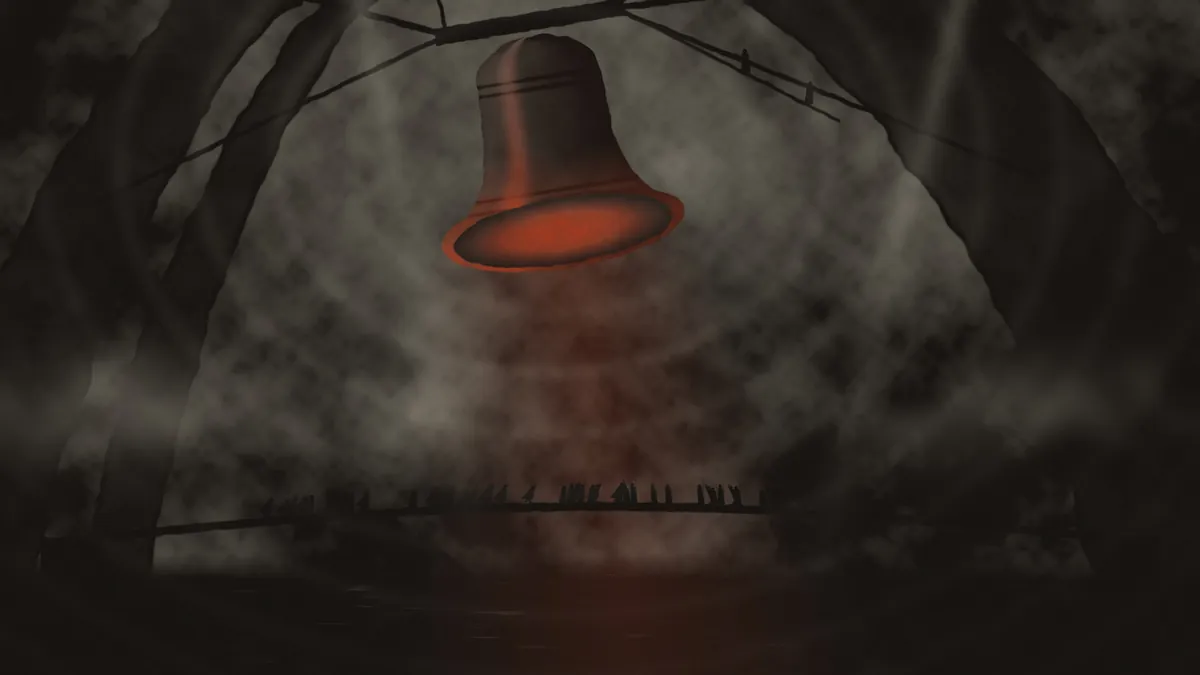
The Great Bell
The Hoist Road climbed into the mountain at a slope that a mule would have refused, and Maelin Rennick had been climbing it for an hour with her right hand on the wall.
She kept it there the way other people kept a hand on a dog. The rock under her glove was cold and dry and a little greasy with old lamp-smoke, and it ran up ahead of her in the dark, unbroken, into the heart of the cliff. She could feel the cliff through it. She could feel the weight of it, the great slow settled mass of the Kharad Wall over her head, and the shafts and chambers cut through it, and the iron. Iron ran everywhere in this mountain: bolts and cramps and the ribs of stairs, and pipes for water and for air. It sang to her faintly through her palm, a thousand small voices, none of them saying anything she wanted to hear.
"Talk to me," she muttered to the wall. "Come on. Where are you?"
"Are you talking to the rock again?" said Dace Tolliver, behind her.
"The rock's better company than you."
"The rock doesn't carry your bag." The old armorer was puffing. He had his long-handled forge hammer over one shoulder and a leather bag of Maelin's tools over the other, and his bad knee had been giving him trouble since the conduit. "Mistress Rennick, how much further is this hole?"
"Ask Anke. It's her hole."
Anke Falk walked ahead of them with a shuttered lantern, a tall, grim girl of nineteen with soot still ground into the lines of her knuckles from the Ashgate furnaces. She had brought the great bell's fittings up this road in June, on sledges, with forty men hauling. She had not smiled since Maelin met her. Maelin was trying to make her do it before the night was out, and so far had failed.
"Four hundred yards," Anke said, without turning. "Then the Founders' Door. Then the chamber."
"You see?" Maelin said to Dace. "Four hundred yards. You could do that on your hands."
"I'm sixty-three, mistress. I could do it on my back, with someone pulling."
Behind them the Hoist Road was full of men. Two hundred men in all. Rovan had chosen every one of them himself by lantern-light in the bakery yard, asking each man what he had sworn and when. Sixty were Callum Breck's highlanders. The rest were old provincial veterans of Rovan's from Karthen, free-city sappers from Lissen, and a handful of foreign-born men like Dace. Every one had sworn to a province or a city or a clan, or to nothing at all. None had ever sworn to the Undying Throne.
Except the twelve at the back. They were Anke's foundrymen from Ashgate, who knew the mountings as well as she did, and who had sworn the Seat's oath as boys because the alternative had been the mines. They walked in a file with a rope tied from wrist to wrist, at their asking. Callum's men walked beside them. Rovan had told them why in the bakery yard, in front of everyone, and the foundrymen had nodded. If the bell took them, the rope would slow them, and a clansman would knock them down.
Rovan was somewhere up ahead with Callum. Maelin could hear his voice, low, every so often, asking a question.
She stopped. Dace walked into her back.
"What?"
"Wait," Maelin said.
She had felt it through her hand. Something had changed in the rock above. It was a shift and a settling, a great weight being taken up. Somewhere ahead and high above them, iron was taking a strain.
"They're drawing the ram," she said. "Hells. What's the hour?"
"Near midnight," Anke said. She had stopped too and turned, and her face in the lantern-light had gone very white. "The first stroke is at midnight. They'll be at it now."
The great bell spoke.
Maelin had felt bells in the stone before. She had felt the ridge bell at Hallam through a frozen road, and the Merrow bell through a mill-race, and a dozen since. They came to her as a hum, a dry insistent buzzing in the rock, like a wasp in a jar.
This was nothing like that. It came down the Hoist Road out of the mountain, and through the floor, and through her hand on the wall. It was not a hum but a blow. It went up her arm and into her chest and shook every bone she owned. Her knees went from under her. She fell against the wall, and the wall was ringing, the whole mountain was ringing, from its roots to the stars. For a breath she could not tell which way was up. Dust came down off the roof of the tunnel in a soft dry rain. Men were shouting. Somebody's lantern smashed.
She got her hand off the wall. It was the hardest thing she had done in years, and it helped a little.
"Maelin!" Rovan's voice came down the slope. "Maelin, are you hurt?"
"No. Blood and iron. No." She was on her knees. Her ears were near enough no use to her now, the left gone since Ashgate and the right dulled since the wagon, and for once she was glad of it. It was the stone she could not shut out. "I'm well. It's the stone. It's loud in the stone."
Behind her, at the back of the file, the twelve foundrymen of Ashgate went down on their knees.
They did it together, all at once, as if the same hand had pushed them. They knelt on the slope of the Hoist Road in the dark, with the rope sagging between their wrists, and turned their faces up the tunnel toward the chamber. Their eyes were open. One of them, a big gray-bearded man called Jesper, was saying something in the northern tongue over and over, under his breath. Maelin needed no translation.
The clansmen around them had their clubs up. Nobody struck.
"Kneel," Anke said. Her voice was steady. "That's the first command of the rite. Everyone in the basin who is bound goes down on their knees at the first stroke, and stays there until an officer tells them something else. My father would be kneeling now, if he were here. I've seen them practice it."
"So they're harmless," said Callum Breck. He had come down the slope with Rovan, swinging his axe. "As long as nobody tells them otherwise."
"As long as no officer with a gorget gets within the sound of his voice," Anke said.
"Then we'll keep the gorgets off," said Callum, cheerfully. "Leave them, Commander. Leave them here with a few of mine. They're no use to us on their knees."
"I need them," Anke said. "There are four keys in the mountings, and each one weighs as much as a horse. I can't draw them with my hands."
"I can," said Maelin. She got up off her knees. She was shaking. "Mother of mountains. I can draw anything with my hands, give me a moment to remember where I left them."
Rovan's eyes went from the kneeling men to Anke to Maelin. Then he looked up the tunnel.
"They come," he said. "They know which key bends first, and if Anke falls they're all we have. Callum, cut the rope between them and get them up the road, carried if it must be, one man to each with a hand on his collar. If any of them moves for a weapon, knock him down. Anke, how long between strokes?"
"Ten minutes. Thirteen strokes in the rite, one at the end of each reading. At the thirteenth, the reach is fixed."
"Two hours, then." Rovan turned up the slope. "Come on."
The Founders' Door opened on the south side of the bell chamber, high up, onto a gallery cut into the rock. Maelin came out onto it and halted, because she could not help it.
The chamber was enormous. It was a great round hall cut out of the living cliff, a hundred yards across and higher than she could see, and light came down into it from shafts in the roof. Fires burned at the shaft-heads, far above, so that pillars of red light stood down through the dark. Stone ribs sprang from the walls and arched across the roof, thick as towers, and met in the middle in a great boss of black rock. And from that boss, and from the four ribs nearest it, the great bell hung.
She had seen it in Anke's drawings, cast and finished. The thing itself was another matter. It was the height of three tall men and broader than it was high. It was a dark dome of bronze that took the red light from the shafts and gave it back as a slow, dull glow. It hung from an iron yoke the size of a cottage. Four great iron hangers ran up from the yoke to the ribs, one to each, and each was pinned into its rib with an iron key and wedged. She could see the keys from here. Their heads were as big as cartwheels.
Beneath the bell, twenty feet below its lip, was the floor of the chamber. In its middle a round timber floor, forty yards across, was laid over the mouth of the old cistern. On the timber floor stood a lectern of black iron, and readers in gray with rolls, and the Seat-guard in bronze helmets, a hundred of them or more. On the far side of the chamber, to the north, a stone arch spanned a light-shaft like a bridge, and led away into the inner passages, toward the Seat.
High on the west wall was the ringers' gallery. A team of men stood there in leather aprons. From it ran the ropes to the ram, a whole tree-trunk shod with bronze, slung on chains from the ribs beside the bell. Even as Maelin looked, they began to haul it back for the second stroke.
"Who's in the gallery?" Rovan said, low, at her shoulder.
Maelin narrowed her eyes. A stout man in a fur-trimmed coat stood at the rail of the ringers' gallery, with a bronze gorget at his throat and his arms folded. She knew him. She had seen him hauled up out of the Sorrel gorge in April with a broken wrist, swearing at her in two languages, and had last seen him lifting his hat to her from a sunken lane at Callan Downs.
"Voss," she said. "Orrin Voss. The bellmaster himself."
"Good," said Rovan. "Callum. The ringers' gallery. There's a stair up to it on the west wall, by the look of it. If you can get to the ringers, the bell stops ringing, and in ten minutes it's done."
"And if I can't?" Callum asked.
"Then Maelin brings it down."
The ram swung. The second stroke came out of the bell and filled the chamber, and Maelin felt it in her teeth and her eyes and the roots of her hair. Below, the readers bowed their heads, and the eldest of them began to read again from the roll in his hands, in a high, carrying voice, name after name.
"Now," said Rovan, and they went down the gallery stair onto the chamber floor at a run.
The Seat-guard were waiting for the king, not for them. They had heard nothing over the bell. They were standing in rows on the timber floor with their axes grounded, facing the bridge-arch on the north side, where the procession should have come in. Callum's highlanders were among them before half had turned.
Maelin stayed out of the fight. She was not there to fight, and Rovan had made her promise. She went down the last flight of the gallery stair with Anke and Dace and the sappers behind her. They crossed the chamber floor along its southern edge, while the fight roared on the timbers to her left.
She saw pieces of it as she went. A highlander and a guard fell off the edge of the timber floor together, into the gap between it and the stone. Rovan cut down a reader who had snatched up a guard's axe. Callum's axe went up and came down, and a bronze helmet rolled across the timbers.
"There," Anke said. She pointed. "The south hanger. There's a ladder to the yoke."
There was. It was iron, bolted to the south rib, and it went up forty feet to the iron frame of the yoke above the bell. Maelin looked up at it. She looked at the bell, hanging there in the red light like a dead moon.
"Bloody marvelous," she said. "I'm forty-seven, child."
"I know. I'll go first," said Anke.
Maelin went first. She climbed with her gloves on. She could feel the bell through the ladder, through the rib, through every bolt, a deep slow trembling that never stopped. At the top she came out onto the yoke, a frame of iron beams as broad as a farm cart. She was standing on top of the bell. Its crown curved down away from her on every side into the dark. Below, a long way down, the fight went on on the timber floor, small and loud.
The south hanger rose from the corner of the yoke beside her, an iron bar as thick as her body, up into the rib. At the top, where it went into the stone, the key passed through it. It was a slab of iron the length of a man, driven through a slot in the rib and the eye of the hanger, and wedged tight at both ends. Its head stood out of the rock a yard above her head.
Anke came up onto the yoke beside her, breathing hard.
"Listen to me," Anke said. "You can't draw them in any order you like. Draw the south first and the bell will swing north, and the north key will take the whole weight and bend. Draw the north first and it'll swing south into the rib and crack it, and the rib will come down, and the roof with it. The lower city is under this chamber. Ten thousand people are under this chamber."
"Then which?"
"East and west first, together if you can. Then it hangs from north and south, and it can't swing far. Then south. When the south goes she'll lurch north and hang off the one key, and you'll have to hold it with everything you've got. Then north, last, and it drops straight." Anke wiped her face with the back of her wrist. "And the cistern must be empty. When it drops, it'll go through the timber floor and into the cistern. It's sixty feet deep. There are people in it."
"What people?" Maelin asked.
"People from the lower city. They came down into it this afternoon, out of the fighting. Inga's man told me. The outflow tunnel runs from the cistern down to the Lamp Market. Hundreds of them, sheltering. Women and children."
Maelin looked down past the curve of the bell, at the timber floor, at the fight. She thought of hundreds of people huddled in the dark under it, listening to the bell and the shouting overhead.
"Rovan!" she bawled. "Rovan Tal!"
It took Callum and thirty of his men to go down into the cistern, by the readers' stair at the edge of the timber floor, and drive the people out through the outflow tunnel. Maelin saw none of it. She heard it, through the iron, as a far-off clamor of voices: women shrieking, children crying, men shouting in the northern tongue and in highland speech. It went on for the length of the third reading, and the fourth.
She drew the east key while they were still clearing the cistern.
She put both hands on the iron of the east hanger, where it rose from the yoke, and she went into it.
It was always like this, at the start. It was like putting her hands into cold water and finding the water was alive. The iron was in her, and she was in the iron. She could feel it run up from the yoke through the hanger, thick and dense and strong, to the key, and through the key to the stone. She could feel the strain in it, the huge dragging weight of the bell. She could feel the bell itself under her feet, humming, full of its last stroke. And through the bell she could feel the field. It went out from the bronze into the mountain, into the stone, through the rock and the city and the basin, a vast slow pulse in everything, with every bound soul inside it beating to it. And somewhere at the far end of it, deep in the oldest stone, something turned its attention toward her hands. No bell had ever done that. This was patient, and it was interested, and it was looking. She took her hands off the iron and found she was shaking.
"What?" said Anke.
"Nothing," Maelin said. "Something old, deep in. It's not the bell." She put her hands back on the iron.
She found the key. She found where it sat in the slot, how the wedges bore on it, how the rust had grown into the joint. She pushed.
Nothing happened. She pushed harder. She put her shoulders into it, and her back, and everything she had, and she felt the iron of the key groan and shift a hair's breadth in the stone.
The ram struck the bell.
It went through the yoke, and through the hanger, and through her. She was inside the iron when it came, and it threw her out of the iron as a horse throws a rider. She found herself flat on her back on the yoke beams, staring up at the ribs. The chamber had gone soundless. Anke's mouth was moving over her, and nothing came out of it, and then the roar came back, slowly, into the one ear that was still worth anything.
"Maelin!" Anke had her by the shoulders.
"I'm well," Maelin said. "Hells. I'm well." She rolled over and spat. "Every ten minutes. Of course. Every ten bloody minutes, that whoreson Voss is going to kick me out of my own work."
"Can you do it between strokes?"
"I'll have to." Maelin got up. Her legs were trembling. "Tell me when it's nine minutes."
"I can't tell minutes. I've no glass."
"Then sing," Maelin said. "Something you know. Sing it twice, and tell me when."
Anke looked at her. Then, for the first time since Maelin had known her, the girl's mouth twitched at one corner.
"I only know foundry songs," Anke said. "They're filthy."
"Better and better," said Maelin, and put her hands on the iron.
She drew the east key on the fifth stroke, and the west on the sixth. With each one the bell shifted on the yoke, and the whole yoke swung a foot, and settled. Maelin rode it on her knees with her hands locked on the iron, and Anke sang beside her in a low, cracked voice, a song about a smelter's wife that would have made a dragoon blush.
Below, the fight had changed. Callum had tried the ringers' gallery. Maelin had seen it, between strokes, from the yoke. He had gone up the west wall stair with twenty men, and halfway up it the stair narrowed to a ledge one man wide, and Voss's ringers had a dozen crossbows at the top. Callum had come back down with eight men fewer. Now the ram went on swinging, every ten minutes, and the readers' voice went on below. They had fled the lectern, but one old man in gray had stayed, kneeling, with a roll in his hands, reading name after name in a voice that never faltered.
And the Seat-guard had come back over the bridge-arch.
They came from the inner passages to the north, a whole company of them, in bronze. Rovan met them at the near end of the arch with forty men. The arch was a single span of stone across the light-shaft, wide enough for four, with no parapet. The light from the shaft came up past it from below, red, and the men fighting on it stood against the red light like figures cut from paper. Maelin saw Rovan in the middle of the near end, with Dace beside him and his old sword going.
And on the arch, behind the guard, she saw Voss.
The bellmaster had come down from the gallery by some inner way. He stood at the far end of the arch with the bronze gorget at his throat, and he was looking past the fight, across the chamber, at the twelve foundrymen.
They were kneeling at the edge of the timber floor where the clansmen had set them down, each with a hand on his collar.
Voss shouted to them in the northern tongue. Maelin understood none of the words. She understood the rest. She saw them stand up.
They stood up all together, the twelve, and the clansmen holding their collars were thrown off like children. Jesper, the big gray-bearded one, caught up a guard's fallen axe from the timbers. His face was wet and working, and he was saying something over and over, and he ran.
He ran at the south rib, at the foot of the ladder.
"Anke!" Maelin shouted. "Below! They're coming up!"
Dace got there first. She saw him leave Rovan's side on the arch and come across the timber floor at a lumbering run, with his bad knee and his forge hammer. He met Jesper at the foot of the ladder. The foundryman swung the axe at him. Dace took it on the hammer's haft and the haft cracked, and he drove the iron head of the hammer into Jesper's belly. Jesper folded and went down. Two more came at Dace. He knocked one sprawling and the other took him round the waist, and they went down together on the timbers. The clansmen were on them a moment later, clubbing.
"Get on!" Dace bawled up at her, from the floor. He was on his hands and knees. "Get on with it, you great slattern! I'm not doing this for my health!"
Maelin got on with it.
She drew the south key on the seventh stroke, and nearly died.
It came out of the rock all at once. The rust let go, and the wedges sprang, and the key shot out of the slot. It went whirling past her head and down, end over end, and struck the timber floor below with a crash that she heard over everything. The south hanger swung free. The bell lurched.
It lurched north, the whole vast weight of it, and the yoke went with it. Maelin went down on her face on the iron beams and grabbed. Anke went sliding past her across the yoke toward the edge. Maelin caught the girl's collar with one hand and held on, and the yoke swung north, and north, and stopped. It hung there, tilted, from the single north hanger, with the bell's lip a yard out of true. The north key screamed in the rock. Dust came down from the north rib in a long pouring stream.
"Hold," Maelin said. "Hold, my lovely. Hold, damn you."
She did not know if she was talking to Anke or to the key. She put her free hand flat on the yoke and went into the iron, all the way up the north hanger to the key, and she held it. She held the key in its slot with everything she had left. She felt the rib around it trying to crack, and she held that too.
Below on the timber floor, Rovan was shouting her name.
"Is it clear?" she shouted back. "The cistern! Rovan, is it clear?"
"Callum!" Rovan roared. "Callum!"
She heard the answer from somewhere below, very faint, coming up out of the cistern mouth at the edge of the timbers. It was Callum's voice, hoarse, and laughing.
"Clear! It's clear! There was a goat!"
On the bridge-arch, the Seat-guard had pushed Rovan's men back to the near end. Maelin saw it from the yoke, over her shoulder, with her hands locked on the iron. The guards came on across the arch in a wedge, with Voss behind them. Rovan met the point of the wedge alone for a breath, his sword going, and two guards went down in front of him, and then Voss was there.
The bellmaster had a sword of his own. He was not a soldier, but he was big and he was fresh, and he came at Rovan with a long overhand cut. Rovan took it on his blade, close to the hilt, and turned it. He stepped in past it, under Voss's arm, as easily as a man stepping through a door. He put his old heavy sword into the bellmaster's side, and pulled it out, and stepped back.
Voss stood on the arch with his hand pressed to his side. He looked at Rovan. Then he sat down on the stone, quite slowly, and toppled sideways off the edge into the red light of the shaft, and was gone.
The guards behind him wavered. Rovan's men went at them.
"Now, Maelin!" Rovan shouted. "Now!"
The ram swung for the eighth stroke.
She saw it coming, from the corner of her eye. She saw the tree-trunk come down on its chains in a long arc out of the dark. She knew what it would do to her when it struck, with the bell hanging from one hanger and her hands in the iron. She thought, with great clarity, that she would not hold the key through it.
So she let the key go.
She drew it with one great heave, the last of her strength, a heartbeat before the ram reached the bell. The north key came out of the rib. The yoke dropped. The bell dropped with it, and Maelin and Anke went down with the yoke, clinging, for a sick endless instant. Then the yoke caught on the stump of the south hanger and stuck, and threw them sideways, and they fell. She landed on her back on the edge of the timber floor, and Anke on top of her.
The great bell went past them. It fell straight. It went through the timber floor as through paper, and down into the cistern, and the ram swung through the empty air where it had hung. It struck the cistern's floor sixty feet below.
The sound was enormous. It was no note at all, only a monstrous splitting crash that came up out of the cistern mouth with a gust of air and dust and splinters. Maelin felt it go through the stone under her back. She felt the bell break. She felt it in the rock as a great crack running through bronze, and a second, and the field that had filled the mountain since midnight rip and fall in on itself and go out.
The rock went quiet.
She lay on her back and looked up at the ribs and the empty boss in the middle of them, and the dust drifting in the red light of the shafts. Anke rolled off her. Somebody was cheering, far off across the chamber. Somebody else was sobbing.
On the timber floor at the cistern's edge, the twelve foundrymen were sitting up and rubbing their wrists where the rope had been. The old reader had stopped reading. He knelt where he was, by the empty lectern, with the roll open across his knees and his mouth open. He looked down at the roll as if he had never seen it before.
Maelin got up. She went across to the bridge-arch, limping. She did not look for Rovan. She looked for Dace.
He was sitting on the stone at the near end of the arch, with his back against the rock wall of the shaft. A Kharadi spear had gone into him under the ribs on the left side, low, and had been pulled out again. His leather apron was dark with it. Rovan was kneeling in front of him, holding a wad of someone's cloak against the wound with both hands, and saying nothing.
"Mistress Rennick." Dace looked up at her. His face was the color of tallow, and he was smiling. "You dropped it."
"I did."
"Good. It was making a noise." He coughed. "Commander. Don't press so hard. You'll push me through the wall."
"Be quiet, Dace," said Rovan.
"I'll be quiet presently. Plenty of time for it." The old man moved his right hand on the stone. A spearhead lay beside him, the one that had gone into him, broken from its shaft. He picked it up and held it up to the red light and looked at the edge, close, the way Maelin had seen him look at a blade in his forge a hundred times. "Northern work. Feel that edge, Commander. Better than mine. Damn them."
He put it down. Then he leaned his head back against the rock, and was gone.
Rovan stayed there on his knees in front of him with his hands on the cloak. Maelin stood behind him and put her hand on his shoulder, and felt it shaking under her glove.
Callum found them there a little later. He came over the bridge-arch from the north, with blood all down one side of his face and his axe in his hand. He was not laughing.
"Commander," he said. "Mistress. You'll want to come and see this."
"The guards?" Rovan said, without getting up.
"Most of them have thrown down their arms. Everywhere through there, all the way along. The bound ones came to themselves when the bell fell. They're sitting in the passages with their heads in their hands." Callum wiped his face. "All except one lot. Six hundred yards in. There's a last passage, with a door at the end of it, and guards in it. Forty or fifty. They're standing in their ranks with their axes up and their eyes open, and they're weeping, some of them, and they'll not move. One of my lads went up to talk to them. They nearly killed him."
A chill went through Maelin. She walked to the end of the bridge-arch, where the stone of the passage began, and stripped off her right glove, and laid her bare hand on the rock.
Silence. The great bell was gone. The mountain was quiet, as quiet as she had ever felt stone.
No. Not quite. Deep in the rock, far off to the north, at the very edge of what she could feel, there was a hum. It was faint and dry and steady, and it had no rhythm to it at all, no strike, no ten minutes. It had been there all along, she realized. The great bell had drowned it.
It did not come from any bell. It came from the place where the stone of the mountain was oldest, and it had been humming there, she thought, for five hundred years.
"Rovan," she said. "There's something else holding them."
Under her palm the hum went on, dry and patient, and there was nothing left in the mountain to drown it.