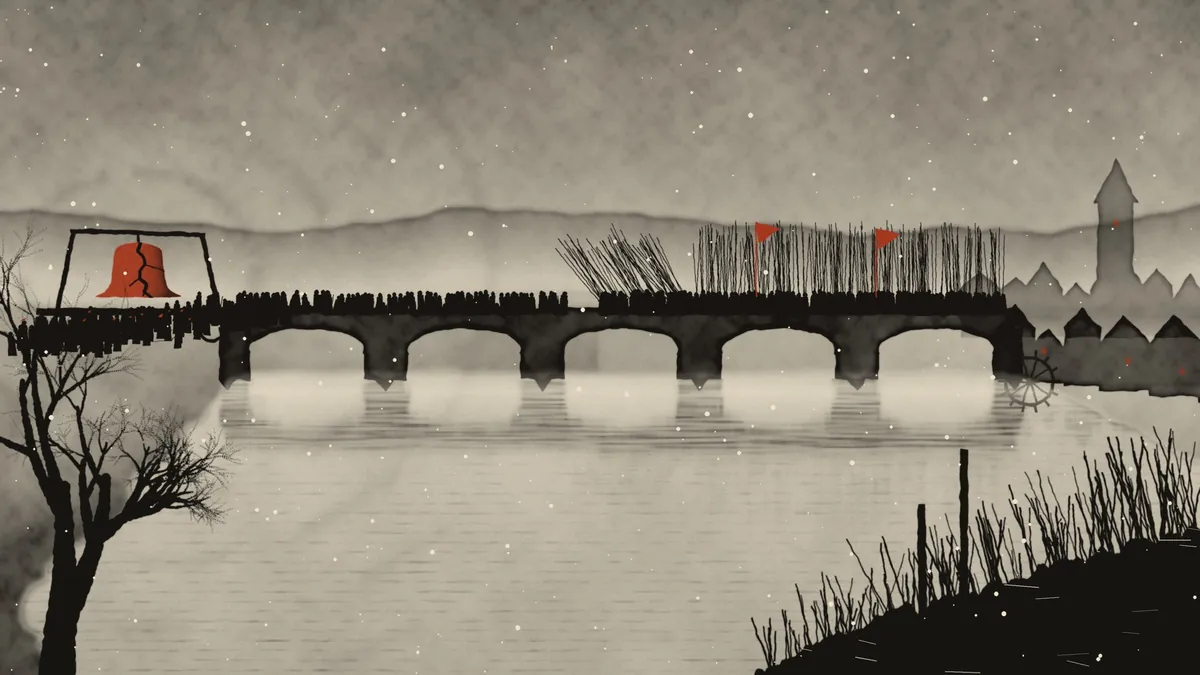
The Defense of Merrow Ford
Dunmere shut its gates on them on the second day.
Rovan had expected it. Word had gone south ahead of them on fast horses. Karthen had fallen, and Hallam, and a renegade commander was loose in the March with a rabble of deserters and a mage who broke royal causeways. The governor of the March stayed off his walls. He sent a clerk instead, who recited a proclamation over the gate in a high, shaking voice, and declared Rovan Tal and Maelin Rennick to be outside the King's peace.
"Outside the King's peace," said Maelin, sitting her horse beside him. "I've been outside it most of my life. It has better wine."
They went round the town by the river road. Cuthbert Marsh went in at the gate, because he had a wife and a militia to answer to, and Maelin let him go with a letter for the Council and her house keys. The Fenwick twins would not go. They said they had been told to stay with the Mistress, and nobody had told them otherwise, and they were not going to start listening now.
A woman came out of the postern gate as the last of the Karthen people went by below the walls. She stood on the river road in a gray cloak, with her hands clasped, and watched them pass. Rovan saw her from three hundred yards off, and knew her by the way she held her head.
He got down from his horse and walked to her. His sister Marta was forty-four, small and dark and upright, with Edran's eyes. She had heard everything the town was saying, and had come out anyway to hear it from him.
He told her. He told her about the inner gate, and the Long Passage, and the supply gate, and the voice on the other side of it. He did not tell her about Gant.
When he had finished she stood for a time looking north, up the road toward the mountains.
"He held the passage," she said. "Until the families were through."
"He held it alone at the end," Rovan said.
"Then he's alive." She looked at Rovan. Her face was dry and white and very steady. "Whatever they've done to him. He's alive, and you'll get him back. Won't you."
"Yes," said Rovan.
She nodded, and turned, and went back in through the postern. He stood on the river road and watched the little door shut behind her.
It was sixty miles from Dunmere to Merrow Ford, and it took them six days.
They came down out of the snow into the lowland rain. The roads were mud to the shin. The children were sick, and two of the old men died in the night at a barn near Holloway, and were buried there. Behind them, always a day or two days back, came the enemy. Rovan's riders saw them on the ridges: gray horsemen first, and then the long dark crawl of infantry, and among them a canvas shape on a wagon drawn by twelve horses.
"They're not hurrying," said Dace, on the fifth day. He had given in at last and was riding in one of the Hallam village carts with his knee bound up. "If they wanted us, they'd have us. What are they after?"
"The same as us," Rovan said. "Food. The pass is shut behind them. They'll have to eat the March to last the winter, and the richest market in the March is Merrow Ford."
They came to Merrow on the sixth afternoon, under a low gray sky.
Rovan had known the town for thirty years. It sat on the south bank of the Arle, which came down broad and brown from the north-west and ran away south-east toward Lissen and the sea. In summer the river was shallow enough here to wade a horse across, and that was the ford that gave the town its name. A stone bridge of five arches stood beside it. On the north bank, at the bridge-head, was a straggle of mills and breweries called the Millside, built along a stone-banked race that took water off the river at a weir upstream and fed it back below. On the south bank was the town proper: a wall in poor repair, a market square, warehouses, the guildhall, and the smell of malt over everything.
They had food. They had walls of a sort. And they had, wintering in the warehouses along the river, the Lissen Free Company.
Alderwoman Joan Tull met them in the market square with the town council behind her and a clerk at her elbow with a wax tablet. She was a thin, gray, fierce woman in a good black coat, and the first thing she did was walk along the line of carts and count the sacks.
"Eleven," she said. "And nine hundred mouths."
"Eight hundred and fifty," said Rovan. "We lost some at Hallam."
"I heard about Hallam." She looked him up and down. "I heard you're a deserter and a traitor and your mage is a madwoman, and there's an army behind you. Is the army true?"
"It's two days off. Perhaps a thousand northerners and five hundred of the Hallam garrison, and a bell."
"What in the name of mercy is a bell?" Joan Tull asked.
He gave it to them in the guildhall, in front of the council, with the rain on the windows and Maelin sitting on the end of the table with her boots on a chair. He told it short and plain, as a report, and he told them what he believed about the oath. When he had finished, nobody spoke for a while.
Then a woman at the back of the hall laughed.
She was sitting on a bench by the door with her feet up on another, and Rovan had taken her for a carter. She was short and very broad in the shoulder, in a buff coat and a pikeman's steel cap pushed back on her head. Her nose had been broken at least once and set by someone in a hurry. She might have been thirty-five.
"So," she said, "the King's soldiers turn into the enemy's soldiers when a bell rings. And the King's officer who lost the fortress has come to tell us so, and wants us to feed his people, and fight for him." She swung her feet down. "Alderwoman, you can count my company out of this until somebody shows me money."
"Captain Dorn," said Joan Tull, without turning round, "commands the Lissen Free Company. They winter here by contract. The contract says they defend the town in an emergency, for a fee." She sounded as if the word fee hurt her teeth.
"The contract says I defend your warehouses against river thieves," said Hessa Dorn. "It doesn't say a thing about northern armies. Or bells."
Rovan turned to face her.
"Captain. How many pikes do you have?"
"Six hundred and twelve, fit," she said. "Why?"
"How many do they need to hold that bridge?"
She looked at him. She had gray eyes, narrow and amused.
"Two hundred on the bridge, three hundred in the Millside, a hundred in reserve. The rest to the ford, if the river's low." She cocked her head. "Why are you asking me? You're the famous soldier."
"Because it's your bridge," Rovan said. "You've been looking at it all winter. I've been looking at it for an hour."
Something changed in her face, though it grew no warmer.
"All right, Commander," she said. "Here are my terms. I'll want them written, and signed by the Alderwoman, before a single one of my people sets foot on that bridge. Battle rate for every pike from the hour the enemy is sighted. Death money to the family of every one of mine who dies, at the Lissen scale, which is high, because we're worth it. And joint command."
Rovan raised his eyebrows and waited for the rest.
"Joint," Hessa said. "You command your people and I command mine, and neither of us orders the other's soldiers into anything. I don't serve under royal officers. I've seen what royal officers do with free-company pikes. They put them where they'd rather not put their own men, and send the family a letter." She hooked her thumbs in her belt. "That's my price. And one more thing."
"Go on."
"These men of yours who might turn when the bell rings." Her eyes went to the windows, beyond which some of Rovan's soldiers stood in the rain. "I want them nowhere near my company. Not behind me, not beside me. If one of your boys turns round and puts a spear in Tobin Reave's back, I'll take it out of your hide."
Rovan weighed her, and she let him. Maelin, on the end of the table, was smiling into her sleeve.
"Those are fair terms," he said. "Write them down."
That night Rovan sat in the guildhall with a candle and a list, and called his soldiers in one at a time.
He asked each man the same question: where he had enlisted, and what words he had sworn, and whether he had ever been sworn again. It took until two in the morning. Some of them knew the answer at once. Some had to think. A few had forgotten, and of those he asked the men who had stood beside them.
At the end he had ninety-two names.
He called them together in the market square at dawn, in the rain. They stood in three ragged ranks, and he could see in their faces that they knew why. Quin was there. So was Orley, the sergeant who had laughed on the road. So was one of the two Karthen horsemen who had come back to themselves at the Sorrel Bridge, a quiet boy named Tey.
"You know what this is," Rovan said. "Every man here swore the new oath. I believe that's why the men turned at Karthen and at Hallam. I can't prove it. But every man who turned had sworn those words, and every man who stood had not." He looked along the ranks. "When that bell rings, I think you'll turn. Through no fault of yours. And I'd have to kill you, or you'd have to kill us."
Nobody said anything. The rain came down.
"So I'm asking you to go. Not far. The south road out of the town runs over a ridge three miles off, by a farm called Ashby. I want you there, on the far side of that ridge, guarding the road behind us. That's further than we've ever seen the thing reach. If we lose, the town's people will come down that road, and you'll be what stands between them and the enemy. If we win, I'll send for you." He paused. "I'm asking. Any man who'd rather leave us altogether can go, now, with my thanks and no hard words."
Quin stepped forward.
"Sir. I'll go. We'll all go." His face was red. "But I'd rather fight. I'd rather fight than be sent away like a dog that bites."
"I know you would," Rovan said. "Lieutenant, you'd be fighting for them, if they ever got the bell close enough. That's the only reason."
Quin stood there a moment longer before he saluted and turned, and the ninety-two marched out of the south gate in the rain toward Ashby, with Orley calling the step.
Hessa Dorn had watched it from the steps of the guildhall with her arms folded and her cap tipped over her eyes. When he came back across the square she fell in beside him.
"You asked them," she said.
"They're my men."
"Hm." She walked a few steps. "I had a colonel once at Saltmere. Royal officer, from Kingsholm. He'd have sent them out with a sergeant and a list, and called it an order." She glanced up at him. "I'll show you the bridge, Commander. You'll want to see where I've put your people."
The enemy came three days later, at noon, down the north bank.
Rovan watched them from the roof of the gatehouse at the south end of the bridge, and took the measure of the ground. The Arle ran across his front from left to right, north-west to south-east, a hundred and fifty yards wide and brown with rain, too deep at the ford now for anything but a desperate man. The bridge ran straight out from under his feet across it. On the far bank, the Millside crouched at the bridge-head, its mills and malthouses packed close along the stone-banked race, with Hessa's pikes in every yard and doorway. Beyond the Millside, the north bank rose in open fields to a low crest four hundred yards off, where the Dunmere road came over it. And the race itself ran away north-west along the foot of that slope toward the weir, and passed through a stone culvert under the embankment where the Dunmere road bent up toward the crest.
The enemy came over the crest. First the gray riders, spreading out along the ridge. Then infantry, in blue, in good order, five hundred of them: the Hallam garrison, with their spears in their hands. Behind them came the Kharadi infantry, gray-cloaked and round-shielded, a thousand strong. And in the middle, on the road at the top of the crest, the wagon with the bell.
They halted it there, on the skyline, four hundred yards from the river. Rovan watched the crew swarm up on the wagon bed and pull the canvas off it. He looked for Edran among the gray riders, and found no sign of him.
"There's your bell," said Hessa, beside him. She had a pike-staff in her hand and was leaning on it. "Pretty thing."
"It'll ring soon," Rovan said.
"Then let it ring," Hessa said. "My people never swore to anything but a contract." She spat over the parapet into the river. "Plague take it, that's five hundred of your King's soldiers in the front of that. I'll be killing royal infantry for a free city's coin. There's a joke in that, if I had time."
The bell spoke.
It came down off the crest and across the fields and the river, and the bridge hummed with it under Rovan's feet. Women screamed in the town behind him. On the far bank, in the Millside, Hessa's pikemen flinched and swore and gripped their staves, and not one of them turned.
On the crest, the Hallam men came forward. They came at a walk, down the slope toward the Millside in a long, even line, as if on parade, and Rovan could see as they came closer that many of them were weeping.
The first assault hit the Millside at a quarter past noon.
Hessa had built a barricade of brewers' drays and malt sacks across the end of every lane, with the race in front of them as a ditch. Her pikes stood behind the barricades four deep. The Hallam men came down the slope and into the race up to their waists in the cold water and climbed out against the pikes. Rovan heard the shock of it from the gatehouse, the long cracking thud of a line meeting a line, and the shouting.
They were good soldiers, the Hallam men. They had been trained by royal sergeants and they fought as they had been trained, and nothing in their faces had anything to do with what their hands were doing. They came on under the pikes and over the sacks. The pikes held them, pushed them back into the race, held them again. Behind them the Kharadi infantry came down the slope at a jog, shields up, and Rovan saw what they meant to do. They would let the Hallam men wear out the pikes, and then they would come through. Up on the crest the bell spoke again, and again after it, every few minutes.
"They'll hold an hour," Hessa said. "Maybe less. Then they'll need help, and you've none to give, because if you put your free men in that crush they'll be fighting the same poor devils as mine." She looked at Rovan. "So what's your mage for?"
"She's for the bell," Rovan said.
He went down the gatehouse stair and across the bridge. Maelin was waiting in the yard of the nearest mill on the north bank, with the twenty he had chosen. They were all free men, old Dunmere articles men and Teshar-born and men from the free cities who had taken royal pay on contract. Dace was not among them, because of his knee, and had said what he thought about that at length. The miller, a frightened man named Abel Crouch, stood beside Maelin with a lantern.
"The race is half drained," Crouch said. "I shut the sluices at the weir yesterday for the ice. There's a foot of water in the culvert, maybe two. It's two hundred yards long, under the road. It comes out in the fields on the other side, past the bend."
"Behind them," Maelin said. She turned to Rovan. Her face was alight. "You're coming?"
"Captain Dorn has the bridge," Rovan said.
"Captain Dorn," said Maelin, "would have the bridge if you were standing on it in your nightshirt. I like her." She pulled on her gloves. "In we go, then."
The culvert was a tunnel of black wet stone, barely high enough for a man to walk stooped. The water in it was knee deep and so cold that Rovan lost the feeling in his feet in the first twenty yards. They went in single file, with one lantern at the front and Maelin behind it, her left hand trailing along the wall.
"It's in the stone," she said, over her shoulder. "The hum. Can you feel it? No, of course you can't. It's like a toothache in the walls." She went on a few yards. "It's getting stronger. We're getting closer to it."
Overhead, through the roof of the culvert, they heard the road: the tramp of feet and the rumble of wheels, and once the scream of a horse. Water dripped on them. Somebody behind Rovan slipped and went under and came up swearing. The lantern-light shook on the wet walls.
The far end came as a gray half-circle of daylight, with an iron grating across it. Maelin put her hand on the grating and it folded out of the arch and fell into the water with a splash.
They came out into a muddy ditch below the road embankment, below the crest, west of the road and behind the enemy's line.
Rovan put his head up over the edge of the ditch. The bell was two hundred yards off, up on the road at the top of the slope, on its wagon. Around it stood the crew, six or seven men in leather aprons, and a guard of perhaps fifty Kharadi with spears, facing the battle below. Their backs were to him. Down the slope, at the Millside, the fight roared in the lanes.
"On me," he said. "Quiet as you can till they see us. Then loud."
They went up the slope at a run.
The guard turned when they were thirty yards off. A man shouted. Spears came round. Rovan hit the line with his old sword in both hands and the twenty behind him, and for a breath the Kharadi gave, because they had been looking the other way. He cut a man down. He caught a spear-thrust on his blade, slid it wide, and drove in under the shield. Beside him a Dunmere man named Burl went down with a spear through the thigh, and the Kharadi closed again.
Maelin went past him.
She went straight at the wagon through the guard with her fists up. A spearman stabbed at her and she caught the head in her glove and crushed it. A man swung a sword at her head and she took it on her forearm and the plates in her coat sleeve rang and the blade broke, and she was at the wagon. She put both hands flat on the iron tire of the near wheel.
The wheel burst. Its iron tire snapped and sprang loose and its spokes went to splinters. The axle broke with a crack, and the far wheel went too, and the whole wagon dropped onto its bed in the mud. The bell lurched in its frame. Ropes snapped. With a long, groaning, metallic roar it tore out of its timbers and fell, and rolled over onto its side in the mud of the road, and lay there.
The crew were thrown everywhere. The Kharadi guard reeled back. Rovan's twenty went in among them.
And down the slope, at the Millside, the Hallam men went on fighting.
Rovan saw it as he fought: the blue line still pressing at the barricades, unbroken, untouched. He killed a Kharadi spearman, and looked again. Nothing had changed.
"Maelin!"
She was on her knees in the mud by the fallen bell, with one glove pressed to the road. Her face was gray.
"It's still there," she said. "The hum. It's still in the ground." She looked at the wreck of the wagon, and at the great bronze shape lying in the mud beside it. "Blood and iron. It's not the cart. It's not the cart, Rovan. It's the thing itself."
One of the bell crew was crawling toward the bell with a hammer. Rovan killed him. Two more of the guard came at him over the wreck, and he took them both on his blade, giving ground, and Burl's brother Joss came up on his left and took one of them off him.
Maelin put both hands on the bell.
Maelin knelt in the mud with her arms spread wide against the bronze, holding the bell in an embrace, and her lips were moving.
Bronze was not iron. He knew that much about her art. It was harder to hear, she had told him once, years ago, and it fought back. Her shoulders went rigid. Blood started from her nose again and ran down her chin. The bell's surface under her gloves began to smoke in the rain.
The crown went first. That was the thick top of the bell where the iron mountings were cast into it, the loops it had hung by. There was a sound like a frozen branch breaking. A crack ran across the crown and down into the shoulder, and one of the iron loops sprang out of the bronze and fell clattering.
Maelin made a sound in her throat and pressed again.
The bell split. It split from crown to lip, with a noise that was not a note at all but a hideous, jarring clang that went through Rovan's teeth and the soles of his feet. It fell apart into two great curved pieces, and rocked, and lay still in the mud.
The hum stopped. Rovan could not feel it. But Maelin's head came up as it stopped, and he looked down the slope.
At the barricades of the Millside, five hundred men of the Hallam garrison stopped fighting in the middle of a stroke.
They stopped all together, in the race and on the sacks and in the lanes, with their swords raised and their spears thrust out, and the raised swords shook, and nobody struck. They looked at the pikes in front of them, and the dead in the water, and the gray-cloaked Kharadi behind them on the slope.
Then they turned.
A great roar went up from the Hallam men, a sound of rage that came up the slope to Rovan like a wave. Half of them turned on the Kharadi behind them with whatever they had in their hands. They went up the slope into the gray shields, swords and spears and fists, with nothing in their minds but murder. The Kharadi line, caught between them and the pikes, staggered and broke. Hessa's pikes came out over the barricades at a run, and the whole slope dissolved into a running fight.
And some of the Hallam men never turned. Rovan saw them as the fight swept past: men who sat down where they stood in the mud of the race, and put their faces in their hands, and did not move again.
The Kharadi drew off north over the crest at a run, and their riders covered them, and they were gone.
Rovan found Maelin lying on her back in the mud by the broken bell, with her eyes open, looking at the rain.
"Are you hurt?"
"I am beyond hurt," she said. "I am in a different country. I may never come back from it." She lifted one hand and looked at it. The glove was scorched black and the iron on it had buckled. "Did it work?"
"It worked," Rovan said.
"Good." She shut her eyes. "Then somebody bring me a drink and a very large bed, and I'll explain it to you all tomorrow."
He left her with Joss and the Fenwick twins, and walked down the slope through the battlefield toward the river. It was getting dark. The rain had eased to a drizzle. All over the slope men were moving about with lanterns: Hessa's pikes, Karthen men, the townspeople with stretchers. And the Hallam men. Some of them were helping. Some were still sitting in the mud, wrapped in their own arms, rocking.
A sergeant of the Hallam garrison stood by the race with a broken spear in his hand, staring at nothing. He was a heavy man of about forty, with gray in his beard and a cut across his scalp. When Rovan came past, he looked round.
"Sir," he said. "You're Commander Tal. From Karthen."
"Yes."
"I'm Sergeant Wace. Hallam Keep." His voice was hoarse. "I've been in it eleven days, sir. Since the ridge. I've done things in those eleven days." He stopped. "I knew what I was doing. Every minute. My hands wouldn't take orders from me. Then it just let go." He looked at the broken spear in his hand. "The men I put down at the race, sir. In the water. Hallam men, two of them, that wouldn't get out of my way. Are they on your list or the Marshal's?"
Rovan looked north, up the slope, at the crest where the bell lay broken in the mud and the last of the light was going out of the sky. Beyond it, beyond the March and the snows of the Ironbacks, there were more bells. He had seen two. He would not believe there were only two.
"Mine, Sergeant," he said. "Go and sit down."
Wace looked at him a moment longer, and nodded slowly, and let the spear fall.
Footsteps came squelching up behind him, and Hessa Dorn stopped at his elbow. She had a cut on her cheek, and her buff coat was black with water to the chest, and she looked tired and pleased with herself. She held out a folded paper.
"What's this?" Rovan said.
"My bill," said Hessa. "For the day."