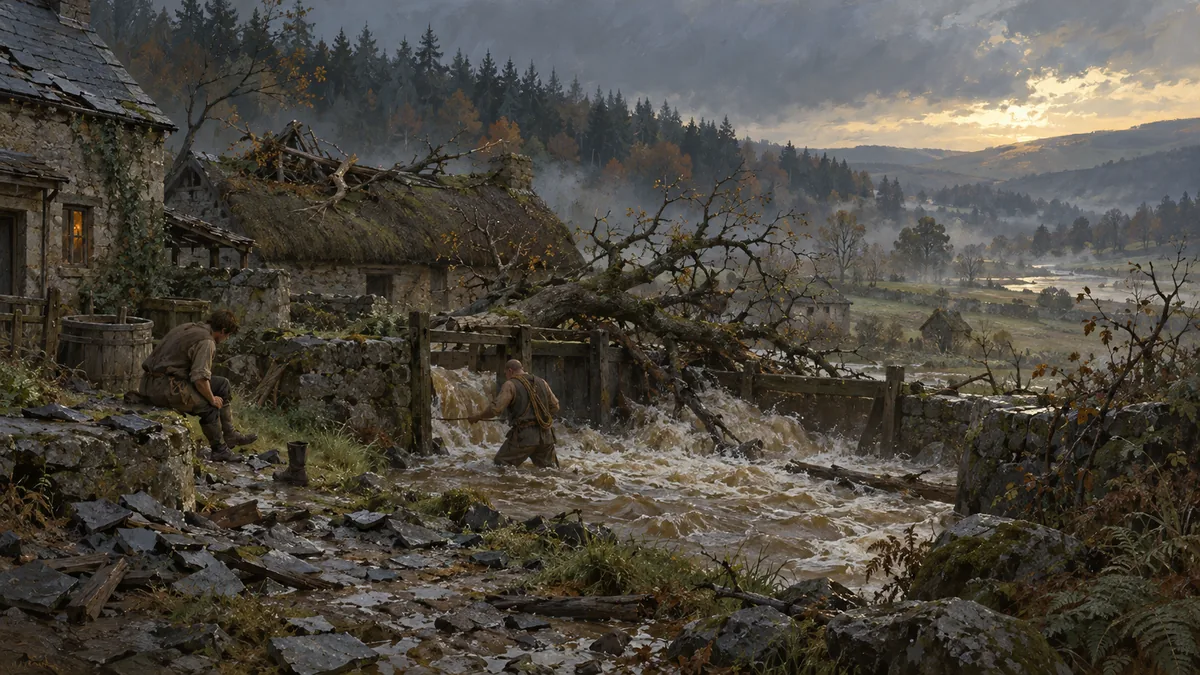
After the Storm
Lio woke because the mill was wrong.
For twenty-two years he had gone to sleep to the sound of the Thornby wheel, a slow wooden knock that came up the millstream and through the wall of the house like a second heartbeat. Most nights it was part of him, like his breathing. But he heard it now, in the dark before dawn, because it had changed. The knock came, and then a long pause, and then a scrape like a boot dragged on stone, and then nothing at all.
He lay and listened. The wind had dropped. All night it had come out of the west over the Great Wood and thrown itself at the house, and twice he had heard slates go off the roof and smash in the yard. Now there was only rain dripping from the eaves and, under it, the river. The Lenn was loud. In an ordinary October it ran so quietly below Thornby that you could hear a trout rise. This morning it roared.
Lio got up, found his boots by feel, and went down.
The kitchen was cold and the fire was ash. His father's coat was gone from its peg, and the back door stood open on a gray square of morning. Lio took the lantern from the shelf, thought better of it, and went out without it. There was light enough coming.
The yard was a ruin. Slates lay in pieces across the cobbles, and a branch of the old pear tree had come down across the dairy roof and taken half the thatch from the cart shed with it. Water stood everywhere. Across the yard, in Edda's cottage, a candle was burning in the window among the geraniums. Lio looked at it for a moment, decided his grandmother was up and therefore well, and went on around the house to the millstream.
His father was already in the water.
Owen Ashby, big-shouldered and bareheaded, stood thigh-deep in the millrace a little above the sluice gate, with a rope over one shoulder and his hands on the trunk of a fallen alder. The tree had come down from the bank in the night and lay across the race at an angle, its roots still clutching a slab of earth. Its crown had jammed against the sluice. Every leaf and stick and drowned thing the storm had sent down the stream had piled up behind it, and the water had nowhere to go but over the top. Below the gate the race ran half empty, and down at the mill the wheel turned a quarter of the way, caught, and hung.
The race turned the Ashby saw-pit wheel above and the miller's wheel below. Owen kept race and wheel in repair for the miller, for a sack of flour every quarter and the right to grumble, and after a storm he was always first in the water.
"Morning," Owen said, without turning round.
"How long have you been in there?"
"Not long."
His father's lips were blue. Lio sat on the bank, pulled his boots off again, shoved his sleeves up past the old forge burn on his left forearm, and slid down into the race. The cold went up through him so fast that he swore before he could stop himself. Owen grunted, which meant he agreed.
"She'll not shift by hand," Owen said. "Rope round the trunk, above the fork. Captain in harness on the other end."
"Where's Captain?"
"Paddock."
Lio waded to the fork. The water pushed at his thighs and found every gap in his clothes. Under his feet the bed of the race was soft with new silt, and something hard rolled away from his heel that might have been a stone or might have been somebody's lost bucket. He took the rope from his father and passed it twice round the trunk, above the fork where the bark was sound. He tied it off with the hitch Owen had taught both his sons before they could read.
"Taren's still abed," Lio said.
"Your brother went down to look at the river an hour ago."
"Of course he did."
His father almost smiled. He waded to the bank, coiled the slack, and climbed out with the water pouring off him. Lio stayed in the race with his hands on the alder. Through the bark he could feel the whole weight of the stream leaning on it, patient and enormous, the way it had leaned all night.
Owen came back leading Captain. The old gelding was twenty years old, gray from muzzle to tail, and had pulled timber out of the Great Wood for most of them. He looked at the race, at Lio standing in it, and at the rope, and sighed through his nose as if he had seen this sort of thing before and thought it beneath him.
"Ready," Owen said.
Lio took a fresh grip on the rope. "Go on, then."
Owen spoke to the horse. Captain leaned into the collar. The rope came up out of the water, dripping, and sang. For a moment nothing moved at all. Then the roots of the alder gave with a noise like canvas tearing, the trunk swung, and Lio threw his weight against it to keep the crown from fouling the gate. The tree rolled over in the race, slow as a sleeper. The piled water behind it found its way, and came.
It knocked him flat. He went under in a rush of brown cold and leaves and came up with his mouth full of silt and his father's hand fisted in his collar, hauling him to the bank. They lay there together in the wet grass, the two of them, breathing like bellows, while the alder went bumping away downstream and the race filled behind it, bank to bank.
Down at the mill the wheel turned, caught, and turned again. Then it found its stride. The knock came up the millstream, slow and wooden, with the small hitch in every turn where the miller's split paddle came round. Owen had been meaning to mend that paddle for him for two years.
Lio lay on his back and listened to it.
"There," his father said.
By the time they had changed and come back into the kitchen, the fire was lit and the room smelled of bacon. Lio's mother, dark-eyed and quick, stood at the range with her sleeves rolled to the elbow. She took one look at the two of them, wet-haired and shaking, and went to fetch the towels warming on the rail.
"You'll have taken cold," Bet Ashby said, and dropped a towel over each of their heads as though they were both still ten.
"I'm warm," Lio said.
"You're blue. Sit by the fire. Not there, that's your grandmother's chair. Where's your brother?"
"Looking at the river," Owen said.
"Is he." She turned the bacon, and the corner of her mouth went up. "With the dairy roof in. Well. It's been a big night for rivers."
She pointed the fork at her younger son. "Lio, go across and fetch your grandmother, would you? And give her your arm over those slates. She'll tell you she doesn't need it. Give it to her anyway."
Lio went back out into the yard. The sky was lightening now from the east, behind the valley, and the clouds were tearing open over the hills in long pale rents. Westward, over the roofs of Thornby and the first slope of trees beyond them, the Great Wood still lay under the dark. Lio had looked at that view every morning since he was tall enough to see over the sill. This morning he kept his eyes on the slates.
His grandmother's blue door opened before he reached it. Edda Ashby stood on the step in her good shawl and her worst boots, holding a candle she had forgotten to blow out.
"I can walk across my own yard," she said.
"Mother says you can't."
"Your mother is a tyrant." She gave him the candle and took his arm. "How bad is it?"
"A limb of the old pear is down on the dairy roof. The cart shed lost its thatch. Father and I got the alder out of the race."
"I heard the wheel stop." She was small and light, and she held his arm with more strength than she would admit she needed. "I lay there thinking, if that wheel doesn't start again by sunrise, I'll have to go and shout at somebody. And then it started." She squeezed his elbow. "Who went in the water?"
"Both of us."
"Fools. Good fools, but fools." She stepped carefully round a broken slate. "Your grandfather would have stood on the bank and told you how to do it."
"He'd have been right."
"He usually was. It made him very hard to live with."
In the kitchen Bet came and took Edda's other arm, and between them they got her into her chair by the fire, with a cushion behind her back and a cup of tea in her hands. Edda allowed it. She allowed most things that were done out of love, with an air of royal patience. Owen sat at the head of the table eating bacon in silence. Lio sat beside him and ate faster.
Edda hummed while she drank. She had always hummed. There was one tune in particular she came back to, a walking tune with a lilt in it. She had hummed it over bread dough and sick children and the mending basket for as long as Lio could remember. None of them knew where it came from. When he was small he had asked her, and she had laughed and said she must have been born with it, because she had never learned it from anyone.
The back door banged open, and Taren came in with the morning on him.
He was soaked to the knees and filthy to the elbows, and his dark hair was plastered to his forehead. He was grinning. Taren grinned at storms the way other men grinned at dances.
"You should see the river," he said. "It's over the Long Meadow. Right over it. There's a hen-house in the middle of it with the hens still sitting on the roof. Somebody's whole hay-rick went past the ford, all in one piece, like a boat."
"Shut that door," Bet said.
Taren shut it with his heel and came to the table. He took a rasher from Lio's plate with two fingers and ate it standing.
"That was mine," Lio said.
"You were too slow." Taren bent and kissed his grandmother's cheek, dripping on her shawl. "Morning, Gran. Did the storm frighten you?"
"Nothing frightens me," Edda said. "Get off, you're wet."
"Lio went swimming," Owen said.
Taren looked at his brother properly for the first time and saw his hair. "In the race? Without me?"
"You were looking at hens," Lio said.
"I was looking at the end of the world. You were looking at an alder." Taren dropped into the chair across from him and pulled the bread toward himself. "If the felled beech stacked above the charcoal clearing has gone over, somebody should go up and look, before the Pennock boys from the orchard over the bridge start helping themselves to our timber."
"Somebody," Lio said.
"Me. Unless you'd like to."
"I'd like to mend Father's bridge, which has lost a rail. After that I'd like to sit down."
"There you are, then. You stay and mend things, and I'll go and see things." Taren tore the bread. "It's what we're each good at."
"You'll go looking for trouble," Lio said, "and find it, and come back at dark with half the forest on you and a story about it."
"That's a very good plan. Better than any you've had. Yours never get past shouting distance of the mill."
"There's plenty within shouting distance of the mill."
"Name me one thing."
"The mill."
Taren threw a crust at him. Lio threw it back and caught him on the ear, and Taren reached for something larger.
Bet put a basket in his hand.
"Eggs," she said. "From the hen-house. If the fox hasn't had them in the night, bring them in, and if he has, tell me, and I'll go and kill him." She turned to Lio and put the milk pails into his hands. "And you can carry those to the dairy, and if that pear branch has come through the dairy roof onto my cheeses, you can carry the branch as well."
The brothers looked at each other over the basket and the pails. Taren began to laugh. Lio held out a moment longer, then began too. Across the room their father bent his head over his plate, and in her chair by the fire their grandmother hummed her tune and smiled into her cup.
Taren went up the timber track at eight, with a billhook through his belt and an apple in each pocket. Lio watched him go from the dairy roof, where he was cutting the pear branch into lengths with his father's bow-saw. His brother walked fast, as he always did, as if the road had promised him something and he meant to hold it to its word. At the top of the lane he turned, saw Lio watching, and lifted an arm. Then the trees took him, and Lio went back to sawing.
The morning passed in work. He cleared the dairy roof and found the cheeses unhurt, and his mother kissed him for it, which was rare enough to be worth the splinters. He and Owen pulled the ruined thatch off the cart shed and stacked what could be saved. Then they took tools and a length of seasoned oak down the path behind the house to the bridge.
Owen had built it the year Lio was born: a footbridge of heavy timber across the millstream, wide enough for a laden barrow. Every hand in the family had worn its rails smooth. On the far bank the path ran on through the Pennock orchard and out onto the valley road, and a short walk down the road the Lenn crossed it at the ford. Lio had gone over those planks most mornings since he could walk. He knew the knot in the third plank that his foot always found. He knew the place on the left-hand rail where Taren had carved his initials at the age of nine and been beaten for it.
The storm had taken the right-hand rail clean off. Something big had come down the millstream in the night and struck it, and gone on.
Owen ran his palm along the broken stub of the post and said nothing.
They worked through the middle of the morning. Lio cut the new post and squared it, and Owen fitted it, and they spoke perhaps a dozen words between them, all of them about the work. Lio liked that silence better than any talk: two men who knew what came next and left it at that. Over the bridge, the Pennock orchard dripped. The trees were nearly bare, and the ground beneath them was littered with windfalls, brown and split and sweet-smelling. Up the big russet apple tree by the far hedge, old Ambrose Pennock's granddaughter Rose, who was ten and feared nothing, was shaking the last apples down into the wet grass, her red kerchief bobbing among the branches. Ambrose was shouting at her to come down. Rose climbed higher. Old Ambrose, bent and bandy-legged, gave it up and came over to stare at the river instead, and stayed to tell them about the great flood of his boyhood, which had been larger in every respect than this one. Owen let him talk, and set the rail.
The sun came out at noon. The light lay on the wet fields, flat and gold, and the whole valley steamed.
They were packing the tools when Lio heard someone running.
Not walking fast. Running, as a man runs when he has run a long way and means to go on, heavy-footed and loud, down the timber track behind the house. Lio stood up. His father stood up beside him. A moment later Taren came round the corner of the cart shed at full tilt, slipped on a slate and caught himself on the pump. He stood there gasping, with his hair full of beech leaves and his face white and wild.
"What is it?" Owen said. "Who's hurt?"
"Nobody's hurt." Taren doubled over and dragged in air. "It's not that. There's a ship."
"A what?"
"A ship." Taren straightened. He was laughing, or nearly. "In the forest. Above the charcoal clearing, by the timber track. There's a ship in the trees."
They went up at four, the three of them, with an axe and a coil of rope and a lantern for coming down. Bet would not let Edda come. Edda gave in at once, which was so unusual that Lio stopped in the yard and looked back. She was standing in the door of her cottage with her shawl clutched at her throat, watching the trees.
The timber track climbed west out of Thornby into the Margin, as the valley called the near edge of the Great Wood. Lio had walked it a thousand times. It ran up past the Pennocks' top pasture, crossed the shoulder of the hill, and went on into the forest between banks of bracken and holly, deep-rutted from a hundred years of timber carts. This was the working edge of the Great Wood, and to Lio it had always been as homely as a barn. Here the charcoal burners kept their camps in summer. Here the village pigs were turned out for acorns in the autumn, and the trappers had their huts, and every path had a name. The deep forest, the forest the old songs were about, lay days farther in. This part was only woodland.
The storm had changed it. Trees lay across the track every hundred yards, and the brothers had to scramble over them or cut round. Once Owen stopped to look at a great beech tree torn out by the roots and shook his head. The ground was sodden, and every ditch was running. The light came down through the broken canopy in shafts, and under it no bird sang.
They passed the charcoal clearing with its cold mounds and its stacked turf. Above it the track forked. The right-hand way went on to the felled beech stacks, and Lio could see from here that the nearest stack had gone over and spilled logs down the slope. Taren walked straight past it and took the left.
"This goes nowhere," Lio said.
"It goes somewhere now."
The left-hand path was a trappers' path, barely a path at all, that ran along the side of a shallow valley and petered out in a stand of old beech trees. In summer there was a dry gully at the bottom of that valley. Lio had walked it with a bow, after pigeons. Ferns and moss grew in it, and the bones of a fallen oak lay along it, and it had never in his life held water.
It held water now.
He heard it before he saw it. The flood runoff was everywhere around them in the ditches and the rills, hurried and muddy. This was deeper and steadier, a clean voice of water, the voice of a stream that had been running a long time and knew its way. They came round a holly thicket, and there it was below them. A stream ten feet wide ran clear and quick over clean gravel, between banks of moss where there had never been banks before.
Lio stopped.
"I know," said Taren, beside him, quietly. "I know. Look which way it's going."
Lio looked. Every water in the Margin ran east. That was the oldest fact of his country, older than the mill, older than Thornby. The springs rose in the high wood and ran down out of the trees, and all of them found their way at last to the Lenn, because the Lenn was at the bottom of everything. A child in Thornby knew that if you were lost in the wood, you followed water downhill, and it would bring you out at the river and home.
This stream ran west. It came out of the beech trees from the east, from the direction of the valley and the village. It went away from them uphill, deeper into the forest, as if it were sliding down a slope that wasn't there.
"That's not right," Owen said. He had not spoken since the charcoal clearing.
"Wait," said Taren. "Wait till you see."
They went down the bank. The ground was soft and the moss gave under their boots and oozed. At the bottom, the stream ran past them, cold enough that Lio could feel the cold on his face from a yard away. A smell came off it that he had never met before, sharp and clean, a little like the brine-tub in his mother's dairy and a little like nothing at all. It caught at the back of his throat.
Taren led them upstream, along the bank, through the beeches. Twenty yards on, he stopped and stood aside, and Lio saw the ship.
It lay among the beech trees above the water, tilted up the bank with its nose in the air. It had run itself aground on the slope, nose first, and broken. What lay there was the front of a ship, the bow and perhaps a third of the hull, broken off clean behind. It was huge.
Lio had seen river barges down the valley at Wexley, and the ferry, and the big flat-bottomed boats that carried grain down the Lenn in good years. This was nothing like them. Its timbers were as thick as his body. Its sides rose steep and curved from a keel like the edge of an axe, and its planking was black and sea-worn, furred with green weed that hung in ropes and dripped. The broken end gaped open, ribs and shadows and torn wood, and inside it Lio could see a deck, and below the deck a darkness that smelled of salt and rot and tar.
He walked toward it without deciding to.
Near the waterline the hull was crusted with shells. They were small and white and sharp, packed tight together, hundreds of them, and they would not come away when he pushed at them with his thumb. Higher up, in the seams between the planks, there was a white rime that he took at first for frost. He touched it and licked his finger. It was salt.
"Barnacles," Taren said, behind him. "That's what those are. I've heard the Wexley bargemen talk about them. They grow on ships that sail the sea, and nowhere else."
"The sea's three hundred miles east, if there's one at all," Owen said.
"I know, Father."
"Then how does a sea-ship come here?" Owen's voice was very quiet.
Taren turned to Lio, and Lio watched the stream.
Lio walked slowly round the bow. On the far side the beech trees stood close around the wreck, and two of them were split and splintered where it had struck them. The splinters all leaned one way. Whatever had brought this thing here had come down out of the west in the night, out of the deep wood, in flood, and driven it in among the trees until it jammed and broke.
The stream at his feet ran the other way. It slid past the broken bow, quick and clear and cold, and went on uphill into the west, as if it were going home.
He put his hand on the hull and felt the cold of the wood.
"Lio," said Taren. "Come and look at this."
His brother was standing at the very front of the ship, below the prow, where the hull rose to a point high above their heads. The bow was carved. Lio had not seen it at first, because the weed hung over it. Taren had pulled the weed away, and now the carving showed: a broad panel of dark wood set into the stem, worked in deep relief. The carving was sharp, almost new, though the stem it was set in was black with age.
A heron stood on one leg with its neck drawn back and its long bill pointing down, the way herons stood in the shallows of the Lenn in the early morning. Around it, framing it, a ring of waves ran in an unbroken circle, each wave curling over into the next. The work was fine. Lio, who had held a carving knife since he was six, could see that whoever had made it had loved the bird. He could see the separate feathers on the folded wings.
"Have you ever seen anything like that?" said Taren.
"No."
"Nor me. There's not a carver in the valley could do that. Not in Wexley either." Taren reached up and ran his fingers along the curl of a wave. "Feel the edges, Lio. The ship's black with age, and this might have been cut last spring. The sea's been at everything but the bird." His face was full of light. "Father. Can we take it?"
Owen looked at the carving until the light began to go out of the gully.
"It's split already," he said at last, and laid his thumb along the grain. "Lio. Bring the axe."
They came down in the dark, with the lantern swinging and the carving wrapped in Owen's coat and carried between the two brothers. The thing was heavier than it looked. The panel had come away from the stem in one piece with a few strokes along the old split, as Owen had said it would. Now it hung between them like a door they were carrying home.
The lights of Thornby came up through the trees. Lio smelled woodsmoke and wet leaves and, faintly, the sweet rot of the windfalls in the Pennock orchard. Below the last trees the mill was knocking, slow and steady. He had not known until he heard it that he had been waiting for that sound.
They carried the carving into the kitchen and laid it on the table, on the coat, and unwrapped it.
Bet came and looked at it with her hands on her hips. Then she took the lamp from the shelf and held it close. Lio saw her mouth tighten, as it did at a calf born wrong. Then she said, "Well," and went to put the kettle on.
Lio sat down. He was tired in his legs and his back and his arms, and there was a scratch on his cheek from some holly in the dark. His father was standing by the range with his back to the room. Taren was walking round and round the table, talking. He talked about the stream and the barnacles and the salt, and about the deck he had seen inside the broken hull, with steps that went down into the dark. He wanted to go back with lanterns and look. He wanted to send to Wexley for the bargemen. He wanted to know who had made the carving, and where, and how long ago, and why a heron.
"Hush," said Edda.
She had come in without a sound. She stood in the doorway from the yard with her shawl over her head, wet with the night, looking past Taren at the table. She was looking at the carving.
Taren stopped talking. Edda came forward slowly, with small careful steps. Lio got up to take her arm, and she walked past his hand. She came to the table and stood over the carving and looked down at the heron in its ring of waves. In the lamplight her face was one Lio did not know, the face of someone listening very hard to a voice in the next room.
She put out her hand and laid it flat on the heron's back.
"Gran?" said Taren.
Her fingers moved on the wood. They followed the curve of the bird's neck, the long bill, and went on to the waves and traced them round, one into the next, all the way to where they began. Her lips were moving. Lio leaned closer, and heard that she was humming, so softly it was hardly a sound at all, the old walking tune that she had hummed all his life.
Then the humming stopped.
"Sarne," Edda said.
Lio had never heard the word. No town in the valley had that name, no village, no river or hill or farm. He looked at his father, and at his mother by the kettle, and at Taren. All three of them looked back at him with the same blank face, and he knew that none of them had heard it either.
"Gran," Taren said gently. "What's Sarne?"
Edda did not answer him. She was still looking down at the carving. Her hand lay on the heron. When her voice came it was very small and very clear, a child's voice in an old woman's throat.
"There's the sea," she said. "There's the sea at the end of the forest."