The Ferryman at Wexley
His father put the compass in his hand at first light.
They were standing in the yard by the pump, with Captain saddled and the mist lying on the roofs. Owen had been up before Lio. He had been up, Lio thought, all night. He held the compass out on his palm, shut, and when Lio was slow to take it, he pushed it gently against his son's chest until Lio's fingers closed on it.
"You ask him," Owen said.
"You know him better than I do."
"I knew him." Owen looked down the yard toward the lane. "He'll talk to you sooner."
Lio put the compass in the inside pocket of his coat, over his heart, and buttoned it. He had the scrap of writing there too, wrapped in a fold of the oilcloth, and in his trouser pocket, where it weighed against his leg, Taren's knife. He had picked it up off the table the night before. His father had watched him do it and gone on lacing his boots.
"Go careful," his mother said from the door.
"It's six miles to Wexley, Mother."
She stood in the door with her apron bunched in her fists and watched him all the way to the lane.
The valley road crossed the Lenn at Thornby ford, under Joss Hobb's window, and ran south down the east bank to Wexley. Lio had ridden it since he was big enough to sit a pony. Beyond the ford it bent away from the river through the low farms of the parish, where the sheep were in close to the steadings for lambing. The first lambs were out, and they stood in the wet fields on legs too long for them and looked at Captain with enormous outrage, and Captain ignored them.
It had rained in the night and cleared, and the hedges dripped. The Lenn ran beside the road, brown and full and fast, carrying branches, and the light came off it in pieces. Away to the right, across the river and the farms beyond it, the Great Wood went south with him all the way, a long dark wall at the top of the fields. Lio kept his eyes on the road. Every few minutes he found he had put his hand on his coat, over the compass, and took it away.
He came into Wexley a little before noon, on market day. The town was built on a rise above a bend in the river, and it was all noise: carts and drovers, pens of sheep in the square, dogs, a man selling hot pies out of a tray round his neck and shouting about them, women arguing over cheese. The hall of Arlen Crane, the Wexley reeve, stood on the far side of the market cross with its stone steps and its iron-bound door. Crane's father had once fired the heath above the town against wolves. Lio rode past the hall without a glance.
Joss Hobb's cart stood by the cheese stalls with his old mare asleep in the shafts. Joss kept the cottage at the Thornby ford and carried for half the parish, and he took the cold pipe out of his mouth as Lio went by.
"He'll turn up, your brother," he called. "He always came through my ford wet to the knees, and he always turned up."
Lio lifted a hand to him and rode on. He went down through the town, under the arches of the stone bridge, along the river path to where the Lenn widened below the last houses and ran broad and slow and brown.
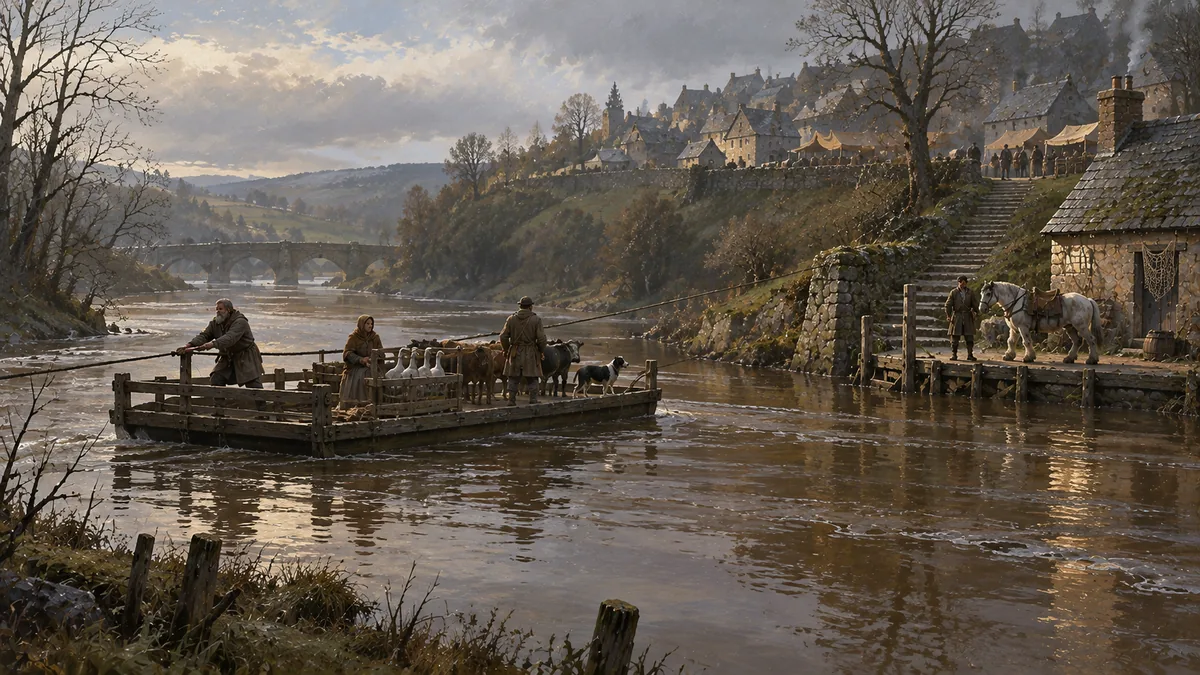
The ferry crossed there, where the river was too wide for any bridge Wexley could afford, and the drove road to the west-bank farms went over on a flat-bottomed boat the size of a barn floor, hauled across on a rope. At the top of the bank a flight of stone stairs went down to the landing stage, worn hollow in the middle. Beside the stairs stood a cottage with a net drying on its wall and smoke coming out of its chimney.
The ferry was halfway across, coming back. A man stood in the middle of it, hauling. He took the rope hand over hand, leaning his weight back into each pull, and the boat came on toward Lio through the brown water at the pace of a man who had done this ten thousand times. It carried two passengers, a woman with a crate of geese and a drover with a dog. The man hauling had his back to them. He was not tall, and he was lean, and the hair under his cap was gray.
Lio led Captain down the stairs and waited at the landing.
The ferry grounded against the stage with a soft knock. The ferryman made the rope fast, and the drover and the dog went ashore, and the woman with the geese stayed where she was, because she was going over. Then the ferryman turned round.
He had a narrow face, brown and weathered and creased deep at the eyes, and a short gray beard. His eyes were light gray, very clear, and they went over Lio and the horse, quietly, from head to foot. Lio had the feeling of being looked at by someone who had seen a great many things come down the river and was in no hurry to decide about this one.
"Penny for you," the ferryman said. "Penny for the horse."
"I'm Lio Ashby," said Lio. "Owen's son."
"I know who you are. You've got his shoulders." The ferryman held out his hand for the pennies. "Kit told me about your brother. I'm sorry for it."
"I've something to show you."
"Bring the horse on, then. We'll talk over."
Lio led Captain onto the boat. The old horse had been over on the Wexley ferry before, and he planted his feet and sighed and resigned himself to it. The ferryman cast off, took up the rope and leaned on it, and the ferry slid off the landing stage into the current, and the town fell away behind them.
The woman with the geese looked at Lio with interest. "You're the Ashby boy," she said. "Your brother found the ship."
"Yes."
"Is it true there's a dragon carved on it?"
"A heron," said Lio.
"Oh," said the woman, disappointed, and turned back to her geese.
They were in the middle of the river. The water went past them on both sides, wide and brown and quiet, with the rope dripping as it came up out of it and went down again behind. Lio unbuttoned his coat and took out the compass and held it out on his hand.
The ferryman looked at it without breaking his stroke. He took one more pull on the rope, and another, and his hands stopped and stayed there.
The ferry slowed. The current took it, swung it a little downstream on the rope, and held it there with the water chuckling along its side.
"Brannoc," said the woman with the geese. "Are we stopping here?"
Brannoc took one hand off the rope and lifted the compass from Lio's palm. His fingers were thick and scarred across the knuckles from hedging, but they found the catch at once, and the lid came up. He tilted it to the light. Lio watched him read the two letters scratched inside.
"My geese have business on the other side," said the woman. "They haven't all day."
Brannoc Hay shut the lid. He put the compass into the breast of his coat, and took the rope in both hands again, and hauled.
"Where did you get it," he said. It did not sound like a question.
Lio told him in a few sentences: Will Snape, the bundle, the bow of the ship, the three things inside the oilcloth. Brannoc hauled the whole time with his eyes on the far bank. When Lio got to the knife, Brannoc's hands paused on the rope, and went on.
The ferry came in to the far bank. The woman took her geese ashore, and a man came down to go back over, and Brannoc took his penny and cast off again. He hauled them back across the river without a word. At the Wexley landing he made the rope fast and kept his hands on it, looking at the water.
"Come to the house," he said. "At dark. I've the ferry till then."
"Mr. Hay—"
"Brannoc."
Lio took the name as it was given. "Brannoc, then. I've ridden six miles."
"Put the horse up at the inn. The Swan." He looked at Lio for the first time since the middle of the river. "Give me till dark."
The cottage was one room, and Lio had never been in a tidier.
A bed stood against one wall, made up hard and square. A table scrubbed white stood by the hearth, where a good fire burned, with a chair on either side. On the walls hung the tools of three trades in neat rows. Lio saw a hedging hook and leather mittens, a coil of rope and a boathook, and a short bow unstrung in its case with a quiver beside it. Nothing lay on the floor. Nothing lay on the table but a loaf and a knife and two plates. Lio thought of the kitchen at home, of his mother's crocks and the dog and his father's boots by the range, and was homesick.
Brannoc had eels in a pan. He gave Lio a plate of them, fried in their skins, with bread and a cup of ale, and sat down across the table and ate without talking. The compass lay on the table between them, shut.
When the plates were empty he pushed his away and sat back.
"Corren Tull started it," he said. "Big laughing lad, one of the twelve. His father was the cooper on Bridge Street. Somebody's grandfather's tale of a road through. We'd all heard it. Corren had heard it most. He'd talk about it till you threw something at him."
"Why did you go?"
"We were young," said Brannoc.
The fire settled, and outside Lio could hear the river going by the bottom of the stairs.
"The first part I remember," Brannoc said. "The Margin. Then past it. Big oaks. Then the trees got bigger than oaks. We found a road. Stone, under the leaves. Wide as the bridge out there, and straight. It wasn't on any map. Corren had every map in Wexley and it wasn't on one. We followed it west."
"Where did it go?"
"I don't know." Brannoc rubbed his thumb along a scar on his knuckle. "That's the part. I remember a camp by a black pool with a tree fallen in it. I remember a camp in a ruin with a fireplace a man could stand up in. Garrow Lisle, a Coldharbour lad, stood up in it and sang. I remember the camps. I don't remember walking from one to the next."
"None of it?"
Brannoc shook his head. "There's the one camp, and then there's the next, and there's nothing in between." He looked at Lio. "We argued. I remember that. About how far we'd come. One said a day, one said a week. Nobody agreed. Nobody could prove it."
Lio thought of the brook with the white stone in it, and of Kit Hay's face when he saw the scar on the birch.
"Then I woke up by a river," Brannoc said.
"Which river?"
"This one. The Lenn, a mile above Coldharbour. On my back in the reeds with my boots full of water." He drank off his ale. "We went in after harvest. When I woke up, the lambs were in the fields. I walked down to Coldharbour, and a woman I knew screamed when she saw me, because they'd had the funeral."
Lio looked at the compass on the table.
Brannoc got up. On the shelf over the hearth, between a tinderbox and a jar of fish-hooks, lay a second compass, brass like the first. He took it down and set it beside the other. Its glass was starred from rim to rim, and under the cracks the needle lay crooked and would not swing. He rested his thumb on the broken glass, as a man presses a bruise to see if it still hurts.
"Corren always walked out front," Brannoc said. "Fifty yards ahead of everyone, looking at things." He stopped, and began again. "He was carrying mine the last I knew."
When the fire had burned low, Brannoc put a log on it and stayed there, one boot on the hearth.
"In October," said Lio. "Kit asked you to come."
"He did."
"Why wouldn't you?"
Brannoc looked down at the fire. "I was afraid," he said.
He said it simply, as he might have said he was tired, and Lio found he had nothing to say back.
"I told your father to turn round when the arguing started. Kit says he did."
"He did. On the second night."
"Good." Brannoc sat down again.
Lio picked up the compass that had come back, the one with the letters, and weighed it in his hand. The brass was warm from the fire.
"Somebody's got Taren's knife," he said slowly, working it out as he spoke. "Somebody cleaned it. Taren never cleaned it in his life. And somebody's got this, that went in with Corren Tull twenty years ago. And they've put them both together in a cloth that smells like that stream smelled, and set them under the bow of the ship on a flat stone where they knew someone would find them." He looked up. "That's not chance."
"No."
"Somebody sent them. On purpose."
"Yes."
"To us. To my family. And to you." Lio put the compass down. "Why would anyone want you?"
"I've been asking myself that since the middle of the river." Brannoc looked at the two compasses side by side, and away. "Whoever has it had it from Corren. Or off him. One or the other." He was silent. "If Corren's dead, they took it off him. If he's not—"
He stopped there.
"If he's not," said Lio, "he gave it to them to send."
Brannoc got up and went to the window and stood with his back to the room.
Lio slept on the floor by the hearth in Brannoc's spare blanket. He woke in the gray before dawn in a strange room. The river told him where he was, and he lay listening. The ferryman was already up and the door was open, and through it Lio could see him on the stairs in the mist, sitting, with his elbows on his knees.
Lio went out and sat on the step above him. The river was hidden, but they could hear it going by beneath the mist, slow and wide, and the boat knocking gently at the landing stage.
"I'm going after him," Lio said.
Brannoc kept his eyes on the river. "Don't."
"I'm going anyway."
"You saw the split oak. You crossed that brook. That's only the edge of it."
"Then I'll go past the edge."
"And come back by a river in the spring with no memory of how, and the rest of them gone." Brannoc's voice was quiet. "If you come back."
"Somebody has him," Lio said. "Somebody cleaned his knife. You don't clean a dead man's knife and send it to his mother." He had not known he believed it until he said it. He said it again, to hear it. "You don't. Somebody wants us to know he's alive. So he's alive, and somebody has him, and I'm going to fetch him home."
Brannoc turned his head then and looked at him, while the mist moved on the water below them, and Lio looked back. He wondered what the ferryman was seeing. He thought perhaps it was a young man who would walk into the Great Wood with a loaf and an axe and get himself lost in a week. He thought perhaps it was something else.
"Will you have me?" said Brannoc.
Lio stared at him. "You said don't."
"I did. You're going anyway." Brannoc stood up and brushed off the seat of his trousers. "It's your brother. I'll not come unless you'll have me."
"Yes," said Lio. Then, because it was not enough, "Yes. Please."
Brannoc went down the stairs to the boat and began to bail her, as if they had agreed the price of a load of hay.
Rupert Fenwick, the trader in curiosities, came into Wexley at dusk.
Lio was in the yard of the Swan seeing to Captain when a covered cart turned in under the arch with pots knocking along its side. On the side, in yellow letters gone pale, it said T. Fenwick, Buys and Sells, Curiosities. An old brown mule drew it into the middle of the yard, stopped, and would go no farther.
The driver climbed down stiffly, a stout bearded man in a coat with a great many pockets, mud to the knee. He gave the Swan's boy the reins and a coin, and said the mule was called Clover and would want her bucket before he wanted his supper. Then he stood in the yard with his hands pressed into the small of his back and asked the boy, quietly, whether it was true about the ship.
"It's true," said Lio.
The man turned round. "Who are you?"
"Lio Ashby. My brother found it."
The man studied him for a moment, warily, as if he had been made a fool of before by people who said such things. Then he crossed the yard and held out his hand.
"Rupert Fenwick," he said. "I heard it at Harrow Fair, from a man who had it from a bargeman who had it from his cousin in Thornby. I've learned not to believe that sort of thing, and I drove two days on it anyway. A sea-ship in the Wood, with barnacles on her. And your brother found her. Where is he? I'd give a great deal to talk to him. I'd buy him supper and ask him every question I've got, and I've got a cartload—"
"He's gone," said Lio.
He had not meant to say it like that. Rupert Fenwick's face changed, and his hand dropped.
"Gone," he said.
"West. Into the Wood. In October."
Rupert turned his head and looked at the cart, and at the mule, and at the dark sky over the roofs of Wexley toward the west.
"You'd better tell me," he said, quite quietly, "and I'd better shut up and listen. People tell me that's the hard part for me."
By full dark they were all in Brannoc's tidy room, and it was not tidy anymore.
Brannoc had not wanted Rupert in his house. He had stood in the doorway with his arms folded and said, "Fenwick," in a voice that would have stopped a bull.
"Hay," Rupert had said happily. "You've not changed. I've asked you for your story every autumn for fifteen years, and you've shut the door on me every autumn, and I don't blame you, I'd have shut it on me too. I'm not here for your story. I swear it. I'm here for the boy, and the ship, and the brother, and I've brought the trays."
Now the trays were all over the table and the bed and the floor, shallow wooden boxes lined with green felt. Rupert passed over most of what was in them and came up with a shell.
It was the size of Lio's fist, and it went round on itself in a spiral to a point, ridged and creamy outside. When Rupert turned it over, the inside was pink and shining, curving away into the dark.
"That one I found myself," said Rupert. "Behind my father's plow, above Coldharbour, when I was nine. A hundred miles from any water bigger than the Lenn. Put it to your ear."
Lio held it to his ear, and there was a sound in it, a long hushing roar, very faint, coming and going, as though from a great distance somebody were breathing. He took it away from his ear, and the sound stopped. He put it back, and it was there.
"That's the sea," said Rupert softly. "That's what they say. I've never heard it. I've only heard that."
Lio gave the shell back. He unbuttoned his coat and took out the fold of oilcloth and unwrapped the scrap of writing and held it out.
Rupert took it and looked at it, and sat down very suddenly on Brannoc's bed.
"Fenwick," said Brannoc.
Rupert was not listening. He was digging in the deepest tray with his free hand, among scraps of paper and parchment folded into sleeves. He came up with one and opened it on his knee. It was a little corner of yellowed skin, torn on two sides, with four lines of brown writing on it. He laid Taren's scrap beside it.
Lio leaned over, and saw that the letters were the same. They leaned the same way and curled the same way, and the strange looped letter that came at the ends of words in Taren's scrap came at the ends of words in the old one.
"A peddler sold me that in Harrow nine years ago," said Rupert. His voice had gone small. "He said his grandmother found it in a hollow tree. Everyone I ever showed it to said I'd been cheated. Everyone." He looked up at Lio. "Where did you get this?"
"Under the bow of the ship. With my brother's knife, and that compass." Lio hesitated. "There's one word on it my grandmother can read. Sarne."
"Sarne," said Rupert. "Sarne." He said it a third time, under his breath, as if he were tasting it. "What is it?"
"She says it's a city. By the sea. She says she was born there."
It was very late. The fire had burned down to red and the trays were packed away when Rupert told them about his crossings.
"Once I walked eleven days west," he said, with his hands going. "In above Coldharbour, in a dry September, with a compass and a great deal of cheese. Sun at my back every morning, in my face every evening. I wrote it down. On the eleventh day I came out of the trees at Hob Farrow's charcoal camp, less than a day from where I went in. Hob looked up from his fire and said, 'Back already, Mr. Fenwick?'"
"You went round in a circle," said Brannoc, without opening his eyes.
"I had a compass, Hay. I'd been somewhere, and it sent me back." Rupert glanced at Brannoc and away. "A passage, I call that. It lets one man through and shuts behind him. A road would stay open for the next man and his cart, and nobody's ever found one."
Brannoc opened his eyes and looked at the ceiling.
"We're going," said Lio. "Brannoc and me. After my brother."
Rupert looked at him across the dark room. Then he smiled, slowly, and it was the saddest and gladdest face Lio had ever looked into.
"You've got something I've never had," Rupert said.
"What?"
"Somewhere to go."