Wending
For three days after the fork nothing came along the road behind them, and Lio watched for it every hour.
The left-hand road ran west through the forest without a bend, though it was a road you had to look for. Most of the time it lay under a foot of leaf-mold and moss, and the only sign of it was a long level shelf between the trees where nothing grew taller than a fern. Then the ground would rise, and the paving would come up through the moss like the backs of sleeping cattle. The stones were gray and square and fitted so close that Lio could not get a knife blade between them. Where the road showed, the cart wheels rang on it. Where it sank, the wheels went silent in the mold, and Clover leaned into the collar and sighed.
Brannoc went back along it every evening. He would wait until they had made camp and Rupert had the fire going, and he would pick up his bow and walk east into the dusk. He came back each time after full dark, set the bow down, and held his hands to the fire.
"Nothing," he said, the first night.
"Nothing," he said, the second.
On the third night he sat a good while before he spoke. "Somebody stood under the big holly at the last bend," he said. "This afternoon, I'd guess. The leaves are pressed flat where a pack was set down. After that they went back the way they came."
"Back east?" said Rupert.
"A little way. Far enough to be out of sight of a man looking over his shoulder." Brannoc turned his hands in the heat.
Lio lay awake afterward with his head on his pack. At home there was always something going on at night, an owl or a fox or a tree settling. Here there was nothing to listen to, and he kept seeing the fork. The woman in the gray cloak had read both milestones before she ever looked up at the three of them on the rise. She had chosen as the song chose.
The next morning the road began to break up.
Roots had heaved the paving up in slabs and tilted them, and the cart had to be walked round them a wheel at a time. Brannoc put his shoulder to the tailboard and Lio went at Clover's head, talking Taren's long nonsense to her. Rupert went ahead, calling back the ground. By noon they had come down into a long hollow where the trees stood farther apart and the light lay green and wet on everything. Walls ran here under the moss, as they had for days, low and broken and wandering off among the trunks, and a row of hollies stood too evenly spaced to have planted themselves.
Brannoc stopped. "Smoke," he said.
Lio smelled it a moment later: wood smoke, thin and blue, from a fire that had been banked all night and was being coaxed awake. Under it was a smell he knew from every morning of his life. Dung and wet straw and warm milk.
"Goats," said Rupert. He had a hand on Clover's neck. "That's goats, Lio, that's a goat-pen, there are people living—"
"Hush," said Brannoc.
They stood in the broken road and listened. Somewhere beyond the hollies a bell clanked, a dull tin bell on a beast that had wandered and wanted the world to know it. Then a child's voice called, high and cross, and the bell stopped.
"We go in," Lio said. "Slowly. With our hands where they can see them."
Brannoc unstrung his bow.
The child saw them first. She was a small girl of eight or so, in a smock of undyed wool, with bare legs scratched to the knee and a hazel switch in her fist. She had a brown nanny goat by the collar. When she saw three strange men and a mule and a covered cart come out of the trees along the old road, her mouth fell open. She let go of the goat and ran.
The goat looked them over. It had yellow eyes and a beard and an air of settled contempt. It walked over to the cart and began to eat the cover.
"Off," said Rupert, flapping his hat at it. "Off, madam. That's oiled canvas, it cost me a week at Wexley fair—"
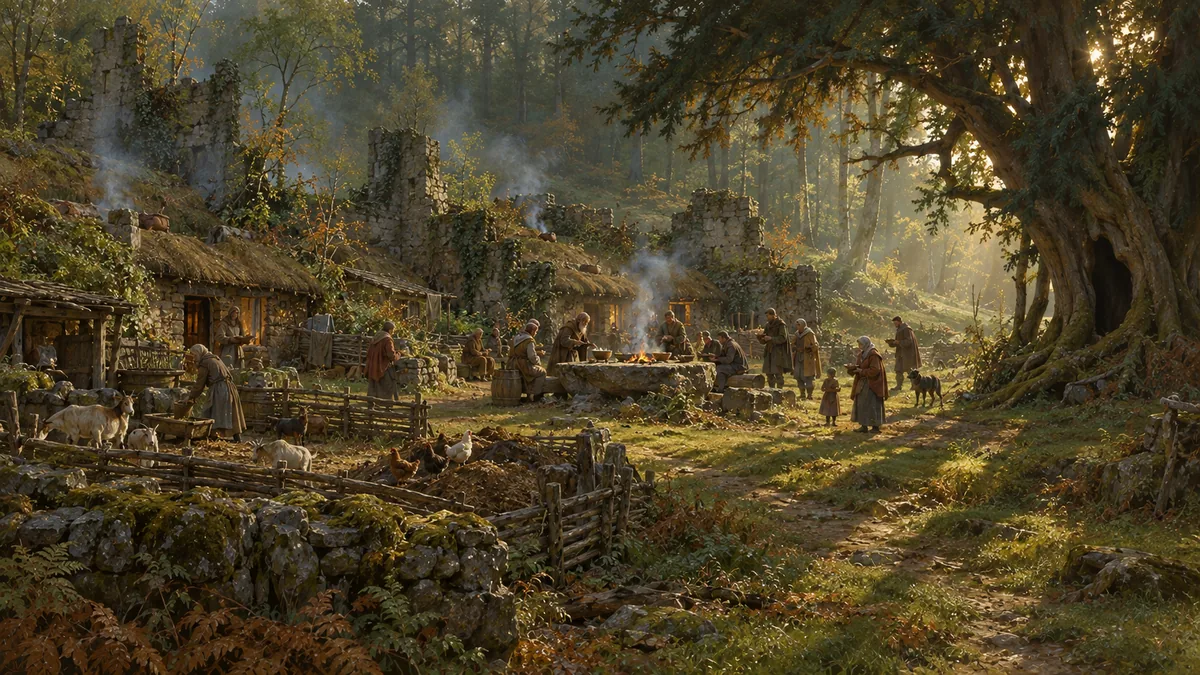
Beyond the hollies the ground opened into a wide clearing, uneven and grassed over. Out of the turf stood the stumps of old walls, gray and square, the same stone as the road. The people of the place had built their houses into the ruins. One cottage used the corner of some great old building for two of its walls and had made the other two of turf and wattle. Another sat inside a ring of stone that might once have been a tower. The roofs were thatched with bracken and weighted with stones against the wind, and smoke went up from a dozen of them into the green light. Between the houses stood goat-pens of woven hazel, and a steaming dung heap with hens on it.
In the middle of the clearing lay a broad flat stone, waist-high, black with old soot at one end. A fire burned on it in the open air. Beyond it, at the edge of the green, stood a yew tree, dark and ragged and hollow-trunked, so old that its lower boughs had come down to the ground and taken root again.
People came out of the houses, slowly, and made a ragged line between the strangers and the fire. In the middle of it a big man held a hay-fork crosswise in both fists, as he might have held a gate shut against cattle. At one end two lanky boys had their slings out and were trying to look as if they hadn't. The little girl had got behind a woman with a baby on her hip and was peering round her skirts, and beside them an old woman leaned on her stick with her chin up.
They were small people, brown and weathered, dressed in wool and leather, and more faces watched from the dark of the doorways. Every one of them was looking at the road behind Lio.
The woman with the baby spoke first. "What road did you come by?" she said.
It was not the question Lio had expected. He had expected who are you, or what do you want. Her voice was slow and burred, with the vowels laid down long like old Ambrose Pennock's at home, over the orchard fence, when he told the story of the great flood. The words were his own, near enough.
"The old road," he said. "From the east. We came over the stone bridge and past the well. We took the left-hand way at the fork."
A murmur went down the line. The big man with the fork said something to the old woman, and she shook her head.
"Nobody comes by the sunrise road," said the woman with the baby.
"We did," said Lio.
"Who keeps it, then?"
He did not know what she meant, until he did. He saw Edda in her chair by the fire, with her shawl round her shoulders and her eyes closed, singing.
"My grandmother," he said.
The line shifted. People looked at one another. Somebody laughed, short and startled, and was hushed. Then the old woman with the stick turned her head toward the houses, and Lio saw that the line was parting to let someone through.
He was the oldest man Lio had ever seen walking.
He was tall, or had been, and he was bent now at the shoulders so that his head came forward. His hair was white and fell to his collar, and his beard was white, and his hands on his blackthorn stick were brown and spotted and knotted at the knuckles. He came across the green slowly, in his own time, and the village waited for him. At the front of the line he stopped and looked at the three of them, and at Clover, and at the goat still eating the cart. His eyes were dark and bright and missed nothing.
"I am Pell," he said. "I keep the words in Wending. You are welcome to the hearth-stone if you come in peace."
"We come in peace," said Lio. "My name is Lio Ashby. This is Brannoc Hay, and this is Rupert Fenwick."
"Good day to you," said Rupert warmly. "What a remarkable place. What a really remarkable—how many of you are there? How long has there been a village here? Are those walls the same age as the road, because the coursing looks—"
"Rupert," said Lio.
Rupert stopped, with an effort that was visible.
Pell looked him over, unhurried, as he might have looked over a new kid in the pen, and turned back to Lio. "You came by the sunrise road," he said. "Ursula says your grandmother keeps it."
"She remembers it," said Lio. "From when she was a little girl. She taught it to me."
"Then she has kept it well, for you to be standing here." Pell leaned on his stick. "There's been nobody come in by that road in my life, nor in my father's. We'd thought it gone."
"It's mostly gone," said Brannoc. "Bits of it."
"Bits are enough, for those that know which bits." The old man studied Brannoc, the bow unstrung on his back, the scars on his hands. "You've walked deep before."
"Once."
"And come out."
"Some of me," said Brannoc.
Pell seemed to find that a reasonable answer to give a stranger. He turned and lifted one hand to the people behind him, and the line broke up at once into a crowd. The boys put their slings away. The big man leaned his fork against a wall. The woman with the baby came forward and took Clover by the bridle, and the goat was dragged off the cart by the little girl with an expression of great injury on both their faces.
They were given a place by the hearth-stone. They were given goat's milk in wooden cups, and oatcake, and a soft white cheese wrapped in dock leaves that tasted of grass and smoke. Rupert asked for the making of it. The woman with the baby was called Ursula, and the big man was her husband, Col. The little girl was called Ivy, and she sat on the far side of the fire and stared at them without blinking for most of an hour.
The children came round the cart, and Rupert opened the back of it for them. He showed them his potsherds and his scraps of script and his little box of coins. Last of all he showed them his shells: a cockle, a whelk, a flat pink scallop the size of his palm. Every one had been found inland, in the Margin, where by every sensible account no shell should have been.
The children looked at the shells in silence. One of the lanky boys picked up the whelk and turned it over and over.
"What's it for?" he said.
"Ah," said Rupert. "Well. Now that's the question."
Lio left him to it. He sat with his back against the warm side of the hearth-stone and drank his milk and watched the clearing. He watched the hens and the goats, and the smoke, and the way the people went about their business. They went by paths. Every one of them, child or grown, walked from door to pen to wall by a worn path through the grass, even where cutting across the green would have been shorter. He watched a woman with a basket go from the yew to a gap in the old wall and through it. She went the long way, round the end of a broken stretch of stone. She was humming.
"You've seen it too," said Brannoc, low, beside him.
"Seen what?"
"They don't go anywhere they haven't been."
In the late afternoon Lio went for water, though Ursula would have sent one of the boys. He had been sitting all day and wanted to be doing something with his hands, and he could hear the spring. He could always hear water. The sound came from beyond the yew somewhere, a thin bright trickle over stone, and when he asked, Ursula only pointed with her chin.
"By the yew tree and down the old wall," she said.
He took the two wooden buckets she gave him and went.
The yew was farther than it looked. He walked to it across the grass, which was rougher than he had thought, all tussock and thistle. He came to the yew and went under the outer boughs, into a dark that smelled of resin and old needles. On the far side he found the wall, waist-high and mossed, running away downhill through the trees. He followed it with one hand on the stones, listening to the water.
The wall bent. He followed it round. It went on downhill, and after that up, which was wrong, because a spring lies at the bottom of things. He stopped and listened. The trickle was there, bright and thin, on his left now and somewhat behind. He turned toward it and walked, with the wall beside him and the ground rough underfoot. He came out from under the dark boughs of the yew with the hearth-stone in front of him and its smoke going up.
He stood still. The smoke was on his right. When he had set out, it had been at his back.
Ivy was sitting on the hearth-stone with her bare feet drawn up. She saw his two empty buckets, and his face, and began to laugh behind her hand.
"You went without the words," she said.
Ursula came out of the nearest doorway with the baby on her shoulder and stared at him too, without a smile. Her look had a kind of pity in it that made his neck go hot.
"Ivy," she said. "Take the comer to the water."
Ivy slid off the hearth-stone and took one of the buckets from him and set off. She went first to the hearth-stone and laid her small hand on it, flat. She turned and walked, and as she walked she spoke. It was a little sing-song, the voice of a child saying something she had said so often she no longer heard it.
From the hearth-stone, out by the yew,
to the spring that the old wall goes down to,
water to wall and wall to the wood:
keep it in mind and the way holds good.
She said it as they walked, a line or two at a time, and the ground went firm and level under Lio's feet. The tussocks had gone. A narrow path he had not seen ran through the turf, and it took them to the yew and round it, not under. The wall was there on the far side, where it had been before, but now it went down. It went straight down through the trees, a little stair of moss and stone. He heard the spring, and it was ahead of them, and they were standing over it.
It was a round stone basin, very old, green with cress at the lip. The water came up in the middle of it so clear that he could see the sand turning at the bottom. It had taken them no time at all.
Lio knelt and filled the buckets slowly. The water was so cold it made his wrists ache.
At home his father rebuilt the wall at the foot of the Long Meadow every spring, where the frost heaved it, because if you left a wall a year it began to go. Every farm in the valley had a wall like that. His eyes went to the narrow path going back up beside the stones, and to Ivy waiting for him with her bucket.
He felt for the song in his head, and it was there.
"Do you have words where you live?" said Ivy.
"There's a mill at home," said Lio.
She considered this. "How do you find your water, then?"
"It comes past the house. You can't miss it."
Ivy gave him a look of deep suspicion, as at a grown man telling a story about a goat that talked. She picked up her bucket and started back up beside the wall, humming. Lio picked up his and followed close behind her, and he kept his eyes on her heels until they came out by the yew.
That night they slept in a byre with the goats, which was warmer than it sounded. Lio woke once in the dark and heard Rupert writing, by the light of the banked fire through the door, the small dry scratch of his pencil going on and on. He went back to sleep to it. When he woke again, it was light, and Rupert was gone, and so was the notebook.
He found him at the hearth-stone with Pell and the children.
The old man sat on a stool in the morning sun with a goat's halter across his knees, splicing a broken strap of it with a bone needle. The small ones of Wending sat on the turf in front of him in a ragged ring, six or seven of them, the youngest barely out of smocks. Ivy sat at the end of the ring with the air of someone who had done all this years ago. They were saying the near ways. One child began a way and the rest came in after, and Pell worked his needle and seemed not to listen. Rupert sat on the ground apart from them with his notebook open on his knee. From his face, and from the state of his hair, he had been watching since dawn.
"To the spring that the old wall goes up to," said a small boy called Ash, loud and sure of himself.
The ring faltered. Pell drew his needle through the leather.
"Down to, Ash," he said. "The wall goes down. Say it again."
The boy said it again, with down in it, and the ring went on. Brannoc sat on the low wall nearby, mending his boot. Across the green, Ursula was milking.
When the children had been let go, the youngest of them hung back at Pell's knee, and the old man spoke to him and not to Rupert.
"The near ways first," he said. "The hearth to the spring. The hearth to the pens. The way to Coombe is two days, and you'll have that when your legs are longer." He drew the needle through. "Nobody made them that's living. They were made before my grandmother's grandmother. We keep them. That's all we do."
The boy ran off. Rupert's pencil had stopped. He was looking at the flattened ring of turf where the children had sat.
"The little lad," he said softly. "Ash. Suppose you hadn't put him right. Suppose he'd said up, and the one beside him heard it and said up, and then all of them, every morning, and you along with them. Would the wall—"
Pell stood up.
He did it all at once, faster than Lio would have believed a man of his age could move. The halter fell off his knees into the ashes. His stick came down on the hearth-stone with a crack that sent the hens squawking, and he stood over Rupert, bent and white-haired, with his breath coming hard.
"Never say that in this place again," he said.
The whole green had turned to look. Across the grass Ursula had stopped milking. Ivy's mouth was open. A woman in a doorway reached out and pulled a small boy inside by his collar, and the door shut.
Rupert had dropped his pencil. "I beg your pardon," he said. "I beg your pardon, I meant no harm by it. I only wondered—"
"I know what you wondered." Pell's voice had dropped, low and rough. "Don't wonder it here. There are children."
He stood over Rupert, breathing. At last he bent, very slowly, and picked the halter out of the ashes and brushed it off, and sat down again on his stool. His fingers would not find the end of the strap. Lio watched him miss it, and miss it again, and find it. He drew the needle through, and the green began to breathe again around them.
Rupert sat with his notebook closed on his knee. He looked like a dog that has been kicked by someone it loves.
"I'm sorry," he said again, very quietly.
"So am I," said Pell. "I spoke hard."
He worked the needle in and out. A hen came back and pecked at the ashes by his foot. When he spoke again it was to Lio, as if Rupert had gone.
"The oldest tales tell of keeping a road," Pell said. "And they tell of making one. Keeping is what we do here. It's what your grandmother did, when she taught you." He kept his eyes on the splice. "Making is forbidden."
Rupert opened his mouth.
"I'll not say more than that." Pell bit off the thread. "I've said more than my father would."
He held up the mended halter and looked at it against the light, and pulled at the splice, and it held. He called across the green to Ivy, and she came running for it. When she had gone he sat with his empty hands in his lap and looked at the yew. He seemed older than he had an hour before.
"Some old quarrel," Rupert said, when Lio found him later at the cart. He was sitting on the tailboard with his notebook, not writing in it. "Mark my words. A fight between two priests about the gods, five hundred years gone, and they've been frightened of it ever since. In Coldharbour you mustn't whistle in the churchyard."
"Maybe," said Lio.
"You don't think so."
"I think he was frightened," said Lio. "Not of you."
Brannoc had come round the end of the cart. He stood with his mended boot in one hand and looked back at the hearth-stone, where Pell sat in the sun.
"Those stones in the grass town," Brannoc said. "Two names for one place." He put the boot on and stamped his foot down into it. "I didn't like them. I don't like this."
Rupert had something clever ready. He saw Brannoc's face, and kept it.
They stayed the day. Lio had meant them to go on in the morning. But Clover had a swelling on her near hind fetlock, and Col looked at it and said she wanted a day's rest and a poultice. Lio had another reason, which he kept to himself. He wanted to know what lay to the west before he went into it.
He asked Pell in the afternoon, carefully, with the old man's stick across his knees between them.
"The road goes on," Pell said. "West of the last wall it goes into the gray."
"The gray?"
"That's what we call it. My grandmother called it that. You'll know it when you see it." Pell eyed him sidelong. "Past the last wall the road's unkept, and none from here go there. A woman and a child went east past the last wall when I was young, and wouldn't stop." He turned the stick between his palms. "If your grandmother's words go on past it, she's the only one living who has them."
Lio saw a girl of seven with her hand in Maud's, the aunt who had brought her east, hurried past a village where the people looked up from their pens and called after them.
"They go on," he said.
"Will you say them for me?"
Lio saw again the figure standing between the milestones, reading, and the pressed holly leaves under the bend. The song was a thing he was carrying, like Taren's knife in his pocket, and he felt the weight of it.
"I'd sooner not," he said. "Not out loud. Not yet. I mean no offense by it."
Pell looked at him. Then the old man smiled, for the first time since they had come, and his whole face folded up into it.
"That's well," he said. "A road's not a thing to hand round the fire."
He looked away east, down the old road the way they had come.
"There's a way from here to Coombe," he said. "Two days. You heard me promise it to the little lad." He set the foot of his blackthorn in the turf. "When I was a boy, Coombe said that way crossed the beck at the alders. We said it crossed at the stepping-stones, a mile down. Both had it from their grandmothers, and both said it every morning of their lives." He drew the stick slowly toward Lio, scoring a line through the grass between them, a hand's breadth deep. "Six winters the way ran both roads at once. Folk walked out on it and came home a day late, or never. Then a fever took half of us. There were forty in Coombe saying the alders, and nine of us left saying the stones."
He lifted the stick.
"It crosses at the alders now," he said. "The stepping-stones are under a bog. My father went to look for them, the spring after, and stood up to his knees in black water where he'd jumped them as a boy." He looked at the scored line. "That's how the old ones put it, and he put it the same, after. What's said hard at one end, the other end must answer. Two keepers who don't agree, and the ground goes to the one who holds it harder. Them that live on it hold hardest, while they remember." He looked west along the old road. "The great road was broken the same way, long ago. Keepers broke it in two, so that nothing the makers sang in the west could walk east."
With the side of his boot he pushed the turf back over the line, and trod it flat, and the grass lay smooth again.
"Your grandmother's at one end of yours," he said. "I'd want to know who's at the other."
The light went early in Wending. The trees stood close round the clearing, and by late afternoon the sun was off the green and the shadows of the yew lay long across the grass toward the hearth-stone. The goats were brought in and the hens driven to their coops. Col built up the fire on the hearth-stone until it roared and threw sparks into the darkening air, and the smell of it went up among the old walls. People came out of their houses and sat round it with bowls on their knees. The children were not shy of the comers at all now. Ivy sat leaning on Lio's arm, eating, and Rupert had recovered enough to tell the boys about Wexley fair, which they did not believe. Brannoc sat at the edge of the firelight with his back to a wall, where he could see the road.
Lio saw him look up, and followed his eyes. Down at the far end of the clearing, where the old road came in among the hollies, someone was walking out of the trees.
She came at an easy pace, a tall figure in a long gray cloak with the hood up and a pack on her back. Her boots were muddy to the calf. She carried a staff of dark wood and swung it as she walked. She walked up the old road and onto the green as if she were expected, and Lio waited for someone to stand up, or call out, or reach for a sling.
Nobody did. Col glanced up at her and went on eating. Ursula shifted the baby to her other arm. At the hearth-stone, Pell raised his head and looked at the woman coming across the grass, and after a while he nodded to her, slowly, as to someone he had not thought to see again.
Brannoc got to his feet. The woman came into the firelight. She swung the pack off her shoulders and set it down at the foot of the hearth-stone, carefully, as a guest sets down a pack in a house where she means to stay, and put back her hood.
She was younger than Lio had thought, perhaps thirty-five. Her face was brown and weathered and composed, and her dark hair was in a braid, tied off with a strip of leather. Fine lines ran from the corners of her eyes, as if she spent her days looking into wind. She looked round the fire at the people of Wending, at Rupert with his mouth open, at Brannoc standing against the wall. Last she found Lio.
She studied his face, and after it his hands, which were holding a wooden bowl on his knee.
When she spoke it was in his tongue, or something that had been his tongue once, long ago. The words were all words he knew. But they came in an older order, with a lift and fall he had only heard in Edda's songs. It was a ballad spoken rather than sung.
"You'll be Taren's brother," she said. "You've his hands."