The Road to the Sea
They came up the valley road the next afternoon in Rupert's cart, the three of them, with Captain tied on behind.
Rupert talked the whole six miles. He talked about the coins and the ship and the word on the scrap. He talked about a man in Harrow who had a stuffed fish with legs, and the price of cheese in the eastern downs, and passages, and the sea. Brannoc sat on the board beside him with his arms folded and his cap pulled down. Somewhere past the Long Meadow, Lio, in the back among the trays, saw the ferryman's shoulders begin to shake. Brannoc was laughing without a sound under his cap, at Rupert, at the fish, at all of it.
"What?" said Rupert, turning. "What is it? What did I say?"
"Nothing," said Brannoc. "Go on. The fish."
His mother was in the dairy when Lio told her.
She was skimming the cream off the morning's milk with the flat tin skimmer, in the cold whitewashed room that smelled of milk and brine and stone. She kept skimming when he began, pan after pan, while he told her about Brannoc and the compass and the ferry stairs. Then he said he was going, and she put the skimmer down on the slate so hard that it rang.
"No," said Bet.
"Mother—"
"I have lost one son to that wood." She turned round. Her face was white, and her dark eyes were furious. "One. I set his place for a month. And you come home and tell me you're going in after him. And you bring Brannoc Hay to my door to take you, Brannoc Hay, who went in with eleven and came out with none—"
"He didn't take me. I asked him."
"You asked him." She laughed, a dreadful little laugh, and turned back to the pans and stared at them.
He had seen his mother angry a thousand times, but never frightened. For a while he stood in the dairy with his arms at his sides, and at last he went to her and put his arms round her, as she had put hers round him when he was small, and she let him. She was shorter than he was. He had not noticed when that had happened.
"You'll come back," she said into his coat, and it was an order.
"I'll come back. With him."
She pushed him off and shoved her hair back with her wrist, roughly, and picked up the skimmer.
"Go away," she said. "I've cream to do."
That evening she took a plate of supper across the yard to the cart, where Brannoc had insisted on sleeping, and handed it up to him. Lio was at the pump and heard them.
"I said a thing about you," said Bet. "Earlier. To my son."
"I heard," said Brannoc. "It was true."
"It was cruel."
"Thank you for the supper, Mrs. Ashby."
"Bring him home," said Bet, and went back across the yard before he could answer.
The next morning she took Lio's good coat off its peg and unpicked its lining. For three nights after that she sat up by the range sewing oilcloth into it, so that the rain would not reach him. She talked about everything but the Wood: the price of salt and the new calf and whether the Pennocks' boys would ever marry, and her needle went in and out. Once Lio woke at midnight and came down for water, and she was there by the range, sewing, with her lips pressed tight together.
On the second morning the felling axe was gone from its pegs over the cart-shed door. Only Owen had used it in Lio's lifetime. Lio found it at the smithy, on Ned Cotter's bench, with an ash-wood haft gone dark and smooth from Owen's hands and an edge so bright it looked wet.
"Your father brought it down at first light," said Ned. "Wanted an edge put on it, though it had one. It's for you, so I'm told. He'd not say so himself." He set the stone going and put the axe to it. "He said to tell you, keep the edge on her. Now hold still and let me tell you what a fool you are."
He told him the whole while the stone went round, and would not take a penny for it.
The rest of the village thought them fools too, and said so, kindly, at the mill and the Wheatsheaf door. Ambrose Pennock leaned on the orchard fence and told Lio about a man in Ambrose's boyhood who had gone into the Wood after a strayed cow. He had come out a fortnight later with no cow, no boots and no notion of his name. Kit Hay wanted to come. He wanted it so badly that he followed Brannoc round the yard for a day asking. Brannoc said no, Kit was needed at home. Kit said nobody needed him at home. Brannoc said Kit's mother did, and would skin them both, and that ended it.
Will Snape came by on the third evening, stood in the yard, looked at the cart and the mule and Rupert, and went away again without a word. In the morning there was a brace of rabbits hanging on the pump.
All that winter, Edda had been getting the song back.
It had come to her in pieces, as the other things had. She would wake with a line in her mouth, or a word, and lie in the dark saying it over until it went or stayed. Some went. Most stayed. By the end of February she had nearly all of it. She had kept it to herself, because she was not sure, and because with Taren gone the Wood was a word the house could not bear. Now she told Rupert.
She had liked him at once. Lio had not expected that. Rupert had come into her cottage behind Lio on the first evening, ducking under the low lintel, and seen the geraniums and the cedar chest with its cloth and teacup. He had stopped in the doorway and stood there, smiling, with his hat in his hands.
"Mrs. Ashby," he had said, "I'm Rupert Fenwick, and I collect things that people tell me aren't true, and I believe I've come to the right house."
"Sit down, Mr. Fenwick," Edda had said. "Mind the cat."
There was no cat. Rupert had looked round for it with great care before he sat down, and Edda had given a shriek of laughter, and from then on they were friends.
On the fourth day they were all in her cottage in the afternoon, with the rain on the window. Edda sat in her chair with her shawl round her. Rupert had the stool at her knee, with his notebook open on his lap. It was where Taren used to sit. Brannoc stood by the door. Lio sat on the floor with his back against the wall and listened, while his grandmother told them, as well as she could, the road from the oaks to the inn.
"Three oaks," she said. "Big. I was little, mind, so everything was big, but these were big to Maud, too. She stood under them and put her head back. They were in a row beside a lane that went down low, between banks. One of them leaned. I remember that. She made me look which way it leaned, and I said that way, and she said, 'That's the way home. Mind it.'" Edda frowned. "There was a brook after. Cold. And a bridge. One arch, all moss. And a well. And an inn beside the well, a great big inn with no roof on it, and we slept there."
"How long between them?" said Brannoc.
"I don't know. Days. Maud carried me some of it." She smiled at him. "And I've got them in the song's order, Mr. Hay, not the order my feet had them in. I didn't think to keep a diary."
"You remember it," said Rupert. He had stopped writing. "Mrs. Ashby, nobody remembers it."
"I'm an old woman with a song in her head."
"Yes!" Rupert put the notebook down. "Listen. I've talked to everyone I could find who's been in deep and come out. Trappers, charcoal men, a peddler, Hay here—"
"Not me," said Brannoc.
"Not you, you shut the door on me, thank you. The others." He turned a page back, and another. "A charcoal man went in after his brother's grave, that he'd dug himself, and came out where he meant to. A trapper went in after a city from his grandfather's tales and walked in a circle for a month. I've a dozen like that, and I can't make them add up. But I've noticed which ones come home." He leaned forward. "And you walked this one, Mrs. Ashby. With your feet."
"I was seven," said Edda. "And I remember it better than last Tuesday. Go on, Mr. Fenwick."
"That's all." Rupert spread his hands. "But if it's right, you may be the first road west this valley has had in—"
"Don't say three hundred years, Mr. Fenwick," said Edda. "I'll feel it in my knees."
Rupert laughed, and Edda laughed with him, and by the door Brannoc looked at the floor and smiled.
"There are words," Edda said, when they had stopped. "To the tune I hum. Did Lio tell you? They've been coming back all winter. It's a walking song, and the oaks are in it, and the bridge and the well." She looked across the room at her grandson. "I'll sing it to Lio. Not tonight. On the last night. He can sing it to you, Mr. Fenwick, and you can write it down in your book."
On the last night she sent the others away.
The rain had stopped. Lio came across the yard in the dark with the lantern. He found her by the fire in her chair, with the cedar chest at her feet and the cloth off it and her hand resting on the carved lid. She had made tea for both of them. She had put the good cups out, the ones with the gold rim, which had been her wedding cups and lived on the top shelf to be looked at.
"Sit down, love," she said. "On the floor, where I can see you."
He sat down on the hearthrug with his back against the side of the chest. She looked at him for a while in the firelight. Then she shut her eyes, and began to sing.
Her voice was thin and old and true, and it went up and down with the tune he had heard all his life. Only now there were words.
Down by the three oaks the lane runs low,
and one of them leans the way you go.
Cross where the brook runs cold and quick,
one stone arch and the moss grown thick.
Her hand lay on the heron on the lid of the chest. It lay quiet, with the fingers spread to keep her place.
Drink at the well with the heron stone,
sleep at the inn and you'll not sleep alone.
Through the town of grass with the gates of oak,
take the left-hand road where the old road broke.
Her voice changed there. It went on, but slower, feeling for each word before she set it down.
Then into the gray where the old names sleep,
by the white ring-stones where the ferns grow deep.
The mill with no water, the hall with no roof,
the chimney that stands with no house for proof.
The fire settled. Her eyes stayed shut, and Lio held his breath.
The beech with two bodies that grew as one,
and keep your face to the setting sun.
Down the stair of roots and over the hill,
and there's the sea at the end of the forest, still.
She stopped. Lio sat on the floor with his arms round his knees and found that the hair was standing up on his arms.
"Well," said Edda, and opened her eyes. "That's it. That's all of it. Sixty years I've been humming that over the bread."
"Gran."
"Hush, love. The inn line, before you ask, is the one Maud said every night, whatever bed we were in, and it meant the fleas." She laughed, and then she did not. "The rest I'll not pretend to. The town I hardly have, and after the road broke, nothing. I have the words. I could sing them in my sleep. But the gray, and the ring-stones, and the mill and the chimney and the beech, I don't remember one thing. It's as if somebody took the pictures out and left me the frames."
"Then the words will have to do," said Lio.
"Sing it back to me," she said.
He sang it back. He had a poor voice, but he had the tune, and he had heard the words once. He sang them through to the end while she listened with her eyes on his face and her lips moving with his. At the fourth line she held up her hand.
"The moss grown thick," she said. "Not the moss is thick. Grown."
"The moss grown thick."
"Again."
He sang it again from the beginning. This time she let him run on. When he came to the end, she was smiling.
"There," she said. "Now you've got it. Now it's yours as well as mine."
They sat together by the fire. Edda poured more tea into the wedding cups. Outside the wind had got up a little and was moving in the bare pear tree, and across the yard Lio could hear Rupert's voice in the cart, telling Clover something.
"Lio," said his grandmother.
"Yes."
"Bring your brother home."
"I will."
"Don't say you will. Say you'll try. I'd rather have the truth from you." She put her cup down. "And Lio."
"Yes."
"If you can," Edda said. "Only if you can. If it doesn't cost you anything." She looked at the fire. "Find out whether there was a boy."
He looked up at her, but her eyes were on the fire. Her hands were folded in her lap, and one thumb was at work on the other hand's knuckles, rubbing.
"A little boy with a scar on his chin," she said. "Who held on to my skirt. I'd like to know if I made him up. That's all." She smiled, a small crooked smile. "At my age you want to know which of your memories you can trust."
"I'll find out," said Lio.
Rupert had the song in his notebook before breakfast. He had knocked on the kitchen door at first light with his book and his pencil. Lio stood in the yard in his shirt and sang it to him while the mule watched over the half-door of the cart shed. Rupert wrote it down, and then made him sing it twice more to be sure.
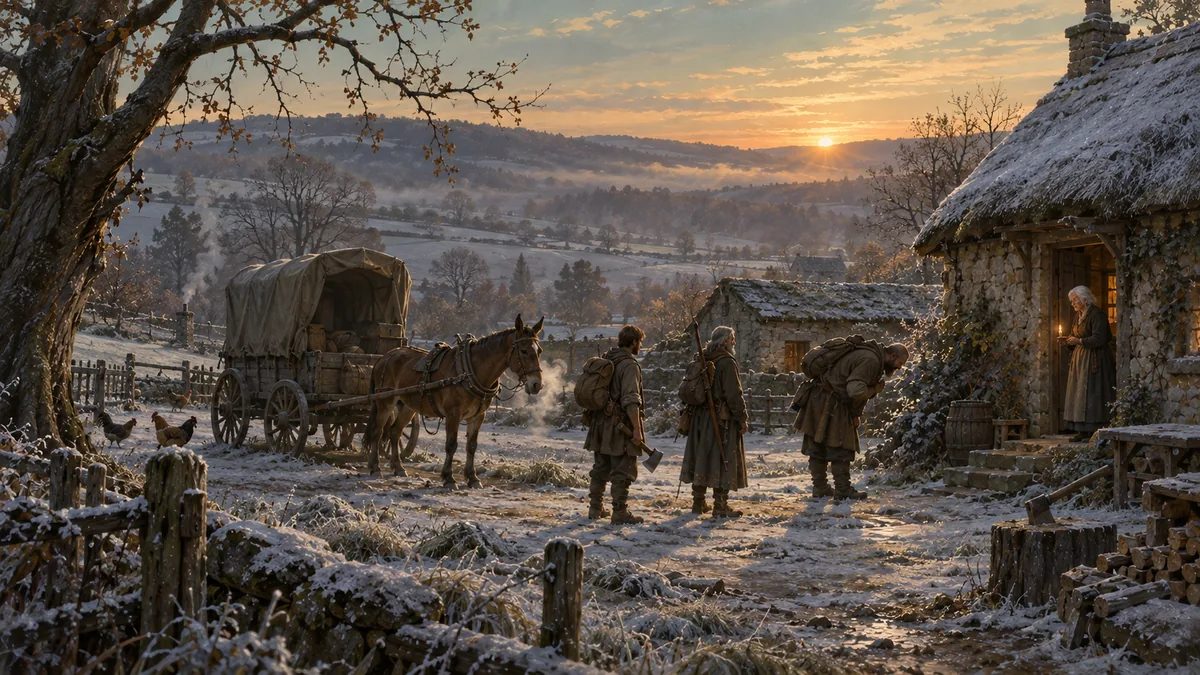
They went at sunrise on the fourth of March.
The yard was white with frost, and over the eastern hills the sky was pale green and gold. Clover stood in the shafts of the painted cart with her breath smoking. Brannoc had his bow on his back and a pack beside it. Lio had his pack and his father's axe and his coat with the oilcloth sewn into it. Edda stood in the door of her cottage with a candle burning in her hand, though the sky was already light. She would not come down the step, because, she said, she would only make a fool of herself.
Rupert went across the yard to her step and took off his hat and bowed over her hand, very low, as though she were a duchess. Edda let him.
"Mr. Fenwick," she said. "You'll write it all down."
"Every word, Mrs. Ashby."
"Not every word. Leave out the parts where my grandson is foolish. There'll be a great many, and I'd rather not read them."
"I'll leave out mine instead," said Rupert. "That'll save more paper."
His father shook hands with Brannoc and with Rupert. Then he came to Lio and put his big hand on the back of his son's neck, and held it there, and took it away.
"Go careful," said Owen.
His mother came out of the kitchen last. She had a bundle in her hands, wrapped in a cloth, and when she gave it to Lio it was warm through the cloth. He could smell it. She had been up before any of them, baking.
"Bread," said Bet. "Carry it."
He carried it.
The timber track went up past the Pennocks' top pasture and over the shoulder of the hill, as it always had. They passed the charcoal clearing. At the fork Lio took the left without thinking, and they came round the holly thicket, and there was the wreck among the beech trees above the dry gully, black and huge, with frost on it.
Brannoc stopped, and went down the bank by himself. Lio and Rupert waited at the top. The ferryman walked slowly round the bow with his hand out, over the barnacles and the planks, until it came to rest on the raw place where the heron had been. He stood a long time at the broken end, looking into the dark of the hull. When he came back up the bank, his face was quiet, and neither of them asked.
Rupert had to be dragged away. He had his notebook out and was writing standing up, and he wanted a day here, a week. Brannoc took him by the elbow and walked him back to the cart and put the reins in his hand.
"It'll keep," Brannoc said. "Your ship's been sitting here since October. It'll be here when we come back."
"If we come back," said Rupert.
Brannoc let go of his elbow and went to the front of the cart.
They went west. The cart went where it could, along the old trappers' paths and the pig-runs, and where it could not, Lio went ahead with the axe and cut it a way. By noon they had passed Will Snape's crow's foot on the old ash tree. By the middle of the afternoon they came to the last charcoal camp in the Margin, a black ring in a clearing where somebody had burned years ago and never come back. A rotted turf shelter leaned beside it, roofless. Beyond it there were no more cut stumps, no more blazes, no more paths.
Lio stood at the edge of the clearing and looked west. The trees went on, and on, gray and brown and enormous. Somewhere behind him, a long way back now, the frost would be lying white in the corner of the Long Meadow by the alders. He could not see it. He knew it was there.
"That's the end of the Margin," said Brannoc beside him.
They went on west, and Brannoc led. Lio had thought he knew the Wood, and in the first hour beyond the charcoal ring he saw that he knew nothing. The ferryman walked as if the ground were telling him things. He went slowly, and he looked back as often as he looked ahead, and at every rise he stopped to listen. Rupert talked, and Brannoc let him, and when Brannoc raised a finger Rupert broke off in the middle of a word.
That first night Brannoc made a fire so small and so well banked that Lio could have covered it with his hat. Rupert had his notebook open on his knee before the kettle boiled.
"Sing it for me, Lio," he said. "All through. I've got it written, but a thing in a book is a dead thing until somebody says it aloud."
Lio drew breath. Across the fire, Brannoc lifted one hand from his knee, and Lio stopped.
"Not out here," said Brannoc. "Not all of it. Listen."
Lio listened. No wind moved under the great trees, and nothing stirred in the leaves. Far off, a branch cracked, sharp and near, though it must have been a long way into the dark.
"A still wood carries a voice a mile," Brannoc said. "There's nothing out here to cover it. Your gran sang it to you in a house with the door shut. That was right." He looked past the fire into the trees. "Somebody came out of this Wood and took your brother, and knew the way to do it. I'd not hand them the whole road. Sing it quiet, and only as far as the next place."
"It wants singing, Hay," said Rupert. "It's a lovely thing."
"Then sing it at home."
Lio looked where Brannoc looked. Nothing moved out there but the firelight on the nearest trunks.
"To the next place," he said, and sang the first two lines, low, with his face to the fire, and stopped there. After that it was the last thing they did each night before they slept.
The trees grew. The oaks of the Margin had been big. These were bigger, wide as cottages at the root, and between them the ground went up and down in long slow folds under a thick floor of leaves. Little grew beneath them, and no path ran anywhere. Twice the cart stuck, and they unloaded it and carried the load and hauled the cart out by hand. Clover pulled, and Rupert pushed and cursed in a voice of great tenderness.
On the third afternoon the ground began to tilt downward, and they came to the head of a lane.
It was old. Lio knew at once how old it was, because he knew the sunken lanes of the valley. The hollow ways between Thornby and Coldharbour had been worn down by feet and hooves and cartwheels for so many years that the road ran deeper than a man's head. This was one of those. It began among the roots of the great trees as a dip in the ground, and then a groove. Then it went down between high banks into shadow, a long green trench running west. Ferns hung over its sides, and the roots of the trees above came out of its walls in knots.
They went down into it. The banks rose round them. The light went green. The cart's wheels made no sound on the old leaves, and Clover walked with her ears laid back. Lio went first, with his father's axe in his hand and his grandmother's song going in his head, over and over.
The lane went down and down, and then it leveled, and opened, and the trees stood back.
Three oaks stood in a row at the foot of the lane, on its right-hand side. They were the biggest trees Lio had ever seen. Their trunks went up into the evening like the walls of towers. The light was going, and their crowns were lost in it. The bark of them was deep-furrowed and gray and green with moss. Around their feet the roots ran out over the ground in great ridges and humps, and the lane wound among them and went on, west, into the dusk.
Lio stood at the foot of the lane and looked up.
The nearest of them stood straight. The middle one leaned. It leaned out over the lane, enormously, slowly, as it must have leaned for centuries, with its whole vast weight tilted toward the west, where the lane ran on into the dusk.
"Oh, look at her," said Rupert softly.
Brannoc had gone on a few steps among the roots to look at the third tree. He stood under it with his head back. When he turned round, he was looking at Lio.
The third oak leaned too. It hung out over the ground to the south, as far and as heavily as the other, and beneath it, where its roots went down, a second hollow way ran off among the trees and was lost in the dark.