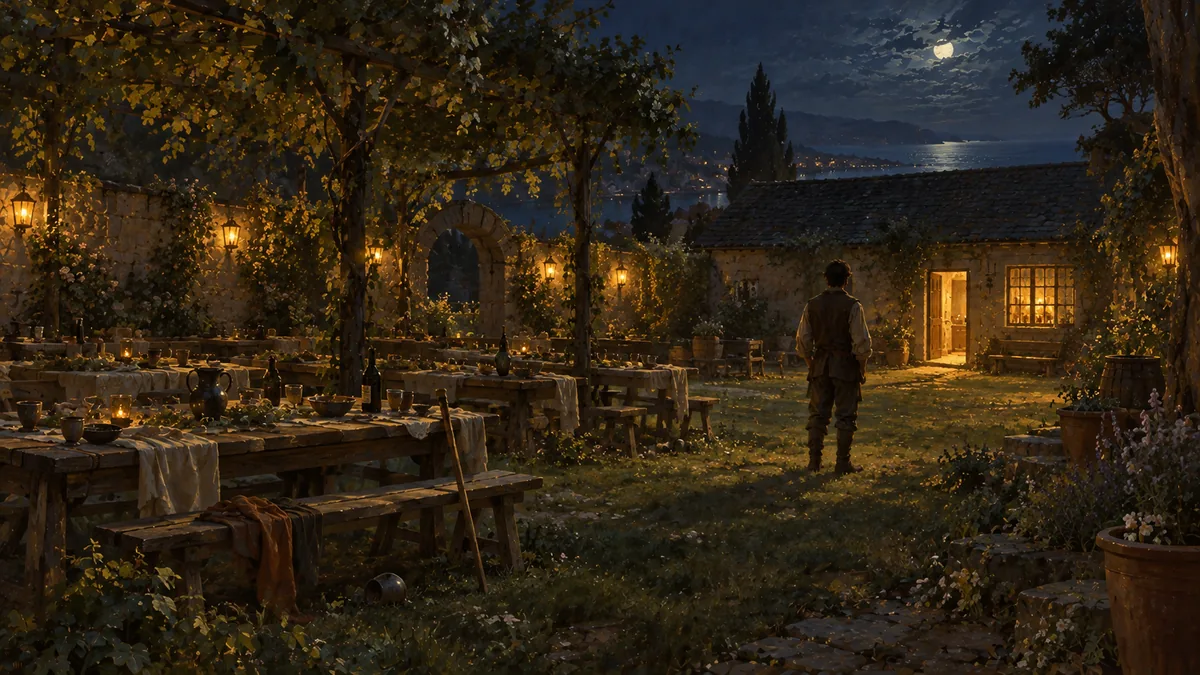
The Schoolroom
"Ah," said Hollis. "Then it's a copyist's error."
He sat down on the bench beside Lio, quite at ease, to listen to the end of the verse.
"Some clerk misread a name in an older copy," he said, "and every copy since has faithfully carried his mistake, as a family carries a nose. We find them all the time. I expect it was meant to be Wexley. It has the same shape in the old hand."
It was a good answer. Master Pryor, the reeve's clerk from Wexley, might have given it, from his fat pony, about the stream that ran west. Lio sat with it while the children finished and were let go, and ran shrieking back under the tables, and the fiddler took up his bow again.
They danced after that. An aunt in green made Lio learn a Sarne reel, which went the wrong way round from every reel in Lenndale. Across the dancers Hollis caught his eye and lifted his cup, and Lio lifted his. He liked the old man very much. He could not stop hearing the children's voices going round on Merrowby, high and certain, as if they were singing about a town they went to on market day.
When the dance broke up he looked down the garden for Stroud's young men. Their table was empty. The fair boy with the raw collar was gone, and Stroud with him.
The lamps were lit along the garden wall when Lio went to find Hollis again, and he was not at his bench. His stick was there, leaning against the end of the table where he had left it.
A light was burning in the schoolroom.
The door stood ajar on a long low room with a smell of chalk and wet wool, and lamps in brackets down one side. On the children's benches, with their knees up round their ears, sat Stroud's young men, twenty of them, big and sunburned and quiet. Stroud leaned in the far corner with his arms folded. And at the front, where the bride stood on any other day with her pointer, stood Hollis, without his stick.
He said a line, and the twenty young men on the benches said it back to him.
He said it again, and they said it again. He lifted a hand where the voice should lift, and they lifted. He let it fall at the end, softly, and they let it fall. It was the old speech, set to a quick light tune that a child could skip to.
"From the stone at the ford," said Hollis.
Twenty voices gave it back to him, "From the stone at the ford," and it was his voice in all of them, the same rise, the same swing, the same small catch before the last word.
"To the leat and the wood."
The benches gave it back to him, every word in his own cadence.
Leat was what the old Western deeds called a millrace. One voice came in behind the rest, a half-beat late. Hollis broke off. He went down between the benches to the fair boy in the third row and bent and said the line to him alone, very gently, as he might have said it to a child of six. The boy said it back, and Hollis said it again. The second time it came right, with the lift and the catch, and Hollis touched his shoulder and went back to the front.
He glanced up then, past the benches, to the door, and saw Lio standing in it. His hand did not falter. He beat the next line on his palm, and the young men gave it back to him, and Lio stepped back out into the dark garden.
In the far corner Stroud had turned his head. He only smiled at Lio across the lamplit room, pleasantly, as a man smiles at a neighbor over a hedge.
Lio went home alone, down the long stairs between the garden walls. Halfway down he found that he was humming the skipping tune. It had got into him in the space of three lines, and it came out of him with the same small catch before the last word. He shut his mouth on it and walked faster.
No stone stood at the ford. The women had their washing stone, and the children had the round one they sat on, and he had stood on both of them every summer of his boyhood. Neither had a word cut in it.
He waited in Hollis's study, because he could not have slept. The lamp burned low on the desk among the papers, and the black cat lay on the hearthrug and watched him walk up and down.
Below him, in the hall, the front door opened and closed. Slow steps crossed the stone without a stick.
"Ah," said Hollis from the doorway. "You're up."
He came in with one hand on the wall and lowered himself into the worn leather chair by the cold hearth. There were two glasses on the little table at his elbow, and he poured wine into both. He looked tired, but he did not look caught.
"I left my stick at the wedding," he said. "I was too pleased with myself to notice. Sit down, Lio."
Lio stayed on his feet.
"What were you teaching Stroud's men?"
"A song for a long road." Hollis held his glass up to the lamp and looked through it. "That is Aldous's business, and mine."
"I heard the line. From the stone at the ford. There's no stone at the ford."
"Then there is no harm in the line." He said it to the wine.
"That boy in the third row. You went down and sang it to him on his own, till he had it."
"Tobin." Something went over the old man's face and was gone. "He has a good ear and no confidence. I was the same."
Lio took the other glass from the table, because his hand wanted something, and put it down again, hard enough that the wine jumped.
"Stroud's deed," he said. "A stone house under trees, and a lesser house across its yard, and a stream behind it taken off the river. Whose house is that?"
Hollis held his gaze.
"An old one," he said. "A house in a deed from before the Wood. There were a hundred like it along the wood's edge in those days, and the deed never says which. Most of them are nettles now."
He said it easily and kindly, as he had said copyist's error under the vine. Then his mouth pressed tight. He took off his spectacles and folded them, and put them in the pocket of his coat, and his hand went up to the white seam on his chin and stayed there, hard, while he looked at the cold hearth.
"Then tell me what you want," said Lio.
"That I'll answer." Hollis leaned forward, and in the lamplight his face was earnest and tired and very kind. "A road is made the way you made yours, Lio, by somebody who knows it walking it and naming it. Mara walked behind you from the oaks to Wending. Every place you knew and named, the menders' road came firm on our side in the same weeks. Walk home by the song, as you came. Let a road-walker or two come a few days behind you. Not an army. And after them, a road a cart can go along, and a family, and an old man with a stick, if he can remember where he left it."
"And if I won't?"
"Then it will come anyway, and come worse. The Wood is going. It will come by wrecks and lures and young men lost in passages, or else by a road with people at both ends of it who know each other's names." He looked at the dark window. "And I want to walk up your lane and knock on my sister's door."
"It's not her home," said Lio. "Here."
The old man looked as though he had been struck, very lightly, in a place that was already sore.
"No," he said at last. "I suppose it isn't. Not anymore."
He sat back in the leather chair, and the lamp hissed on the desk.
"You think me a liar," said Hollis.
"I think you told me one thing under the vine and taught another in that schoolroom."
"Yes." He did not argue it. "Will you do something for me, Lio? Not for Aldous, and not for the Survey. For me. When you go home, and you sit by her fire, will you tell her that I kept the table? That the gull is still there, and I never let them plane it out?"
Lio looked at him, the white hair and the folded hands and the spectacles put away in the pocket.
"I'll tell her," he said.
"Thank you." Hollis leaned his head back against the leather. "Good night, Lio. Leave the lamp. I shall sit a while."
A line of light showed under Taren's door on the top landing. Inside, his brother was walking up and down, to the window and back.
Lio sat on his bed in the dark without lighting the candle. Through the wall the pacing went on. It went to the window and paused, and came back, and paused, and went to the window again. Taren had walked like that at home the night before he went up the timber track, and Lio had lain in the next bed and let him.
He got up off the bed and went out to the landing in his stockinged feet, and knocked.
The pacing stopped, and the boards creaked close on the other side, and the door opened.
Taren was dressed. He had his boots on and his blue coat buttoned to the neck, and his face was white and set, and there was a key on a string in his hand.
"I heard you come in," he said. "I heard him come home after, and the two of you in his study, and I've been standing here an hour trying to think how to say it." He held up the key. "I can't say it. I'll have to show you. Get your boots."