One Stone Arch
They slept that night among the roots of the oaks, and Rupert did not sleep at all.
Lio woke in the dark and saw him sitting up with his blanket round his shoulders. There was no moon. The oaks were only a deeper black against the black, and the two that leaned were two great slants of darkness, one going over them toward the west and one toward the south. Rupert sat with his face turned up between them.
"Go to sleep," Lio said.
"I can't," said Rupert. "I've been wrong for twenty years, Lio. I thought it was all bits. Coins and shells and a word on a scrap, bits that came out of the Wood by accident. This isn't a bit. A child walked past this tree and sang a song about it, and went away and got old, and the tree waited." He looked from one dark slant to the other. "Only which tree?"
Lio lay with his head on his pack and thought of his grandmother at seven, standing under one of these oaks with her head back. He could not see which one. He slept badly.
In the morning the light came gray and green down through the great crowns, and they could see what they had come to. The lane ran on west beyond the middle oak, still sunken between its banks. The other way went off south under the third oak, deeper if anything, with the ferns hung thicker over it.
"That one," said Rupert. "The lane runs low, she says, and that one's lower. Why would Maud make a child look which way a tree leaned, if it only pointed straight on?"
Lio walked to the middle oak and looked up into it, and went on to the third, and back. The middle oak went out over the lane like an elbow and turned up again, and its crown stood square to the sky. It had leaned for centuries. The third was tipped from root to top in one straight line, and on its north side the ground had heaved up in a long lip of torn earth. On that lip grew a stand of birches no older than Lio was.
"That one went over in a storm," he said. "When Gran was here, it stood up straight."
Rupert stared at the birches on their torn lip of root. "West, then," he said.
Brannoc had watched all of it from the lane. Now he turned and looked back the way they had come, up into the east, for so long that Lio went and stood beside him. The lane climbed away from them, green and shadowed, with the ferns hanging over it and the light at the top.
"That's what it looks like going home," said Brannoc. "You turn round to come back, and it's a road you've never seen. Every little way, turn round. Learn it the other way too."
"Is that what happened to you?"
Brannoc considered him. "No," he said. "But I've known men it happened to. Come on."
Toward evening the lane shallowed and ran out among the roots of the great trees, as it had begun, and after that there was only the forest.
The next day was the first that frightened Lio. Nothing happened, and that was the trouble with it. The trees stood round them, huge and gray and all alike, and the ground went up and down in long slow folds under the leaves. The sky was white, and nothing cast a shadow. Brannoc led, and stopped, and looked back, and led again. Lio turned round every little way as he had been told, and every time, the forest behind him looked like the forest in front.
Toward noon Rupert pulled up the cart. "We're going north," he said. "There's a lean in the ground, can't you feel it? We've been bearing right since morning."
Lio tried to feel it, and could not. Every direction was the same direction. A cold touch came at the back of his neck that he had last felt at the split oak with his father.
Brannoc walked off to where a shaft of light had broken through the cloud and lay on the leaves. He looked at it, and up at the sky, and pointed off to the left among the trees.
"There's the sun. It's noon, and it's there, so that's south." He turned and pointed along their line. "That's west. We're on it."
"Then what's the lean I've been feeling?"
"The Wood," said Brannoc. "It'll tell you things. It told me things for weeks. Go by the sun when you can see it, and by moving water when you can hear it."
They heard the brook before they saw it.
Early in the afternoon, going down a long slope among beech trees, Lio caught a sound under the silence so faint he took it for the blood in his ears. It rose in front of them and became water, quick and loud and hurrying, and they came out of the trees onto the edge of a ravine.
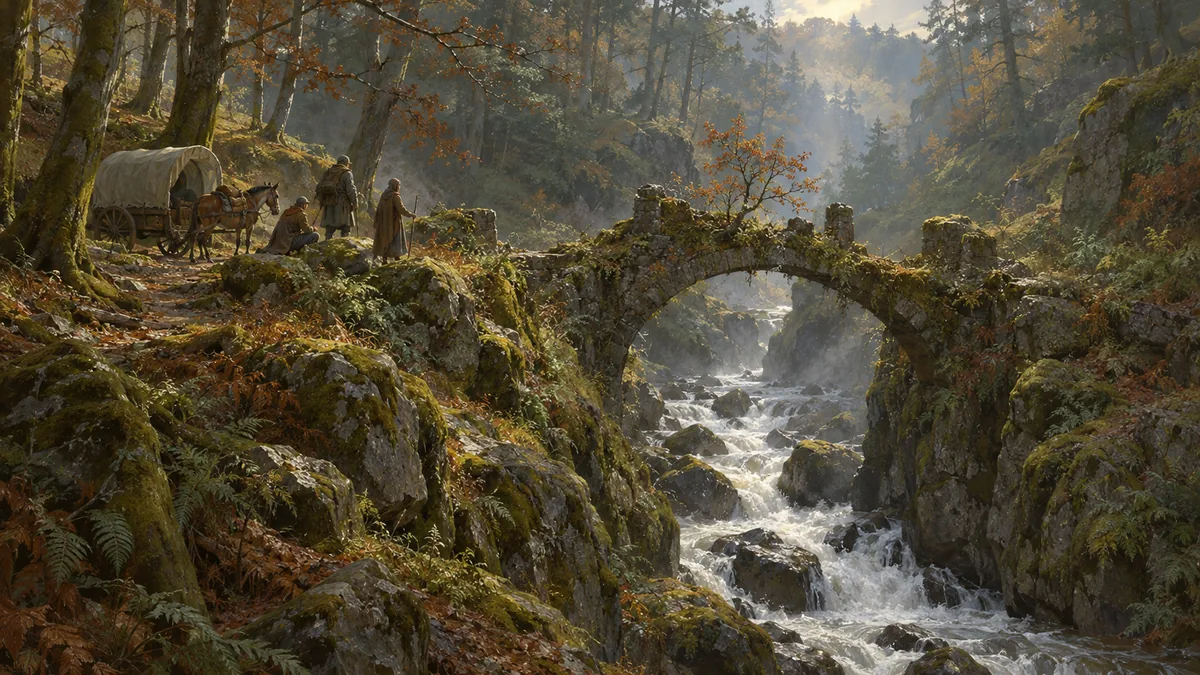
The brook ran at the bottom between walls of rock and fern. A man could have thrown a stone across it, but it was deep and fast. It came down out of the north over a long staircase of boulders, white and roaring, and went away south in a hurry. The air that came up out of the ravine was so cold that Lio's breath smoked in it.
Downstream, where the ravine narrowed, something humped like a cat's back sprang from rock to rock. Lio took it at first for a fallen tree. Then he saw the curve of it, too true for any tree: a bridge, a single arch of stone, very high and very narrow. The moss lay over it deep and soft, green and gold and gray. Out of the moss grew ferns, and from the very top of the arch grew a young rowan, its roots running down the stones on both sides and gripping them. The parapets had fallen long ago. Only their stubs stuck up through the moss at the edges.
Rupert had hold of Lio's sleeve. "Mrs. Ashby crossed that," he said. "Sixty years ago, holding Maud's hand."
Brannoc stood at the edge of the ravine with his hands hanging at his sides and looked at the bridge for a long time before he went down.
Close to, the bridge was bigger than it had looked, and older. Lio knelt where the arch sprang from the rock and pulled the moss back with his hands. The stones beneath were great squared blocks, gray and fine-grained, laid in a curve so true that the joints were narrower than a knife blade. Lio had helped his father build three bridges, and as a boy he had sat whole afternoons under the arches at Wexley, looking up. Whoever had built this knew things about stone that nobody in the valley knew.
He walked out onto the arch, testing every step. At the top, by the rowan, the roots had gone down between the stones and opened the joints. One stone had sunk below its neighbors. When he put his weight on it, it moved and grated.
"There's a stone up there I don't like," he said.
They carried the load over by armfuls and took the rest of the day about it, Rupert with his trays clutched to his chest and his eyes shut. Then Lio went back for Clover.
The old mule stood at the foot of the arch, looked from the moss to the white water below, and laid her ears back flat.
"I know," said Lio. "I don't like it either."
He talked to her, hardly knowing what he said. It was the nonsense Taren used to talk to Captain on the timber track, long and quiet and about nothing. At last her ears came up. She put one hoof on the moss of the arch, and then another. Lio walked backward in front of her with the halter in his hand. The cart came up onto the bridge behind her with a long creak of its axle, and the wheels sank into the moss.
At the top, beside the rowan, the near wheel came onto the loose stone.
Lio heard it before he felt it: a grinding, deep under the moss, and the stone dropped. It went only a finger's width, two, but the wheel went with it, and the cart lurched toward the edge where the parapet had been. Brannoc had his shoulder to the tailboard in an instant, heaving it back toward the middle. Clover threw up her head. Lio held her with both hands on the halter and talked to her, loud now. For a moment mule and cart and men hung on the crown of the arch, with the brook going white underneath.
Then the wheel came up out of the hole. Clover went forward. The cart came over the crown and down the far side with a rush. Lio ran backward in front of her and fell on the rocks at the bottom, and the mule pulled up and stood over him, blowing, with her nose in his hair.
Brannoc came down the arch behind the cart, walking carefully, and looked down at him.
"You're Owen's son," he said.
That evening Rupert took the kettle down under the arch and came back without it, wet to the shoulder, with a thin silver coin on his palm. On one face a tower stood over three wavy lines.
"Every bridge on the Lenn has pennies under it," he said. "Folk throw one in for luck. Why should they be different out here?" He dug in his trays for its twin, which a pig-runner at Coldharbour had turned up with his spade, and laid the two side by side on his knee. The same tower, the same little window cut near the top. "Same die. One came out of the Wood and one stayed in it, and I've found it."
Lio went downstream and fished the kettle out of the shallows. When he came back, Rupert was bent over his notebook in the last of the light, writing fast in a small round hand, and Brannoc was feeding the fire.
"He'll be like that till dark," said Brannoc.
The day after the bridge, the road came up out of the ground.
They were going west through open oakwood when Clover's hoof struck something under the leaves and rang, iron on stone, a sound Lio had not heard since Thornby. Brannoc went down on his knees and swept the leaves away with his arms. Under them was black earth, and under the earth, when he dug with his hands, a slab of gray stone as wide as a door and as long as a man, worn smooth and fitted tight to the next slab and the next. Down the middle, faint in the stone, ran two shallow grooves where wheels had gone.
Brannoc sat back on his heels and wiped his hands slowly down his knees.
"Is it yours?" said Lio. "The road you followed?"
"Stone's stone, under leaves." Brannoc brushed a last leaf off the slab. "It goes west, anyway."
It went west. Mostly it lay under the leaf-mold, and they knew it only by the ring of Clover's hooves and by the trees, which stood back from it in two long walls, as though even now they would not grow on it. Sometimes it came up for a stretch, gray and bare, with moss in the joints, and went under again.
Lio tripped over the first of the other things: a ridge in the leaves running away from the road, straight and knee-high and furred with moss. He put his foot on it and felt stone. A little way along it, two leaning posts stood on either side of a gap, with an iron pin rusted into one of them.
"It's a field wall," he said. "That's a gateway."
Rupert at once wanted to follow the wall into the trees to see where it went. Brannoc stayed on the road with his arms folded.
"Keep in sight of the stones, Fenwick," he said.
Once Lio had seen one, he saw them everywhere, long low mossy ridges running off among the oaks and meeting at corners. They made shapes he had known all his life. Here was a field long and narrow, running down to where a stream must once have been. There was one squarer, on a rise, with a gateway in each corner for driving sheep. The oaks stood in the middle of them now, older than any tree in the valley, and before the oaks somebody had plowed here.
Near the top hedge of one field stood a tree that was not an oak. It was low and twisted, with gray scaly bark, and its branches went out crooked and close, unpruned for longer than anyone could know. Lio crouched beside it. A hand's breadth above the roots, a ridge ran all round the trunk where the bark changed. Above the ridge it was one tree, and below the ridge it was another.
Ambrose Pennock had shown him that ridge on every tree in the orchard at home. It was the graft. Somebody had cut a twig off a good apple tree and bound it onto the stem of a wild crab and sealed it with clay, and waited, and watched it take. Somebody had stood here in this field with a knife and a ball of twine.
Lio kept his hand on the apple tree until Brannoc called him back to the road.
They came on the well some days after the bridge, in the afternoon.
The road ran straight and broad through a long grassy clearing, and at its side stood a well-curb, round and waist-high, of the same fine gray stone as the bridge. Somebody had cleared the brambles off it, long ago or not so long, and its rim was clean.
Lio went round it looking for the heron, and went round it again.
He found no bird. On the side that faced the road, low down on a single long stone, a pale scar showed where the face had flaked away. Frost had got into it, winter after winter, and taken off a hand's depth of the surface. If anything had been cut there, it had gone with the frost.
"There'll be more than one well on a road this long," said Brannoc.
Lio looked at the scar where the bird should have been. He thought of the oaks, and the birches on the torn lip of the roots, and how sure he had been. A tree could go over in twenty years. A well could lose its bird. A man who had read one tree right could read the next one wrong, and walk all three of them west into nothing on the strength of it.
Brannoc had gone on past the curb into the long grass. After a moment he called Lio's name, not loudly.
Behind the well a great house lay in the grass. Its walls were gone to their footings, but the footings showed its shape, and its shape was enormous. A long range of rooms ran back from the road with a wing on either side, and between the wings lay a cobbled yard with grass in the cobbles and a mounting-block at its gate. Lio walked through a room so long that the Wheatsheaf would have fitted in it twice over. The hearthstone at its far end was the size of his mother's kitchen table. The doorstep was a single long slab, worn into a hollow in the middle by feet.
"Sleep at the inn," said Rupert from the doorway, "and you'll not sleep alone." He looked round the roofless walls. "Who with, do you suppose? Ghosts?"
"Fleas," said Lio. "Gran says Maud said it every night, whatever bed they were in."
Rupert's shout of laughter went round the empty walls and came back. "Then it's the inn," he said. "And I don't think even the fleas are left."
They let Rupert's bucket down the well on a long rope and drew it up full. The water came up so cold it hurt their teeth. They drank out of the bucket one after the other, and Clover had the rest and put her nose back in for more.
They made a small fire in the lee of the great hearth, where it could not be seen from the road. Rupert wrote in his book. Brannoc sat with his back to the hearthstone and his bow across his knees, and went out twice to walk round the walls.
At dusk Lio took the kettle and went out to the well. The grass of the clearing was soft and wet, and he walked straight across it from the gate of the inn yard to the curb. He filled the kettle and put his hand on the scarred stone, low down where the face had flaked. In the last of the light he could not see it. But under his fingers, at the edge of the scar, where the frost had not reached, a groove ran down in a long straight line and turned at the bottom, as a heron's leg turns at the foot.
Above it, in the broken face, his thumb found the tip of a bill.