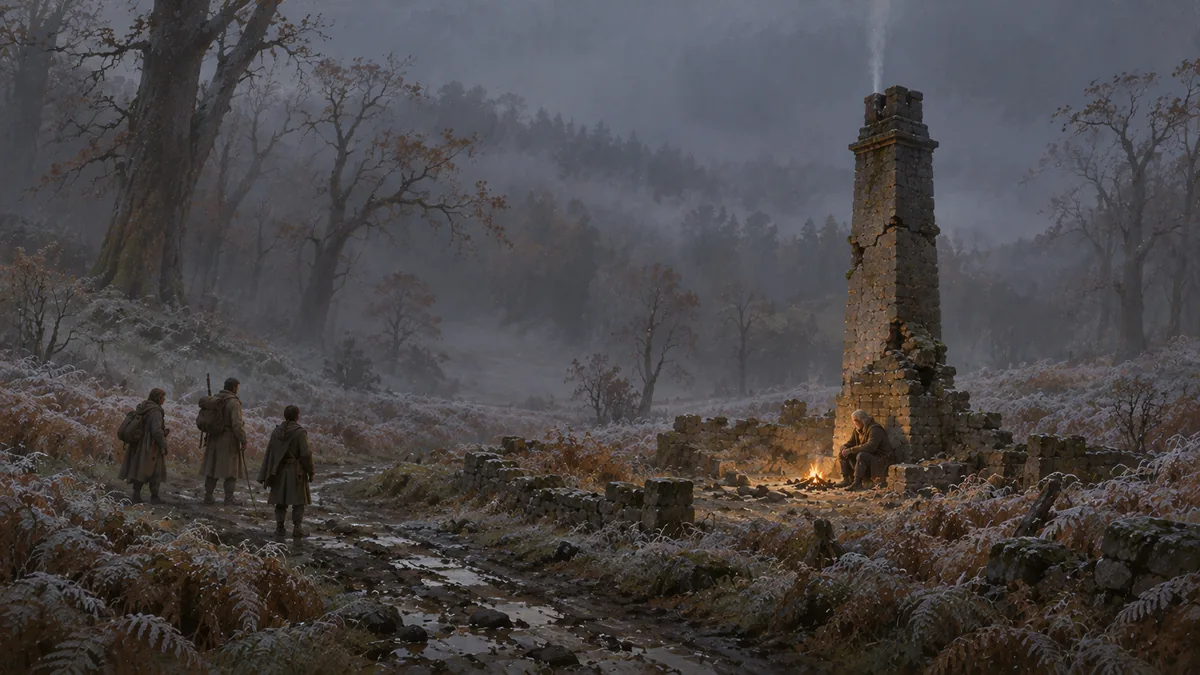
The Chimney With No House
Past the hall the road ran on through the ferns, and before the day was half gone a tree stood across it.
It was two trees, or it had been. Two great beech trees had grown up side by side, so close that their trunks had touched, and pressed, and over the slow years grown together. From the ground to the height of a house they were two, with a long seam running up between them like a fold in gray cloth. Above that they were one trunk going up into one crown. Between their roots, where the two bodies stood apart, there was a gap a man could walk through, and the road went into it. Lio stopped short of the gap.
"Two bodies," said Rupert behind him. "Lio. Isn't that the beech tree?"
"It can't be." Lio had sung the chimney line since the hall. He had it in his mouth now. "The chimney comes first. Then the beech tree."
"Perhaps the chimney fell down."
"Then there'd be stones." Through the gap the gray was the same gray as everywhere else. This country had put a hill behind them. It had put a woman behind a tree. "It's put this in front of us. That's all."
Brannoc looked at the beech a while, and at Lio.
"It's your road," he said.
So Lio took them back. He walked them east along the road toward the hall, slowly, singing, with his eyes on the ferns at the left hand for a stepped top, a heap of fallen stone, anything at all. There was nothing. Under the great west door of the hall he turned them round and came back slower still, and the beech stood across the road again with its gap open, waiting. He would not go through it. He tried the ground to the north of it, a foot at a time, and the leaf-mold gave under him like bog. Brannoc had him by the pack strap the whole while.
The gray thickened, and they had gone nowhere. They slept on the road in the mouth of the gap, because it was the only road there was.
In the morning Lio took them back toward the hall once more. A mile along, Rupert stepped off the edge of the buried paving where the leaves hid a drop, and went down into a hollow full of dead leaves up to his chest. Brannoc hauled him out by the collar. Rupert sat on the road rubbing his ankle, and talked, to show them he was all right.
"Did I tell you about the chestnut man at Wexley fair?" he said. "With the helmet?"
"By the fire," said Lio. "The night of the frost."
"So I did." Rupert smiled. "Old—" He stopped, with his mouth open on it. "I've bought chestnuts off him twenty years. What's his name?" He frowned at his hands, and then up at Lio, quite cheerfully. "It'll come."
Lio sat down on the road beside him. A day gone, and Taren a day farther off, and Rupert short a name. He had done that.
He heard his grandmother then, as clear as the rain on her window. I've got them in the song's order, Mr. Hay, not the order my feet had them in. She had smiled at Brannoc when she said it. She had been seven, and she had walked it once, and a song goes where the rhyme will let it.
He got up. "We go by the ground," he said.
They went back to the beech, Rupert limping and saying it was nothing. Lio walked into the gap between the two great trunks with a hand on the smooth bark on either side, and the road was firm under his feet all the way through.
A short way past the beech, as the gray began to thicken toward dusk, he saw the chimney.
It stood up out of the ferns ahead, hard on the left edge of the road. Tall and square, it was built of the same gray stone as everything else, with a stepped top and a crack running down one face. Nothing stood round it: no walls, no fallen roof, no hearth-stones in the grass. The chimney stood up by itself in the gray as if someone had taken the house away and forgotten to take that.
Then he saw the smoke. It was coming out of the top of the chimney, thin and pale and straight, the first smoke they had seen in that country that was not their own. At the foot of the chimney, where the hearth would have been if there had been a house, a small fire was burning on the road itself. Somebody had scraped the leaf-mold back to the old paving and laid it there. Beside the fire, on a block of stone, a man was sitting.
He sat very quietly, with his hands on his knees, watching the flames. He was not old. His hair was brown. He wore a long coat of brown wool, faded gray at the shoulders, and on one elbow of it there was a patch. The patch was red, a different cloth from the coat, bright and coarse, sewn on with big careful stitches.
Behind Lio, Brannoc had stopped walking.
Lio turned. Brannoc was standing in the road, looking at the man by the chimney. He was looking at the red patch on the elbow of the brown coat, and at the stitches that held it on. His bow had slipped from his shoulder into the ferns, and he had not bent for it.
By the fire the man leaned forward and laid another stick on it, carefully, as if it were the last stick in the world. The smoke went up out of the chimney, thin and straight, into the gray.
Brannoc went forward alone, and Lio let him.
He stood in the road with Rupert beside him and sang under his breath, and the road lay firm under the leaf-mold. Whatever was waiting by that fire belonged to Brannoc's errand, and not to his.
Brannoc walked slowly along the road toward the fire. The man by the chimney kept his eyes on the flames until Brannoc was almost on him. At last he lifted his head, and smiled, and got to his feet.
"Good evening," he said. "Come and sit. It's not much of a fire, but it's warm."
A valley voice, with the long Coldharbour vowels in it, the ones the Wexley men laughed at on market days. Lio heard them and felt his chest tighten.
Brannoc stood on the other side of the fire and looked at him.
"Garrow," he said.
Lio knew the name from the ferry-house at Wexley. Garrow Lisle had gone west with Brannoc and the rest of the twelve, and stood up in a ruined fireplace and sung.
The man in the brown coat turned this over with care, as if it were a riddle. He had a thin, good-humored face, brown from somewhere, though there was no sun here to brown it. His beard was short and soft. He might have been thirty, and Brannoc beside him looked like his father.
"Is that someone you're looking for?" he said. "I've not seen anyone, not for some time. But you're welcome to wait here, if you like. People do come by. Now and then."
He had seen Lio and Rupert at the road, and he beckoned them in, a host at his gate. "Sit, all of you. There's room. Mind the stone, it rocks."
Lio and Rupert came on along the road and sat down by the fire, on the paving, because there was nowhere else. The road lay firm under him. A fire on it would hold it, as the hearth-stone held at Wending, for as long as they sat. The man sat back down on his block of stone and folded his hands on his knees, and waited to be told their news.
Brannoc sat down last, directly across from him, close enough to touch, and did not touch him.
"You don't know me," he said.
"I'm sorry." The man looked truly sorry. "Should I?"
"I'm Brannoc. Brannoc Hay. From Wexley."
"Brannoc." The man said it over carefully, to keep it. "That's a good name. I'm—" He stopped, and a frown came between his brows. "I seem to have—it's gone out of my head. It'll come back."
Lio had thought he understood the hollowed. He had stood at the wall of the woman's garden and been sick with it, and walked away. But she had been a stranger to him, and he could not have guessed what she was before.
This man had a mother in Coldharbour.
Lio could see everything he had been. He could see it in the coat, in the big careful stitches round the red patch. He could see it in the hands, which were a farmer's hands, square and scarred across the knuckles. He could hear it in the voice, which said warm the way nobody south of Coldharbour said it. Somewhere at the far end of Lenndale there was a house where this man had grown up. He had walked out of its door one morning twenty years ago, and now he sat in the gray by a chimney with no house, and he did not know his name.
Brannoc took off his pack. He laid what food they had on a cloth by the fire, oatcake and the hard dried meat from Wending and a few wrinkled apples, and offered it to the man first. The man thanked him and took an apple and held it without eating it.
"Do you remember coming here?" said Brannoc.
The man thought about it honestly. His eyes went to the chimney, and the fire, and the ferns beyond it.
"I remember the chimney," he said. "I've always kept a fire in it. It seemed a pity, a good chimney like that, and nothing in it." He turned the apple in his hands. "I think I was walking with some people, and then I wasn't. I sat down here to wait for them." He looked up, hopeful. "Were you with them? Is that how you know me?"
Brannoc's hands closed on his knees.
"Yes," he said. "I was with them."
"Well, there," said the man, pleased. "You've come back."
The gray thickened toward its kind of dusk. The smoke went up the flue and out of the stepped top, thin and straight. It was the strangest hearth Lio had ever sat at: a fireplace and a fire, and no walls or roof or door, and the great trees going up into the gray on every side.
Brannoc sat with his forearms on his knees, and after a while he began to talk.
He told it out of order, beginning in the middle and going back and forth. His voice was low and slow, the voice he used on the ferry when the river was up and the passengers were frightened.
"Your name's Garrow," he said. "Garrow Lisle. You were born in Coldharbour, in the last house before the sheep-walk. Your mother's Agnes. She's a little woman with a voice on her that'll call you in from the top field without trying. She keeps bees. You were stung so often as a lad you stopped swelling up, and you'd show off for the girls by putting your bare hand in the hive."
The man listened as he might have listened to a peddler's talk of some far country. He nodded in the right places.
"I was hired up to your mother's for the haymaking the summer I was fifteen," said Brannoc. "And every summer after. You were twelve, and you threw me in the sheep-dip the first week, and I held you under the pump the second, and that was us. Since we were lads." He looked at the red patch. "Your mother sewed that. The week before we went. You'd torn the elbow out climbing the mill gate drunk, and she had no brown cloth, so she cut a piece off her red flannel petticoat. And she said, there, now everyone will know you're mine." Brannoc's mouth moved. "You said you'd not wear it. You wore it."
The man looked down at the red patch on his elbow and touched it with two fingers.
"It's a good patch," he said.
"It is."
Rupert sat beside Lio with his new book closed in his lap and his pencil in his hand. It stayed shut, and Lio thought he had forgotten he held it.
Brannoc told him about the pony Garrow had bought at Wexley fair, which went lame before he got it home. Garrow had led it the six miles, talking to it, and named it Patience. The man smiled at the pony.
Lio had never heard Brannoc say so much in a week as he said in that first hour.
"There was a girl called Jenny," Brannoc said. "Jenny Brook, from the farm below the chapel. Red hair. Laughed at everything. You'd looked at her across the chapel for two years and never said a word. Then one harvest you had three pots of Dyer's cider and walked straight across the threshing floor and asked her to dance. You were the worst dancer in Lenndale. She took her shoes off so you'd stop treading on them, and danced barefoot, and laughed till she couldn't stand." His voice had gone quiet. "After, you came back up to the barn where I was waiting with the cart. You couldn't speak. You just stood there grinning."
"She sounds a fine girl," said the man.
"She was."
"Did I marry her?"
Brannoc opened his mouth, and shut it. In the firelight Lio saw his throat move.
"Let me tell you about the goose," he said.
"Dyer had a goose," Brannoc said. "A big gray goose, the worst-tempered bird in Lenndale. She went for the parson once and had his hat in the millpond. And you had a joke about her. You told it every harvest supper for ten years, and it was never funny, not once, not even the first time."
He leaned forward over the fire.
"You'd stand up on the bench," he said. "And you'd say, why does Dyer's goose always win the argument? And everyone would groan, because they knew. And you'd say, because she's got the bill, and Dyer only sends one." He sat back. "That was the whole joke. And you'd laugh so hard you fell off the bench, every year, and everyone laughed at you laughing."
The man in the brown coat had his head on one side. Then he laughed.
It was a big laugh. It came up out of him all at once, too loud for the gray, and it shook his thin shoulders and made him put a hand on the chimney to steady himself. He laughed with his whole face, his eyes screwed shut. It was the laugh of a man falling off a bench.
Across the fire Brannoc sat and watched him laugh. His face held. Only his eyes moved, going over the man's face, and his hands were locked between his knees until the knuckles stood out white.
"She's got the bill," said the man, gasping. "Oh, that's good. That's a good one." He beamed at Brannoc. "Is it yours?"
"No," said Brannoc. "It's yours."
He talked all night after that, and the goose had opened something. The man still smiled, but every so often his face went ahead of the story instead of behind it. When Brannoc told him about the morning the twelve set out, the man put his hand flat on his chest before Brannoc had got to the bread.
It was after harvest, Brannoc said, with a frost in the night, so that the ferry rope was white with it. Corren Tull was whistling through his teeth. And Garrow had his mother's bread inside his coat, still warm, and kept putting his hand on it. Then there was the night Garrow sat up on watch and saw a light moving in the trees, and the two of them followed it and lost themselves, and came back at dawn to find the others had eaten their breakfast.
"You said it was a will-o'-the-wisp," Brannoc said. "You said your gran had seen one."
"It was," said the man, and stopped, surprised at himself.
Lio lay on his side and watched the two of them across the embers. He thought of the people at home who could do this for him, if it ever came to it. His mother could, and his father, in fewer words. Edda could, with her eyes shut. Taren could tell it best of all, with his hands going and every story made a little larger than it had been. Lio wanted very badly to hear his brother tell it. He wanted to hear Taren tell about the winter he fell through the ice on the millpond. He wanted the night the two of them borrowed Ambrose Pennock's ladder and could not get it back over the wall. He held on to that until he slept.
When he woke, not long after, the fire had burned low, and Brannoc was talking yet, hoarse now, going back over the bees and the voice and the red flannel petticoat. Rupert was awake with the book open on his knee. He had written one line in it, and Lio could read it upside down in the firelight.
Garrow. Brannoc told him his life all night.
Toward morning the gray thinned. It never brightened in that country, but the thickness went out of it, and Lio could see the great trees again at the edge of the ferns.
The man by the chimney lifted his head.
"Garrow," he said.
Nobody had asked him. He said it into the smoke, slowly, wondering, and looked down at the red patch on his elbow. "Garrow. That's me. I'd put it down somewhere." He looked across at Brannoc, and his face changed, and for the first time he looked at somebody as if he knew him.
"You're Brannoc," he said. "From the ferry. You couldn't fork hay to save your life."
Brannoc reached across the fire and took him by the back of the neck, and held on.
"Lisle," said Garrow. "Garrow Lisle. Agnes's lad." He was laughing, and frightened, both at once. "How long have I been sat here, Bran? Where's the others?"
Brannoc let him go. His face was gray with the night.
"A good while," he said. "I'll tell you on the road. Can you walk?"
"I'll walk to Coldharbour if you'll carry the pack." Garrow got up off his stone, and swayed, and caught the chimney, and grinned at himself. "Give me a minute. My legs have forgot." He looked at Brannoc again, and the grin went uncertain. "Jenny. Did she wait?"
"I'll tell you on the road," said Brannoc.
Garrow studied his face a moment, and nodded, and let it be.
They gave him a minute. Brannoc sat back on his heels and shut his eyes. Rupert got up to see to the embers, because it wanted seeing to, and because Lio thought he could not sit still for gladness. Lio himself stood and stretched, and turned to look west along the road, and reckoned how they would go: Garrow in the middle, Brannoc at his elbow, the song out in front.
When he turned back, Garrow was putting a stick on the fire.
He did it carefully, as if it were the last stick in the world. He sat down on his block of stone and folded his hands on his knees and looked up at the three of them, and smiled, and Lio knew before he spoke.
"Good morning," he said. "Come and sit. It's not much of a fire, but it's warm."
Lio stood where he was. A whole night of Brannoc's voice had gone into that man, with nothing but a fire holding the road under them and Taren somewhere west of it. It had bought them the time it took to stretch.
Brannoc opened his eyes.
"Garrow," he said.
"Is that someone you're looking for?" The man was sorry. "I've not seen anyone, not for some time. But people do come by."
Brannoc told him the goose. He told it at once, there on his knees in the ashes, fast and hoarse, the bench and the groan and the bill. The man listened all the way through, nodding at the bench.
"That's a good one," he said, and smiled, and did not laugh.
Brannoc told him his name, and his mother's, and the patch. The man said each name back after him, kindly, to show he had heard, and they went into him and out again like water through a sieve. Brannoc stopped in the middle of Jenny Brook and knelt there with no more words in him.
"Tell it again," said Rupert. "Tonight. We'll sit up with you—"
"A night to buy an hour," said Brannoc. "And the hour went by daylight."
He got up anyway. He bent and put his arms under Garrow's and lifted him, and the man came up obligingly, and swayed. Then Brannoc turned to stoop and take him on his back, and Garrow understood what was being done to him. He put one hand on the chimney and held it, his face anxious and mild, a man being taken away by strangers and loath to give offense.
"Please," he said. "I'd sooner not. I said I'd wait for them, you see. They'll look for the smoke."
Brannoc let go, and the man sat. The cut on Brannoc's forearm had opened under the binding, and the blood was coming through.
"Where are you from?" Brannoc said, hoarse. "Do you know that?"
The man looked at the flames, and at the chimney, and at the great trees going up into the gray. He held out one hand, slowly, back along the road the way they had come.
"That way," he said. "East. Wasn't it? I don't know anything else about it. But it was that way."
Brannoc looked at the hand a while after it had gone back to the man's knee.
"I can't carry a man home who doesn't know he's being carried there," he said. "He'll sit down by the first stone and wait for us to go."
He knelt in front of Garrow on the bare ground, so that their faces were level.
"Listen to me," he said. "We're going west. There's a lad gone that we've come for. I'm going to leave you food, and wood, all you can use. And I'm coming back this way, and when I do, I'll stop at this chimney, and I'll take you home. To the east."
"That's good of you," said Garrow. "People do come by."
"Your name's Garrow. From the east. Say it when you put wood on the fire."
Brannoc stayed on his knees a moment longer. He reached out and set the collar of the brown coat straight where it had rucked up under the man's ear. The man let him, and thanked him.
"Garrow," said the man, obligingly. "From the east. I'll try to keep it by me." He smiled. "And I'll keep the fire in, so you'll see the smoke."
They left him most of what they had. Brannoc stacked wood against the chimney until the pile stood as high as Garrow's head. He left him the dried meat, and half the oatcake, and the last of the apples. Lio left him his blanket. Rupert stood with his hand inside his coat, and at last he brought out a small clay whistle shaped like a bird. It was a thing from his collection that he had bought at a fair years ago and never been able to play. He gave it to Garrow. Garrow turned it over in his hands with great pleasure, and blew it, and it gave a thin sweet note, and he laughed.
Then they went, and Lio walked first, singing loud and badly, and let it be bad. Brannoc walked behind Rupert with his eyes on the road until it began to bend. There he looked back.
Lio looked back with him. The chimney stood up out of the gray, with its stepped top and the crack down its face, and thin smoke going up out of it, straight. At its foot a small figure in a brown coat sat on a block of stone with something in its hands. As they watched, it lifted one hand.
Brannoc raised his arm in answer. He turned and walked on.
They had gone a long way before he spoke.
The great trees stood round them and the gray lay on everything, and the road ran on west under the leaf-mold. Rupert limped between them with his hands in his pockets, and Brannoc came last. Lio could hear his steps, slower than usual, and his breathing. Once the steps stopped on the road behind, and stood, and started again. Lio let him be. He sang a little louder, so that Brannoc would have something to walk toward.
"He's not aged," Brannoc said. "Twenty years, and he's hardly older than the morning we went. And me with a gray head." He walked a while. "I was like that."
Lio kept his face to the road and his song going. But he slowed, so that Brannoc could come up.
"Not so far gone," Brannoc said. "But on the way. When I woke by the river I had my name and nothing else, and it took a year to get the rest." He breathed in. "Eleven went into the dark between, and I've never known where. I've always been afraid I left them."
"Brannoc," said Lio.
"And this morning I did."
"You'll come back for him."
"I said I would."
"Then you will."
Brannoc did not answer that.