Only One Road
They came down Cooper's Steep in the first gray of the morning with their packs on their backs, as if they were going to the boats for a day's fishing.
Brannoc was waiting at the corner of Corren's lane. Behind him, across from the green door, two men of the watch leaned on the wall in gray coats with their staves propped beside them. They had been there all night. One of them was paring an apple with a little silver knife, round and round, so that the peel came off in one long curl. He looked at Brannoc's pack, and at the bow across it, and went on paring.
Corren, Brannoc's old friend from the lost twelve, stood on his step in his shirtsleeves with a mug in his hand, and his eyes went from the four of them to the watchmen and back.
"Not past them, Bran," he said, low, in the eastern tongue. "Not like this. They'll be at the harbor before you are."
"Then they'll be at the harbor," said Brannoc. "Go in, Corren. Mind the boy."
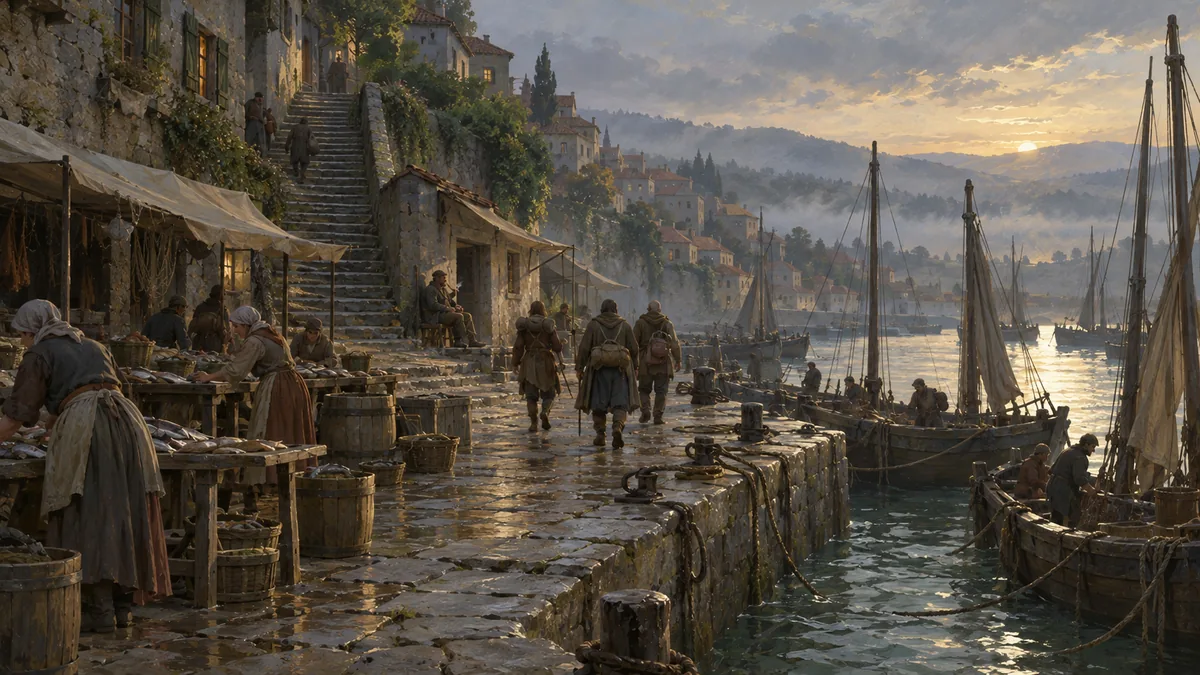
The road east went along the quay. It ran the length of the harbor front past the fish market and the survey office and the foot of the Gull Stair, and out at the land gate at the far end, where the walls came down to the water. Every other way out of the lower town climbed the whole city first. Sil walked in front with her hood down. She had said she would, and she kept it down, though the fishwives at their trestles turned to look at her.
Abel the doorkeeper sat on his stool outside the survey office in the early sun with his pipe. He took the pipe out when he saw Sil, and opened his mouth, and shut it again, and glanced up the quay.
Osric Dane, the man who ran the Road Survey, was standing at the foot of the Gull Stair.
He was square and weathered, perhaps fifty, with his coat on and his boots, and a sergeant of the watch beside him with a stave. More gray coats stood along the harbor wall to the right and in the mouth of the fish market behind. None of them hurried.
Sil stopped a few yards off. The others stopped behind her.
"Arden," said Dane.
"Dane."
"You're a surveyor of the Road Survey." Dane did not raise his voice, but it carried along the stone. "You left your post in November without leave or a word to anyone. I let you sit on your mother's step. And here you are on my quay with a pack on your back, walking east." His eyes went to the pack. "Where are your books?"
"In your cabinet," said Sil. "Behind your new lock."
"So they are. I looked last night." He nodded to the sergeant. "But the rest of it's in your head, Arden, and your head's going east. I'll not have a surveyor of mine carry my crossing over the Wood to the people it's crossing to. You'll come to the watch-house on the Mole."
The sergeant came forward and took Sil by the arm.
Lio saw her other hand go to her coat, over the place where the field book lay, and come away again. She did not pull against him. She stood very straight with her chin up and looked at Dane.
"Let her go," said Taren.
He had come up past Lio with nothing in his hands. Brannoc came behind him, not hurrying, with his unstrung bow held crosswise in front of him like a quarterstaff, and planted himself in the sergeant's road.
The watch closed in. They came along the harbor wall and out of the fish market with their staves held low and easy, until there were twenty of them in a ring on the open quay. To the left was the water, green and deep and cold, slapping against the stones a man's height below the edge. The four of them stood inside the ring with the sea at their heels.
"Put that down, man," Dane said to Brannoc. "I've no quarrel with easterners walking home. Walk. Only she stays."
Brannoc did not put it down. A watchman on the left reached for the bow, and Brannoc jerked it back, and the man's stave came round low and hard. It caught Brannoc on the forearm, the arm Mara's staff had cut at Wending, and Lio heard the blow land. Brannoc grunted and went down on one knee on the stone. Taren went for the man who had struck him and was caught by the collar and flung back. A stave came up level with his throat.
"Hold!" Dane shouted. "Hold, damn you!"
They held, for the moment. Brannoc got up slowly, with his left arm against his chest and his teeth set. Taren stood with the stave across his collarbone and his hands open. The ring had closed to two strides. Next time Dane would be too late to shout. Somebody was going to be hurt worse than Brannoc, and Lio could see which of them it would be.
He turned his eyes from it, up the Gull Stair.
At the very top, small against the morning sky, an old man stood with a stick. He was not coming down. He stood with one hand on the wall, looking down at the quay.
"Brannoc," said Lio. "Stand still."
"Lio—"
"Stand still. Please."
He stepped out of the ring of his friends and walked across the open stone to Dane alone, and stopped in front of him.
"She told me all of it," he said. "In the Heart, at the fire, every night. Every line on your board, and the month you mean to cross. Whatever's in her head is in mine." He held out his wrists, the two of them together. "If you mean to keep it from the East, you'll have to keep me as well. Take me. Let her go home."
Dane looked at the wrists, and at his face.
"She's never set foot in the Heart," he said. He let that lie on the stone between them a moment, and stepped over it. "You'd go in my watch-house for her. For a surveyor who ran out on me in the winter."
"Yes."
"And she'd go home without you."
"She'd go home," said Lio. "They all would. That's what I want."
The quay had gone quiet around them. A gull walked along the edge of the stone.
Up at the top of the stair the old man had seen it. He took his hand from the wall, and set his stick on the first step, and began to come down.
"The Gull Stair," said Taren softly, behind him.
Hollis came slowly, a step and then the stick. It was a long stair. Its treads were worn into hollows in the middle by more feet than anyone could reckon, and he set his slippers in the hollows one after another, with his hand on the wall. Dane saw him too, and folded his arms and watched him come, and let him. A fishwife came out of a doorway and stared and went in again. Lio held his wrists out in the morning sun and listened to the stick on the stone, far above, then nearer, all the way down.
Somewhere on that stair, sixty years ago, a girl had held her brother's hand very hard so that he would not fall.
Hollis came off the last step with one hand on the wall. He had come out without his coat, in a shirt and a gray waistcoat buttoned wrong, and he was wearing his house slippers. His face was gray with the stair, and his chest went up and down.
The watchmen parted for him. He came across the quay, leaning hard on the stick, and put his hand on Lio's wrists and pushed them gently down.
"Let them go, Osric," said Hollis.
"She's a deserter," said Dane. "You know it, and I know it, and she's never denied it. And this one's just offered himself for the same."
"He has, and he has told you why, which is more than most men do." Hollis turned his head and looked at the sergeant until the man let go of Sil's arm. "This is my sister's grandson. Your watch is on this quay for the Survey, Osric, and the Survey is the Archive's, whatever we have both pretended these ten years. I'm standing them down." He drew breath. "All of them. And the two at Corren Tull's door."
Dane's face went dark red from the collar up.
"Those two aren't mine," he said. "Tull's held on Aldous Stroud's word, given at the north gate. That's city business. You've no say in it, and no more have I."
Lio saw Hollis's hand on the head of his stick. It was shaking. The old man saw him see it, and closed his fingers tighter, and the shaking stopped.
"Then the rest," said Hollis.
"She knows the crossing, Hollis. Every station on it. You'd have me open the gate and wave it east?"
"I'd have you remember there are people at the far end of your road," said Hollis. "They'll be told it's coming. By her now, or by you in September with stakes. I know which I'd rather."
"You know what they'll say on the hill to this."
"Yes," said Hollis.
The two men looked at each other across the wet stone. Dane said one word in Western, and the sergeant looked at his boots.
"Stand aside," Dane told his men. "Let them by."
The gray coats looked at one another. Slowly they lowered their staves and stepped back, until there was a broad lane of empty quay between the four of them and the city. Dane turned to go, and turned back once.
"Arden," he said. "Tell your people I'll be stood in their valley in September with a chain." He turned to Lio. "I laid a culvert once where a deed said rock, Ashby, and it was bog, and two men lost their legs to it. I build on ground walked by a man I trust." He jerked his chin at Taren. "Your brother walked mine for me."
He went away up the quay toward the survey office.
Lio's knees had gone to water. Brannoc came to his shoulder with his arm held against his chest, and kept quiet, and Lio was more grateful for that than for anything anyone had said to him in Sarne.
Taren looked at the old man in his slippers and his wrong-buttoned waistcoat, and his face worked.
"Hollis," he said. "I'm sorry. We should have told you."
"You should," said Hollis. "And I should have asked." He put up a hand and touched Taren's cheek, lightly, to see that he was there. Then his knees went.
Lio caught him under one arm and Taren under the other. He weighed nothing. They got him up the Gull Stair between them, a step and a rest and a step, with Brannoc behind carrying the stick and Sil in front looking back at every turn. Halfway up the old man began to laugh, very short of breath, at himself, and Lio found that he was laughing too.
They stayed in the city that day. By nightfall the keys of the Archive had gone to another man, and Hollis Lorne had his house and his cat and his bad knee.
Hollis sat at his desk in the last of the light with his spectacles in his hand. Lio stood in the doorway.
"I'll tell you something, since I've nothing now to lose by it," said Hollis. "When the boy from the fish market came running up to say the watch had you, I went to the head of the stair in my slippers and stood there. I had very nearly decided to let Osric have you, and keep my keys. Then you walked out alone across the stone and held out your wrists to him. And I found I was on the stair."
Lio came in and stood by the window.
"Corren," he said.
"I went to the north gate this afternoon. The sergeant was very civil to me." Hollis turned the spectacles over in his fingers. "Corren is Aldous Stroud's matter, and I have nothing left to stand anyone down with. Aldous came up after, to tell me he rides with the first party. He was very kind, and he never once said Corren's name. That is how I knew."
"I'll not walk Gran's road east," said Lio, "and have your walkers come behind me. Ambrose Pennock doesn't know his orchard's on a map with a woman's name on it. My father doesn't know a man called Stroud has a deed to his house. Ask them first."
"And if they're asked, and they say no?" said Hollis. "Is it to be never, then?"
"I don't know. Maybe there should be a road someday. It's not mine to give you. It's theirs."
Hollis sat back in the big chair. His thin clever face was very tired, and Lio could find no anger in it anywhere.
"Go home, then," he said. "There is only one road, and we will be a few days behind you, whatever you do. Mara goes out on the eastern road the day after you."
"I saw your songs," said Lio. "In the plan chest at the survey office. In your hand."
"Yes. And I lied to you under that vine, as easily as I'd pour you a glass of wine." Hollis looked down at the spectacles. "Merrowby is no clerk's error. It is on my father's other map, the one the Archive ordered of him and he would not finish: the eastern country made over, with new towns on it. I found his sheets in the vaults, and I took up the survey where he left it. Where his bones failed I put on flesh. The children sing it, forty to a room, and the roads come firm under the menders' boots."
"They took a chisel to your door," said Lio. "And you kept their keys."
"I went in to find what they had taken from us. The maps were there. And I stayed."
"And Stroud's men?"
"He wants me at the front of them, at your ford." Hollis turned the spectacles over once. "They sing it in my voice. If I stop, they are singing nothing."
"Corren told me you were the kindest man in Sarne," said Lio. "He told me to be careful of it."
"Corren is a wise man." Hollis folded his spectacles and laid them on the desk. "I have spent my life among the papers of men who did terrible things for the best of reasons. I used to wonder how they slept."
"Write to her," said Lio. "Don't send a road. Not first. Write to her. She's waited as long as you have, and she didn't even know what she was waiting for."
The old man sat with his hands on the desk and could not seem to lift his eyes from them.
"I shall," he said. "When I can find the words. I have been looking for them for fifty-nine years, and I have found every other kind of word but those."
Lio had known it would be Rupert's room before he climbed the stairs. He climbed them anyway, all six flights to the top of the Archive, and knocked on the open door.
Rupert Fenwick, the trader who had come west with them, was sitting on the bed among his shells. When he saw Lio he stayed where he was.
"Come in," he said. "Sit down. I know what you're going to say."
Lio sat on the only chair. The room smelled of salt and new paper, and the round window over the harbor mouth stood open on the gulls.
"We're going home," said Lio. "Tomorrow, at first light, from the land gate."
"I heard about the quay. The whole Archive's heard." Rupert looked down at his hands. "I'm not coming, Lio. I'm staying here."
Lio had known it on the stairs. It made no difference, now that it was said.
"Because they want me," said Rupert. "That's the vain answer, and it's true, and I'm ashamed of it. Forty-four years, and the valley only ever wanted me for a laugh." He shook his head. "But it isn't only that. This side and ours were one world once. A road belongs to anyone who'll walk it."
"It ends in my mother's dairy."
"I know it does. I'm sorry, and I still think it."
The blue notebooks from old Ansel, the Archive's keeper of coins, were stacked on the table, still blank. The stained one was gone.
"Where's your book?"
"I sent it up to Hollis," said Rupert. "This morning, before the quay."
"The gray," said Lio. "That's the only thing he hadn't got. Mara lost us in the gray." He stopped. "But you burned the song. You burned the book at Wending, with Brannoc watching. I saw it go down to your fingers."
Rupert held his eyes. That was the worst of it, afterward.
"I wrote it out again," he said. "Song and all, in the back of the new one, the first night we stopped in the gray and you two slept. I'd read it as it burned, every page, and said it over to myself all the way out of Wending so I'd not lose a word. I read Master Ansel the dates out of the back of it on our first night here. You stopped me at the case."
Lio remembered the sixth of March read out of a book that had been blank at Wending, and himself by the pillar deciding. Not here, not tonight. There had been a great many nights since, and he had let every one of them go by.
"I knew," he said. "That first night. I knew, and I didn't ask you."
"I'd have told you," said Rupert. "And done it anyway." His hands twisted in his lap. "I can't remember any of it, Lio. I walked through the middle of the world with you, and I can't remember a single day. It's only in that book. If I take it back into the forest and lose it, it's gone forever. Somebody should keep it. That's all I've ever done, since my mother. Keep things, so there's something left over."
"That's betraying us," said Lio. "You know it is."
"I know you think so. And I'll not argue it with you. I'd lose."
He got up off the bed among the shells and went to the windowsill and came back to Lio's chair.
"Hold out your hand."
Lio held it out, and Rupert put a shell in it. It was the Coldharbour sea-horn, worn smoother than any shell on the strand by thirty-five years of handling.
"The field above Coldharbour," said Rupert. He closed Lio's fingers over it with both his hands. "You take it back and put it in the furrow where I found it. It's been on the wrong side of the Wood all my life. Give my love to Edda. Tell Brannoc he's a dour old stick and I'll miss him every day."
Lio got up. He put the shell in his pocket, and put his arms round Rupert, and held him. Rupert smelled of salt and ink and the inside of his coat.
"You were right about the sea," said Lio.
"I was right about the sea," said Rupert into his shoulder, and laughed, and held on.
They came down to Corren's lane at first light on the twenty-fifth to fetch Brannoc, and the watch was there before them.
The green door stood open. The sergeant from the north gate was in the lane with a paper in his hand, and four gray coats behind him, and Corren between two of them in his shirt, with no boots on. He was not struggling. One of the watchmen had him by the arm above the elbow, quite gently.
"On his papers," the sergeant said in the eastern tongue, to the lane at large, and folded the paper away.
Petra, Corren's wife, stood in the doorway with little Wren on her hip, talking fast and low in Western. The boy Bran pushed out past her skirts toward his father, and she caught him by the collar and pulled him back inside behind her.
Brannoc was standing in the lane with his pack at his feet and his bad arm strapped across his chest. He had seen all of it. He took one step toward the watchmen, and Corren said his name.
"No, Bran." Corren spoke in the eastern tongue, quick and quiet. "It's papers. They don't hang a man for papers. It's not me Stroud wants. It's the song." He looked at Lio, and back. "Go home. Beat him at the far end."
"I'll come back for you."
"Go on, you great ox," said Corren, and they took him up the lane.
Brannoc stood and watched him go, until the gray coats turned the corner at the top. Petra had not moved from the step. She looked at Brannoc across the lane, and then she went in with the children and shut the green door.
Brannoc picked up his pack. He walked down to the quay and along it to the land gate without looking back, and the others went after him.
Lio looked back once, at the top of the first rise. The arch of the land gate stood empty. High on the hill above the harbor, at the head of a long stair, a heron in a ring of waves looked down from its scarred stone.
The returning road went east into the hills, and the hills went up into the trees.
On the first day it was a road like any road, paved and drained and cambered, with milestones in Western beside it and carts going up and down. On the second day the carts stopped and the trees began, beech and oak and holly closing in on either side. The road went on between them, broad and firm, with the undergrowth cut back and the stumps still raw. On the third day they passed the last road-menders' camp, and the road went on alone.
Taren said very little. Once, on the second evening, he lingered where the cut-back trees began, gazing west toward the sea for so long that Lio went to his side.
"I'll come back," Taren said. "One day. You know that."
"Yes."
"Hollis has begun the letter. He told me at the door. He's on the fourth beginning, and the cat has sat on two of them."
The road was firm. That was what Lio could not stop noticing. Deep in the forest, coming west, the old roads had surfaced out of the leaf-mold for a mile or two and sunk again. This one ran on straight and pale under his boots, its stones fitted close, the trees standing back from it on either side.
On the third night he could not sleep at all. He lay by Brannoc's small fire with Rupert's shell in his fist. Across the embers Brannoc was awake too, with his blanket round his shoulders and his bruised arm in his lap. Once he got up and laid another stick on, and stood over Lio as though he had something to say. Then he lay down again and turned over.
Near dawn an owl called off in the trees and was not answered.
On the fourth morning Sil climbed a tree. They had come to the top of a long rise, where the road crossed the shoulder of a hill and the forest fell away into a valley full of mist. She went up a tall beech tree, branch over branch, as quick as she did everything, and when she came down her face was set and pale.
"Smoke," she said. "Back along the road. Two fires, a day behind. Perhaps two. Small fires, well made, the way Mara taught me to make them." She brushed the bark off her hands. "They're following us. Hollis said they would."
They went on. The road went down off the shoulder of the hill into the mist, and the mist was cold and smelled of moss and old leaves, and the trees grew bigger as they went down. The stones of the road were dark with wet. They walked for an hour, perhaps, and the road held under them, true and straight and firm, going east.
East, toward the three oaks and the bridge and the well, and Wending, and the gray, where his grandmother's song would carry them again, line by line. And somewhere at the end of the stones, a great many days away, the ford at home. Knee-deep at the riffle, at the end of summer.
He stopped walking.
The others went on a few steps before they noticed, and turned. Brannoc first, then Sil. Taren last, frowning.
Lio looked down at the fitted stones under his boots. "If I walk it home singing, every line I sing sets a stone for them," he said. "Remembered from both ends. They'd have wagons in our yard by midsummer."
Brannoc stood a while across the wet road from him, and his eyes went past Lio to the beech trees.
"There's no song for that ground," he said.
"No."
"Then it'll cost. Off a road the gray eats the calendar. It'll cost us the summer, maybe more." Brannoc looked at him steadily. "Aye. Well." He hitched his pack higher on his good shoulder. "I came through once without one."
Lio put his hand in his pocket and found Rupert's shell there, and held it, and turned to his left, where the beech trees grew thick and close beside the road with the mist among their trunks. The dead leaves of last autumn lay deep beneath them. He stepped off the stones.
The leaves gave under his boot. They were soft and wet, and they sighed. He took another step, and another, until he was among the gray trunks with the forest close and cold on every side.
He heard Brannoc come in after him, and then Sil. Taren stood on the crown of the road a moment longer, looking back the way they had come. Then he stepped off too.
Behind them the road ran on into the mist, broad and pale and empty, with the wet shining on its stones. Nothing moved on it. A single beech leaf came down out of the gray and lay on the crown of it, the only thing on the long way east.