What Rupert Forgot
Lio sang until his throat was raw. When he grew tired of the words he hummed Edda's walking tune, and that seemed to serve as well.
He thought of home as he walked. He did it on purpose, because of the frost, and because of what Brannoc had said by the fire. He walked through it in his head. He went down the timber track and past the charcoal clearing, and came out of the trees by the Pennocks' top pasture with the roofs of Thornby below him and the smoke going up. He came down into the yard, round the broken slates, past the pump. Beyond the house he could see the footbridge over the millstream, and the orchard past it. He went to the dairy.
His mother was in the dairy door. She stood as she always stood at that hour, with her sleeves rolled to the elbow and her hands red from the cold water and a cloth over her shoulder. She was looking out across the yard at him. She was about to say something sharp and fond about his boots, about the mud he was bringing in. He could see her mouth. He could see the gray coming into her hair at the temples, and the line between her brows, and the cloth.
He looked for her eyes.
He knew they were dark, for he had been told so a hundred times. Taren had them, and Lio had his father's. He knew her eyes were dark as surely as he knew the Lenn ran south. But he looked at her face, and where her eyes should have been there was only a blur, as if someone had put a thumb to a drawing while the ink was wet.
His feet stopped of themselves. He stood in the road in the gray with the song gone out of his mouth, and Rupert walked into his back, and Brannoc said his name. He hardly heard them, for he was looking at his mother, and he could not see her eyes.
He told them nothing about his mother's eyes. He said he had a stone in his boot, and he sat on a root and took the boot off and shook it, and put it on again, and got up and sang.
But he could not stop looking. All that day, walking, he kept going back to the dairy. He would come up the yard in his mind, round the pump, and there she would be, with her sleeves up and the cloth on her shoulder and her mouth just opening to scold him. And there would be the blur where her eyes should have been, soft and gray, like a window when the breath has fogged it. Each time he looked it had spread.
He lay that night under Brannoc's spare coat, which Brannoc had put over him without a word when he saw him shivering, and kept his eyes open till the gray thinned. He thought, if it can take her eyes, it can take her. He thought, it can take the dairy. He thought of the woman in her garden, kind and puzzled, with a weed between her finger and thumb, who had put her name down somewhere and could not think where. He held on to the dairy with all his strength, and it was like holding water.
In the morning he got up and sang, because there was nothing else to do. He sang hoarse and thin. Brannoc gave him one hard look, and let it be.
It came back on the second day, and not because he looked for it.
They were walking through a long stretch of the gray where the great trees stood farther apart and the ferns gave way to a pale, dry moss that crunched underfoot. Lio had given up going to the dairy. He could not bear it anymore. Instead, without deciding to, he had begun simply to walk home.
He let himself walk, and let the pictures come as they liked. He came down the timber track with the bracken brown on the banks, past the charcoal clearing with its cold mounds, and past the Pennocks' top pasture. He smelled the Pennock orchard before he saw it, down beyond the millstream: windfalls, and wet grass, and the sour-sweet rot of the apples nobody had picked up. He heard the mill. He went round behind the house and heard the millstream, the hurry of it under the sluice, the place where it ran shallow over the stones and talked. He heard the planks of Father's bridge knock hollow when somebody crossed. He knew every sound it made. He knew where the alder had come down into the millrace in the storm and where his father had stood in the water with blue lips.
He came up into the yard. He did not go to the dairy. He went to the pump, and worked the handle, and the cold water came up with the iron smell on it and splashed his boots. He went to the woodpile where he and Taren had argued. He went into the kitchen, and the range was lit, and his grandmother was in her corner by the range with her cup, humming. Somebody had left the back door open, and there was a draft on his neck, and he heard his mother say from the dairy, "Shut that door, were you born in a barn?"
He turned his head in his mind, toward her voice. There she was.
She was inside the dairy this time, at the long slate shelf, with a cheese in her hands that she was turning to look at the rind. She was laughing at him. She was laughing because he and Taren had been throwing crusts again, and Taren had hit the dresser, and she had heard the plates jump. She turned round with the cheese in her hands and looked at him over it. Her eyes were dark, so dark the pupils hardly showed, and they were creased up at the corners with laughing. There was a fleck of lighter brown in the left one that he had forgotten he knew.
He stopped in the moss and stood there with his mouth open.
"Lio?" said Rupert behind him.
"It's all right," said Lio. He swallowed, and found that he was smiling. "It's all right. I've got a stone in my boot."
He did not take his boot off. He went on, singing, and the song came out stronger than it had for days. He walked with his mother's dark eyes laughing at him over a cheese. He had stood on the bed of the millrace in October with the flood leaning on him, and put his heel down through the silt, and found the stone.
He sang, and walked, and for the rest of that day he left the dairy alone.
The next day, with her dark eyes kept close and taken out often, like a coin a man is afraid of losing, Lio felt something on his face.
It was so faint at first that he thought he had imagined it. He stopped in the road and turned his head slowly. Warmth lay on the left side of his face, and on his forehead, the warmth of a fire across a room.
"Brannoc," he said.
Brannoc had come up beside him with his head lifted.
"Aye," Brannoc said softly. "I feel it."
There was no sun. There had been no sun for days. But the gray ahead of them was paler than the gray behind, and the warmth came from there. When Lio looked down at his feet he saw, for the first time since the last wall, a shadow. It was thin and faint, hardly darker than the moss, and it lay behind him, pointing east.
He put his face toward the warmth and walked.
They walked toward that warmth for three days, and each day their shadows were darker behind them. On the afternoon of the third they came to the stair of roots.
The ground had been rising for some time, a long slow climb through moss and then through ferns again, with the warmth growing on their faces and their shadows lengthening behind them. Then the trees ended. They ended all at once, at the lip of a steep bank that fell away below them into green.
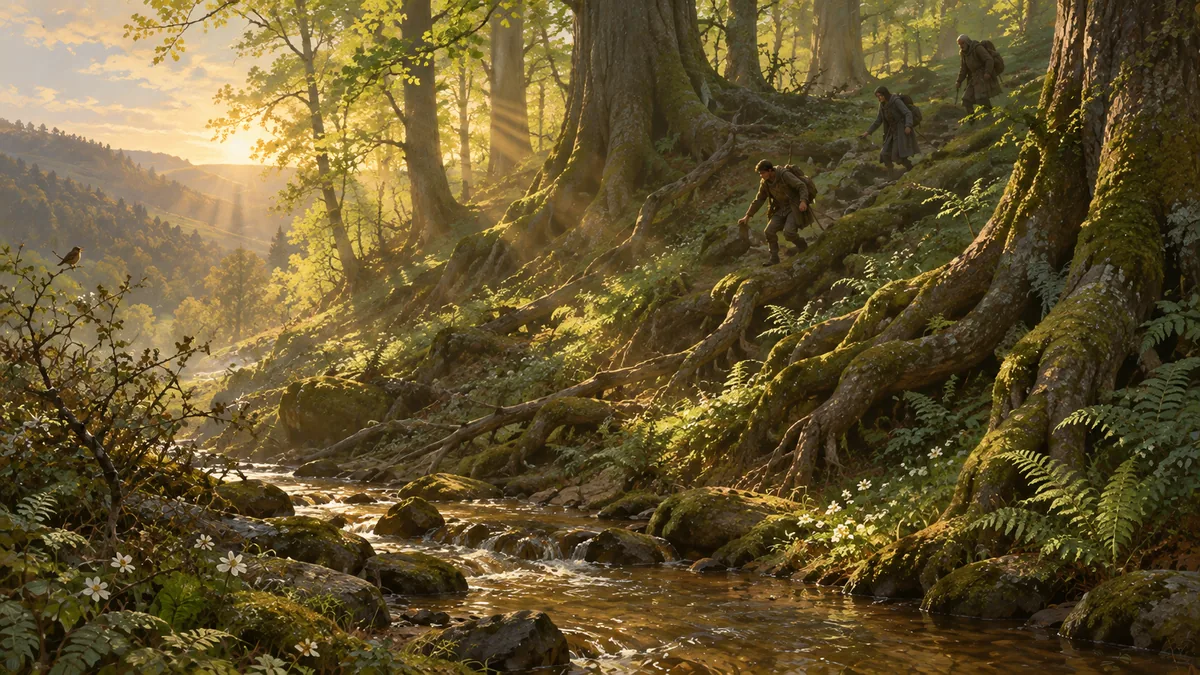
Lio stood at the top of the bank and stared. Below him the slope went down steeply, and it was covered with roots. They were the roots of the trees along the lip, great gray roots as thick as a man's body. They came out of the bank and went down it in loops and coils and steps. Moss lay thick on them, and between them, in the pockets of black earth, grew ferns and wood-sorrel and little white anemones, and the color of them was so bright after the gray that it hurt his eyes. At the foot of the slope there was a stream. He could hear it. He could hear water running over stones, a quick small voice, and over it, from somewhere in the trees beyond, a bird.
A wren: he knew it at once, the loudest little bird in the Margin, a scold and a singer. It was going on at them from a thorn bush at the foot of the slope.
They went down, and it was hard going. The roots were slippery with moss and the drops between them were longer than they looked, and twice Rupert sat down hard and slid. Brannoc went last and steadied each of them over the worst places with a hand on the pack. Halfway down, the light changed.
It came through the trees on the far side of the stream in long slanting bars of gold, the light of a late afternoon in spring, with the sun low ahead of them in the west and shining straight into their faces through new leaves. Lio stopped on a root and put up his hand against it. The sun was warm on his palm. His shadow went up the slope behind him, long and sharp and black.
Rupert was laughing. He was sitting on a root below Lio with the sun on his face, laughing aloud, with his hat off and his hair standing up.
"Look at it," he said. "Oh, look at it. Look at the sun."
They came down to the stream. It ran clear and fast over brown stones, westward, with the light on it. Brannoc knelt on the bank and put his whole face in it and drank, and came up with the water running out of his beard. Lio knelt beside him. The water was cold and tasted of stone and leaf, and he drank until his teeth ached.
The wren went on scolding them from its thorn.
They camped that night on the far bank, under an oak with real leaves on it, small and new and bronze. Brannoc found a hazel thicket, and in the dusk he caught a rabbit with a snare he made from a bootlace. There was a real dusk that night. The sun went down ahead of them in the west, red behind the trees. The sky went from gold to green to deep blue, and stars came out in it, and an owl called down the stream.
They ate the rabbit and sat by the fire. None of them said much. Rupert lay on his back in the warmth of the fire with his hands behind his head and looked up at the stars through the oak leaves, and every so often he sighed.
"I'll write it up," he said at last. He sat up. "The gray. I'll write it up tonight, while it's fresh. I made notes going through, I know I did, but I'll want it all down properly before I lose the edges." He was feeling in his coat. "Everything goes so fast after."
He found his book, the cheap green one he had started walking round the ring-stones, already soft at the corners. He opened it on his knee by the firelight, with his thumb holding the back pages shut out of habit, and turned the front ones over. Lio watched him over the fire. He was smiling, and turning the pages, and his lips moved as he read. Then the smile went.
"The white ring-stones," he said. "Warm to the touch. Dressed faces." His head came up. "Did I write this?"
"You wrote it at the stones," said Lio. "Walking round them."
Rupert looked down at the page again. He turned over. "Hill with dead tree goes behind." He turned over. "The mill with no water. Undershot wheel, paddles water-worn, no channel." His finger was moving down the page. "Woman in garden. Hollowed, Brannoc calls it." He turned over. "The hall with no roof. Inscription over the west door, chiseled out." He turned over. "Beech tree, two bodies. Lio would not pass it." He turned over again, and his finger came to rest.
Lio knew what was on that page. He had read it upside down by the light of Garrow's fire.
"Garrow," Rupert read slowly. "Brannoc told him his life all night." He raised his eyes to Brannoc. "Who's Garrow?"
Brannoc met his eyes.
"A friend of mine," he said.
"Did I meet him?"
"You gave him your whistle. The clay bird."
Rupert's hand went to his coat, to the place where the whistle had always been, and found it flat. Then he laughed.
It was a bright laugh, a quick high cheerful laugh, and it went on too long.
"Well, now," he said. "See that. Isn't that a thing. I gave a man my whistle and I can't remember his face." He laughed again and rubbed his nose with the back of his wrist. "Isn't that a thing. That's a good one. I'd not have believed it if you'd told me. That's going in the book, that is."
"Rupert," said Lio.
"No, it's all right. It's all right." Rupert was turning the pages again, fast now, back and forth. "Let me see. Let me just see what I've got. Wending, I've got Wending. I remember Wending, I remember the goats and that fierce old man and the woman coming in at dusk, and Clover." He caught on the mule's name, and went on. "And the wall. I remember the wall, the last wall, and the gray beyond it, and you singing, and her voice behind us. And then." He looked up. "And then the roots. This afternoon. The stair, and the sun, and the wren. And nothing between."
"Nothing at all?" said Lio.
Rupert shook his head and held up the book. "It's all in here. In my hand. I can see where I pressed hard and where the pencil went blunt, there, at the mill, and I sharpened it on a stone. I don't remember sharpening it. I don't remember any of it. I walked through all of that, eleven days of it, and I wrote it all down, and it's gone." He laughed again, that bright quick laugh. "It's gone, and here's the book. Here's the book."
He put the notebook down on his knee, open, and looked at it. The fire cracked. Down by the stream the owl called again, nearer.
"My mother forgot things," said Rupert.
He said it quite quietly, to the notebook.
"She was younger than I am now. First it was the bread, where she'd put it. Then a whole day." He turned a page without looking at it. "By the time I was twelve she'd look at me some mornings, very kindly, and ask me who I was."
Brannoc sat with his hands between his knees.
"I left her bits of paper on the table," Rupert said. "Where the bread was. Who'd been to the door. Then I just kept on." He closed the notebook. He smiled, a small one, not the bright one. "People think it's because I'm a crank. I suppose it is. But if it's all written down, there's something left over."
"And here it is," he said, to the cheap green book in his lap. "Something left over."
Lio got up and came round the fire and sat down next to him, with no words for it. He sat with his shoulder against Rupert's, as he would have sat with his brother at home, and presently Rupert leaned on him.
"Brannoc," said Lio. "Tell him about Garrow."
So Brannoc told him. He told it short, because his voice was still hoarse, and because it was Brannoc. A man in a brown coat with a red patch on the elbow, sitting by a chimney with no house. A name given back at dawn, and gone again by breakfast. A whistle that gave one thin sweet note, and a man who laughed when he blew it.
"He could play it?" said Rupert.
"He got a note out of it."
"I never could." Rupert looked into the fire. "I never once could. I'm glad he has it."
He opened the notebook again and found the page, and under the line about Garrow, by the light of the fire, he wrote something more. Lio looked away and let him write.
In the morning Rupert was quiet. He walked with the green book buttoned inside his coat, and once Lio saw him put his hand flat over the place, and keep it there a while.
The country beyond the stream was a forest again, and a forest Lio could read. This was not his forest. Here the trees were different, more oak and less beech, and there were holly and yew trees in the understory and a kind of tall pale-barked tree he did not know. But it was a forest with a morning and an evening in it, with birds, with deer tracks in the soft places by the stream and the droppings of foxes on the stones. The light came down through it green and gold. They crossed stream after stream that day, and every one of them ran west, down the land, as water ought to run.
And it was remembered. Lio felt that before he saw any sign of it. The ground was firm under his feet without the song, and when he stopped singing to test it, the way stayed. Before noon he found the first blaze, a cut on the trunk of an oak at head height, old and healed over, made with an axe by someone who had meant it to be seen. An hour later he found another. Brannoc found a stump with saw marks on it, gray and weathered. Rupert found a broken clay pipe in the leaves and turned it over and over with an expression of great happiness.
"Somebody comes here," said Rupert. "Somebody walks here, from the other side."
"Not often," said Brannoc. "Not for a while."
On the second morning after the stair, they heard the chain.
At first Lio could not place it: a small bright clinking, metal on metal, coming through the trees ahead of them. It stopped, and started again, and stopped. A voice called out a word strange to him. The voice was young, a woman's, sharp and clear, and another word followed, and the clinking began again.
"That's measuring," said Brannoc, very low. "That's a chain. I've seen the reeve's men use one at Wexley, laying out the market."
"Out here?" said Rupert.
They went forward through the hollies, carefully. Beyond them the ground opened into a long glade running north and south, with a stream down the middle of it. A tall striped pole stood upright in the turf at the near end. From its foot a chain of heavy links ran away through the grass toward the stream, and at the far end of it, with her back to them, a young woman was walking. She walked in a dead straight line, paying the chain out behind her as she went. She wore a brown coat belted at the waist, and boots to the knee, and a pack with a crossbow slung on it.
Halfway across the glade the chain had fouled. It had gone over the root of a fallen alder and caught in the crook of it, and she had not seen. She reached the stream and pulled, and the chain jerked taut and would not come. She pulled again. Without turning round she said something short and hot in her own tongue.
Lio had walked the bounds of woodlots with his father, holding the chain's far end. He knew that tug, and the walk all the way back after it, and the measure begun again from the pole. He went out of the hollies before he had thought about it. He crossed to the alder and lifted the chain off the root, and walked it straight, the links running over his palm, until it lay true along her line. He stood holding it and waited.
The chain went slack. The young woman had turned round.
She stood by the stream with her end of the chain in her hand and looked down the length of it at him. She did not reach for the crossbow. Her eyes went to the alder root, and to the chain lying straight across the grass between them, and back to his face.
She said something to him, quick and sharp, in a tongue he had never heard.
"I don't understand you," said Lio. "It was caught. On the root."
She stared at him. She was about his age, or older, with a narrow brown face and short dark hair cut straight across at the jaw. Her eyes went past him to the hollies, where Brannoc had come out with his bow on his back and Rupert behind him. They came back to Lio.
When she spoke again, she spoke in the old speech, the speech of Mara Vey. But in her mouth it had none of Mara's music. It came out clipped and hard and exact, each word set down like a peg in a line.
"Hold it there," she said. "Don't move it." She bent and read the brass tag on the last link, and took a pencil from behind her ear and wrote in a squat field book bound in gray board.
"What are you measuring?" said Lio. "Out here?"
"Where the ground gives out." She put the book away, and only then looked up. "Now. Say who sent you."
"Nobody sent us," said Lio.
"The Survey sent you. Or Dane. Or she did." She began to take in the chain, hand over hand, walking toward him as she gathered it, until there was only a yard of it left between them. "Three of you, to bring me back. Say which, and I'll know how far to trust the rest."
"We don't know any of those names," said Lio. "We've come from the east."
The young woman laughed, short and without humor.
"None come from the east in my time," she said, "save the one Mara brought."
Lio's breath caught. "That's my brother," he said. "The one she brought."
"Mara walked him through," the young woman said. "You've no Mara. By what road?"
"By my grandmother's," said Lio. "On a song. Through the gray."
For an instant she stared at him as though he had told her that he had walked across the sea.
"None cross the gray on a song," she said. "None cross it at all, save walkers, and they come back half what they went in. You're lying, or you're mad, or you're Dane's and think me a fool."
"I don't know who Dane is," said Lio.
She weighed him a while longer across the last yard of chain. At last she jerked her chin at Rupert.
"You. The stout one. Come here."
Rupert came forward, slowly, through the grass. She reached into her coat and brought out a folded paper and shook it open, and held it out to him.
"What's that?" she said.
Rupert took it, and held it close, and forgot her entirely. "Writing," he said. "But every letter's the same. No hand did this. How was it done?"
Something went out of her shoulders. "Any child in Sarne could tell you," she said. "Easterners. Truly."
"Truly," said Lio.
"Then you're the first that ever came over it on a song." Her eyes narrowed. "What do you want?"
"To bring my brother home," said Lio.
She was silent. Before she could answer, Brannoc stepped forward.
He came through the grass slowly, until he stood beside Rupert, and he put his hand inside his shirt. The young woman's hand went to the strap of her crossbow. Brannoc stopped, and held up his empty left hand to show her, and drew the other out slowly. The compass came with it, on a cord.
"I'm looking for someone too," he said. "Not a lad. A man. He went west twenty years ago, with me, and I lost him in the gray, and I've thought him dead." He held the compass out on his palm, so that she could see the brass, and the scratched lid. "He'd be forty-seven now. Big man, brown-haired, laughs too loud. Carried a deer on his shoulders once for a mile. Whistles through his teeth when he's frightened and doesn't want you to know. His name was Corren. Corren Tull."
The young woman studied the compass on Brannoc's palm, and afterward Brannoc himself, his gray hair and the deep lines beside his mouth, and frowned.
"Corren Tull?" she said. "Tull the hull-mender? He lives three streets from my mother."
She heard it as it left her, and her mouth went wry.
"Sarne's a hill with a harbor at the bottom," she said. "Everyone's three streets from somebody's mother."