The Survey
Brannoc sat down in the grass.
His legs went from under him, and he sat in the wet grass of the glade with the compass shut in his fist and his bow across his knees, looking at nothing. The young woman with the chain stared down at him, and turned to Lio, at a loss.
"He's been dead twenty years," said Lio. "To him."
"Corren Tull?" She frowned. "He's not dead. He's at the boatyards. He mends hulls." She looked at Brannoc again, at his gray hair and the lines in his face, and the frown deepened. "He sings at his bench. You can hear him from the ropewalk." She hesitated. "He has a wife. Two children."
Brannoc opened his fist and looked at the compass on his palm, and shut it again.
"He would," he said at last. "He always did land on his feet."
Lio went and crouched beside him. He did not touch him, because he knew better than that with Brannoc. He only crouched there at his shoulder until Brannoc breathed out, long and hard, and put the compass away under his shirt, and got up.
"I'm all right," Brannoc said. "Ask her about your brother."
Her name was Sil Arden. She was small and square-shouldered, with ink ground into the creases of her fingers, and she gave her name grudgingly, and only after Lio had given his.
"Surveyor," she said. "Of the Road Survey, in Sarne. I was."
She said Sarne as Lio would have said Wexley, as the name of a place she had bought bread in a thousand times. He had to look down at the stream a moment before he could ask.
"The one Mara brought," he said. "Tall. Dark. Talks with his hands, and asks you a question about everything until you want to hit him."
"All Sarne has seen him. Half of it has answered his questions." She was coiling the chain now, quickly and neatly, loop over loop on her forearm. "He's living up the hill with the old Archivist, who keeps the city's records. I saw him once, in November, in the map room, the week before I ran. Well fed. The Archivist keeps a good table."
Mara had told him Taren lived, at a fire in the dark, and he had believed her because he wanted to and distrusted her because he had to. This was a stranger who wanted nothing from him, and she said that Taren was well fed in the voice of someone mentioning the weather.
He sat down on a stone. Rupert came and sat beside him and put a hand on his back, between the shoulder-blades, and left it there.
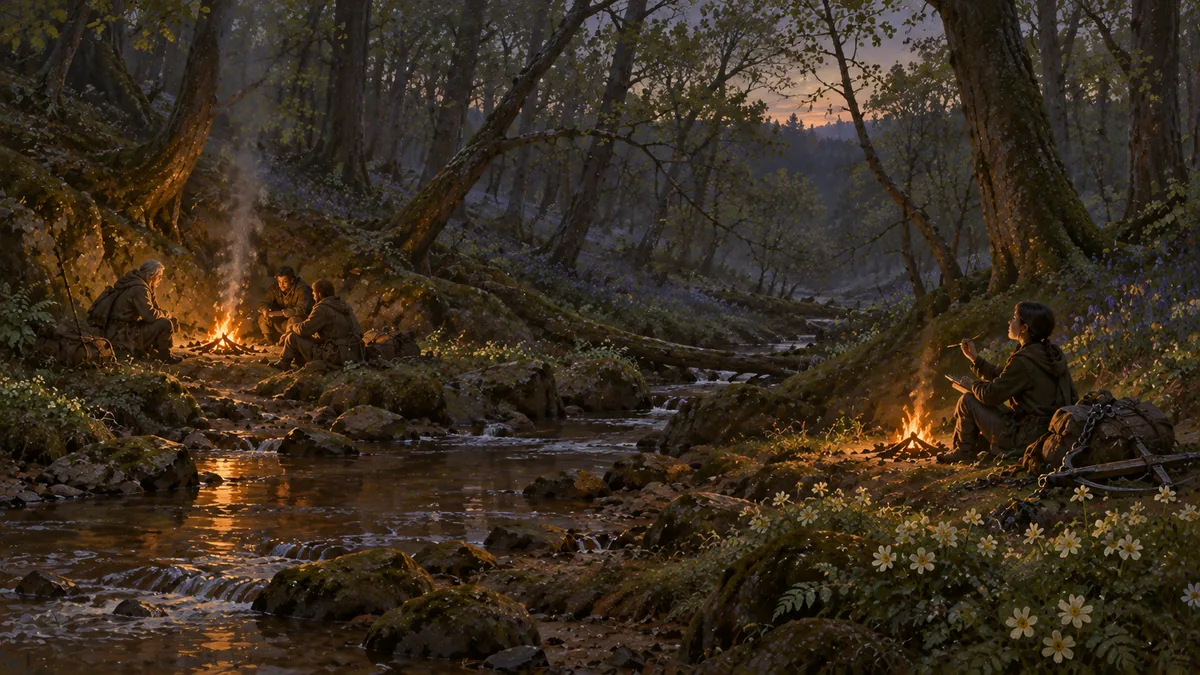
They made camp that night by the stream, because Sil would not walk anywhere with them until she had looked at them longer. She built a fire of her own a little way off, small and neat, with the crossbow beside her. She ate a hard brown bread that smelled of caraway and watched them across the grass as she ate. Every so often she took out her little book and wrote in it. Once she held her pencil up at arm's length against the trees, squinting along it, and wrote again. It was how a woodsman sights a fall-line, and Lio liked her for it before he could stop himself.
Rupert moved nearer by degrees and asked her questions, and she answered some of them shortly and ignored the rest.
"You said walkers," Rupert said. "Is Mara one?"
Sil's head came up. "Where is she?"
"We lost her in the gray," said Lio. "The second day in. She'd followed us from the oaks, and in the gray she was calling out the bits of the song she'd heard, and none of them belonged there. I called her in to us." He made himself say the rest. "She went behind a tree, and she didn't come out the other side."
Sil put her bread down. Her face had gone pale under its brown.
"The gray," she said. "We call it the Heart, in Sarne. It's the same country." She looked at the fire. "She'll come out. She always comes out."
"Pell said she doesn't age," said Lio.
"Not much." Sil's mouth twisted. "Walkers who force passages live slow."
"You know her," said Brannoc.
"She trained me. I was fifteen. She walked me into the western woods and taught me to hold a road in my head, and I walked with her till I was twenty-one. Then she took to forcing passages alone, and I went to the Survey and learned the chain. Two years of it. She'll call that running away."
"Did you?" said Rupert.
"Yes," said Sil.
She picked up her bread and ate it, and did not look at any of them again until the fire burned down.
In the morning she walked with them. She said nothing about it. She packed her chain and her pole at dawn, and when they set off west along the stream she fell in behind Brannoc.
The stream grew as others joined it, and ran fast and brown between banks of hazel and alder, so like the brooks of the Margin at home that Lio kept forgetting where he was. There were primroses on the banks, and the first bluebells coming up in the hollows like smoke.
Toward noon Brannoc came up and walked beside Sil. He did not speak for so long that she began to look at him sidelong, ready to be angry.
"Does he whistle yet?" Brannoc said. "Through his teeth."
Sil thought about it. "When a tide's wrong, and a hull's late, and the owner's on the quay. You can hear it across the yard."
Brannoc dropped back behind her. A little later Lio heard a sound from the back of the line that he had never heard in all the weeks of walking: Brannoc, whistling through his teeth, low and tuneless and badly out of practice. He kept it up for a quarter of a mile, and stopped.
Rupert lasted under an hour before he asked her how a road came back once the trees had it.
"Ten years ago the old roads east went a mile into the trees and gave out," said Sil. "Now they come back, firmer every year. In Sarne they say it's the children singing the old songs again. The office calls that keepers' talk. Hedge-keepers and old wives." She gave the word the clerks' sneer, and grimaced at herself, and shrugged. "Somebody always knows which road will firm before the Survey does."
"Who?" said Lio.
"I don't know. I only held the chain."
They were walking through open oak wood on the second day, with the ground thick under them with last year's acorn cups, when Lio asked why she had left.
Sil walked a good way before she answered. A woodpecker was working somewhere off to the left, a dry hard knocking that came and went.
"What's at the foot of your forest, Ashby?" she said.
"Thornby," said Lio. "Our yard. The mill. The Pennocks' orchard."
"Then there's a field drawn on it," she said. "There's a field drawn on everything east of the gray, and a name in it. I walked the roads and chained them, and the drawings went back to the office, and other people drew fields on them out of the old deeds." She kicked an acorn cup out of the path. "Then they began talking about wagons. Seed corn. And nobody in the office had asked who was on that land now."
"So you came east."
"To tell them. Whoever they are." She looked at him sidelong. "My ledgers are in my cabinet at the office, every tract I drew. You can't carry books like that through a passage. So I chain the road where it fails, and tell myself I'll be believed."
"In Thornby," said Lio, "they'd lock you in the reeve's cellar and send for a priest."
"I know it."
They heard the dog before they saw anything: a deep, interested baying back along the stream the way they had come, and after it a man's voice calling a name.
Sil was off the path before Lio had turned his head. "Down," she said. "In the holly." They went into a holly brake on the slope above the water and lay flat in the dead leaves with the spines in their necks. Brannoc put his hand over Rupert's mouth before Rupert could ask anything.
Two men came along the stream path in brown coats belted like Sil's. The one in front carried a cocked crossbow over his shoulder as a man carries a hoe, and he had a cold; he stopped to blow his nose on his fingers. The other had a hound on a cord. She was an old liver-colored bitch, gray in the muzzle, with one ear torn to a fringe. She came snuffing along the path to the place where they had turned off, and lifted her head toward the holly. Her tail began to go.
The man let the cord run out and cursed her in Western. She came up the slope with her nose in the leaves. Her gray muzzle pushed into the brake a foot from Lio's face, and went past him, and found Sil, and licked her ear from end to end with great thoroughness.
Sil lay under it without a flicker. Her hand came up slowly out of the leaves with a crust of the caraway bread in it. The bitch took it with soft lips, and backed out with it, and sat down on the path to eat it.
The man at the cord bent and looked at what she had, and laughed, and said something to the other. Lio heard "Arden" in it, and felt Sil's arm go hard against his. The man with the cold answered and spat in the stream. They went on east along the water, arguing, with the bitch looking back once over her torn ear, until the trees took the sound of them.
Sil sat up with leaves in her hair and wiped her ear on her sleeve.
"Moll," she said. "She followed my chain all last summer for the crusts. Kell's the one with her cord. He thinks she's found a road-mender's dinner." She picked a holly leaf out of her collar. "Osric Dane's posted me. He runs the Survey, and he hates loose ends. Any walker or road-mender who sees Arden brings her in, and whoever's with her. They'll sweep this water again in two days, with dogs that never ate from my hand."
That evening she sharpened her knife by the fire in short hard strokes. Whatever she did, she said, she did in the morning, before the dogs came back. She would go east, alone, and force a passage as Mara had taught her.
"Mara's in the gray with half a song in her head," said Brannoc. "And she's a better walker than you."
"Come west instead," said Lio. "Take us to Sarne and my brother, and get your books. You'll not be believed with nothing in your hands. Then come home with us, on the song. My father will stand next to you in front of the reeve."
The whetstone stopped. Sil sat with the knife across her knees.
"You'll not sing that song where anyone can hear it," she said. "Not in Sarne. Not in your sleep. And if they take me there, you'll not come after me. You'll take your brother and go."
"No," said Lio. "I left a man by a chimney eight days back. I'll not do it twice."
Brannoc looked down at his hands. "He's right," he said to Sil.
Sil stared at Lio across the fire. She slid the knife into its sheath.
"You're a fool," she said.
"Yes," said Lio.
They came onto the returning road the next morning.
The forest thinned ahead of them into hazel and birch, the scrub that springs up wherever men have been cutting, and they came out of a hazel brake onto the lip of a cutting, and the road lay below.
It ran straight from east to west, as wide as the high street at Wexley, and the trees on either side had been cut back a long way. Their stumps stood in rows along the verges, pale and new, and the smell of sap and sawdust was everywhere. The old paving had been dug out and relaid, and where stones were missing there was new gravel, raked level. East, the way they had come, it ran under the trees as far as Lio could see, and then it stopped in a raw wall of brush and torn stumps where the cutting had reached and gone no farther.
"That's a day east of where it was in the autumn," said Sil. "More."
On the north verge the road-menders had left their camp. Two handcarts stood with their shafts down beside a fire-pit, and picks and shovels leaned against a stump, and an empty kettle hung from an iron tripod. Brannoc crouched and put his hand into the ashes.
"Warm underneath," he said. In the gravel by his boot there were wheel ruts, crisp at the edges and damp at the bottom, and in one of them a crushed beetle was still moving its legs.
"They sleep at the main camp, west," said Sil. "They'll be back at sunup. They always leave the tools."
Beside the tool-chest lay a sheaf of wooden stakes tied with twine, each a yard long and pointed, with their tops painted red. Sil drew one out and turned it in her hands. There was a mark burned into the wood near the top, two crossed lines inside a ring.
"That's my mark," she said. "I set these last autumn, a day's walk west, where the road stopped firming. Every one in a line across the road, so they'd know how far to dig." She looked east along the new gravel. "They've pulled them up and brought them on."
She laid the stake back among the others, red top uppermost. Then she looked east along the new gravel, the way they had come, toward the gray and Thornby beyond it.