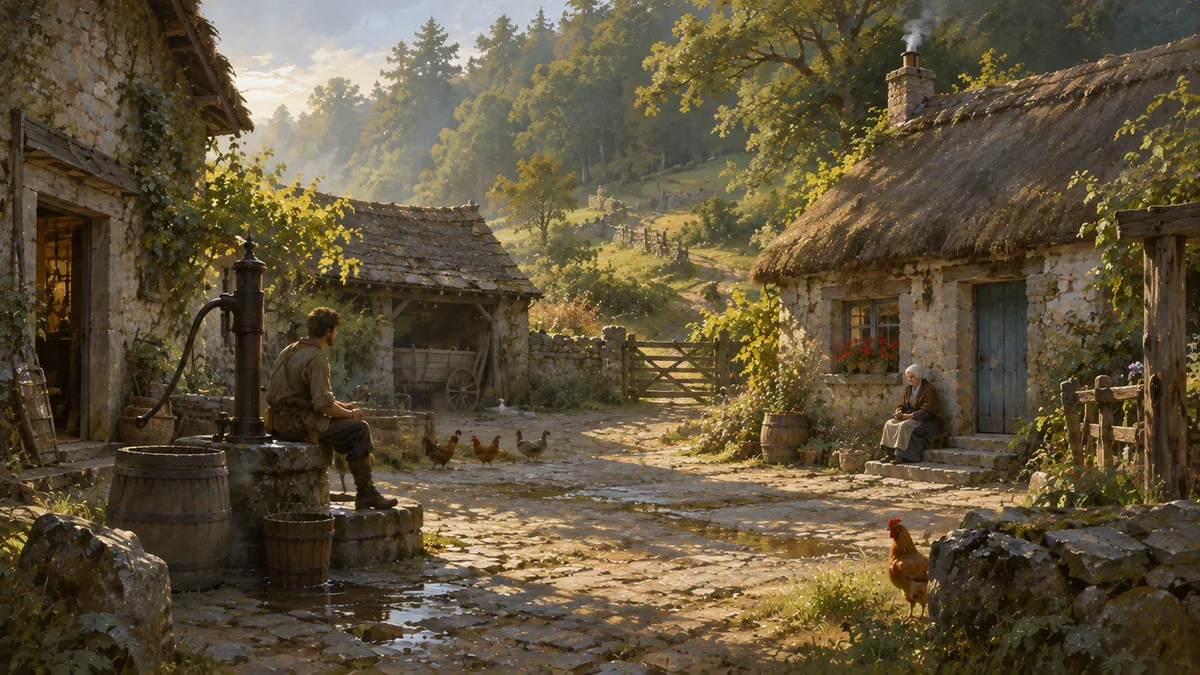
Elin
There was a slip of paper pinned to the wall beside Edda Ashby's bed, and every morning she woke and read it, and every morning there were two words on it that she did not know.
She had written it herself. She knew that much, because it was her hand, gone spiky with age, and because the pin was the one from her good shawl. She had written it on the night her grandsons came home out of the forest. In the kitchen she had held Lio's hand all evening. Later, in the cottage, he had sat on the floor by her chair and told her again about the house above the sea, and the boy, and the boy's name, and her own. She had said them over until she had them. When he had gone she found a pencil and wrote them down, large and careful, so that she could keep hold of them.
In the morning there were two words on the wall. They were perfectly good words. One of them had two of the same letter in the middle. They meant nothing to her at all.
She lay looking at it now, in the gray before sunrise, with the sparrows starting in the thatch.
"Hollis," she said aloud, reading. "Elin."
Nothing. They were words a traveler might have taught her at an inn, for a kind of cheese, or a saint. The sounds went nowhere.
Across the room, in the old box-bed that had been Aunt Maud's, carted over from Withy Farm across the river, the surveyor girl turned over and said something in Western in her sleep. Sil Arden slept as she did everything, hard and neatly, with her boots set side by side under the bed. She had lodged with Edda for five weeks now. Every evening she told Edda about the harbor at Sarne, and the fish market, and the steep streets. Every evening Edda saw it, gulls and pale stone and red roofs, a loud salt city that had lain at the bottom of her mind for fifty-nine years like a coin in a well.
And every morning she woke and could not remember her brother's name, or the name she was born with.
"Well, Jacob," she said to the ceiling. Her husband had been listening to her up there for twelve years without once answering back, which was more than he had managed alive. "There's a thing. I can tell you the price of eggs in Wexley in the year of the hard frost, and I can't keep two words for one night."
Jacob made no comment, and she got up.
She had been getting up in this valley for fifty-nine years. She had got up to babies and frosts and floods. She had got up the morning after Jacob's funeral, when the sun came over the eastern hills as usual and she thought that very rude of it. Now she got up to two words on a wall and a surveyor in Maud's bed. It was a long way to come, she thought, pulling on her stockings, for so little sense.
The family fussed her through breakfast, and she allowed it.
Bet would not let her carry the teapot. Owen would not let her sit anywhere but the chair by the range. Taren brought her bread with the butter spread right to the edges, because she had once told him at five that she liked it so. Edda had not the heart to tell him she had stopped liking it so at about the time he started remembering. She ate it. It was a small price for being loved.
Lio was not at breakfast. He had gone up the timber track at dawn with Sil, as far as the fork above the charcoal clearing, and no farther. He went no farther these days.
She was halfway through her bread when she heard them in the yard.
She knew at once that something had happened. It was in Lio's step on the cobbles, which was quick, and slowed. He had hurried most of the way and lost his nerve at the end. He came in at the back door with something in his hands, and Sil came in behind him and stayed standing by the door.
"Gran," he said. "Sil found it under the wreck. Where the bundle was. Same oilcloth."
He came across the kitchen and put it in her lap.
The packet was flat and the size of her two hands, wrapped in the dark, stiff oilcloth she remembered from February, and tied with cord. A beech leaf was stuck to one corner. On a square of pale paper sewn to the outside, in brown ink, someone had written a single word.
Her eyes knew the letters before she did. She saw them go past her mind as a bird goes past a window, and come back. It was a name of four letters, and it began with a capital that had a little hook at the top of it, curled over like the head of a heron. Nobody in the East made a letter that way. Nobody in the world made it that way, except one.
She had taught it to him. She knew it all at once, sitting by the range with her bread going cold. She had sat with him on the floor of a room with a blue tiled stove. She had held his fat hand round a stick of charcoal and made the first letter of her name for him. She had drawn the little hook on top because he liked birds. He had been three. He had pressed so hard that the charcoal broke.
"Elin," Edda said.
The kitchen had gone very quiet.
"That's me," she said. "That's my name." She put her finger on the curled hook. "My brother wrote it. That's his hand."
"There's more," said Sil, from the door.
Owen put his cup down.
"Up the gully, the far side of the wreck. A fire," said Sil. "Turf cut in a square and laid back over the ash after, the way we're taught. But the turf hadn't knit. The ash was warm. One night old."
"A trapper, then," said Taren. "Will Snape, or one of the Coldharbour lot, they're up there all summer after the—"
"Trappers don't put the turf back." Sil looked out at the yard. "And there's a print by Edda's gate. Boot nails in a ring round the heel. Survey issue. I wore them two years." She nodded at the packet in Edda's lap. "Somebody walked from the West to this yard with that, and lost their nerve at the gate, and left it at the wreck. Two years ago not even Mara could have walked it."
She held out a second packet, smaller, sealed in green wax. "This was tied under the first. It's for you, Master Ashby."
Owen took it. He broke the seal with his thumb and read it where he sat, slowly, as he read a timber-buyer's letter, with his mouth shut. Edda could see it from her chair: a clerk's hand, square and upright, in the valley's tongue, and at the foot a name with a flourish under it. Stroud. He was the Western man with the old deed to this house. A figure stood in the middle of it, written out in words and again in figures. Edda had kept the house accounts for Jacob for thirty years. It was a fair price for the house and the yard and the saw-pit, and something over, for the trouble. It was the second time of asking. Lio had told them in July of the first. It had been at a wall in the hills above Sarne, with this same courteous man beside him, asking him to name a sum so that his mother need never carry another pail.
Owen folded the letter once along its crease and looked at Lio, and Lio shook his head. Owen leaned past her chair and opened the door of the range and laid the letter on the coals, and shut the door on it, and picked up his cup.
He had not said a word. Bet had seen. She stood with the teapot in one hand and looked at the shut door of the range. She looked at her husband's bent head. Her other hand went up to the neck of her dress.
"In my yard," said Bet. "By her gate. While we slept, and never knocked."
She held her collar closed. Owen got up and went to the back door and stood in it, looking across the cobbles at the gate, and stayed there.
Edda looked from one of them to the other, and saw her mother.
It came up out of nowhere, as sharp as the crust in her fingers. A long table under a lamp, in a room high in a house above the sea, with maps on it spread one over another. Her father with his hands on them, big and quiet, smelling of ink. Her mother beside him, dark-haired and gray-eyed, with one hand at her throat, holding her collar closed. They were afraid. Edda had seen fear enough in her long life to know it. Men would come to the door soon enough, the new men, with warrants, and her parents never once looked at the door. They were looking down at the maps, at whatever lay on them, as you look at a dog you have always trusted when it has begun to growl.
"Gran?" said Taren.
"My mother stood so," said Edda. She was looking at Bet's hand. "When she was frightened. They were frightened, the last night. Not of the door." She could see the lamp on the maps, and their two faces over it, and not what they were looking at. That was on the end of her tongue, like the two words on her wall.
"Now then," she said, and had to say it again. "Now then. Don't all stand there. Somebody find me my scissors."
She would not open it in the kitchen.
She could not do it with all of them watching her, loving her, waiting to see what her face would do. She was sixty-six years old and she had a right to her face. So she took the packet across the yard on Lio's arm, because there was no shaking him off, and at her door she took her arm back.
"Go and see to something," she told him.
"Gran."
"I'll be on the step. You can sit on the pump and watch me, if you must. But you'll not read it over my shoulder."
He went as far as the pump and sat on it, and watched her.
She sat on her step in the morning sun and cut the cord with her sewing scissors. Inside the oilcloth there was waxed paper, and inside that a letter, three sheets written close on both sides. The writing was in the eastern tongue, in the old way of it, the way the road-walkers spoke. She had not known she could read it. She found that she could. The letters came to her slowly, one by one, and faster, until she was reading easily.
It was not a tidy letter. It had been written at more than one sitting, in two inks. The hand grew smaller and more crowded as it went, as if the writer feared to run out of paper before he ran out of things to say.
My dear Elin, I am told you have lived all your life within sound of a mill. I am glad of it. I have lived all mine within sound of gulls, which are noisier, and less honest, and steal.
I do not know how much of me you have. Your grandson says a little: a small boy holding your skirt. I have rather more of you than that. I have kept you for fifty-nine years, and I am afraid I have kept you seven years old, holding my hand on the Gull Stair and telling me not to look down. It is a poor sort of keeping for a man who has made keeping his trade.
A line was struck through below that, three times, hard enough to score the paper. Under it the writing began again in the second ink.
They have taken my keys, which is a great deal of iron to lose at my age, and I find I miss them less than I ought. I have a bad knee and a great many books. Your grandsons' friend Mr. Fenwick is cataloguing the Archive's coins. He is wrong about half of them, and I have no longer the standing to tell him.
The second sheet was closer written than the first, and it began You will want to know why. She could not face why, not on a step in the sun. She turned to the last sheet, as she had always turned to the end of a letter first, to see who it was from.
The road is coming, Elin. The first of them go in at the start of September, and I mean to come with them, though I come now as nobody in particular, with no office and no say. I would rather walk it to your door myself than have it walked there by strangers. I have begun to think that some of what I have done these ten years
That sentence broke off. A blot sat where the pen had rested on the paper, and below the blot, in a different slant, one more line.
I am too old to wait another fifty-nine years.
Your brother, who still makes your letter with the hook on it,
There was no name. He had written the line about the hook and gone no further, and drawn under it, small, in the corner of the page, a heron in its ring of waves. Its bill was too long and one leg was crooked, and the waves had not met at the top.
Edda sat with the sun on her hands and the letter in her lap.
From nowhere she heard a voice she knew for hers. It was a child's voice, high and cross and frightened, shouting down a flight of steps between pale walls with the gulls crying over it.
"Hollis! Hollis, come back! You'll fall!"
And a small boy in a blue smock, running down the steps away from her, laughing, turning at the bottom to see if she was coming.
"Hollis," said Edda.
It stayed. She waited for it to go, and it did not go. It sat in her mind as firmly as Jacob's name, as firmly as Thornby. Hollis. Her little brother, who could never say Elin and called her Lin until he was nearly four. Who had a gap in his front teeth from falling off the garden wall. Who slept with a wooden heron under his pillow that their father had carved for him.
When she came back to herself the sun had moved off the step. Lio was kneeling in front of her. He had taken the letter out of her hands and folded it, and he was looking up into her face.
"Gran," he said. "You've gone cold."
"I've remembered him."
"I heard you."
"He was at the window." It came up out of her from somewhere very deep. "The night they took me. I was in the carriage at the door with Maud, and I looked back, and he was at the window upstairs in his nightshirt. He'd got out of bed. He had his hands on the glass. He was four." Her voice cracked, and she could not stop it. "Nobody had woken him to say goodbye. And I didn't wave, Lio. I was too sleepy and too cross, and Mother pulled the curtain across, and I let her. I didn't wave to him."
She was weeping. She could not remember when she had last done it like this, with her whole body, with her face open and ugly and her hands over it. Lio put his arms round her on the step, and she held his coat in both fists and pressed her face into his shoulder. Over his shoulder she saw Bet come to the kitchen door. Bet stood there with her hand on the frame. She went back in and shut the door, softly. Edda would love her for that until the day she died.
"Then you'll wave," said Lio. "When he comes. You'll stand at the gate and wave him all the way up the lane."
Edda laughed into his shoulder, a wet, cracked laugh.
"I'll do better than that," she said. "I'll box his ears for drawing such a terrible heron."
In the afternoon she sat in her doorway shelling beans, because there was no stopping her, and Lio sat on the mounting block across from her and pretended to mend a halter.
Sil had gone with Brannoc to follow the boot-nails, and Taren to Wexley to tell Crane. Lio had been told to stay with his grandmother.
They were the first of the runner beans, long and green and furred, and her thumb went down the seam of each pod and the beans went into the bowl without her. Her hands had done it for sixty summers. Somebody's hands had done it before hers, in a kitchen at the bottom of a stair, with steam going up off the copper. Two red hands, quick and neat, over a bowl of peas, and a broad kind face above them that never spilled one.
She knew that face. She saw the night they sent her away. It was late, and she had been woken and dressed in her traveling clothes and brought downstairs, too sleepy yet to be frightened. Someone was beating on the street door. A man's voice outside was reading something out, slow and loud, with names in it, her father's and then her mother's, and under the reading went a sharp ring of iron on stone, a chisel at the heron over the lintel. Her father stood in the study with the door open, feeding papers to the grate as fast as it would take them. Her mother came out with her collar in her fist and two folded maps under her arm. She knelt and laid them in the cedar chest at Elin's feet, and pressed the heron, and the lid shut with no keyhole to show where. There were two people in the hall in dark coats. One was a man she did not know. The other was the woman from the kitchen stairs, and in the traveling coat she was a stranger. She would be Maud. She would be Maud for the next twelve years, and Edda would call her aunt, and never once ask why an aunt should have such careful hands.
And she saw Maud after, at the western edge of a great wood, at dusk, many days from the sea. The man in the dark coat had gone back along the track to the horses, and she could hear them blowing. Maud knelt in the leaf-mold in front of her and took her face between her two careful hands. Look at me, Lin, she said. We're going to put it all down now, the house and the stair and your mother and your name. Down under, where the roots are. Not the tune. The tune you keep, and the way it goes. You'll not lose the rest. You'll only not find it. Her thumbs moved over Elin's eyelids, one and then the other, light as moths. The wood had smelled of fern. When Elin opened her eyes she was a little girl called Edda, humming, and the sea was nothing to her.
The bowl had tipped in her lap. Lio was off the mounting block and catching it before the beans went.
"Maud was in our kitchen," Edda said. "Lio. I watched her shell peas every summer I had in that house, and I didn't know her face when she came for me in a coat." She held up her hands and looked at them, green-stained to the knuckle. "She put it all down under, with her thumbs. She told me I'd not lose it. I'd only not find it."
"You've found it now."
"Some." She took the bowl back from him and split another pod. "Who teaches a kitchen-woman to do a thing like that?"
He had no more idea than she had, and the good sense not to pretend. He sat down on the step below her and held the halter he was not mending.
"It's held fifty-nine years," she said at last. "It'll keep till supper."
At supper she remembered the chest.
It stood by her hearth, under its cloth, with her teacup on it, where it had stood since January. She had looked at it every day. Now, sitting at Bet's table with a spoon halfway to her mouth, the chest came into her mind, and her spoon stopped.
"Bring it," she said.
Lio and Taren carried it across the yard between them and set it on the kitchen table. Lio lifted the cloth off. The cedar had gone dark with age and smelled, under the cloth, of summers long gone. The heron stood on the lid in its ring of waves, carved deep and worn smooth at the edges by the hands of people who had tried to open it and could not.
Owen had once looked at it for a whole wet afternoon with his carpenter's eye and declared that whoever made it was either a genius or a fool, and he did not know which.
The family stood round. Sil had come in from the yard and hung back by the dresser with her arms folded. The lamp was lit.
Edda put her hand on the heron and pressed.
Nothing happened. She pressed the bird's breast and its folded wing, and the waves all the way round. Her hands knew this. She was sure her hands knew it, and the lid sat on the box as tight and blind as it had sat all winter.
"Gran," said Taren gently.
"Hush. I'm doing it."
She did it all again, and her fingers slipped. She could feel them all watching her, loving her, and she could not bear it.
"Go and sit down," she said. "All of you. Go on. Bet, go and see to your dairy. I'll not have the whole family standing over me like a calving."
They went, more or less. Owen sat down at the far end of the table. Bet went to the sink and kept her back to the room. Lio stayed where he was, because he was Lio.
Edda shut her eyes.
She did not think about the chest. She thought about the steam coming off a cup. She thought about a hand, cool and dry, laid over her small one, and the smell of ink. Here, her mother said. Not like that, Lin, you're pushing it like a door. Feel for the eye. Now press. And the wave behind it, the third wave, turn it with your thumb, toward the sea.
Her hand moved under the remembered hand. She found the eye with her forefinger, a tiny round boss no bigger than a lentil, and pressed. She found the waves behind the bird with her thumb, and felt along them, one and two and three, and turned the third toward the sea.
Something clicked under her hand. The lid rose a finger's breadth and hung there.
She opened her eyes. Owen had half risen from his chair. Bet had turned from the sink with a cloth in her hands.
"A genius, then," said Owen, very quietly.