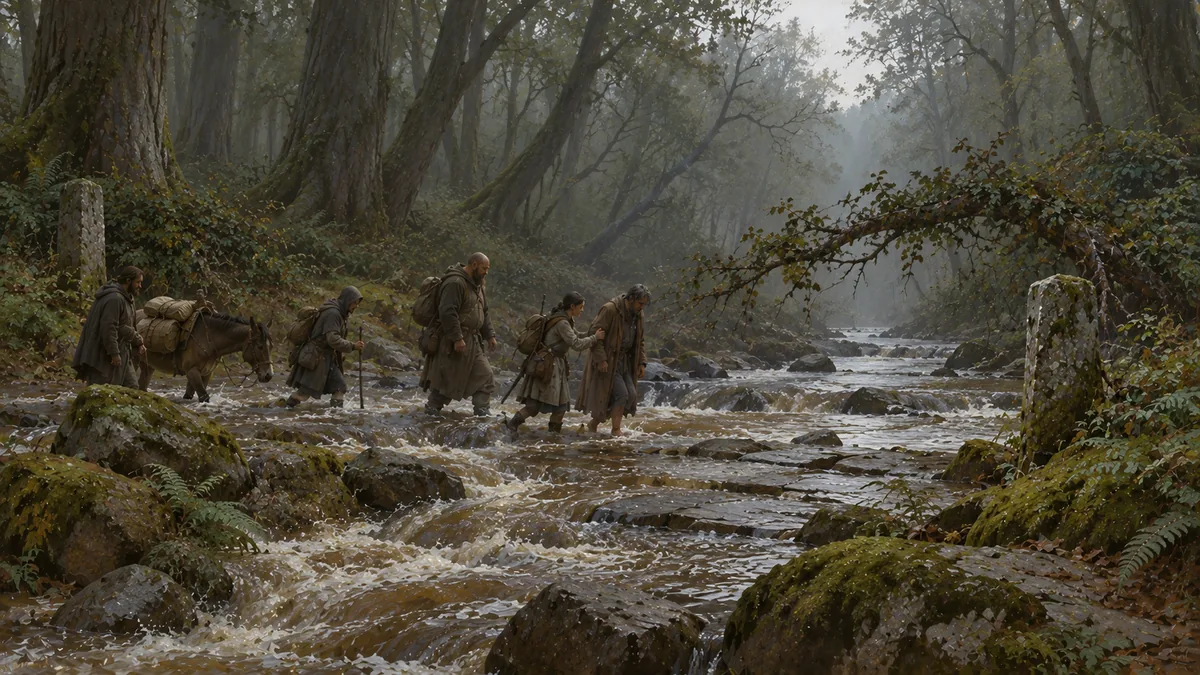
Garrow Walks East
"Garrow," Brannoc said.
Garrow, the lost man they had left sitting by the chimney with no house, did not stop at his name, nor did he quicken. He went on along the bank at the same slow pace, his eyes on the ground in front of him, until Brannoc came down through the ferns and stood in his way. There he halted and looked up.
He was thinner than Lio remembered. His beard had grown out, brown and ragged. The coat hung off his shoulders, and his feet were bare and black with mud. But his face was the face Lio remembered from the chimney, a house with the shutters open and the rooms swept bare. He looked at Brannoc, and then at the water going by, with the same mild interest.
"Good day," he said.
Brannoc answered him gently. "And to you, Garrow."
"Yes," Garrow said, pleased. "That's my name. Garrow." He seemed to turn it over. "Garrow Lisle."
Brannoc's hand came up and stopped in the air between them. Then it went on and settled on Garrow's arm, very lightly.
"Lisle," Brannoc said. "That's right. That's new, that is. You hadn't that when I left you."
"Hadn't I?"
"No."
Garrow considered this. "I've been walking," he said. He lifted one hand and pointed east along the stream, into the gray. "I came from over there. A long time ago. I thought I'd go back and see."
"I said I'd come for you."
"Did you?" Garrow smiled at him, a kind, vague smile. "That was good of you."
Brannoc stood holding his arm. After a while he turned his head and looked back up the bank at Lio.
"He'll be slow," Brannoc said. "I'll not pretend otherwise. He'll slow us all."
"He comes," Lio said.
"If there's a cost—"
"Then we'll pay it. He comes, Brannoc."
Sil, standing beside Lio, had folded her arms. She was looking at Garrow with a careful horror Lio had not seen on her before, as she might have looked at a bridge she had been told was sound and could see was not.
"How long has he been in here?" she said quietly.
"Twenty years."
"He looks thirty."
"He's lived about five years of it," Brannoc said. "The rest went by outside, without him."
Sil went down the bank to Garrow and took his other arm, as Lio's mother took Edda's to cross the yard. Garrow allowed it with an air of faint surprise, and the five of them went on east beside the water, at Garrow's pace.
Garrow's pace was slower than it looked.
He walked steadily enough. He did not stumble or tire. But he stopped. He stopped for a fern uncurling and for a beetle on a stone. He stopped for a bird none of them could name, that sang one note over and over in the high branches. He would stand and look at a thing with his head on one side until somebody touched his arm. Then he would nod, pleased with whatever it was, and walk on.
Lio walked first and kept his mind on home, which was harder with Garrow behind him. Every time Garrow stopped for something the gray held out to him, Lio felt the way loosen under them all, and had to take hold of home again. He learned to think of it more fiercely when the soft slap of those bare feet stopped behind him. The smell of the dairy on a hot morning. The grain dust in the mill doorway, gold in the light. The way Captain, his father's old carthorse, blew through his nose at the paddock gate when he heard the bucket.
In the late afternoon, at a halt, he sat down beside Garrow on a fallen trunk.
"How did you find this way?" he asked. "Coming out of all that gray. How did you know to walk here?"
Garrow thought about it so long that Lio thought he had forgotten the question.
"I heard something," Garrow said. "In the night. Far off." He frowned hard, and two fingers moved on his knee, slow, keeping time to something.
Lio's skin prickled. "A mill."
Garrow turned the word over, as if feeling for its edges. "A mill." He looked at Lio with surprise, and behind his eyes something turned over, like a fish in deep water. "There was a mill at home," he said. "By the bridge. The miller had—" He stopped. The fish went down again. "I don't know what the miller had," he said, apologetic.
"A goose," said Brannoc, from the other end of the trunk. His voice was rough. "Sam Dyer had a goose."
"Did he?" Garrow smiled. "I should like to have seen her."
Lio woke in the night and found Brannoc sitting up.
The fire had burned down to a red eye. Garrow slept beside it on his back with his hands folded on his chest. Brannoc sat with his blanket round his shoulders and his bow across his knees, watching him.
"Go back to sleep," he said, without turning.
Lio sat up instead and pulled his blanket round him. "You said you'd come back for him," he said. "And you came."
"He walked half the way himself." Brannoc's voice was very low. "I'd have been months yet. I'd have had to go all the way round by Sarne and cross that gray again from the far side, alone, at my age. I told myself I would. I don't know that I'd have done it." He turned the bow in his hands. "He heard your mill, and he got up and walked toward it."
He was quiet a while.
"His mother'll be past eighty, if she's living. Agnes. From fifteen I went up to Coldharbour every summer for the haymaking, and she fed the lot of us at her back door, bread and dripping. She'd rap your knuckles with the spoon if you reached before she said." His eyes went to Garrow's sleeping face. "What do I tell her?"
"That you brought him home."
"Brought her what, though?" said Brannoc.
Lio had nothing to answer. He lay down again, and had nearly slept when he heard the knock.
It came from behind them, from the west, back up the stream, very faint: a knock and a pause and a knock, and in the pause a little dragging catch, as of wood on wood. Across the embers Garrow's eyes opened. He sat up, slowly, and turned his face toward the sound. He got one knee under him.
Brannoc put out his hand and took the hem of the brown coat between his finger and thumb, and held it. Garrow looked down at the hand, puzzled and patient. Then he lay down again with his face still turned to the west, and listened, smiling, until he slept.
Brannoc did not let go of the hem. He was sitting the same way, with the cloth in his fist, when the gray came back into the trees.
They found the thread on the fourth day.
The stream had grown into a little river by then. It ran fast and brown between banks of roots, and in places it went under the trees altogether, through a tunnel of leaning trunks. Where it came out into the gray again there was a real ford, paved with flat stones that the water had polished, with a stone post on either side where a chain might once have hung. Lio walked down into it with the cold pulling at his shins.
On the far bank a bramble grew out over the water. Sil, crossing behind him with Garrow on her arm, stopped in the middle of the ford and stood looking at it.
"Lio," she said.
A thread was caught on one of the thorns, a single strand of gray wool a hand's length long, lifting in the air off the water. He reached up and took it off the thorn and rolled it between his fingers. Coarse and oily and undyed, the gray of a heron's back.
Sil had come up beside him, but she did not touch it.
"That's road-walker's cloth," she said. "They weave it in Harl Street, by the rope-walk, and they oil it twice." Her mouth had gone hard. "I wore it for six years."
"Mara," Brannoc said.
"It could be any walker."
"Could it?"
Sil looked at the thread in Lio's palm. "No," she said. "It's her."
Brannoc put a finger to the bramble cane where the wool had hung. The cane was dragged forward along its length, the thorns turned and a leaf torn half off, all of it pulled one way. "Caught going east," he said. "She's ahead of us, and lost. She came through this ford casting about, and went on east. An hour since, maybe less."
"She's been on our path," Sil said to Lio. "How is she on it? You can't follow a held way unless you're holding it with us. She'd have to have been near us, at night, by our fires. Close enough to hear us talk."
"Close enough to hear us talk about home," Lio said.
He put the thread in his pocket, beside Rupert's seashell. Garrow stood in the ford with his face turned up to the bird that sang one note. Brannoc was watching the trees behind them.
"We could go faster," Brannoc said. "You and Sil and Taren. I'll stay with him and come on at his pace. You'd come up with her by morning."
"No."
"Lio—"
"We go together," Lio said. "All of us. If she's ahead, we'll come up with her at his pace. I'm not leaving anyone else in here."
"Then we go at his pace," Brannoc said, "and she gets further on." He went back to take Garrow's arm.
That night they sat close round the fire and talked of home.
They ate, and then, as Brannoc had told them they would every night, someone began, then someone else, and it went round the fire until they slept. Sil told them about the harbor at Sarne on the morning the fishing fleet went out, with the boats crowding the mouth and the women on the wall shouting. Brannoc told them about Wexley market and the cheese-woman who cheated everybody so charmingly that they thanked her for it. Garrow listened to all of it with the same calm, and once he laughed at a place in a story where the rest of them had gone quiet.
Then it came round to Taren.
He was sitting with his back against a tree and his knees drawn up, looking at the flames. For a moment Lio thought he would say, You tell it, as he had at the broken bridge. But he roused himself.
"I'll tell about the time Father took the old horse to Wexley fair," he said, "and the horse wouldn't cross the bridge. You remember, Lio. Father sat on him half the morning on the end of the bridge with all of Wexley shouting advice. In the end he got off and walked across, and the horse walked over after him, meek as you like. And Father got back on at the other end as if he'd meant to do it all along." He was grinning. "Father's horse. Old—" He stopped.
He looked at Lio across the fire, still grinning, and the grin went slowly wrong.
"Old what's-his-name," he said. "Help me."
"Captain," said Lio.
Taren laughed. He slapped his knee. "Old Captain. I'm that tired I'd forget my head." He went on with the story, and he told it well, with his hands, making them all see the horse planted on the end of the bridge and Owen's long-suffering back. Sil laughed. Brannoc smiled, and Garrow said, "Yes."
Lio sat with his arms round his knees and watched his brother's face in the firelight. He had known that horse's name since before he could say his own. So had Taren, who had been six when Captain was a foal, and had named him.
At first light, while the others were still rolling their blankets, Sil came and squatted beside Lio at the dead fire.
"How long has it been, out there?" she said.
"I don't know."
"Nor do I." She ran her thumb down the stock of her crossbow, where she had cut a notch every morning since they stepped off the road. There were four. "I can count ours. I can't count theirs." She picked up a charred stick and turned it in her fingers. "You can't, off a road. The first crossing is set for September. It's in the book, in my hand. If we lose the summer in here, Lio, there's no warning left to bring. We walk out of the trees and they're already on your ford."
Brannoc knelt with his blanket half rolled and looked across the ashes at Garrow, who sat with his bare feet to the last of the warmth.
"It's his pace," Brannoc said. "I'll say it the once. Every time he stops, we stop, and outside the days go on without us."
Sil snapped the stick and threw the halves into the ashes. Brannoc finished rolling his blanket and went to get Garrow on his feet.
That morning Lio walked beside his brother instead of in front. It was harder that way. He kept the smell of the orchard and the sound of the mill at the back of his mind. With the front of it he talked to Taren: the dairy roof, the Pennock boys, the year the ice took the stepping stones out of the ford. Taren answered him easily, and laughed in the right places, and Lio told himself that was all right.
At the noon halt Garrow sat down beside Taren on a root.
He had not chosen to sit by anyone before. He had sat where he was put, or where he happened to stop. Now he crossed the little clearing with his slow, careful steps and lowered himself onto the root at Taren's side, and looked into Taren's face as a man looks over a gate at a neighbor's field.
"You're from over there," Garrow said. He nodded east, into the gray. "Like me."
"Am I?" said Taren.
"I think so. You've the look of it." Garrow smiled. It was the warmest smile Lio had seen on him. "It gets easier," he said. "You'll see. You stop wanting to get anywhere. It's very restful, after."
"That sounds pleasant," Taren said.
Lio was on his feet before he knew it. He was across the clearing and taking his brother under the arm and hauling him up off the root, and Taren came up easily, surprised, with his bread still in his hand.
"Walk with me," Lio said. "Come and look at the river."
"I was talking to—" Taren looked back at Garrow, and frowned, and could not find the name.
Brannoc had come too. He put his hand on Garrow's shoulder and bent and said something to him, low, and Garrow nodded and turned his face up to the trees.
"He means it well," Brannoc said over his shoulder. "That's the worst of it."
Lio walked his brother down to the river. The bank was steep there, and below it, on the near side, a flight of stone steps came down out of the fern to the water's edge. It did not stop at the edge. It went on down under the river, step after step, pale and clean, until the brown water hid it. Somebody had once walked down those steps to go somewhere under the river, or the river had come up over a road.
Lio stood at the top of the steps with his hand on his brother's arm and waited.
He had waited for Taren's questions all his life, as you wait for the next spatter when the rain is coming. Who built that? Where does it go? Why does the water run brown after rain and clear after frost? Taren had asked them of their father until Owen hid in the saw-pit, and of Edda until she pretended to be deaf, and of every stranger who came through Thornby on the Wexley road. A stair going down into a river would have had him on the bottom step by now with his boots full of water.
Taren looked at the steps, and at the river going over them, and ate his bread.
"Ask me something," Lio said.
"What about?"
"Anything. You always do."
Taren thought about it, honestly, with his eyes on the water. "I can't think of anything I want to know," he said.
Lio told him about the ford at home instead. He told him how the riffle sounded in August when the water was low, and how the old ash tree on the far bank leaned out over it. Taren listened and nodded. When they went back up to the others, he had dropped the crust somewhere and did not seem to know it.
Brannoc was waiting at the top of the bank. His eyes went to Taren's empty hand.
"How long?" Lio said to him. "With Garrow. How long did it take?"
"I wasn't there when it took him. I wasn't there for myself, rightly. One day I knew Corren's face and the next I couldn't find it." Brannoc's voice was low. "It's not fast. And then it is."
The afternoon came on gray and windless.
They walked through country that had once been fields and was now a long, soft slope of fern, with the ghosts of walls running across it. Lio kept hold of Taren's arm, and talked. He told him about the house, room by room: the range, the shelf with the lantern on it, Edda's chair by the fire, with her shawl always over the back of it. He told him about their father standing in the millrace in October with his lips blue, saying Morning. Taren answered less and less, and then only when he was asked, and Lio talked until his throat was raw.
At the top of the slope a wall ran across their way. It had fallen long ago, and what was left of it was a low, broken ridge of gray stones, knee-high, with moss on the top and foxgloves growing out of the cracks. The light was going. Somewhere ahead, under the trees, the river ran.
Taren stopped at the wall and sat down on it, carefully, with his hands on his knees.
"Taren," Lio said. "Get up. We're nearly at the camp."
Taren lifted his head and looked up at him.
He studied Lio's face with a patient, careful attention, as at a stranger who has stopped him to ask the way. He looked at his hair, and his coat, and the hand Lio was holding out to him. His eyes were Taren's eyes, dark and quick under the dark brows, but there was nobody behind them, nobody at all.
"I'm sorry," Taren said kindly. "Do I know you?"