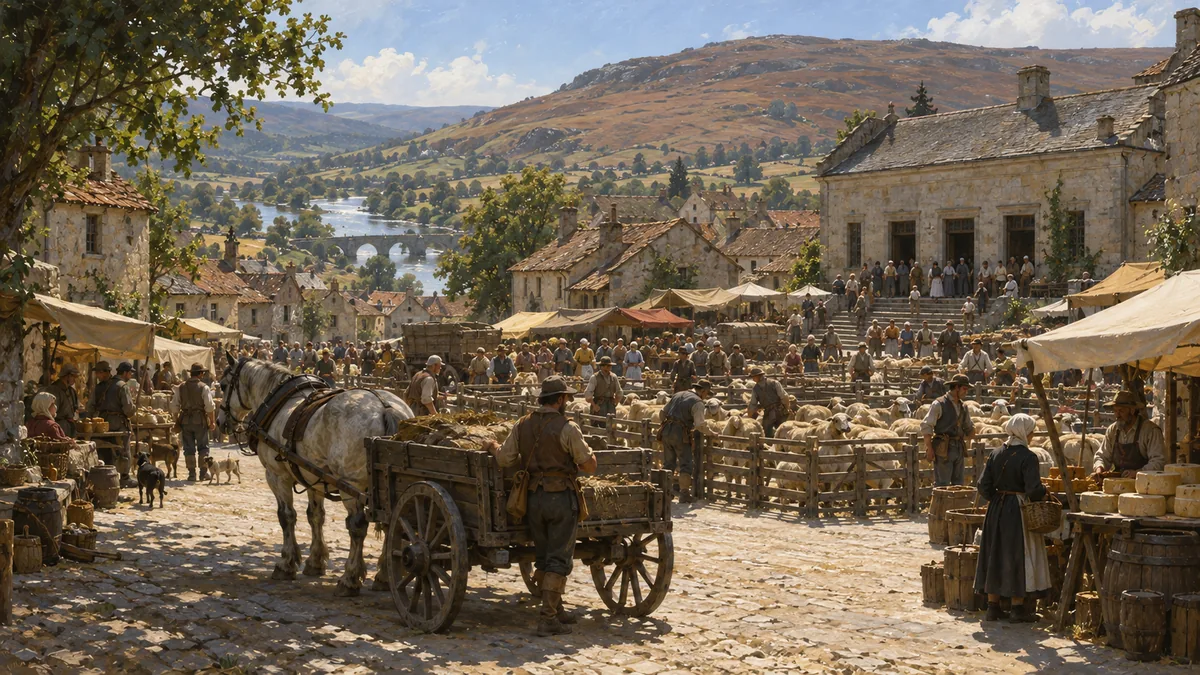
Amberlow
By ten o'clock on the first of August the reeve's hall at Wexley was full, because Crane had sent his clerk round the market stalls to say there was a tale worth hearing.
Ned Cotter the smith had come down from Thornby, and the Coldharbour miller with flour in his eyebrows, and half the drovers from the sheep pens. Near the front, on a stool he had brought himself, sat Gideon Marrable the timber-master, who had paid Lio full price for the storm-felled beech logs before Midwinter and promised to argue next year. The windows stood open on the square, and the noise of the market came in at them with the flies.
Crane sat behind the long table in his black coat. He listened to Lio without interrupting. He listened to Taren.
Then Sil stood up and unwrapped her book.
Lio had carried it, or watched her carry it, from the drafting room in Sarne through all the gray. He had seen her sleep with her arm across it. He had never once seen it open. She took off the oilcloth and the waxed linen under it and laid it on the table in front of Crane. It was a squat field book bound in gray board, with its corners worn round. She opened it.
Crane looked down at the Western writing and put his heavy hand on it.
"I can't read this," he said. "I can't enter in the record a paper I can't read. Nor can I take its reading on the word of the person putting it in, when she's told me herself she's a clerk of the very office she accuses, and a runaway one at that."
"Surveyor," said Sil. "Not clerk. And I can read it."
"So you say." Crane looked round the hall. "A ship in a wood. A road-walker in Ambrose Pennock's orchard, who came to take it off him. And a girl with one book, in a hand not a man here can read, who tells us an army's coming."
"Not an army. A survey. Settlers behind it, with deeds."
"Deeds to what?"
"To this." Sil turned the book round. "The valley. Every field."
Somebody laughed at the back. It spread along the benches, the easy laugh of men fetched from market to hear a tale. One of the drovers said, loud enough to carry, that he'd known a man in Coldharbour who saw the moon come down in his duck pond.
Bet stood up. Her face was white, and her voice carried to the door.
"Ned Cotter," she said. "You stood on a bench at midwinter and drank to my son dead. There he sits. Laugh at that."
The laughing stopped. Ned Cotter looked at his boots.
"Ask her about your fields," said Lio.
Crane turned his heavy head toward Lio.
"Name a field," said Lio. "Any field you like. One Sarne could never know."
The hall quieted. Crane sat back. He was a magistrate, and he knew a fair test when one was put to him, and he did not like being put to it.
"The Ings," he said. "Below the bridge, on the east bank. My barley ground."
Sil was already turning pages. She went past her own field notes, in her small square hand, to the pages at the back where she had copied the Survey's plan of the parish. She ran her finger down a margin and halted. She turned the book on the table so that Crane could see. A plan lay across both pages, inked fine and ruled. It showed a river bending, and a bridge of three arches, and on the east bank below it a long field with a line drawn slantwise across its lower end.
"Wexley Ings," Sil read. "Tract forty-one. Bounded west by the river. South by the mill-leat. Divided by the old bank." She looked up. "That's this line. 'An earthen bank of great age, a thorn at its north end, not to be plowed.' The tract below goes to a family called Brede, on the old deed. The tract above goes to you. They have you in it as tenant."
"There's no bank," said Ned Cotter from the benches. "Is there, Arlen?"
Crane was looking at the page. He was looking at the slanting line, with a little cross drawn at the end of it for the thorn.
"My father broke a plowshare on that bank," he said. "The year I was born. He tried to plow it out with four oxen and broke the share and lamed the near ox. I've plowed round it all my life." He took his hand off the book. "There's a thorn at the top of it. A blackthorn. My mother hung washing on it."
The benches had gone quiet.
"Who drew this?" said Crane.
"Survey clerks, off the old deeds, so the stakes go where the deeds say. I copied it in the drafting room in November." Sil closed the book on her finger. "The West has never seen your field. Nobody had to. It was written down before the Wood."
When Crane spoke again his voice had not risen at all.
"Then we burn it."
"Burn what?" said Lio.
"The Margin." Crane looked past him, out of the open window, at the brown hill above the town where nothing had grown but bracken since he was seven. "My father burned the wolves off that hill, and they never came back. When the wind goes into the east, we'll fire the wood from the river side, a mile deep. A road must come out somewhere." He looked at Lio across the table. "You came here and told me they're coming, lad. I believe you now. I'd sooner their road came out into ash than into my barley."
The hall broke into noise. The charcoal burners were shouting, and the miller, and someone was banging a bench with his fist. Lio stood in the middle of it with his mouth dry. The Margin. The pig-runs and the trappers' huts and the stacks, and every track he had ever walked, and his father's living.
Gideon Marrable got up off his stool.
He was slow about it, because his knees were bad, and he stood with one hand on the table's edge while the hall went quiet round him. He was a small, wide, bald man of sixty-five with a face like a walnut.
"You set fire to the Margin, Arlen," he said, "and I'll be sat in front of it."
"Then you'll burn with it."
"Maybe so," said Gideon. "I'm old. It'd save my daughter the trouble."
Someone laughed, and choked it off. Sil had opened her mouth to speak. Crane lifted his hand to her without turning his head.
"The bench will hear no more today," he said. "Gideon. Mind your stool."
They drove home up the valley in the heat, with the cheeses sold and the cart quiet. At the top of the long rise above Thornby, where the road came out of the hedges and you could see the whole western side of the valley, Owen pulled Captain up.
The Margin lay along the hill above the village, green and close in the noon light. There were the beech stacks above the charcoal clearing, and the pale scar of the timber track going up into the trees, and a thread of smoke from one of the burners' mounds. There was the top of Ambrose's pasture with the cherry trees, and above it the first of the beech trees Lio's grandfather, old Jacob Ashby, had planted. Owen sat and looked at them with the reins slack in his hands.
"He means it," Bet said.
"He does." Owen gathered the reins. "I've thinned those trees thirty winters. I'll not watch a man from Wexley burn them because he's frightened of a book." He clicked his tongue, and Captain leaned into the collar. "Gideon's right. If it comes to it, I'll be stood in front of them."
In the back of the cart Sil started to say something, and thought better of it, and held her book.
Rose Pennock had taken Mara over in the first week, as she took over kittens and lame jackdaws, and led her round the orchard by the hand every day, telling her things.
Mara let herself be led. She knew her own name, and Rose's, and in the evenings she sang the child hill songs from above Sarne in a voice that brought Ambrose out to his door to listen. But in the mornings she would come down the loft ladder and stand at the orchard gate with her hand on the latch, and not know which way to turn. Sometimes she stood there till Rose came for her. Kit Hay sat on the wall with a cudgel, watching, and grew bored of it.
On the Monday after the hearing Lio went down with the milk and found them in the bottom rows.
"That's the russet," Rose was saying. "With the iron round it. Grandad put that on when it split. That's Gran's pear tree. It gives nothing. Grandad won't cut it down because Gran planted it, and she's dead."
"It gives nothing," said Mara.
"Not one pear. Not ever." Rose pulled her on. "And that's the pig."
Ambrose's old sow lived in a hurdle pen at the bottom of the orchard, under the damsons. She was a vast ginger creature with a torn ear, and she was standing on her hind legs against the hurdle, looking at the baskets of windfalls. As they came down the row she leaned her weight on the hurdle, and the hurdle went over.
Rose shrieked. The sow came out of the pen at a trot that shook the ground and went straight for the baskets. Kit Hay fell off the wall. Lio started forward and knew he would be too late.
Mara was already moving.
She went past Rose at a run, low, with her skirts caught up in one fist. She got to the sow before it reached the baskets and took it by the torn ear and the root of the tail together. The sow screamed and bolted. It dragged her through the nettles and a drift of rotten windfalls, and she went down on one knee and came up again with her grip unbroken. She dug her heels in and leaned back on the ear. The sow swung round with its trotters skidding. She put her knee into its shoulder and walked it back into the pen by main force, talking to it in a low, furious voice. She kicked the hurdle up behind it and stood on the bottom rail.
She stood there, breathing hard, with apple-mush to her elbows and a long green smear of nettle down one cheek.
"My father had a sow like that," she said. Her voice was hoarse. "The one year we had anything. The landlord took her for the rent at Martinmas, and I walked behind the cart to the end of our lane, and my father came and carried me home."
She lifted her head. She looked up past the orchard and the yard to the hill above them, and the dark line of the Wood along the top of it, and Lio saw her eyes go west along it and settle, sure as a compass needle.
"That way," she said. "Over the Wood. Down to the sea, and up the hill road, and my father's gate's the fourth on the left." She turned her hands over and looked at them. "I was coming here. To this orchard, with a paper in my book. And after Sil." She frowned at the sow. "I had it the whole time, and I couldn't put it in any order."
"You caught her," said Rose. "You caught Duchess. Nobody catches Duchess."
Mara wiped her hands on her borrowed dress. She looked at the orchard a while longer, at the russet with its iron band and the dead woman's pear tree and the pig grunting into the trough.
"In the deed in Sarne," she said, to Lio, "this had my name on it. Orchard, old, it said. Fruit trees of uncertain kind." She looked down at Rose. "Nobody wrote down there was a pig."
Ambrose came down the row slowly, on his stick, to see what the shrieking had been.
"Who put her back?"
"She did," said Rose. "By the ear. By herself."
Ambrose studied Mara from under his hat. "Then you'll know to stake that hurdle," he said. "She'll have it over again by Sunday, else. She's a thinker, that sow." He turned and went back up the row toward his russet. "Rose. Find the lady a stake."
Rose went for a stake. Mara stood at the orchard pump with her arms under the spout while Kit worked the handle, and the water ran brown off her and then clear.
Sil came down through the rows at a run, with the kindling hatchet still in her hand. Somebody had shouted for her across the yard. She pulled up short at the pump.
Mara looked at her over the running water. "You've sat on my ladder every night since July," she said, "telling me lies about my father."
"I never—"
"A red cow."
"It was red. You'd walk her down to the river of an evening, and—"
"Brindled," said Mara. "Brown, with black over it in stripes. You'd lose her in the bracken. I showed you a dog in Harl Street." She shook the water off her hands. "You never could keep a color in your head, Sil Arden. Only bearings."
Sil laid the hatchet down on the trough, blade turned away from them all. Then she turned her back on them and stood looking up into the damsons, and kept her back turned until Rose came back with the stake.
Two days later Ambrose walked Mara the bounds, and Lio went because Ambrose asked him to.
"In case she takes a fancy to run," Ambrose said, loud enough for Mara to hear. "Not that I'd catch her. Not that you would, by the look of that sow."
They went sunwise from the stile at the top of the pasture, Ambrose first with his stick. He showed her the thorn hedge his grandfather had laid, and the ditch below it that had to be cleared every March or the bottom rows stood in water. Mara's lips moved. Lio saw that she was saying something under her breath in the old speech, as the road-walkers said a road.
"What's that?" said Ambrose.
"The bounds as they're written in Sarne," said Mara. "North by the thorn hedge."
"Fancy," Ambrose said, not much struck. "Grandad's hedge, that is. Clear the ditch in March, or the bottom rows drown." He went on.
At the corner stood an old crab apple with an iron spike in it, driven in by Ambrose's father the year of a quarrel about a pig. "East by a tree with iron in it," Mara said under her breath. Then she said it again aloud, slowly, testing it. "The crab with the iron in it. The year of the pig."
"The year of the pig," Ambrose agreed. "Your Duchess's great-grandam, that was. Nobody remembers who won."
They went down to the millstream, where the Pennock land met the water and the Ashby land began across the footbridge, and along the bottom hedge, and back up past the cider house. At every corner the deed and the old man agreed. At every corner Mara said it back in Ambrose's words and not the deed's, and Lio watched her find that out.
They came to the pen under the damsons last. Duchess was asleep in the shade with her ear inside out, behind a hurdle staked at both ends. Rose sat on it above her, swinging her bare feet, eating a green apple she had been told not to.
"There," said Ambrose. "That's all of it." He felt in his coat for his pipe. "Five generations it's fed, and never made one of us rich."
Mara took the road-walker's book from inside her dress. It was thin now, with the torn stubs showing at the back. From between its first pages she drew a folded paper sealed in blue wax, and Lio could see the green square of the orchard drawn on it from where he stood. She did not open it. She folded it long and narrow and twisted it into a spill.
"Every corner, as the deed says," she said. "Somebody in Sarne wrote those down two lifetimes before the Wood, and they're there yet. It's a true deed." She held the spill out to Ambrose. "You'll want a light."
Ambrose squinted at the blue wax. "That's good paper to burn."
"It was good paper."
He shrugged, and struck his flint, and lit the spill and his pipe from it, puffing. When it had burned down to his fingers he shook it out and dropped the end in the grass, and Mara put her foot on it.
"At the picking," she said. "You'll want hands?"
"I always want hands," said Ambrose. "I can't pay them."
"I've asked for no pay."
Mara took the green apple out of Rose's hand and threw it into the pen, and Duchess woke and ate it.
That evening Lio took the milk down to the cider house and found Sil there before him. She was sitting on the bottom rung of the loft ladder with her arms folded. Mara sat above her on the edge of the loft with her legs hanging down, and the two of them were arguing in Western, low and fast.
They broke off when he came in. Then Sil changed to the eastern tongue. She wanted a witness.
"She says I ran," Sil said.
"You ran." Mara looked down at the top of Sil's head. "Six years you walked with me, from the day you were fifteen. I taught you every road I had, as Wenna Sloe taught me. And you took that and ran east in winter to tell strangers what my people meant to do. You'd have forced a passage alone, if an easterner hadn't walked out of the trees and handed you a song."
"I warned them." Sil kept her eyes on the floor. "I drew stake-lines over their kitchens for two years in that drafting room, off old deeds, and never once thought there'd be a kitchen under the line. Then Taren told me about this one. That's why I ran. Not to spite you."
"You might have died in there, and I'd not have known where to go to look." Mara's voice was quiet and hard. "I've done that once. Wenna went on ahead of me into the gray, ten winters back, and I lost her in the Heart. I sat at Wending a month after, and she never came out to me." She looked down at her bare foot. "I didn't come east for the orchard only."
Sil sat on the rung with her face turned away toward the door. Lio set the milk down on a barrel-head and stayed.
"You came for the orchard first," Sil said at last.
"I did," said Mara. "I'm not proud of the order."
Sil got up off the ladder. She reached up and took hold of Mara's bare foot where it hung, and held it hard, and let it go, and went out past Lio into the orchard.
Mara stayed on the loft edge, swinging one bare foot.
"She'll chain your gully again in the morning," she said. "She always did walk off a quarrel."
In the second week of August Sil wanted the gully chained again, and Lio went up with her.
He had been going up every few days since July. Somebody ought to watch a door, he told himself. So he went down into the gully in the early mornings and stood under the gray nose of the wreck and looked west. Some mornings he stayed longer than he meant to. The beeches stood close and green beyond the wreck, with the light going in among them in long slants. He would find he had been standing there thinking of the harbor at Sarne at dawn, the masts and the gulls and the fish-boats going out on the turn, until the dew had soaked his boots through.
Sil ran her chain along the gully floor from the wreck to the first of the western beeches. She knelt at the end of it and pressed the ground with her palm, and frowned.
"Firmer," she said. "Every time I come. Firm all the way in from this end." She sat back on her heels. "Something's meeting it."
"Their walkers."
"Not just theirs." She pointed down the gully with her chin. "Look at the ferns."
Lio looked. Along the gully floor the bracken lay pressed in a line, a narrow trodden way from the wreck to the beeches, and the ground of it had gone pale and hard. At its edge was a boot-print, broad at the toe, with the nails in a straight eastern row. He had bought those boots at Wexley fair.
The line was his, every yard of it. Every few days since July he had come down here to look west, and wanted it. The steep streets and the gulls, and the harbor full of masts. A door at the end of the valley that went somewhere. In the Heart he had wanted a mill, and walked past one that turned in a millrace he had filled out of nothing.
He stepped off the trodden line into the bracken and stood there.
"Lio?" said Sil.
"It's me," he said. "That's me, meeting it. I've been walking their road out to them."
Sil looked at the print, and at him. She did not tell him he was wrong.
"I'll not come down here again," he said. "You'll have to chain it on your own."
She coiled her chain.
After that he went as far as the fork above the clearing and no farther. Some mornings he stood there a while, with the gully below him and the wreck's gray nose showing through the beeches, and wanted nothing, as hard as he could. Then he went home.
He found the stone a few days after.
He was taking the butter and eggs down to Joss Hobb, the old carrier who kept the cottage at the ford, early, because Joss went to Wexley on Thursdays. The path went over Father's bridge and through the orchard onto the valley road, and Lio turned south toward the river.
He knew this road with his eyes shut, where the ruts ran deep after rain and where the cold air pooled on calm mornings, so that you walked down into it as into water. The river came up to meet him round the last bend, soft and broad and unhurried, low with August.
The road went down a short slope of beaten earth into the ford, and out again on the far side and up past the old ash tree.
He halted at the top of the slope.
There was a stone at the water's edge.
It stood on the near bank, a yard up from the river, beside the place where the road went down into the ford. It was a little higher than his knee, square-shouldered, cut by hand long ago and softened by weather. Gold lichen spread over its top in round patches the color of egg yolk. A bramble had rooted against its back and grown up over one shoulder.
It had not been there on Tuesday.
He set down the crock and the basket in the grass and went down to it and crouched. Letters were cut into its face, deep, but the lichen had grown into them. He scraped at it with his thumbnail and it came away in dry gold flakes.
He knew the word before he had cleared it. He had last seen it in Sarne, written large across a map of his valley, over Father's bridge and the mill race and the ford and the orchard. Taren had put his finger on it and told him what it said.
AMBERLOW, said the stone.
Lio crouched there with his hand on it. It was cold from the night by the river. When he pressed his palm against it, it did not shift by a hair. He worked his fingers into the soil at its foot and found no edge, and no loose earth, and no sign that anyone had ever set it there.
He had sat across a table from Hollis in May and said it aloud. There's no stone at the ford. And the old man had answered him gently, to his wine. Then there is no harm in the line.
He heard the cart before he saw it, the creak of an axle and the slow clop of an old mare who did not hold with mornings. Joss Hobb's cart came down the slope toward the water. Joss sat on the box with the reins slack and a cold pipe in his mouth. He drew up beside the stone, because Lio was crouching there, with his near wheel an arm's length from it. Joss had seen him at this ford once before, on Midwinter night, from his window, and had the sense then to keep his door shut.
"Morning, Lio," he said. "You're up early. Is that my butter?"
"It is." Lio stood and fetched the crock and the basket and handed them up. "Mother says mind the eggs. They're for your sister."
"Your mother says that every week."
"She means it every week."
"She does." Joss looked down at him more closely. "You all right, lad? You've a bad color."
"Joss," said Lio. "That stone. By your wheel. How long has that been there?"
Joss Hobb looked at the stone, and then at Lio, with a slow, puzzled patience, as if Lio had asked him how long the river had been there.
"Why, it's the old stone," he said at last. "Always been there, hasn't it?" He took the pipe out of his mouth and pointed the stem at it. "I've watered this mare beside that stone since she was a filly." He put the pipe back. "You want to get some sleep, lad. All that walking in the forest. It's not good for a man."
"No," said Lio. "I expect it's not."
Joss clicked his tongue, and the mare sighed and walked in. The cart went down into the ford with the river chuckling round its wheels and came up the far bank under the ash tree, where the low branch knocked Joss's hat askew. He swore at it and set it straight, and turned round on the box.
"Tell your mother I'll come home by the Merrowby lane," he called back across the water. "It's kinder on the mare's feet. She's not to keep supper for the crock."
He raised his whip and drove on up the road toward Wexley.
Lio had known every lane on the Lenn since he could walk. He was running before the cart was out of sight, up the valley road and over the bridge, shouting for Sil before he was halfway through the orchard.